
Liquid Calories: Spot the Sugar in Your Glass: Zone 2 + NEAT (2025)
Liquid Calories: Spot the Sugar (Zone 2 + NEAT)
Table of Contents
🧭 What Are “Liquid Calories” & Why They Matter
Liquid calories are energy you drink—sugary sodas, fruit juices, sweetened teas/coffees, energy drinks, flavored milks, and heavy smoothies. They’re easy to overconsume because:
-
They’re weak at triggering fullness compared with solid food.
-
They deliver fast sugars (often free sugars) that spike glucose and insulin.
-
They can crowd out water and milk/unsweetened options that support hydration and nutrition.
Examples (typical):
-
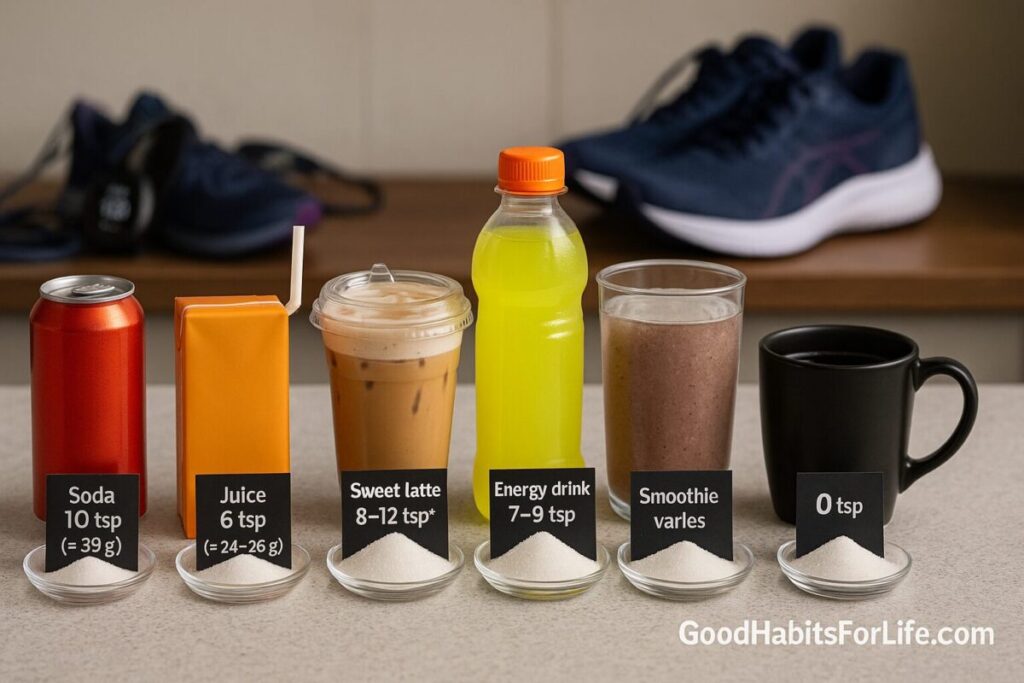
355 ml soda: ~150 kcal, ~39 g sugar ≈ 10 tsp
-
250 ml packaged juice: ~110 kcal, ~24–26 g sugar ≈ 6 tsp
-
350 ml sweetened latte: 120–250 kcal+ depending on milk/syrup
Health links: Routine intake of sugar-sweetened beverages (SSBs) is associated with weight gain, type 2 diabetes, heart disease, and dental caries. Global guidance advises limiting free sugars to <10% of daily energy, with a further benefit at <5%. Reducing liquid sugars is a high-impact, low-friction move for metabolic health.
✅ Quick Start: Do-This-Today Upgrades
-
Audit one day of drinks. Note time, type, size, and sugar grams.
-
Set a “Sweet Window.” If you’ll have a sweet drink, confine it (e.g., with lunch only, max 1 serving/day, not after 18:00).
-
Swap list:
-
Soda/juice ➜ sparkling water + squeeze of citrus
-
Sweet tea ➜ unsweetened tea + mint/lemon
-
Syrup latte ➜ flat white/cappuccino; ask ½-sweet if syrups used
-
Smoothie ➜ blend whole fruit + ice + yogurt; cap to 1 cup (250 ml)
-
-
Label math in 2 seconds: sugar (g) ÷ 4 = teaspoons.
-
Hydration anchor: 500 ml water on waking, 500 ml pre-lunch, 500 ml mid-afternoon (1.5 L baseline; adjust for heat/exercise).
-
Add movement: +2,000 steps/day (NEAT) and 20–30 min Zone 2 (conversation-pace cardio).
🗺️ 7-Day Starter Plan
Goal: Cut liquid sugars, maintain hydration, and ignite steady burn with NEAT + Zone 2.
-
Day 1 – Count & Cap: Log all drinks. Choose one sweet drink max; others unsweetened/water. +2,000 steps.
-
Day 2 – Home Base: Stock fridge with cold water, sparkling, unsweetened tea. Brew a 1 L pitcher nightly. 25 min Zone 2.
-
Day 3 – Label Ninja: Check 3 go-to drinks; rewrite choices. Half-sweet if ordering out. +2,500 steps.
-
Day 4 – Timing Tweak: Move any sweet drink earlier (pre-afternoon). 30 min Zone 2.
-
Day 5 – Smoothie Smart: If having one, keep to 250–300 ml, 1 piece fruit + protein (yogurt or milk), and no added sugar. Stairs + breaks = +2,000 steps.
-
Day 6 – Restaurant Script: Practice order (see scripts). 30 min Zone 2 or two 15-min bouts.
-
Day 7 – Review & Lock:
-
Sugary-drink average this week?
-
Steps average? Zone 2 minutes?
-
Set next week’s targets: ≤3 sweet servings/week, 8–10k steps/day, 150–210 min Zone 2/week.
-
🛠️ Techniques & Frameworks
Label Reading (10-Second Check)
-
Sugar line: aim ≤5 g/100 ml for “everyday” drinks; >8–10 g/100 ml = treat.
-
Ingredients: sugar aliases (sucrose, glucose, HFCS, fructose, honey, syrup, jaggery). First 3 ingredients carry weight.
-
Serving trap: many bottles list 2 servings—multiply accordingly.
The SIPS Method
-
Scan the label or ask for nutrition info.
-
Identify sugar grams & caffeine.
-
Plan a swap (water, unsweetened, ½-sweet).
-
Schedule the sweet (if any) within your Sweet Window.
Habit Loop Tweaks
-
Cue: Afternoon slump ➜ Pre-decide: 300 ml iced tea unsweetened + 5-min walk.
-
Craving: Sweet taste ➜ Flavor: citrus, mint, cinnamon.
-
Response: Water first, then decide.
-
Reward: Track streaks; use a non-food reward at week’s end.
🧠 Zone 2 + NEAT: The Metabolism Combo
-
Zone 2 ≈ easy, talk-in-full-sentences pace, roughly 60–70% of max HR or RPE 3–4/10. It builds mitochondrial capacity and improves fat oxidation. Aim 150–300 min/week total moderate intensity.
-
NEAT = Non-Exercise Activity Thermogenesis—all movement outside workouts (walking, stairs, chores). NEAT varies widely and can add hundreds of kcal/day difference between people.
Why pair with drink fixes?
-
Cutting liquid sugar reduces energy spikes and cravings.
-
Zone 2 improves metabolic flexibility and endurance.
-
NEAT keeps your daily burn steady and reduces sedentary time.
Starter targets: -
NEAT: +2,000–3,000 steps/day above baseline; stand every 30–45 min.
-
Zone 2: 25–40 min, 4–6×/week (walk, cycle, swim, easy jog).
👥 Audience Variations
Students/Teens
-
Carry a 1 L bottle; swap energy drinks for unsweetened iced tea.
-
“Half-sweet” at cafés; cap to 1 syrup pump.
-
Gamify steps: campus loops between classes.
Parents/Kids
-
Keep juice ≤125 ml portions; offer water or milk first.
-
Make infused water (orange + mint).
-
Family walk after dinner: 10–15 min.
Busy Professionals
-
Default office order: black coffee/americano or flat white.
-
Calendar walking 1:1s and stair breaks.
-
Travel: buy 2 waters (1 sparkling) at gate; skip mixer calories.
Seniors
-
Hydration reminders across the day; warm herbal teas if cold water is unappealing.
-
Zone 2 via brisk walking with poles; check meds for diuretics.
-
Focus on protein-paired snacks if smoothies replace meals.
⚠️ Mistakes & Myths to Avoid
-
“Juice is always healthy.” Whole fruit > juice for fiber and fullness.
-
“Diet soda makes you gain fat directly.” Evidence is mixed; main win is calorie reduction—if diet drinks help you displace sugar, it can be a bridge strategy.
-
“Coconut water is calorie-free.” It contains natural sugars—treat as a sweet drink.
-
“Smoothies don’t count.” Large café smoothies can be 300–500 kcal.
-
“I only drink on weekends.” Weekend binges can erase weekday progress.
💬 Real-Life Scripts & Examples
-
Café: “Flat white, no syrup please.” / “I’ll do the latte ½-sweet.”
-
Restaurant: “Sparkling water with lemon, please.”
-
Home: “We keep one sweet drink for Sunday lunch; the rest are unsweetened.”
-
Office: “Let’s do a walking coffee—americano for me.”
-
Party host: “We’ve got water, seltzer, and unsweetened iced tea at the front.”
🧰 Tools & Resources
-
Water trackers: WaterMinder, Waterllama (simple reminders, logs).
-
Food logging: Cronometer, MyFitnessPal (check sugar per serving; cons: time cost).
-
Wearables: Any step counter for NEAT; heart-rate feedback for Zone 2.
-
Label help: Local nutrition databases; barcode scanners (verify entries).
Pros/Cons snapshot
-
Apps boost awareness and streaks ✅; manual entry can fatigue ❌.
-
Diet beverages help transition ✅; may maintain sweet preference ❌.
-
Sparkling water scratches “fizz” itch ✅; watch flavored varieties for sweeteners ❌ (if you’re sensitive).
📌 Key Takeaways
-
See it to change it: 10-second label math exposes hidden teaspoons.
-
Swap first, then cap: Default to water/unsweetened; time-box sweets.
-
Move more, gently: NEAT + Zone 2 make your new drink habits “stick” metabolically.
-
Track 3 things: sweet servings, steps, Zone 2 minutes.
-
Aim for consistency, not perfection.
❓ FAQs
1) Is fruit juice better than soda?
Nutritionally it has vitamins, but similar sugar and minimal fiber. Treat as occasional and keep to small portions (≤125–150 ml).
2) Do diet sodas derail weight loss?
Evidence suggests they can reduce calorie intake when replacing sugary drinks. If they help you transition to water, they can be useful.
3) How much water should I drink daily?
Needs vary; begin with 1.5–2 L/day (more in heat/exercise), spread across the day.
4) What exactly is Zone 2 without a heart-rate monitor?
You can talk in full sentences but feel you’re working; breathing is faster yet controlled (RPE ~3–4/10).
5) How many sugary drinks are “safe”?
There’s no strict safe number; aim for as few as practical, ideally ≤3/week. Keep free sugars under 10% of energy, preferably <5%.
6) Are smoothies bad?
Not inherently. Keep to 250–300 ml, use whole fruit + protein, and avoid added sugars.
7) Does coffee count as hydration?
Yes. Moderate coffee contributes to fluid intake; limit sugar/syrups and watch caffeine timing for sleep.
8) I exercise hard—can I use sports drinks?
For >60–90 min continuous hard training or in extreme heat, carbohydrate-electrolyte drinks can help. Otherwise, water + electrolytes is usually enough.
9) How fast will I notice changes?
Many people feel steadier energy within 1–2 weeks when sugars drop and Zone 2/steps increase.
10) Can I drink late at night?
Prefer unsweetened, caffeine-free options after mid-afternoon to protect sleep and glucose control.
📚 References
-
World Health Organization. Guideline: Sugars intake for adults and children. https://www.who.int/publications/i/item/9789241549028
-
U.S. CDC. Get the Facts: Sugar-Sweetened Beverages. https://www.cdc.gov/nutrition/data-statistics/sugar-sweetened-beverages.html
-
Harvard T.H. Chan School of Public Health. Sugary Drinks and Health. https://www.hsph.harvard.edu/nutritionsource/healthy-drinks/sugary-drinks/
-
Imamura F, et al. Consumption of sugar sweetened beverages and incidence of type 2 diabetes: systematic review and meta-analysis. BMJ. 2015;351:h3576. https://www.bmj.com/content/351/bmj.h3576
-
American Heart Association. Dietary Guidance to Improve Cardiovascular Health. Circulation. 2021/2023 updates. https://www.ahajournals.org/doi/10.1161/CIR.0000000000001031
-
Levine JA. Non-exercise activity thermogenesis (NEAT). Proc Nutr Soc. 2003;62(4):667-79. https://www.cambridge.org/core/journals/proceedings-of-the-nutrition-society/article/nonexercise-activity-thermogenesis-neat/
-
ACSM. Physical Activity Guidelines & Intensity Definitions. https://www.acsm.org/education-resources/trending-topics-resources/physical-activity-guidelines
-
Achten J, Jeukendrup AE. Maximal fat oxidation during exercise (Fatmax): intensity and relationship with training status. Int J Sports Med. 2003;24(8):603-8. https://pubmed.ncbi.nlm.nih.gov/14625522/
-
National Health Service (NHS). Sugars. https://www.nhs.uk/live-well/eat-well/food-types/sugars/
-
European Food Safety Authority (EFSA). Sugar consumption and health outcomes. https://www.efsa.europa.eu/en/topics/topic/sugars
Disclaimer: This article is for general education and is not a substitute for personalized medical or nutrition advice; consult your healthcare provider for individual guidance.