
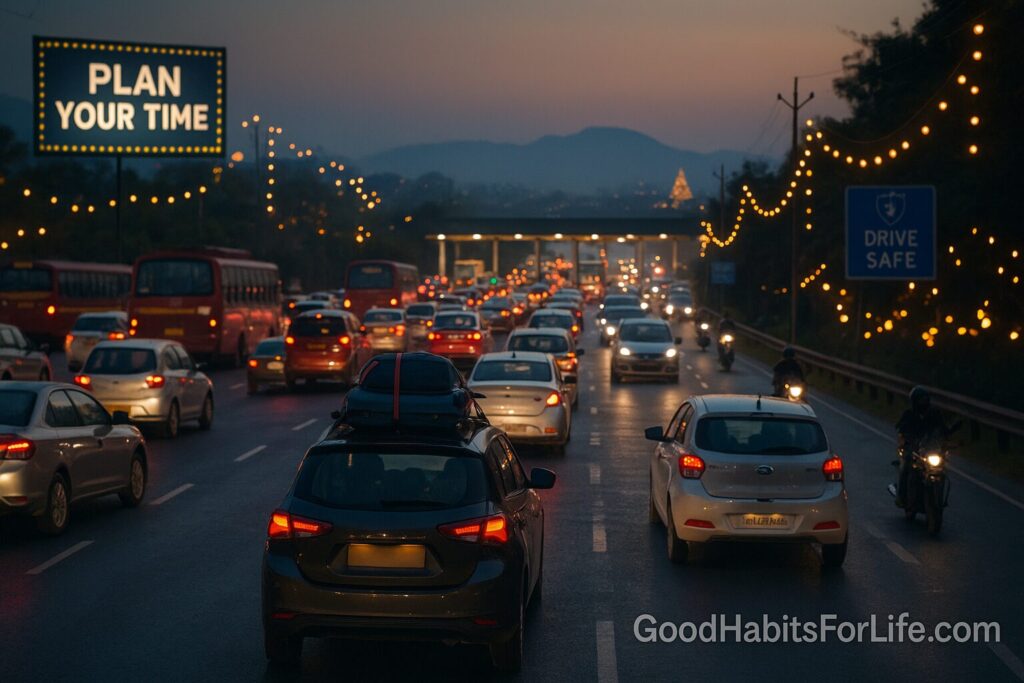
Festival & Holiday Traffic: Timing & Patience
Festival Traffic Tips: Timing & Patience for Safe Trips
Table of Contents
🧭 What & Why: Festival & Holiday Traffic
What it is: Periods when travel demand spikes (religious festivals, school holidays, long weekends), often doubling vehicle volumes and increasing crash risk. Congestion causes stop-and-go driving, longer reaction times, and impatience behaviors like tailgating and aggressive lane changes.
Why it matters (evidence-backed):
-
Holiday periods see higher traffic volumes and elevated fatal crash risks linked to speeding, impairment, and fatigue (various road safety agencies consistently report spikes during major holidays).
-
Longer headways (3–4+ seconds) and speed management reduce crash likelihood; rests every ~2 hours cut fatigue-related errors.
-
Planning departure windows reduces exposure to peak congestion, improving on-time arrival and mood.
Bottom line: You can’t control traffic—but you can control timing and patience habits to arrive safer and calmer.
✅ Quick Start: Do This Today
-
Pick a shoulder window:
-
Outbound: 05:30–07:00 or after 20:30.
-
Return: Early morning of the day after the main festival, or late evening on the last day.
-
-
Add buffer: Plan +30–50% extra time (more if weather/processions expected).
-
PACE your routes: Save Primary + Alternate + Contingency routes offline. Identify 2–3 safe stop points every 120–150 km.
-
Share your ETA: Send live location and “don’t wait for me” message (template below).
-
Patience cues:
-
Box-breathing 4-4-4-4 while stopped.
-
“Smooth is fast” mantra.
-
Play a calm playlist or podcast; set phone to Do Not Disturb.
-
-
Space & speed: Keep ≥3 s following gap (≥4 s heavy traffic; 6+ s in rain). Obey local speed limits.
-
Hydrate & rest: Carry water and snacks; break every ~2 hours (or 150 km / 90 mi).
🛠️ 7-Day Habit Plan (Starter)
Goal: Arrive on time and stress-light during the festival weekend.
-
Day 1 (Plan): List festival dates, expected peak times, weather, procession routes. Decide Outbound and Return shoulder windows.
-
Day 2 (Routes): Save P/A/C/E routes offline. Mark fuel, food, restrooms, clinics.
-
Day 3 (Car & Docs): Tyres (incl. spare), fluids, wipers, lights, FASTag/tolls, registration/insurance. Pack a small emergency kit.
-
Day 4 (Comms): Create family group (WhatsApp/Signal). Add “I’ll be late—start without me” script & share-ETA instructions.
-
Day 5 (Patience Practice): 5 minutes of box-breathing + “courtesy wave” habit every commute; practice 3-second rule.
-
Day 6 (Dry Run): Short drive at target time; test ETA share, playlists, DND mode, and alternate routes.
-
Day 7 (Travel): Leave in your window, follow breaks every 2 hours, keep headway, and use patience cues at each slowdown.
🧠 Techniques & Frameworks for Timing & Patience
TTT Method – Time, Tolerance, Triggers
-
Time: Leave during shoulder windows; add 30–50% buffer.
-
Tolerance: Pre-decide “acceptable delay” (e.g., +45 min). Treat everything under it as on plan.
-
Triggers: When anger rises (tight chest, rapid breath), apply 4-4-4-4 breathing and increase following gap by +1 second.
PACE Route Planning
-
Primary: Fastest main route.
-
Alternate: Parallel arterial.
-
Contingency: Slower but reliable (toll-free/backroad).
-
Emergency: Safe stop or overnight option.
Headway & Speed
-
Default ≥3 s, ≥4 s in dense traffic, ≥6 s in rain/fog/night.
-
Avoid speed bursts >10 km/h over flow; variance—more than raw speed—raises risk in platoons.
Break Rhythm
-
2-hour / 150 km rule (whichever first). Stretch 5–10 minutes; swap drivers if possible.
Convoy Micro-Rules (if traveling with friends/family)
-
Each car follows GPS independently; no bumper-to-bumper following.
-
Pre-set regroup points; use left-lane courtesy and avoid risky “catch-ups.”
🗺️ Smart Departure Windows (By Trip Type)
| Trip Type | Best Outbound Window | Avoid | Return Window | Notes |
|---|---|---|---|---|
| City across town | 06:00–07:30 or 20:30–22:00 | 17:30–20:30 | 06:00–08:00 next day | Check procession maps & closures. |
| Inter-city highway (3–6 h) | 05:30–06:30 or after 21:00 | 08:30–12:00 | Early AM day after | Fuel early; plan two rest stops. |
| Pilgrimage/temple town | Pre-dawn (05:00–06:00) | Mid-morning arrival times | Late evening departure or next morning | Expect walking routes & barricades. |
| Hill station | 05:30–07:00 | 10:00–16:00 (hairpins clog) | 06:00–08:00 | Watch for fog; add extra buffer. |
| Coastal/beach | 06:00–07:30 | 12:00–18:00 | 06:00–08:00 | Sun glare; hydrate well. |
Times are guidelines—adjust for local advisories, school breaks, and weather.
👥 Audience Variations
-
Parents with kids: Pack snacks, wipes, small trash bags, 2–3 quiet activities. Plan 15-minute leg-stretch stops—kids’ patience is the schedule.
-
Students: Split driving; use Pomodoro-style driving blocks (50 min drive / 10 min rest × 4; then a longer break).
-
Professionals on deadlines: Share ETA early; set “arrival window” in calendar invite so small lateness isn’t stressful.
-
Seniors: Increase break frequency (every 90 min), avoid night glare, bring meds & water; sit-to-stand stretches at stops.
-
Two-wheelers: Extra visibility, reflective gear, rain covers; ≥4-second headway; avoid lane-splitting in dense pilgrim zones.
⚠️ Mistakes & Myths to Avoid
-
Myth: “Backroads are always faster.”
Reality: Many are single-lane with mixed traffic; safe but often slower. Use only as Contingency. -
Mistake: Leaving right before a procession or peak prayer time.
-
Mistake: Tailgating to “block” cut-ins—this increases crash risk and invites more cut-ins. Keep your gap.
-
Myth: “Constant lane-switching saves time.”
Reality: In heavy flow, it yields negligible gains and higher risk. -
Mistake: Skipping breaks or driving when drowsy—micro-sleeps kill.
-
Mistake: Relying on one app only; keep offline maps and a second source for alerts.
💬 Real-Life Examples & Scripts
Pre-trip family message (copy-paste):
“We’re leaving at 05:45 to avoid festival traffic. ETA 10:15–11:00. Please start without us if we’re late—I’ll share live location. See you soon!”
If you must travel at peak:
“Traffic is heavy. I’m keeping to a safe gap and will take a short break at [Stop]. Updated ETA: [Time]. Don’t wait for me.”
Convoy separation rule:
“If we get split, meet at [Regroup Point] or wait at the next toll after paying. No risky catch-ups.”
Road-rage diffuser:
“Not my fight today.” (Repeat internally; breathe and let them go.)
🧰 Tools, Apps & Resources
-
Google Maps / Apple Maps — Pros: Excellent ETA & rerouting; live congestion. Cons: Occasional festival closures appear late.
-
Waze — Pros: Community-reported hazards, police, closures. Cons: Works best where user base is dense.
-
INRIX / Local 511 services / State traffic police feeds — Pros: Verified incidents & planned closures. Cons: Interface varies by region.
-
Mappls (MapmyIndia) / Here WeGo — Pros: Strong coverage in some regions; good offline. Cons: Fewer crowd-reports than Waze.
-
Road safety checklists — Government/NGO PDFs for pre-trip inspections and fatigue management.
📌 Key Takeaways
-
Plan the clock, not just the route. Shoulder windows + time buffer beat lane-hopping.
-
Patience is a skill. Use breathing, music, and pre-decided tolerance for delays.
-
Space saves lives. Keep a generous following gap; break every ~2 hours.
-
Have a backup plan. PACE your routes and save them offline.
-
Communicate early. Share ETA and remove arrival pressure.
❓ FAQs
1) What is the single best time to leave during festival weekends?
Very early (around 05:30–07:00) usually beats peak congestion. Late-evening departures (after ~20:30) are the next best.
2) How much extra time should I add for festival traffic?
Add 30–50% to normal drive time; more (60–80%) if processions, fog, rain, or hill roads are likely.
3) Are backroads a smart shortcut?
Sometimes for Contingency, but many are slower/less safe under holiday volume. Check road width, lighting, and fuel availability.
4) How far should I stay behind the car ahead?
Keep ≥3 seconds in normal dry conditions; ≥4 seconds in heavy traffic; ≥6 seconds in rain/fog/night.
5) What should I pack for long holiday drives?
Water, snacks, power banks, paper maps or offline maps, basic first-aid, torch, reflective triangle, rain gear, wipes, and a clean cloth for windshield.
6) How do I stay calm when stuck for hours?
Use box-breathing, play calming audio, accept your pre-set tolerance window, and take safe micro-breaks when possible.
7) Is it safer to drive late at night to avoid traffic?
Lower congestion but higher fatigue risk and sometimes wildlife/pedestrian hazards. Only if you’re well-rested and have clear lighting.
8) What if my arrival time conflicts with a religious procession?
Adjust to arrive at least 90 minutes before or 2 hours after known procession times; check local police or highway advisories.
9) How often should I stop on a 6-hour trip?
At least two 10-minute breaks (every ~2 hours) plus one longer stop if carrying kids or seniors.
10) How do I handle road rage from others?
Don’t engage. Maintain lane, increase headway, let them pass, and avoid eye contact or gestures. If threatened, head to a public, well-lit place and contact authorities.
📚 References
-
World Health Organization. Global Status Report on Road Safety 2023. https://www.who.int/publications/i/item/9789240077614
-
National Highway Traffic Safety Administration (NHTSA). Holiday Driving & Road Safety Resources. https://www.nhtsa.gov/road-safety
-
AAA Foundation for Traffic Safety. Traffic Safety Culture & Holiday Travel Insights. https://aaafoundation.org/
-
Federal Highway Administration (FHWA). Traffic Analysis Toolbox & Congestion Management. https://ops.fhwa.dot.gov/
-
OECD/International Transport Forum. Road Safety Annual Report (latest edition). https://www.itf-oecd.org/road-safety-annual-report
-
INRIX. Global Traffic Scorecard (latest). https://inrix.com/scorecard/
-
Centers for Disease Control and Prevention (CDC). Drowsy Driving Prevention. https://www.cdc.gov/sleep/features/drowsy-driving.html
-
TRB/National Academies. Driver Behavior and Traffic Flow Research. https://www.trb.org/
-
UK National Highways. Planned Roadworks & Major Events Advice. https://nationalhighways.co.uk/travel-updates/
-
State/Regional 511 Traffic Services (e.g., US) — incident and closure feeds. https://www.transportation.gov/511