
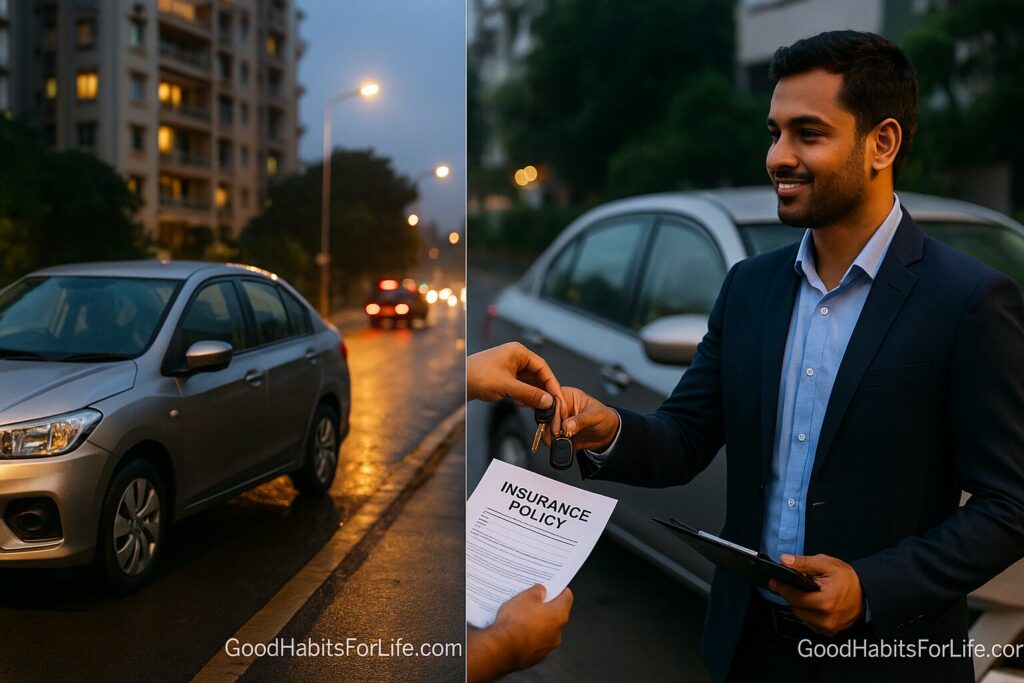
Insurance Basics: ThirdParty, Comprehensive, AddOns
Insurance Basics: ThirdParty, Comprehensive, AddOns
Table of Contents
🧭 What is Third-Party vs Comprehensive Insurance
Third-Party Liability (TP) covers your legal liability if your vehicle injures someone or damages a third party’s property. In India, TP is mandatory for any vehicle on public roads. IRDAI
Comprehensive (Package) Policy combines third-party liability with own-damage (OD)—protecting your car against risks like accident damage, fire, theft, vandalism, floods and other natural perils (as per policy wording). It’s not mandated by law but is the sensible default for most daily drivers. IRDAI
Why it matters: A single major crash or flood event can exceed the value of the car. Comprehensive protection + the right add-ons cap out-of-pocket risk to a predictable premium.
Legal context (India): The Motor Vehicles Act (as amended in 2019) requires valid third-party insurance; penalties apply for non-compliance, including fines and/or imprisonment. Ministry of Road Transport & Highways
✅ Quick Start: Choose in 5 Steps
-
Confirm the non-negotiable: You must have at least TP to be road-legal. (Then decide if you add OD.) IRDAI
-
Check car age & value (IDV):
-
New (<5 years) or financed? Comprehensive is usually wise.
-
Older car with low resale value and minimal use? Consider TP + selective add-ons (or OD with higher deductible).
-
-
Map risk exposure: Parked on the street? Flood-prone city? Theft hotspots? Long highway commutes? If “yes” to any, OD + add-ons likely pay off.
-
Price sanity: Compare premiums vs the car’s IDV and your risk tolerance.
-
Shortlist add-ons by scenario (see table below): zero-dep for new cars, engine protect in flood zones, return-to-invoice for year-1 cars, roadside assistance for long drives, NCB protector if you have 2–5 years of NCB.
One-look matrix
| Scenario | Likely Best Fit |
|---|---|
| Brand-new or financed car | Comprehensive + Zero-Dep + RSA; consider RTI |
| Flood/theft-prone locality | Comprehensive + Engine Protect + Key/Lock |
| Highway commuter | Comprehensive + RSA + Consumables |
| City, older car (>7 yrs) | TP (mandatory) ± OD with higher deductible; pick add-ons sparingly |
🛠️ 7-Day Starter Plan
-
Day 1: Pull current policy, RC, PUC. Note renewal date and NCB status.
-
Day 2: Estimate IDV (Insured Declared Value) and list risks (parking, weather, theft).
-
Day 3: Decide TP-only vs Comprehensive using the matrix above.
-
Day 4: Pick add-ons (see next section). Set a target premium budget.
-
Day 5: Compare 3–5 quotes (same IDV, add-ons, deductibles for apples-to-apples).
-
Day 6: Read policy wordings (perils, exclusions, deductibles, voluntary excess).
-
Day 7: Buy/renew; set calendar reminders for PUC checks and renewal 15–30 days before expiry.
🧠 Techniques & Frameworks (IDV, Deductibles, NCB)
IDV (Insured Declared Value)
-
Approximate market value of your vehicle used to determine OD premium and maximum claim for total loss/constructive total loss. Lower IDV = lower premium but lower payout.
-
Tip: Avoid under-declaring IDV just to save premium; it can cost you at claim time.
Deductibles & Voluntary Excess
-
Compulsory deductible is fixed by tariff; voluntary excess (if you opt in) reduces premium but increases what you pay per claim.
-
Good rule: If you rarely claim and keep an emergency fund, a modest voluntary excess can be efficient.
NCB (No-Claim Bonus)
-
Discount on OD premium (not TP), starting at 20% after the first claim-free year and moving up to 50% over successive claim-free years; one own-damage claim typically resets NCB. NCB attaches to you, not the vehicle—transferable to a new car/policy, subject to rules. Policyholder
Framework: RAIN for add-ons
-
Risk: flood/theft/accident profile
-
Age of car: depreciation hits new cars hardest
-
Income/affordability: premium vs potential loss
-
Needs/usage: daily driver vs weekend beater
🛡️ Popular Add-Ons: When to Buy / When to Skip
| Add-On | Buy If… | Skip/Note |
|---|---|---|
| Zero Depreciation (Depreciation Waiver) | Car ≤5 years, high repair costs, want larger payouts for parts | Costs extra; usually limited number of claims/year |
| Engine Protect | Flood-prone areas, water-logging risk | Read exclusions (e.g., consequential damage due to cranking after flood) |
| Return to Invoice (RTI) | New (often ≤3 years), high theft risk | Not useful for older cars; limited to total loss/ theft |
| Roadside Assistance (RSA) | Long trips, older battery/tyres | Often has service radius/wait times; check limits |
| Consumables Cover | You want nuts/bolts/oil etc. paid during claims | Small claims may still be uneconomical after deductibles |
| NCB Protector | You’ve built 25–50% NCB and want to preserve it after one claim | Usually protects NCB only for first claim and under conditions |
| Key & Lock Protect | Smart keys are expensive | Check per-claim limits |
| Tyre Protect | Poor roads, low-profile tyres | Often excludes wear/tear; read wording |
Add-ons vary by insurer—always check the policy wording/schedule for limits and exclusions.
👥 Variations by Driver Profile
-
Students/first-time drivers: Start comprehensive in year-1 to cushion early mistakes; add RSA.
-
Parents with family car: Comprehensive + zero-dep (if car ≤5 years) + key/lock; consider NCB protector.
-
Professionals with long commutes: Comprehensive + RSA + engine protect (if city floods).
-
Seniors/low-mileage users: Consider higher voluntary excess; keep RSA; evaluate if OD still makes sense after ~7–10 years.
⚠️ Common Mistakes & Myths
-
“TP also pays for my car repairs.” Myth—TP covers others’ loss, not your car. Choose OD/comprehensive for your car. IRDAI
-
Under-declaring IDV to save premium. Short-term gain, long-term pain at claim time.
-
Letting NCB lapse. You usually have a limited time window on renewal/porting to retain it; one OD claim can reset it. Policyholder
-
Ignoring exclusions. Water-ingress after cranking the engine, drunk driving, no-PUC/invalid DL, or commercial use of a private car can void claims.
-
Driving without valid TP. It’s illegal and risky—fines and liability exposure apply under the MV Act (2019). Ministry of Road Transport & Highways
🗣️ Examples & Copy-Paste Scripts
1) Call your insurer for a flood-season check-up
“Hi, I’m reviewing my car policy before monsoon. My car is a 2022 model parked in a flood-prone area. Can you confirm if engine protect is included, its limits/exclusions on hydrostatic lock, and the process to add it from my renewal date?”
2) Ask for a like-for-like quote
“Please quote with IDV ₹___, zero-depreciation, RSA, and NCB protector. Also send a second quote with the same IDV but without these add-ons so I can compare.”
3) Accident claim (first call checklist)
“There’s been an accident at [location]. No injuries / Injuries reported. Policy no. __. Kindly register a claim and share the surveyor ETA and network garage details. I’ll upload photos, FIR (if needed), and RC/PUC/DL copies to the portal.”
4) Endorsement request (details changed)
“Please endorse my policy for updated address/phone and add an additional driver. Confirm if any premium difference or underwriting approval is needed.”
📚 Tools, Apps & Resources
-
IRDAI – Consumer/Policyholder portals: Official guides, complaint routes, and NCB rules. (See Bima Bharosa complaint portal.) IRDAIPolicyholder
-
General Insurance Council – Education: Plain-English primers on motor insurance. GICouncil
-
Motor Vehicles Act (2019): Know the legal baseline for compulsory TP and penalties. Ministry of Road Transport & Highways
🔑 Key Takeaways
-
Be compliant: TP is legally mandatory; comprehensive gives real protection. IRDAI
-
Customize smartly: Add-ons should follow risk + car age + usage—not FOMO.
-
Protect your discount: NCB is valuable (20–50% on OD); one claim can wipe it out. Policyholder
-
Read the fine print: Exclusions, deductibles, and claim limits decide real-world payouts.
-
Set reminders: PUC checks, renewals (15–30 days early), and seasonal risk reviews.
❓ FAQs
1) Is third-party insurance enough?
Legally, yes; financially, often no. TP doesn’t cover your car. If you’d struggle to pay for repairs/theft/flood damage out of pocket, go comprehensive. IRDAI
2) What exactly does comprehensive add beyond TP?
It bundles own-damage cover (accident, fire, theft, natural calamities, etc.) with TP. Add-ons can extend it further (e.g., zero-dep, engine protect). IRDAI
3) How is NCB calculated and applied?
It’s a discount on OD premium only—typically 20% to 50% for consecutive claim-free years; resets after most OD claims and is generally transferable to a new car/policy under rules. Policyholder
4) What penalties apply if I drive without insurance?
The MV Act (2019 amendment) provides for fines (and/or imprisonment) for driving without valid TP insurance. Amounts and enforcement are per law/regulation. Ministry of Road Transport & Highways
5) Which add-ons are most valuable for new cars?
Zero-depreciation, RTI (in early years), and RSA. Consider engine protect if you face flood risk.
6) Can I carry digital copies of my policy?
Most insurers and authorities accept digital policies; always keep your e-policy and key documents handy. (Check your state’s practice and carry a physical copy when unsure.)
7) Does NCB protector keep my NCB forever?
Usually it safeguards NCB for one claim in a policy year and under defined conditions—read the wording carefully.
8) Are premiums fixed by the government?
TP base rates are regulated; OD is market-priced based on IDV, make/model, and underwriting. (See regulator resources for updates.) IRDAI
9) Do I need PA (Personal Accident) cover?
Owner-driver PA cover is strongly recommended (regulatory treatment may vary over time). Buy adequate limits even if not bundled.
10) How do I complain if a claim is unfairly rejected?
Escalate to the insurer’s grievance cell; if unresolved, raise it via IRDAI Bima Bharosa and, if needed, approach the Insurance Ombudsman. IRDAIcioins.co.in
📖 References
-
Insurance Regulatory and Development Authority of India (IRDAI) — Non-Life Products: Motor Insurance (TP vs Comprehensive, Act-only). https://irdai.gov.in/non-life2 IRDAI
-
IRDAI — Motor Insurance Handbook (English) (NCB, coverage basics). https://irdai.gov.in/documents/…/Motor%20Insurance%20Handbook… (PDF) IRDAI
-
Motor Vehicles (Amendment) Act, 2019 (compulsory insurance & penalties). Ministry of Road Transport & Highways. https://morth.nic.in/…/MV%20Act%20English.pdf Ministry of Road Transport & Highways
-
IRDAI Policyholder/Consumer Education — No-Claim Bonus (20–50% on OD) and guidance. https://policyholder.gov.in/ Policyholder
-
IRDAI — Grievance Redressal / Bima Bharosa complaint portal. https://irdai.gov.in/grievance-redressal-mechanism1 IRDAI
-
General Insurance Council — Motor Insurance basics (education portal). https://www.gicouncil.in/insurance-education/introduction/ GICouncil
-
Council for Insurance Ombudsmen — How to lodge a complaint. https://www.cioins.co.in/ cioins.co.in
⚖️ Disclaimer
This article provides general information about motor insurance and is not legal or financial advice; for decisions, consult your insurer, a licensed advisor, or relevant regulators.