
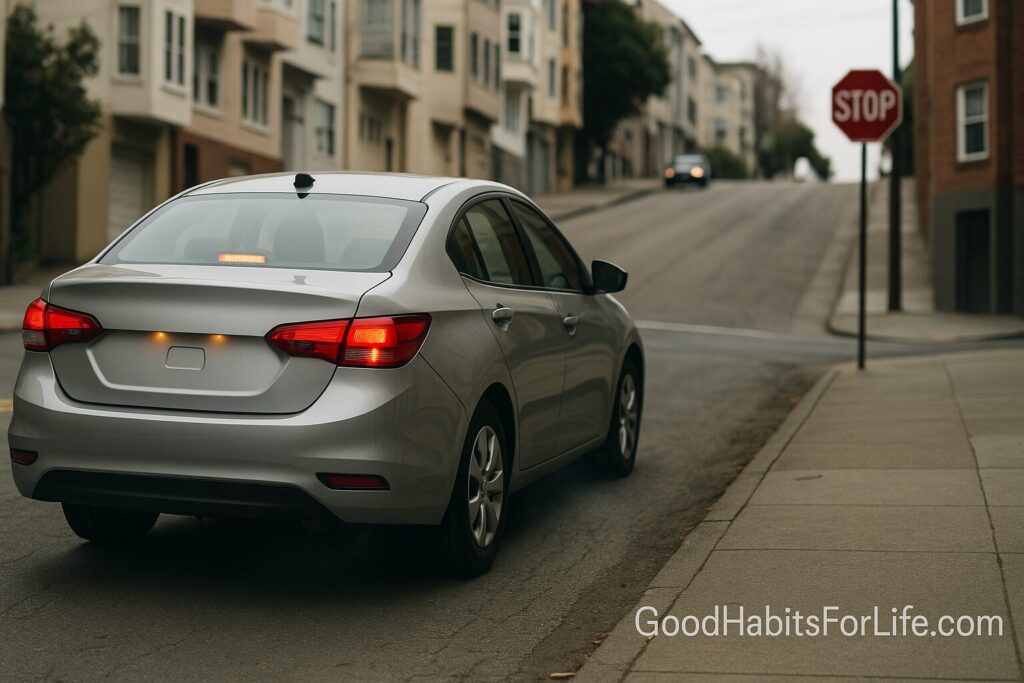
Hill Starts & Stops: Manual and Automatic Tips
Hill Starts & Stops: Manual and Automatic Tips
Table of Contents
🧭 What Counts as a Hill Start & Why It Matters
A hill start is moving off from rest on an incline without rolling backward (uphill) or forward (downhill). A hill stop is stopping and safely securing the vehicle on a slope. Mastering both improves:
-
Control & safety: prevents roll-backs/roll-forwards and rear-end collisions.
-
Mechanical sympathy: smooth clutch control reduces wear on clutch and brakes.
-
Confidence: you’ll handle junctions, bridges, parking ramps, and mountain roads calmly.
You’ll use three fundamentals:
-
Hold the car (footbrake, handbrake/parking brake, or hill-hold).
-
Prepare (gear selection, bite point/creep, mirrors).
-
Go (release the holding device last, with smooth throttle).
✅ Quick Start: Step-by-Step (Manual & Automatic)
Manual transmission — uphill start
-
Prepare: Clutch down → select 1st gear.
-
Hold: Keep footbrake pressed (or apply handbrake firmly).
-
Bite point: Raise clutch to the bite (rev needle dips slightly, nose lifts). Hold it.
-
Mirrors & blind-spot check; signal if needed.
-
Throttle: Add gentle gas (≈ 1,200–1,800 rpm on most petrol; a touch less on diesels).
-
Release hold, then move:
-
With handbrake: release it smoothly first → car grips → lift clutch a bit more while adding throttle.
-
With footbrake: ease off brake only once bite + throttle feel strong.
-
-
Clutch up: Once rolling, release clutch gradually; fully up by ~10–15 km/h (6–9 mph).
Manual — downhill start
-
Prepare: Clutch down → select 1st (or 2nd on mild slopes for smoother roll).
-
Hold: Footbrake or handbrake.
-
Control: Ease clutch to bite (or just above bite) and release the brake; minimal throttle needed.
-
Use engine braking: Keep revs modest; short-shift early to avoid free-rolling.
Automatic — uphill start
-
Select D and keep footbrake pressed.
-
If equipped, Hill-Start Assist (HSA) will hold brakes for ~2–3 s after you lift off the brake.
-
Throttle on; release brake. Car should creep forward without roll-back.
-
If no HSA and little creep, use handbrake: hold with handbrake, add throttle, release handbrake as the car wants to move.
Automatic — downhill start
-
Select D (or L/B mode if available for stronger engine braking).
-
Release brake smoothly to allow gentle creep; control speed with light brake pressure.
-
Avoid shifting to N; maintain engine braking.
Stopping on a hill (both)
-
Manual: Brake first; as revs dip toward idle, clutch down to avoid stalling → stop → neutral + handbrake.
-
Automatic: Keep footbrake pressed; to park, select P after you’re stationary and the parking brake is applied.
🧠 Techniques & Frameworks
The HPG Framework (Hold–Prepare–Go):
-
Hold: Decide your hold (footbrake, handbrake, or HSA).
-
Prepare: Gear, bite/creep, mirrors, space check.
-
Go: Release the hold last while applying progressive power.
Clutch Bite Control (manual):
-
Practice on a 5–7% gradient. Find the spot where the car wants to move, then freeze your ankle. Add a tiny throttle before releasing the hold.
Engine Braking & Low Gears:
-
On long descents, use a lower gear so the engine helps control speed (reduces brake fade). Many automatics offer L, B, or paddle-downshifts for this.
Parking on hills: wheel direction & securing
| Situation | Wheel direction | Why |
|---|---|---|
| Uphill with curb | Turn wheels away from curb | If the car rolls, wheels touch curb and stop vehicle. |
| Uphill without curb | Turn wheels toward road edge | If it rolls, vehicle moves off the roadway. |
| Downhill (with/without curb) | Turn wheels toward the curb/edge | The curb/edge blocks the roll. |
Always use parking brake. Manuals: leave in 1st (uphill) or reverse (downhill). Automatics: select P after applying the parking brake so weight isn’t resting on the parking pawl.
Traction on steep/loose surfaces:
-
Start with gentle throttle; avoid wheel-spin. If wheels slip, ease off, re-find bite/creep, then try again. Consider 2nd gear starts in some manuals on loose/gravel to reduce torque spike.
🛠️ 7-Day Hill-Control Habit Plan
Daily dose: 10–15 minutes. Start with mild slopes, then progress.
-
Day 1: Empty car park ramp (2–3% grade). Manual: handbrake hill starts x10. Auto: HSA + non-HSA technique.
-
Day 2: Residential incline (5–7%). Add mirror/blind-spot routine to every move-off.
-
Day 3: Controlled downhill starts + gentle engine-braking descents.
-
Day 4: Mixed traffic on a short hill; practice stop → start sequences 6–8 times.
-
Day 5: Parking practice on slopes: wheel direction, parking brake, gear/P selection.
-
Day 6: Steeper gradient (8–10%). Manual: throttle timing; Auto: brake-to-throttle timing.
-
Day 7: Mini-assessment loop: three uphill starts, three downhill starts, two slope parks. Note stalls/rolls and fix patterns.
Checkpoint metrics:
-
Roll-back/forward 0–10 cm max; 0 stalls by Day 7; smooth launches within 3 s of releasing brake.
👥 Audience Variations
-
Students/Teens: Use the handbrake method consistently at first; it buys time and reduces panic. Practice with cones and a known gradient.
-
Parents with kids onboard: Do a mirror-scan-breathe routine before moving to reduce distraction (quiet cue for kids: “hands on laps”).
-
Professionals/Commuters: Anticipate queue creep on flyovers; leave a 1–1.5 car gap so you can roll 0.5 m forward without re-starting the bite.
-
Seniors: Prefer HSA/handbrake to reduce left-leg fatigue; take gentler gradients and avoid peak-hour ramps early on.
-
Automatic-only drivers: Learn handbrake assist for cars without HSA; practice switching from brake to throttle without rushing.
⚠️ Mistakes & Myths to Avoid
-
Riding the clutch to “hold” on a hill ❌ → causes overheating and wear. Use brake/handbrake/HSA instead.
-
Neutral on descents ❌ → removes engine braking and control.
-
Parking with wheels straight ❌ on slopes → curb/edge won’t catch a roll.
-
Relying only on “P” on a slope ❌ → strain on parking pawl; always set parking brake first.
-
Over-revving at the bite ❌ → wheel-spin, lurching, clutch wear.
-
Skipping mirror/blind-spot checks ❌ → vulnerable users (cyclists) often queue alongside on hills.
💬 Real-Life Examples & Copy-Paste Scripts
Manual, 10% uphill with handbrake:
“Clutch down → 1st. Set handbrake. Find bite. Mirrors, right shoulder. Little gas. Release handbrake… hold bite… more gas… clutch up, smooth.”
Automatic, 7% uphill without HSA:
“D selected. Handbrake on. Ease throttle to feel forward tug. Release handbrake. Keep steady throttle; don’t floor it.”
Downhill stop → start (manual):
“Brake to slow, clutch down near idle, stop. Neutral + handbrake. To go: 1st, bite. Mirrors. Release handbrake and roll with light gas.”
Parking uphill with curb (any):
“Stop. Parking brake firm. Wheels turned away from curb. Manual: 1st gear; Auto: select P after brake set.”
🧰 Tools, Apps & Resources
-
OBD-II Bluetooth dongle + telemetry app: review throttle/clutch timing (manuals benefit).
-
In-car gradient display or smartphone inclinometer: track progress by gradient percentage.
-
Dashcam with speed overlay: analyze roll-back distance and launch smoothness.
-
Owner’s manual: locate HSA settings, low-gear/“B” modes, and parking brake procedures.
Pros/Cons (quick):
-
Telemetry & dashcam = objective feedback ✅; setup time and data overload ❌.
-
Inclinometer = precise targets ✅; watch for distraction ❌.
-
Owner’s manual = model-specific ✅; can be dense ❌.
📌 Key Takeaways
-
Use Hold–Prepare–Go every time.
-
Manuals: handbrake + bite is the most forgiving start on steeper hills.
-
Automatics: rely on HSA when available; otherwise handbrake-assist.
-
On descents, use engine braking (low gear/L/B modes).
-
Secure parking on slopes = wheel direction + parking brake (+ gear/P).
❓FAQs
1) What rpm should I aim for in a manual hill start?
Usually around 1,200–1,800 rpm depending on engine. Enough to prevent stalling without over-revving.
2) Is it okay to hold the car with the clutch on a hill?
No. Use the parking brake/footbrake/HSA; holding with the clutch overheats and wears it.
3) Which gear for long downhill stretches?
Use a lower gear so the engine helps control speed. In automatics select L/B or paddle-downshift if available.
4) My automatic rolls back slightly—normal?
Some autos (especially dual-clutch units or low-creep tuning) can roll on steep hills. Use HSA or the handbrake-assist method.
5) How do I park safely on a steep hill?
Turn wheels per the table above, apply parking brake, and select P (auto) or 1st/Reverse (manual). Curb/edge acts as a backup stop.
6) Can I start in 2nd gear on gravel?
Sometimes, yes—2nd gear can reduce torque spike and wheel-spin. Only on very mild inclines and with smooth throttle.
7) When should I release the clutch fully?
Once the car is moving and stable (≈10–15 km/h / 6–9 mph). Release progressively to avoid jerks.
8) Do EVs need special hill-start techniques?
Most EVs have strong creep and hill-hold; apply gentle accelerator and release brake. Use B/regenerative modes on descents.
9) What if I stall on a hill with traffic behind?
Handbrake on → neutral → restart calmly → set up bite + mirrors → release handbrake and go. Keep hazard awareness; no rush.
10) How do I judge gradient difficulty?
Start <5%, progress to 7–10%. Your car’s manual or a phone inclinometer can estimate slope.
📚 References
-
UK Highway Code — Waiting & parking (Rule 252: parking on a hill). https://www.gov.uk/guidance/the-highway-code/waiting-and-parking-238-to-252
-
UK Highway Code — Control of the vehicle & braking. https://www.gov.uk/guidance/the-highway-code/general-rules-techniques-and-advice-for-all-drivers-and-riders-103-to-158
-
Waka Kotahi NZ Transport Agency — Parking on hills. https://www.nzta.govt.nz/roadcode/general-road-code/road-code/about-driving/parking/parking-on-hills/
-
California DMV — Parking on Hills (Driver Handbook). https://www.dmv.ca.gov/portal/handbook/california-driver-handbook/parking/
-
RAC (UK) — How to do a hill start (manual & automatic). https://www.rac.co.uk/drive/advice/learning-to-drive/hill-starts/
-
Royal Society for the Prevention of Accidents (RoSPA) — Driving techniques & use of gears/braking. https://www.rospa.com/road-safety/advice/drivers