
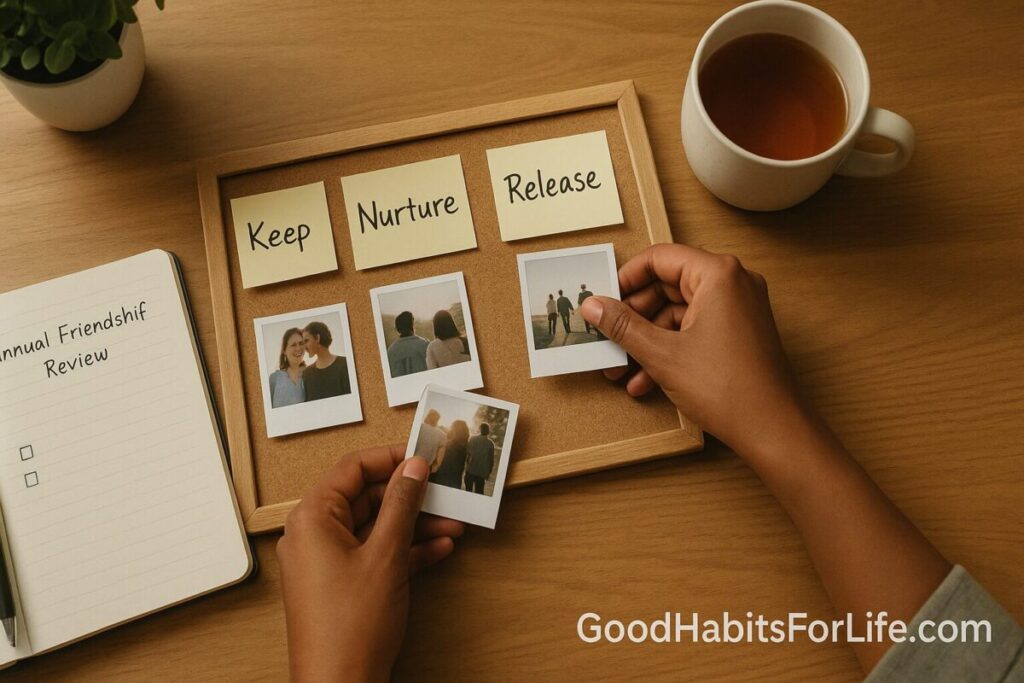
Annual Friendship Review: Keep, Nurture, Release
Annual Friendship Review: Keep, Nurture, Release
Table of Contents
🧭 What is an Annual Friendship Review?
An annual friendship review is a structured reflection where you assess your social circle and decide which relationships to keep as they are, nurture with more time/effort, or release (step back, redefine, or end). It’s not cold; it’s intentional—aligning your relationships with your values and wellbeing.
Why it matters (evidence-based):
-
Strong, supportive relationships are linked to longer life and better health. Large meta-analyses and long-running cohort studies show social connection predicts longevity and wellbeing.
-
Conversely, persistent conflict and high-strain relationships are associated with increased stress and poorer mental and physical outcomes.
You’re simply giving your friendships the same thoughtful review you’d give your finances or career—so the best connections get the attention they deserve.
✅ Quick Start: 60-Minute Sprint
Block one hour. Grab a notebook or spreadsheet.
-
List people you interacted with regularly this year (aim for 20–40 names).
-
Rate each on 1–5 for: energy after contact, trust/safety, mutuality, shared values/goals, recent effort from each side.
-
Tag moments: +3 best shared moments, −3 draining or boundary-crossing moments.
-
Classify each friendship (first pass): Keep / Nurture / Release.
-
Choose 3 actions you’ll take in the next two weeks (e.g., schedule a catch-up; express appreciation; set a boundary; step back kindly).
-
Calendar it: add one monthly check-in reminder for the next quarter.
Rule of thumb: spend ~70% of social time on Keep, 20% on Nurture, 10% on Release actions.
🧠 The Keep–Nurture–Release Framework
Use these objective signals to avoid impulsive decisions.
Keep (steady and strong)
-
You feel safe, seen, and energized after contact.
-
Mutual effort (texts, plans, care in hard times).
-
Respect for boundaries; conflicts are repaired.
Actions: Maintain cadence (e.g., monthly call, quarterly meet-up). Express gratitude twice a year.
Nurture (promising but underfed)
-
Warm but low frequency, or life changes pulled you apart.
-
One repairable issue: miscommunication, mismatched schedules, missed milestones.
Actions: Plan a standing ritual (first Friday coffee), share your year’s goals, invite collaboration (walk club, hobby, volunteering).
Release (step back or end)
-
Repeated disrespect, manipulation, constant take/no give, or severe value clash.
-
You chronically feel drained, anxious, or lesser after interactions.
-
Repairs fail or only you initiate them.
Actions: Reduce access (fewer replies, longer intervals), redefine the lane (“neighbourly hello” vs. close friend), or have a clear, kind closure conversation.
🛠️ 30-60-90 Day Action Plan
Days 1–30: Clarify & Pilot
-
Do the 60-minute review.
-
Send 3 appreciation notes (Keep).
-
Schedule two low-effort hangouts (Nurture).
-
For one Release candidate, trial distance: no initiation for 30 days; observe impact.
Checkpoint: Do you feel lighter? Any friendship instantly brighter with attention?
Days 31–60: Boundaries & Rituals
-
Add simple rituals: monthly walk, co-working hour, Sunday voice notes.
-
Script and set one boundary (see scripts below).
-
Try 1:1 “deep catch-up” (90 minutes) with a Keep friend you value.
Checkpoint: Energy after social time ↑? Fewer frictions?
Days 61–90: Deepen or Close
-
Plan one shared project (book swap, 5-km charity run, mini-trip).
-
If Release still warranted, do a kind closure or define a lighter lane.
-
Review calendar: lock quarterly touchpoints with Keep friends.
Checkpoint: % of social time spent with Keep/Nurture matches your rule of thumb?
📚 Techniques & Tools (Boundaries, Red Flags, Check-ins)
1) Energy–Mutuality–Safety (EMS) Score
Rate each friendship 1–5 on:
-
Energy (you leave feeling +, neutral, or −)
-
Mutuality (effort, reciprocity, reliability)
-
Safety (respect, non-judgment, consent with time/topics)
Average to compare objectively.
2) Green / Yellow / Red Flags
-
Green: celebrates wins, keeps confidences, repairs quickly.
-
Yellow: frequent cancellations, mild one-sidedness, avoidable gossip. Address with a boundary.
-
Red: contempt, chronic disrespect, big breaches, coercion, or identity attacks. Prioritize safety; consider ending.
3) Boundary Formula (CALM)
-
Concern: “When X happens…”
-
Ask: “…I need Y instead…”
-
Limit: “…If not, I’ll do Z (limit/step back).”
-
Maintain: stick to it kindly and consistently.
4) Friendship Maintenance Habits
-
Micro-touches: 5-minute voice note, meme that says “thinking of you.”
-
Shared rituals: first-Monday call, quarterly dinner, annual trip.
-
Repair script: “Last week felt off to me—can we rewind and reset?”
5) “Dunbar tiers” planning
Plan time for inner circle (5), close (15), meaningful (50). Moves you from overload to focus.
👥 Variations by Audience
Students: Use campus proximity—study pods, club projects. Protect study weeks with short “rain-check + reschedule” texts.
Professionals: Calendar-block social time like meetings. Rotate walking 1:1s near the office. Protect no-meeting Fridays for personal connections.
Parents/Caregivers: Stack social time onto kid logistics (park meet-ups, shared rides). Use “kitchen-table hangs” instead of going out.
Seniors: Prioritize weekly routines (walking groups, community classes). Keep transport and accessibility in mind.
Teens: Model digital hygiene—no pressure for constant replies. Suggest activity-based hangs (sports, art, volunteering).
⚠️ Mistakes & Myths to Avoid
-
Myth: “Ending a friendship is always cruel.”
Reality: Kind honesty + clear boundaries can be the most respectful option. -
Mistake: Only pruning, never planting. Schedule new-friend seeds (classes, clubs).
-
Mistake: Letting one conflict define everything. Try a repair before release—unless safety is at risk.
-
Myth: “Good friends never disagree.” Disagreement + repair often strengthen bonds.
-
Mistake: Ghosting because hard talks feel awkward. Use the scripts; be brief and kind.
📝 Real-Life Examples & Scripts
Appreciation (Keep):
“Hey [Name], this year you were a bright spot—thanks for the check-ins and laughs. Want to lock a first-Monday coffee for next quarter?”
Nurture invite:
“I’ve missed you! Can we try a standing last-Friday walk for the next two months and see how it feels?”
Boundary (CALM):
“When plans change last-minute, I scramble childcare. I need 24-hour notice where possible. If that keeps being hard, I’ll pause planning for a bit.”
Repair:
“I value us, and I think last week landed wrong. Can we chat for 10 minutes to reset?”
Kind release (lighter lane):
“I’m grateful for our history. My bandwidth is tight and I’m focusing on a smaller circle. I won’t be able to hang like before, but I’ll cheer for you from here.”
Closure (clear and compassionate):
“Given our repeated conflicts and how I feel after, I need to step back from the friendship. I wish you well and won’t be staying in touch. Please respect this boundary.”
🧰 Tools, Apps & Resources
-
Notes/Spreadsheets: Google Sheets or Notion for your EMS scores and quarterly plans (simple, shareable).
-
Personal CRM: Clay or Monica—keeps gentle reminders to check in (pro: helpful nudges; con: setup time).
-
Journaling: Day One or Standard Notes—to track energy before/after social time (pro: private; con: manual).
-
Scheduling: Google Calendar recurring events; Calendly for easy booking (pro: fewer back-and-forths; con: feels formal to some).
-
Safety: If red flags include abuse or coercion, contact local support services or trusted professionals immediately.
🔑 Key Takeaways
-
Your time and attention are finite—review them yearly.
-
Use objective scores and Keep–Nurture–Release to avoid overreacting.
-
Small, reliable rituals nurture most friendships.
-
Boundaries protect respect; repair before release unless unsafe.
-
A short, kind script beats months of silent resentment.
❓ FAQs
How often should I do a friendship review?
Once a year is great; add brief quarterly check-ins to course-correct.
Isn’t this too analytical for friendship?
It’s simply intentional. You’re not grading people; you’re aligning your time with healthy, mutual connections.
How do I know it’s time to release?
Look for patterns: repeated disrespect, dread before contact, no repair after feedback. Safety trumps sentimentality.
What if I’m the one who dropped the ball?
Own it. Try: “I pulled back during a hectic season. If you’re open, I’d like to try a monthly catch-up for the next two months.”
Should I tell someone I’m ‘releasing’ them?
Only if appropriate. Often a gentle step-back and clearer boundaries are enough. Use a closure script if they push for clarity or if harm was significant.
How can I make new, high-quality friends?
Join regular, small-group activities (classes, volunteering). Consistency + shared goals accelerate closeness.
What if our values changed?
Name it and try a new lane (activity-only, group-only). If misalignment causes harm, release.
How do I handle mutual friend dynamics after a release?
Keep it brief and neutral: “We’re spending less time one-on-one.” Don’t enlist others to take sides.
📚 References
-
Holt-Lunstad, J., Smith, T. B., & Layton, J. B. (2010). Social relationships and mortality risk: A meta-analytic review. PLOS Medicine. https://doi.org/10.1371/journal.pmed.1000316
-
Waldinger, R., & Schulz, M. (Harvard Study of Adult Development). Harvard Gazette coverage on relationships and wellbeing. https://news.harvard.edu/gazette/story/2017/04/over-nearly-80-years-harvard-study-has-been-showing-how-to-live-a-healthy-and-happy-life/
-
Mayo Clinic Staff. Friendships: Enrich your life and improve your health. https://www.mayoclinic.org/healthy-lifestyle/adult-health/in-depth/friendships/art-20044860
-
Centers for Disease Control and Prevention. Loneliness and Social Isolation. https://www.cdc.gov/aging/publications/features/lonely-older-adults.html
-
Hall, J. A. (2018). How many hours does it take to make a friend? Journal of Social and Personal Relationships (University of Kansas). https://news.ku.edu/2018/03/28/new-study-finds-it-takes-more-200-hours-friends
-
American Psychological Association. How to set boundaries and find balance. https://www.apa.org/topics/relationships/boundaries
-
Dunbar, R. I. M. (2018). The anatomy of friendship. Trends in Cognitive Sciences / Oxford University resources on social network layers. https://www.ox.ac.uk/news/2010-08-16-friends%E2%80%99-number-limited-brain
-
WHO. Social connections and health (social determinants of health, wellbeing). https://www.who.int/health-topics/social-determinants-of-health
Disclaimer: This article is educational and not a substitute for personalized mental-health or safety advice.