
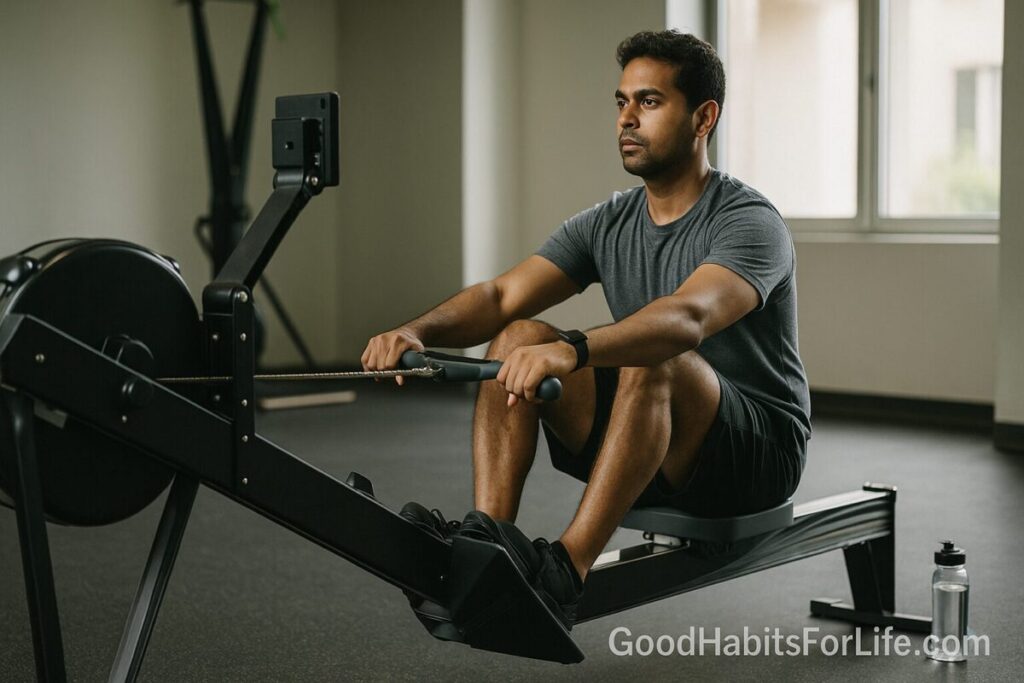
Rowing Machine Technique: Split Goals: Zone 2 + NEAT (2025)
Rowing Machine Technique: Zone 2 + NEAT (2025)
Table of Contents
🧭 What & Why
Rowing technique in one line: push with the legs, swing the body, then draw with the arms—reverse it to return. This sequence protects the back, lengthens the stroke, and converts strength into speed efficiently. Authoritative technique models from Concept2 and British Rowing emphasize this order to maximize distance per stroke and minimize injury risk. concept2.comBritish Rowing
Zone 2 cardio is steady, conversational aerobic work around your first ventilatory threshold (VT1). It improves mitochondrial efficiency, fat oxidation, and endurance while being easy to recover from—ideal for building a big “base.” Research on training-intensity distribution shows most successful endurance programs are dominated by low-intensity work, with only a small dose of hard efforts. umh1617.umh.esPubMedPMC
NEAT (Non-Exercise Activity Thermogenesis) is all your everyday movement outside formal workouts—walking, chores, taking the stairs, fidgeting. NEAT can vary massively between people and contributes substantially to daily energy expenditure. When you pair a structured Zone 2 row with high NEAT, you reap both cardiovascular and metabolic benefits. PubMedWiley Online Library
Why split goals (Zone 2 + NEAT) on a rower?
-
Rowing is full-body, joint-friendly, and easy to progress.
-
Zone 2 rows build aerobic base and technique under minimal fatigue.
-
NEAT keeps your total daily movement—and calorie burn—high without added stress.
✅ Quick Start (Do This Today)
-
Set up the machine (2–3 min).
-
Foot stretcher: strap across the widest part of your foot; heels can lift slightly at the catch.
-
Damper: start at 3–5; then confirm drag factor on the monitor (often ~100–140)—clean machines read lower. concept2.com
-
Warm up (6–8 min).
-
3 min easy @ 18–20 spm
-
3 min technique drills: pause at finish, pause at body-over, legs-only / legs+body / full
-
1–2 min gradual build back to easy pace
-
Technique cues (every stroke).
-
Catch: shins vertical, arms straight, torso hinged forward, neutral neck.
-
Drive: legs → body → arms; push the footplate away.
-
Finish: handle to lower ribs, elbows in; avoid over-leaning.
-
Recovery: arms → body → legs; glide, don’t rush. concept2.comBritish Rowing
-
Zone 2 test (10–20 min).
-
Row at an effort where you can talk in full sentences (talk test = pass). If using HR, this often aligns near VT1 for many people. PMC
-
NEAT add-ons (rest of day).
-
Aim for mini-bouts: 5–10 minutes of easy walking, chores, or stair breaks each hour you’re sedentary. That’s NEAT.
🧠 30–60–90 Habit Plan
Goal: excellent basic technique, consistent Zone 2 volume, and a high-NEAT lifestyle.
Days 1–30: Technique + Consistency
-
Row 4×/week: 20 min Zone 2 @ 18–22 spm (include 5–8 min of drills).
-
Focus: damper 3–5, long relaxed strokes, smooth recoveries.
-
NEAT: add 30–60 min/day of purposeful movement (walk breaks, errands on foot).
-
Checkpoint: film 30–60 s of your stroke; assess legs-body-arms order.
Days 31–60: Build the Base
-
Row 4–5×/week: 30–40 min Zone 2.
-
1 session can include 8–10 × 30 s “pickups” (just above Zone 2) with full easy recovery—stays mostly aerobic.
-
NEAT: target 60–90 min/day of cumulative movement.
Days 61–90: Endurance & Economy
-
Row 5×/week: 40–60 min Zone 2; optional 1 short threshold session (e.g., 2×8 min comfortably hard) if recovered.
-
NEAT: maintain 90+ min/day movement (walk meetings, post-meal 10-minute walks).
-
Checkpoint: steady 30-min row shows improved pace/500 m at same spm/effort.
Why so much easy work? Successful programs keep the majority of time at low intensity; you recover better and progress longer. PMC
🛠️ Technique & Frameworks
Stroke Phases (and the common fixes)
-
Catch → Drive: push the machine away with your legs first; keep arms straight until knees are almost straight.
-
Mid-Drive: once the legs finish, swing the torso from ~1 o’clock to ~11 o’clock.
-
Finish: draw the handle to the lower ribs; wrists flat.
-
Recovery: reverse the order; slow the slide, let the flywheel decelerate.
-
Posture: neutral spine; avoid rounding at the catch/finish. British Rowing
Stroke Rate & Pacing
-
Zone 2 economy: 18–22 spm with relaxed, powerful drives and long recoveries.
-
Watch: split (pace/500 m), spm, heart rate (optional), drag factor.
Damper vs Drag Factor
-
Damper is the lever; drag factor is what the monitor measures. Start at 3–5, then adjust by feel and outcome. High damper is not “harder = better”; it often shortens strokes and taxes the back. concept2.com
The Talk Test (simple Zone 2 calibration)
-
If you can speak full sentences without gasping, you’re likely in Zone 2 (near VT1), a validated field cue used across populations. PMC
🧩 Split Goals: Zone 2 + NEAT—How They Work Together
-
Zone 2 rows drive aerobic adaptations (mitochondrial density, capillarization) at low stress.
-
NEAT adds large, sustainable daily energy expenditure without formal training—critical for weight management and metabolic health. Wiley Online Library
Daily template (busy schedule):
-
Morning: 25–35 min Zone 2 row.
-
Daytime NEAT: 6–10 short movement snacks (3–10 min each): stair breaks, campus/office laps, chores, errands on foot.
-
Evening: 10-minute walk after dinner.
👥 Audience Variations
-
Beginners / Deconditioned: prioritize drills + 15–20 min Zone 2; extend by 5 min/week.
-
Professionals (desk-bound): schedule hourly 3–5-min NEAT alarms; walking calls; printer/water breaks.
-
Students: study sprints—10 min walk every 50 min; short rows between blocks.
-
Seniors: keep spm lower (16–20), larger recovery; consider HR monitor for consistent pacing; mind hip/knee comfort.
-
Athletes: 80–90% of rowing time easy; 1–2 higher-intensity sessions/week only if technique holds.
⚠️ Mistakes & Myths to Avoid
-
Yanking with arms first. Leads to short strokes and sore shoulders—legs drive the show. British Rowing
-
Rushing the slide. Zone 2 is about calm recoveries; think “push hard, float long.”
-
Max damper thinking. It’s not a “strength test”; start 3–5 and use drag factor to personalize. concept2.com
-
Ignoring NEAT. One great row can’t undo 12 sedentary hours; build motion snacks into the day. PubMed
-
Only hard sessions. Most time should be easy to accumulate quality volume. PMC
💬 Real-Life Examples & Scripts
Technique drill block (8 min):
-
1 min legs-only (arms straight, torso forward).
-
1 min legs + body (add torso swing).
-
1 min full stroke (add arms).
-
2×(1 min pause at finish → 1 min pause at body-over).
-
2 min easy continuous.
30-minute Zone 2 session (template):
-
6 min warm-up (drills) → 22 min steady @ 18–20 spm (talk test pass) → 2 min cool-down.
Workday NEAT script:
-
“Every hour, I stand, drink water, and walk the longest hallway/stairwell once. After meals, I walk 10 minutes. While on calls, I pace or do light chores.”
🧰 Tools, Apps & Resources
-
RowErg monitor: pace/500 m, stroke rate, drag factor.
-
ErgData (Concept2 app): auto-logs rows; tracks drag, splits, and HR (with strap).
-
HR straps/watches (optional): Polar H10, Garmin/Apple/Coros for stable HR.
-
Technique resources: Concept2 technique page; British Rowing technique pages/videos. concept2.comBritish Rowing
📚 Key Takeaways
-
Master legs–body–arms and relaxed recoveries before chasing speed.
-
Use Talk Test to set Zone 2; stay conversational. PMC
-
Keep damper 3–5 and personalize with drag factor on the monitor. concept2.com
-
Build volume with mostly easy rowing; sprinkle intensity sparingly. PMC
-
Make NEAT a daily habit—small motions, big impact. Wiley Online Library
❓ FAQs
1) How long should a Zone 2 row be?
Start with 20 minutes and build toward 30–60 minutes as technique and comfort improve.
2) What stroke rate is best for Zone 2?
Typically 18–22 spm keeps things economical and relaxed; focus on long strokes, not high rate.
3) Is a higher damper setting better?
No. Begin at 3–5 and use drag factor to personalize feel; high damper often shortens strokes and stresses the back. concept2.com
4) How do I know I’m in Zone 2 without a heart-rate monitor?
Use the Talk Test—you should be able to speak in full sentences. PMC
5) How often should I row?
Aim for 3–5 Zone 2 sessions/week; layer in short technique drills each time. WHO recommends 150–300 min/week of moderate activity across modalities. PMC
6) Can I just row and skip NEAT?
You’ll progress, but daily movement outside workouts adds meaningful energy expenditure and metabolic benefits. Keep both. Wiley Online Library
7) Is rowing safe for my back?
With neutral spine and good sequencing, rowing is back-friendly; avoid rounding and over-leaning. Progress duration gradually and stop if you feel sharp pain.
8) What metrics should I track?
Pace/500 m, spm, session duration, optional HR, and weekly NEAT minutes (movement snacks).
9) When do I add hard intervals?
After 6–8 weeks of consistent Zone 2 + solid technique; keep total hard time small compared with easy volume. PMC
10) How do Zone 2 + NEAT fit general health guidelines?
They’re a practical way to hit WHO’s 150–300 min/wk moderate target while keeping you active all day. PMC
📚 References
-
World Health Organization. 2020 Guidelines on physical activity and sedentary behaviour. (Adults: 150–300 min/wk moderate). PMC
-
Seiler S. What is Best Practice for Training Intensity and Duration Distribution in Endurance Athletes? IJSPP, 2010. (Three-zone model; VT1-anchored easy work). umh1617.umh.es
-
Stöggl TL, Sperlich B. The training intensity distribution among well-trained and elite endurance athletes. Sports Med, 2015 (polarized distribution evidence). PMC
-
Concept2. Indoor Rowing Technique (stroke phases & positions). concept2.com
-
British Rowing. British Rowing Technique—How to Indoor Row (legs–body–arms model). British Rowing
-
Concept2. All About Damper Setting and Drag Factor (start 3–5; personalize). concept2.com
-
Kwon Y et al. The Talk Test as a useful tool to monitor aerobic exercise training intensity. J Exerc Rehabil, 2023 (Talk Test ≈ VT1). PMC
-
Levine JA. Non-exercise activity thermogenesis (NEAT). Best Pract Res Clin Endocrinol Metab, 2002; 2004 (NEAT concept & variability). PubMed+1
-
Treff G et al. Initial Evaluation of the Concept-2 Rowing Ergometer’s Accuracy. Front Sports Act Living, 2021. Frontiers
-
British Rowing. Rowing Machine Technique (indoor technique & injury minimization). British Rowing
⚖️ Disclaimer
This guide is educational and not a substitute for personal medical advice. Consult a qualified professional before starting or modifying any exercise program, especially if you have health conditions or pain.