
Feynman Technique 2.0: Teach Back with Constraints
Feynman Technique 2.0: Teach Back with Constraints
Table of Contents
🧭 What is “Feynman Technique 2.0”?
Classic Feynman Technique: pick a topic → explain it in plain language → find gaps → study → simplify again.
2.0 upgrade: keep the loop, but add purposeful constraints that pressure-test your understanding and memory. Constraints simulate real-world demands (limited time, mixed audiences, different formats), creating “desirable difficulties” that improve durable learning.
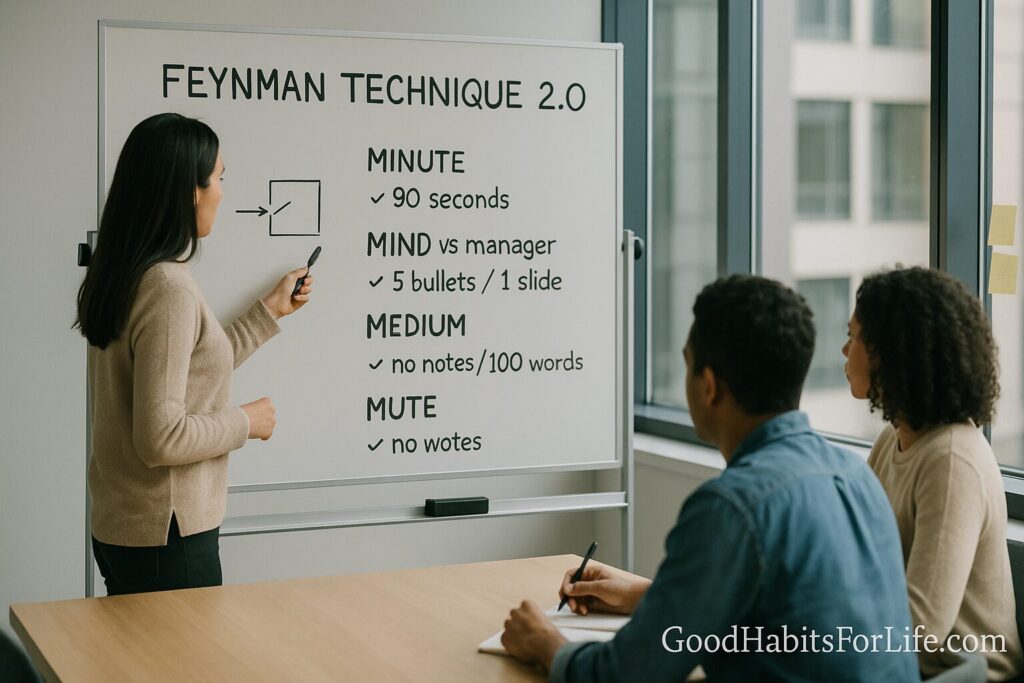
Four constraint types (the 4Ms):
-
Minute — time limits (e.g., 90-second or 5-minute teach-back).
-
Mind — audience shift (child, peer, manager, client).
-
Medium — output format (whiteboard, 5 bullets, audio memo, 1-slide).
-
Mute — resource limits (no notes, only 1 diagram, exactly 100 words).
Goal: produce a clear, accurate explanation under constraints—then iterate.
✅ Why constraints supercharge learning (evidence)
-
Retrieval practice: explaining without notes is a strong form of self-testing that boosts long-term retention compared to rereading.
-
Generation effect: forming your own explanation deepens encoding versus passively consuming content.
-
Cognitive load & coherence: limits on words or time force you to strip extraneous detail and build clean schema.
-
Interleaving & transfer: switching audience/medium compels flexible knowledge that transfers across contexts.
-
Spaced repetition: repeating teach-backs on a schedule stabilizes memory traces.
(See References for research on test-enhanced learning, desirable difficulties, and effective study strategies.)
🛠️ Quick Start: Do this today (15 minutes)
Topic: one sub-idea you studied this week.
-
Pick the 4M set (2 minutes):
-
Minute: 2-minute limit
-
Mind: explain to a 12-year-old
-
Medium: 5 bullet points only
-
Mute: no notes
-
-
Teach back (2 minutes): speak aloud or record a voice memo.
-
Gap hunt (4 minutes): mark fuzzy spots; check source; fix.
-
Refine (4 minutes): redo the 5 bullets from memory.
-
Archive (3 minutes): paste bullets into a “Teach-Back Log” with date + difficulty rating (1–5).
Success metric today: can you recreate the 5 bullets 30 minutes later with ≥90% fidelity?
🗓️ 7-Day Starter Plan (+ 30-60-90 Roadmap)
7-Day Starter
-
Day 1 – Select & slice: choose a chapter/lecture; carve three micro-topics (≤5 bullets each).
-
Day 2 – First loop: 2-minute, child audience, 5 bullets, no notes. Log gaps.
-
Day 3 – Dual coding: 90-second whiteboard sketch; max one diagram. Compare to Day 2 bullets.
-
Day 4 – Transfer test: explain to a peer persona; 1 slide limit.
-
Day 5 – Interleave: mix this topic with an older one; alternate 60-second summaries.
-
Day 6 – Stress test: 30-second elevator pitch; exactly 50 words.
-
Day 7 – Retrieval check: closed-book quiz (5 Qs you write yourself) + final 2-minute teach-back.
Weekly checkpoint: accuracy ≥80% on your self-quiz + explanation rated “clear” by a peer (or your future self) on re-listen.
30-60-90 Roadmap
-
Day 30: 10 teach-backs archived; hit three different audiences & three media.
-
Day 60: promote to concept maps; present one 5-minute mini-lesson live/recorded.
-
Day 90: compile a Portfolio of Explanations (top 5 videos, 5 one-pagers); teach a short workshop or share a tutorial thread.
🧠 Techniques & Frameworks (constraint menu)
The 4Ms—mix & match
| Constraint | Options (pick 1–2) | Purpose |
|---|---|---|
| Minute | 30s, 60s, 2m, 5m | Forces prioritization; surfaces core causal chain |
| Mind | child, peer, manager, skeptical client | Drives audience-fit and transfer |
| Medium | 5 bullets, 1 slide, 1 diagram, 100 words, 90-sec audio | Builds multi-representation memory |
| Mute | no notes, only key terms list, 1 analogy max | Reduces dependency; increases retrieval load |
Explanation scaffolds
-
The 5-Point Ladder: Definition → Why it matters → How it works → Example/analogy → Boundary/limitation.
-
CER (Claim-Evidence-Reason): make a claim, show evidence, explain the link.
-
Feynman-plus-Map: end each teach-back by drawing a mini concept map with 5 nodes.
Memory enhancers
-
Spacing: Day 1, 3, 7, 14, 30 reviews.
-
Interleaving: alternate topics each session.
-
Elaboration prompts: “How would I prove this wrong?” “What’s the simplest analogy?”
-
Calibration: after each session, rate clarity and confidence (1–5) to avoid illusion of learning.
👥 Audience variations
Students:
-
Use course outcomes to choose teach-back targets.
-
Pair up: 2-minute swaps at the end of study sessions.
-
Constraint focus: Minute + Mute (exam realism: short time, no notes).
Professionals:
-
Turn teach-backs into update briefs for your team (1 slide, 90-sec readout).
-
Constraint focus: Medium (slides) + Mind (executive audience).
Educators/Trainers:
-
Assign rotating “student-teacher” roles with fixed constraints (e.g., 3 bullets + 1 diagram).
-
Capture 30-second recaps at the end of classes.
Teens:
-
Use relatable analogies (games, sports); keep 60–90 second limits.
-
Reward streaks in the Teach-Back Log.
Seniors/Lifelong learners:
-
Prefer audio memos; repeat on longer spacing (1–3–7–14 days).
-
Keep diagrams large; focus on one analogy.
⚠️ Mistakes & myths to avoid
-
Myth: “Rereading = learning.”
Reality: retrieval + explanation beats passive review for long-term retention. -
Mistake: explaining with notes open.
Fix: add a “Mute: no notes” rule for at least one round. -
Mistake: over-long monologues.
Fix: 60–120s constraints; clarity rises when you trim. -
Myth: “If I can explain it simply, I oversimplified.”
Reality: simplicity with accurate boundaries is expertise. -
Mistake: never testing transfer.
Fix: rotate audience and medium weekly. -
Mistake: no log = no progress.
Fix: one-page Teach-Back Log with dates, constraints, scores.
💬 Real-life examples & scripts
Example 1 — Physics: Newton’s 2nd Law (child, 60s, 5 bullets, no notes)
-
Force makes things speed up or slow down.
-
Bigger mass needs more push to change speed.
-
Equation is F = m × a.
-
If you push a light cart, it speeds up more than a heavy one.
-
Double the force → double the acceleration (if mass stays same).
Example 2 — Data privacy (manager, 90s, 1 slide)
-
Claim: We must minimize stored personal data.
-
Evidence: Breach risk scales with volume; regulations require minimization.
-
Reason: Less data = smaller blast radius + simpler compliance.
-
Action: Delete legacy fields; set 90-day retention; audit quarterly.
Script template (fill-in):
“[Concept] matters because [problem it solves]. At its core: [definition in one sentence]. It works by [process in 3 steps]. For example, [analogy/example]. Remember [boundary/exception].”
🧩 Tools, apps & resources
-
Voice Memos / Google Recorder / iOS/Android Recorder
Pros: frictionless; auto-transcripts (some devices). Cons: harder to skim than text. -
Obsidian / Notion (Teach-Back Log template)
Pros: backlinks, tags, daily notes. Cons: setup overhead. -
Anki / Quizlet (spaced retrieval)
Pros: automates spacing; cloze deletions complement teach-backs. Cons: can encourage trivia if poorly designed. -
Loom / ScreenPal (1-slide explainers)
Pros: quick share; visual + audio. Cons: storage/organization needed. -
Whiteboard apps (Excalidraw, Jamboard-style)
Pros: fast diagrams that stick. Cons: messy without templates.
One-page Teach-Back Log (fields): Date • Topic • 4Ms used • 5 bullets/slide link • Clarity (1–5) • Confidence (1–5) • Next gap.
📌 Key takeaways
-
Teaching back with constraints turns knowledge into portable, test-ready understanding.
-
Rotate Minute, Mind, Medium, Mute to create desirable difficulties.
-
Use spacing, interleaving, retrieval to convert short-term gains into durable memory.
-
Track with a simple Teach-Back Log and weekly checkpoints.
-
Aim for simple + accurate boundaries—the signature of mastery.
❓ FAQs
1) Is the Feynman Technique only for beginners?
No. Experts use it to detect hidden gaps and sharpen transfer across audiences.
2) How short should a teach-back be?
Start with 60–120 seconds. If you ramble, your model isn’t clean yet.
3) What if my topic is highly technical?
Use layered constraints: 1 slide for executives, 5 bullets for peers, 1 diagram for specialists. Keep boundaries explicit.
4) How often should I repeat teach-backs?
Follow spacing: Day 1, 3, 7, 14, 30. Add a brief interleaved recap between topics.
5) Should I write or speak?
Both. Alternate mediums to strengthen memory representations.
6) How do I grade myself?
Closed-book self-quiz (5 Qs), clarity rating (1–5), and ability to explain in ≤90 seconds without notes.
7) Can this replace practice problems?
No—pair teach-backs with domain-specific practice (e.g., problem sets, coding katas).
8) How do I use this in a study group?
Rotate “teacher” roles; fixed constraints (2 minutes, 5 bullets). Peers ask one boundary question each.
9) What if I freeze without notes?
Step down the difficulty: allow 1 prompt word per bullet, then remove prompts next round.
10) Any tip for exams with essays?
Practice 5-bullet skeletons under 5-minute limits, then expand to full essays from memory.
📚 References
-
Dunlosky, J., et al. (2013). Improving Students’ Learning With Effective Learning Techniques. Psychological Science in the Public Interest. https://doi.org/10.1177/1529100612453266
-
Roediger, H. L., & Karpicke, J. D. (2006). Test-Enhanced Learning. Psychological Science. https://doi.org/10.1111/j.1467-9280.2006.01693.x
-
Bjork, R. A., & Bjork, E. L. (2011). Making things hard on yourself, but in a good way: Creating desirable difficulties. Psychology and the Real World. (UCLA/CU scholars overview)
-
Brown, P. C., Roediger, H. L., & McDaniel, M. A. (2014). Make It Stick: The Science of Successful Learning. (Harvard/Belknap)
-
Mayer, R. E. (2009, 2021). Multimedia Learning. Cambridge University Press.
-
Cepeda, N. J., et al. (2008). Spacing Effects in Learning. Psychological Science. https://doi.org/10.1111/j.1467-9280.2008.02076.x
-
The Learning Scientists. Six Strategies for Effective Learning (university-affiliated cognitive psychologists). https://www.learningscientists.org/
-
Weinstein, Y., Madan, C. R., & Sumeracki, M. A. (2018). Teaching the Science of Learning. Cognitive Research: Principles and Implications. https://doi.org/10.1186/s41235-017-0087-y