
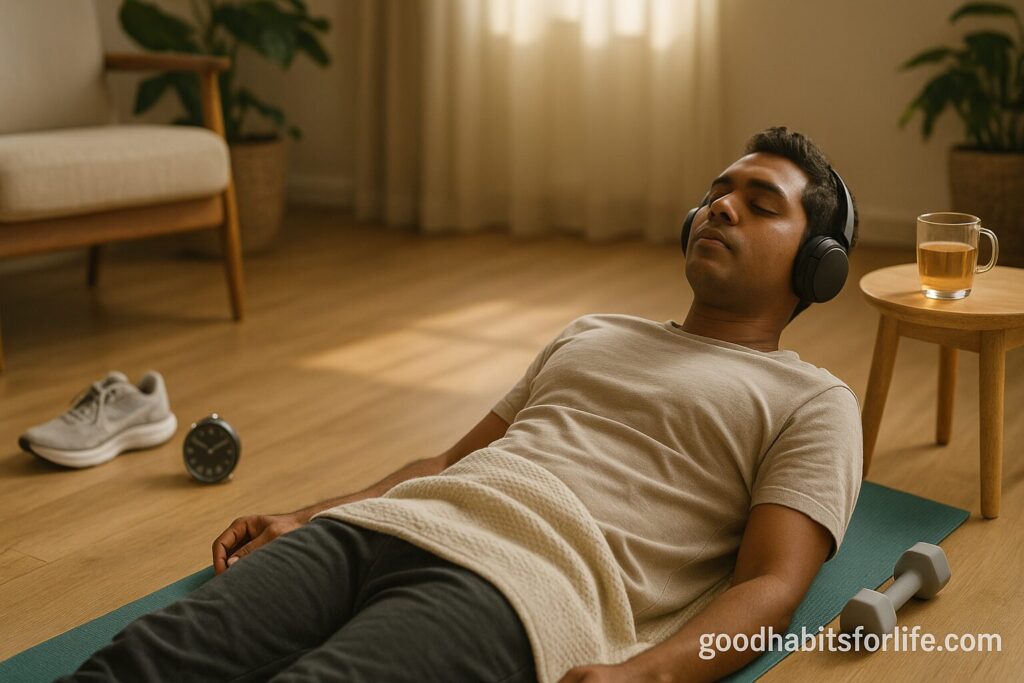
Non-Sleep Deep Rest (NSDR) for Everyday Calm: Zone 2 + NEAT (2025)
NSDR for Everyday Calm (2025): Zone 2 + NEAT
Table of Contents
🧭 What is NSDR—and why it works
Non-Sleep Deep Rest (NSDR) is a short, structured relaxation protocol (often guided audio) done awake, eyes closed, and still. It typically blends slow breathing, body scanning, and attention cues—very similar to yoga nidra. The aim is to shift you toward a parasympathetic (“rest-and-digest”) state, which can reduce perceived stress and support focus later in the day. Evidence on relaxation techniques and yoga-based practices shows benefits for stress, anxiety, and sleep quality when practiced regularly (see References).
Core elements of NSDR
-
Comfortable lying or seated posture
-
Eyes closed; minimal stimulation
-
Slow, diaphragmatic breathing
-
Body scan or gentle attention cues
-
10–30 minutes (even 10 helps)
What you’ll likely feel: less mental noise, lower muscle tension, calmer breathing, and an easier “re-start” when you go back to work or family tasks.
✅ Why pair NSDR with Zone 2 & NEAT
Calm is easier to keep when your nervous system and metabolism cooperate.
-
Zone 2 cardio (easy-steady aerobic work you can maintain while speaking in full sentences) builds mitochondrial capacity and cardio-metabolic health. It lives around ~60–70% of max heart rate (or “comfortable, nose-breathing pace”).
-
NEAT (Non-Exercise Activity Thermogenesis) is all the light, everyday movement outside workouts—walking, taking stairs, carrying groceries, doing chores. It meaningfully increases daily energy expenditure and counters the risks of long sitting.
The synergy
-
NSDR downshifts stress → you’re more likely to choose steady movement.
-
Zone 2 builds durable energy → less afternoon crash, less stress reactivity.
-
NEAT keeps circulation, glucose control, and mood steady between sessions.
A simple stack: NSDR (10–20 min daily) + Zone 2 (30–45 min, 3–4×/week) + NEAT snacks (2–5 min each hour you’re awake).
🛠️ Quick Start (today)
-
Pick a 12–20 min NSDR audio. Search “yoga nidra” or “NSDR” in a reputable app; save one favorite.
-
Schedule a Zone 2 block. Today or tomorrow: 30–40 min brisk walk, easy cycle, or light jog. Use the talk test (full sentences, not gasping).
-
Set NEAT alarms. Every hour, do 2–5 min of light movement: walk a hallway, stairs, outside lap, or 10 squats + 10 calf raises.
-
Create a cue. After lunch → 10 min NSDR; or mid-afternoon → 12 min NSDR reset.
-
Log it. Tick boxes in Notes/Tasks: NSDR ✅ | Z2 ✅ | NEAT ✅ x (how many).
-
Sleep support. Dim screens 60–90 min before bed; optional 5–10 min very gentle breath-focus.
🗺️ 30-60-90 Habit Roadmap
Goal: everyday calm, steady energy, and sustainable cardio fitness.
Days 1–30 (Foundation)
-
NSDR: 10–15 min daily (set a repeating calendar slot).
-
Zone 2: 3×/week × 30–40 min (walk, bike, elliptical).
-
NEAT: 6–8 movement snacks/day (2–5 min each).
-
Checkpoint (Day 30): Notice stress reactivity (0–10), average steps/day, and ability to hold a brisk conversation on walks.
Days 31–60 (Build)
-
NSDR: 15–20 min on 5–6 days/week; 10 min on the light day.
-
Zone 2: 3–4×/week × 35–45 min. Optional one short surge: last 5 min slightly faster while still talkable.
-
NEAT: Aim for 7,000–10,000 steps/day (or +2,000 above your baseline).
-
Checkpoint (Day 60): Better focus mid-afternoon? Fewer “wired-tired” evenings? Resting HR trending down?
Days 61–90 (Solidify)
-
NSDR: 20 min daily (or 10 min AM + 10 min PM).
-
Zone 2: 4×/week × 40–50 min. Add one long easy session (60 min) every other week.
-
NEAT: Keep hourly snacks; add one active commute or default “stairs only.”
-
Checkpoint (Day 90): Calm feels available on demand; Zone 2 is automatic; step count is steady without strain.
🧠 Techniques & Frameworks
The Calm Stack (3-2-1):
-
3 NEAT bursts before lunch (walk, stairs, chores)
-
2 Zone 2 sessions by Thursday
-
1 NSDR session daily (12–20 min)
Talk Test for Zone 2: You can speak full sentences; if you can sing, go a bit faster; if you’re panting, slow down.
Heart-Rate ballpark: HRmax ≈ 220 − age. Zone 2 ≈ 60–70% HRmax. Example: age 40 → HRmax ≈ 180; Zone 2 ≈ 108–126 bpm (use as a guide—context matters).
NSDR micro-protocol (6–8 min) for busy days:
-
10 slow exhales (twice as long as inhales).
-
Body scan head→toes (1–2 breaths per region).
-
Count 20 breaths (quietly).
-
Open eyes slowly; stand; take 10 slow steps.
NEAT menu (rotate): hallway lap, one flight of stairs (up & down), 15 chair-stands, 20 calf raises, dishwashing by hand, one outdoor loop, park farther away, phone-call pacing.
👥 Variations by Audience
-
Students: NSDR after intense study blocks; Zone 2 between classes; walk-and-talk review calls; 8–9k daily steps around campus.
-
Professionals (desk): Calendar-block NSDR at 14:30; NEAT lap on every meeting that ends early; treadmill desk for 15–20 min before hard work.
-
Parents: Family walk after dinner (15–20 min Zone 2 pace for you, play for kids); 6-min NSDR while baby naps.
-
Seniors: Prioritize safety—start with 10-minute gentle walks; NSDR seated; include light mobility during NEAT.
-
Teens: Turn gaming breaks into 3-minute movement bursts; NSDR before exams or sports nights.
⚠️ Mistakes & Myths to Avoid
-
Myth: “NSDR is just napping.” → NSDR is awake relaxation with guidance; naps can be useful too, but they’re different.
-
Mistake: Going too hard on “Zone 2.” If you can’t talk comfortably, you’ve drifted to Zone 3.
-
Myth: “10k steps or nothing.” → Improvement is dose-responsive; +2,000 steps/day from your baseline already helps.
-
Mistake: Skipping NSDR on busy days—the day you “don’t have time” is the day 6–10 minutes helps most.
-
Myth: “I must feel zen during NSDR.” → Wandering mind is normal; the practice is gently returning attention.
💬 Real-Life Examples & Scripts
2-minute reset before a high-stakes call
Sit tall, eyes soft. Inhale 4s, exhale 6–8s × 8 breaths. Drop shoulders. Ask: “What’s the one outcome I need?” Walk 20 slow steps. Start call.
12-minute NSDR lunch break
Lie down, legs supported. Play a saved NSDR/yoga nidra. When it ends, roll to side, stand slowly, sip water, take a 3-minute stroll.
Zone 2 brisk-walk script (35 min)
5-min easy warm-up → 25-min talkable pace → 5-min easy cool-down. If watch says >70% HRmax, ease slightly; if you can sing, speed a touch.
NEAT at work (hourly 3-minute loop)
Stand → hallway lap → one staircase → 10 chair-stands → back to desk. Log a ✅.
🧰 Tools, Apps & Resources
-
Timers/Alarms: phone focus timer; watch reminders each hour.
-
Audio apps: reputable meditation apps with yoga nidra/NSDR tracks (download 1–2 favorites).
-
Trackers: any HR-capable watch can estimate Zone 2; otherwise, rely on talk test.
-
Environment: eye mask, thin pillow/rolled towel under knees, light blanket (for NSDR comfort).
-
Shoes: comfortable walking shoes to make Zone 2/NEAT friction-free.
Pros: low cost, flexible, beginner-friendly. Cons: requires consistency; gadgets can distract—set “do not disturb” during NSDR.
📌 Key Takeaways
-
NSDR is a reliable, short practice to reduce stress and reset focus.
-
Zone 2 and NEAT give you sustainable energy and metabolic support.
-
Use talk test or ~60–70% HRmax for Zone 2.
-
Start today: 12 min NSDR + 30–40 min brisk walk + hourly NEAT.
-
Lock it in with the 30-60-90 plan and simple cues.
❓ FAQs
1) What’s the difference between NSDR and yoga nidra?
They’re closely related; many NSDR audios are essentially yoga nidra (guided, eyes-closed body scan and breath). Both are done awake.
2) Can NSDR replace lost sleep?
No. It may help you feel restored and support sleep quality, but it doesn’t substitute for full nightly sleep.
3) When should I do NSDR?
Common slots: late morning, after lunch, or mid-afternoon. Avoid right before a demanding drive. If it makes you too alert at night, keep it earlier in the day.
4) How long should a session be?
10–20 minutes is effective. On busy days, even 6–8 minutes helps.
5) How do I find Zone 2 without a watch?
Use the talk test: you can speak full sentences comfortably. If speech is choppy, slow down.
6) Is brisk walking enough for Zone 2?
For many people—yes. Choose a pace that’s steady but comfortable. Hills can help.
7) How many steps should I aim for?
If you’re at 4,000–6,000 now, add ~2,000 steps/day. Many adults benefit around 7,000–10,000 steps if appropriate.
8) I have trouble “switching off” during NSDR—tips?
Let thoughts pass, keep bringing attention back to breath/body scan. Headphones and a consistent script help.
9) Any safety considerations?
If you have cardiovascular, respiratory, or mental-health conditions, check with a clinician before changing exercise or introducing unfamiliar practices.
10) Will Zone 2 make me faster/stronger?
It builds an aerobic base and recovery capacity. For speed/strength, add skill-specific work later; keep Zone 2 as your foundation.
📚 References
-
World Health Organization. Guidelines on Physical Activity and Sedentary Behaviour (2020). https://www.who.int/publications/i/item/9789240015128
-
U.S. Department of Health and Human Services. Physical Activity Guidelines for Americans, 2nd ed. https://health.gov/paguidelines
-
American Heart Association. Target Heart Rates. https://www.heart.org
-
National Center for Complementary and Integrative Health (NIH). Relaxation Techniques & Mindfulness: What You Need To Know. https://www.nccih.nih.gov
-
American Academy of Sleep Medicine (Sleep Education). Napping and Sleep Health. https://sleepeducation.org
-
Levine, J. A. Non-exercise activity thermogenesis (NEAT). Best Pract Res Clin Endocrinol Metab. 2002. https://doi.org/10.1053/beem.2002.0227
-
Ekelund, U., et al. Physical activity attenuates mortality risk associated with high sitting time. The Lancet. 2016. https://doi.org/10.1016/S0140-6736(16)30370-1
-
Tang, Y.-Y., Hölzel, B., Posner, M. I. The neuroscience of mindfulness meditation. Nat Rev Neurosci. 2015. https://doi.org/10.1038/nrn3916
-
Manzoni, G. M., et al. Relaxation training for anxiety: a meta-analysis. Acta Psychiatr Scand. 2008. https://doi.org/10.1111/j.1600-0447.2008.01255.x
-
Mayo Clinic. Move more to burn more: Understanding NEAT. https://www.mayoclinic.org
Disclaimer: This guide is educational and not a substitute for personalized medical or fitness advice; consult a qualified professional before making changes to your health routine.