
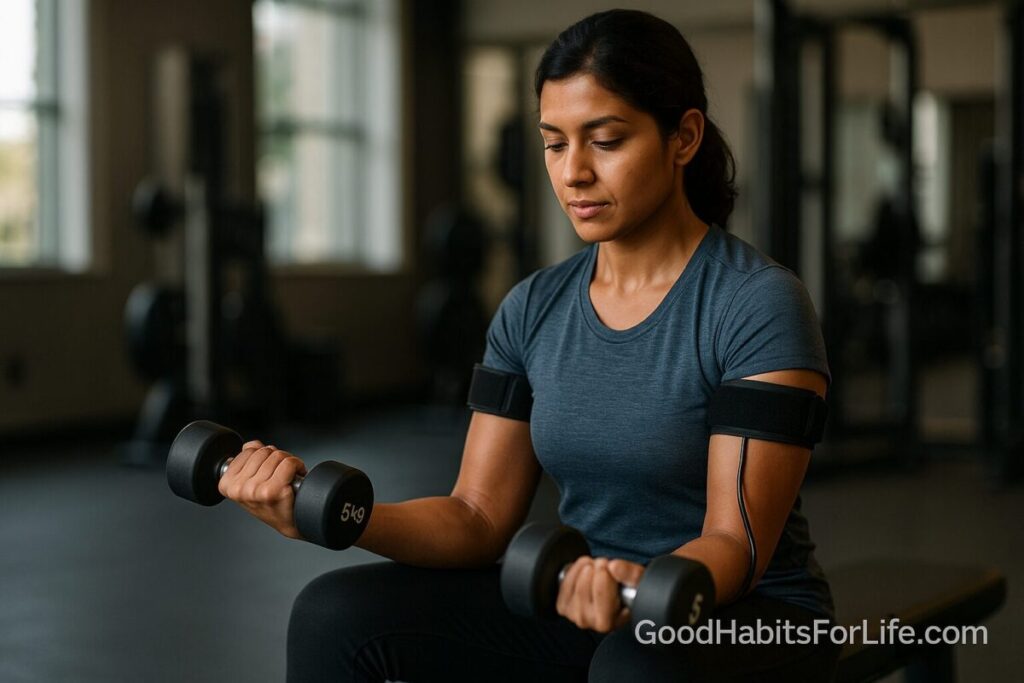
Blood Flow Restriction (BFR): Safe Starts: Dopamine Detox (2025)
Blood Flow Restriction (BFR): Safe Start Guide 2025
Table of Contents
🧭 What Is BFR & Why It Works
Blood Flow Restriction (BFR) training uses a specialized cuff or band to partially limit arterial inflow and fully restrict venous outflow to a limb during exercise. That controlled restriction creates a low-oxygen, metabolite-rich environment that amplifies muscular stress even with light weights.
Why athletes, patients, and busy people care:
-
Strength & hypertrophy with light loads: Meta-analyses show BFR with 20–30% 1RM can produce gains comparable to heavy lifting—useful when joints, pain, or time limit heavy work.
-
Rehab accelerator: In post-op or painful conditions where heavy loading isn’t possible, BFR helps maintain or rebuild muscle earlier in rehab.
-
Time-efficient: The hallmark 30-15-15-15 cluster is short but potent.
Physiology (in brief): Hypoxia + metabolite accumulation ↑ fast-twitch recruitment, cell swelling, and anabolic signaling (e.g., mTOR), while central drive increases due to effort—together supporting growth and strength with minimal joint stress.
⚕️ Safety, Contraindications & Screening
BFR is generally safe when properly screened, dosed, and supervised. Most adverse events are minor and transient (e.g., temporary discomfort or subcutaneous petechiae). Serious complications are rare in screened populations using proper equipment.
Absolute/relative contraindications (consult a clinician if unsure):
-
History or high risk of deep vein thrombosis (DVT)/pulmonary embolism, known clotting disorders
-
Uncontrolled hypertension, severe cardiovascular or peripheral vascular disease
-
Sickle cell disease, active infection, open wounds under the cuff area
-
Pregnancy (relative), cancer in the limb, lymphoedema, or recent grafts that could be compromised
-
Neuropathy or disorders that affect sensation in the limb
Stop immediately if you notice numbness/tingling, sharp pain, limb pallor/cyanosis, dizziness, or unusual swelling after the session.
Best practice: Determine Limb Occlusion Pressure (LOP) with a calibrated device (Doppler, built-in sensors), then set training pressure as a percentage of LOP, not a guess.
🛠️ Quick Start: Do This Today
-
Choose the right tool: Use purpose-built BFR cuffs with LOP/auto-calibration (avoid elastic straps or improvised tourniquets).
-
Measure LOP: Sit quietly 5 min; measure arm LOP (each arm) and thigh LOP (each leg).
-
Set training pressures:
-
Arms: ~40–50% of LOP
-
Legs: ~60–80% of LOP
-
-
Pick one movement: Start with a single exercise per limb group (e.g., leg extension or biceps curl).
-
Load & reps: 20–30% 1RM (or a weight you could lift ~30–40 reps to failure unoccluded). Perform 30-15-15-15 with 30 s rests, cuff kept inflated during the cluster.
-
Frequency: 2–3 sessions/week per muscle.
-
RPE target: Sets should feel 7–9/10 effort by the final mini-set.
-
After: Deflate between exercises; check skin, capillary refill, and comfort.
Handy reference
| Parameter | Arms | Legs |
|---|---|---|
| Training pressure (%LOP) | 40–50% | 60–80% |
| Load | 20–30% 1RM | 20–30% 1RM |
| Set pattern | 30-15-15-15 | 30-15-15-15 |
| Rest (cuff inflated) | 30 s | 30 s |
| Sessions/week | 2–3 | 2–3 |
Wide cuffs need lower pressure than narrow cuffs to reach the same occlusion—another reason to measure, not guess.
📈 30-60-90 Day BFR Habit Plan
Goal: Build a safe, sustainable BFR routine that complements (not replaces) your broader training or rehab.
Days 1–30: Foundations
-
Weeks 1–2: 1–2 BFR exercises total (e.g., leg extension, biceps curl). 1–2 clusters each, 2×/week. Master setup, LOP, and RPE.
-
Weeks 3–4: Add 1 more BFR exercise (same limb or the other). 2–3 clusters each, still 2–3×/week. If RPE <7, +5% load or +5% LOP (stay within ranges).
Days 31–60: Progress & Pairing
-
Introduce BFR finishers after your normal lifts (e.g., heavy squats → BFR leg extension).
-
Progress to 3 clusters/exercise, 2–3 exercises/session (different muscles).
-
Track total occlusion time (keep individual limb occlusion ≤10–15 min/session).
Days 61–90: Personalization
-
Decide your use case:
-
Rehab/Joint-friendly: Keep BFR as a primary stimulus for involved limbs.
-
Performance: Use finishers or deload-week maintenance.
-
-
Progress one variable at a time: load (2–5%), clusters (+1), or pressure (+5% LOP within range).
-
Deload week every 4–6 weeks: reduce clusters by 50% or skip BFR.
🧪 Techniques & Programming That Work
Determining LOP:
-
Use cuff’s auto-LOP or a handheld Doppler over the distal artery. Record values per limb; recheck monthly or when body comp changes.
Cuff width & placement:
-
Place cuffs high on limb (proximal arm or thigh).
-
Wider cuffs (10–13 cm arms; 13–18+ cm legs) need lower pressure; narrow cuffs need more. Stay consistent with the same cuff.
Set/rep structures (evidence-based):
-
Classic cluster: 30-15-15-15 at 20–30% 1RM.
-
Alternatives: 3–5 sets of 15–30 reps to near-failure with short rests (30–45 s), cuff inflated during the block.
-
Walking/cycling BFR: 5–20 min at ~40% VO₂max with 40–50% LOP (legs) for deconditioned or rehab populations.
Frequency & total dose:
-
2–3 sessions/week per muscle is typical.
-
Keep time under occlusion reasonable (commonly ≤10–15 min per limb per session).
When to deflate:
-
Keep cuff inflated during the cluster (sets + intra-set rests), deflate for 1–2 min between different exercises or when switching limbs.
Combining with traditional training:
-
Option A (Rehab): BFR as primary, add gentle ROM and isometrics.
-
Option B (Strength): Heavy compound lifts first, BFR as finisher for joint-friendly volume.
-
Option C (Busy): Short BFR circuits on off days to maintain muscle with minimal load.
👥 Audience Variations
-
Students/busy professionals: 2×/week 15-minute BFR mini-sessions (one upper, one lower). Track RPE and sleep to prevent overreach.
-
Seniors/deconditioned: Prioritize walking BFR or leg press/BFR with lower pressures (start ~40–50% LOP legs, progress cautiously). Always consult a clinician if medical history is complex.
-
Post-op/rehab: Coordinate with your PT/physician. Start with isometrics + BFR, then light open-chain, then closed-chain.
-
Athletes: Use BFR on deload weeks, in-season maintenance, or to bring up lagging muscle groups with minimal joint stress.
⚠️ Mistakes & Myths (incl. “Dopamine Detox”)
Common mistakes
-
Guessing pressure (e.g., using knee wraps). → Measure LOP and set %.
-
Cuff too distal (mid-thigh/arm). → Place high on limb (proximal).
-
All sets to pain-face failure. → Aim for RPE 7–9 by last mini-set, not max agony.
-
Too long under occlusion. → Keep individual limb ≤10–15 min/session.
-
Ignoring symptoms. → Stop for numbness, pallor, sharp pain, dizziness.
About “dopamine detox”
-
There’s no medical process of “detoxing dopamine.” Dopamine is an essential neurotransmitter you cannot and should not “flush.” What people often mean is reducing stimulation (screens, ultra-palatable treats) to make focused work or training easier. That behavioral break can help attention, but it doesn’t change baseline dopamine in the way the phrase suggests. For BFR, the “new-toy” novelty might help motivation, but progress still depends on safe dosage, consistency, and sleep/nutrition.
💬 Real-Life Examples & Scripts
Gym script (to a coach/PT):
“I’m starting BFR for quads using a calibrated cuff. My measured LOP is 180 mmHg on the left thigh. I’ll train today at 70% LOP with 20–25% 1RM, the 30-15-15-15 cluster, 30-second rests. Please keep an eye on cuff placement and my knee alignment.”
Self-check cue list (before each session):
-
✅ LOP measured in last month
-
✅ Cuff proximal, skin intact, no numbness
-
✅ Pressure set: arms 40–50%, legs 60–80%
-
✅ Load 20–30% 1RM, RPE goal 7–9 by last set
-
✅ Total limb occlusion time planned ≤10–15 min
Progression example (legs, 8 weeks):
-
Week 1–2: Leg extension, 60% LOP, 20% 1RM, 1–2 clusters
-
Week 3–4: +Leg press finisher, 65% LOP, 25% 1RM, 2 clusters each
-
Week 5–6: 70% LOP, 25–30% 1RM, 3 clusters on main, 2 on secondary
-
Week 7–8: Maintain pressures, add calf raises BFR (1–2 clusters)
🧰 Tools, Apps & Resources
-
Medical-grade BFR cuffs with auto-LOP (examples in the market: Delfi/SmartCuffs, Owens Recovery Science, AirBands). Look for: calibrated pressure, width options, safety release, logs.
-
Doppler device (if your cuff lacks auto-LOP) for accurate occlusion detection.
-
Training log apps (Strava, Hevy, Strong) or simple Google Sheets to track pressure, load, RPE, occlusion time.
-
Heart-rate/health tracking (Apple Health, Garmin): useful for pacing and recovery.
We don’t endorse a specific brand; choose devices with clear safety documentation and support.
🔑 Key Takeaways
-
Measure, don’t guess: Use %LOP—the single biggest safety upgrade.
-
Start light: 20–30% 1RM, 30-15-15-15, 2–3×/week.
-
Set pressures by limb: Arms 40–50%, legs 60–80%.
-
Monitor total occlusion time and symptoms; deflate between exercises.
-
Progress one variable at a time and deload every 4–6 weeks.
-
Trends ≠ shortcuts: Novelty (e.g., “dopamine detox”) can boost focus, but results come from consistent, safe programming.
❓FAQs
1) Can I do BFR every day?
Short walking BFR can be done more frequently, but for resistance training, 2–3×/week per muscle is typical to allow recovery.
2) Is BFR better than heavy lifting?
It’s comparable for hypertrophy with light loads, but max strength still favors traditional heavy loading if you can tolerate it.
3) How tight should it feel?
You’ll feel pressure and a “pump,” not numbness or sharp pain. If fingers/toes tingle or go pale/blue, deflate immediately and reassess pressure/placement.
4) Can I use knee wraps instead of a cuff?
No. DIY methods risk over-occlusion and nerve/vascular issues. Use calibrated cuffs and %LOP.
5) What about varicose veins or high blood pressure?
These need medical clearance. Many vascular or cardiovascular conditions are contraindications or require clinical supervision.
6) Do I keep the cuff inflated between sets?
During the 30-15-15-15 cluster, yes (with 30 s rests). Deflate between different exercises or longer breaks.
7) Will BFR help if I’m already lifting heavy?
Yes—as finishers, deload weeks, or for lagging muscle groups while sparing joints.
8) Is BFR safe for teens?
Limited data; if considered, it should be clinician-supervised, using conservative pressures.
9) How soon will I notice results?
Some see size/strength changes in 3–6 weeks, especially when new to BFR and consistent with 2–3 weekly doses.
10) Does “dopamine detox” make BFR more effective?
It doesn’t alter dopamine itself. Reducing digital stimulation can improve focus/adherence, but dose and consistency drive results.
📚 References
-
Patterson SD, et al. Blood flow restriction exercise: considerations of methodology, application, and safety. Frontiers in Physiology (2019). https://doi.org/10.3389/fphys.2019.00533
-
Hughes L, et al. Blood flow restriction training in clinical musculoskeletal rehabilitation: a systematic review and meta-analysis. Br J Sports Med (2017). https://doi.org/10.1136/bjsports-2016-097071
-
Centner C, et al. Low-load blood flow restriction training induces significant increases in muscle strength and mass: a systematic review and meta-analysis. Sports Medicine (2019). https://doi.org/10.1007/s40279-019-01085-1
-
Slysz J, Stultz J, Burr JF. The efficacy of blood flow restricted exercise: a systematic review & meta-analysis. J Sci Med Sport (2016). https://doi.org/10.1016/j.jsams.2015.10.004
-
Loenneke JP, et al. A mechanistic approach to blood flow occlusion. J Appl Physiol (2012). https://doi.org/10.1152/japplphysiol.00090.2012
-
Nakajima T, et al. Use and safety of KAATSU training: Results of a national survey. Int J KAATSU Training Res (2006). https://doi.org/10.3806/ijktr.2.5
-
Patterson SD & Brandner CR. The role of blood flow restriction training for applied practitioners: a questionnaire-based survey. J Sports Sci (2018). https://doi.org/10.1080/02640414.2017.1389101
-
Harvard Health Publishing. “Dopamine fasting” is less about dopamine, more about mindfulness. (2019). https://www.health.harvard.edu/blog
-
American Physical Therapy Association (APTA). Blood Flow Restriction Training Overview & Clinical Guidance. (Access summary). https://www.apta.org/
-
Centers for Disease Control and Prevention (CDC). Venous Thromboembolism (Blood Clots)–Facts. https://www.cdc.gov/ncbddd/dvt/
Disclaimer
This guide is educational and not medical advice; speak with a qualified clinician before starting BFR, especially if you have medical conditions or concerns.