
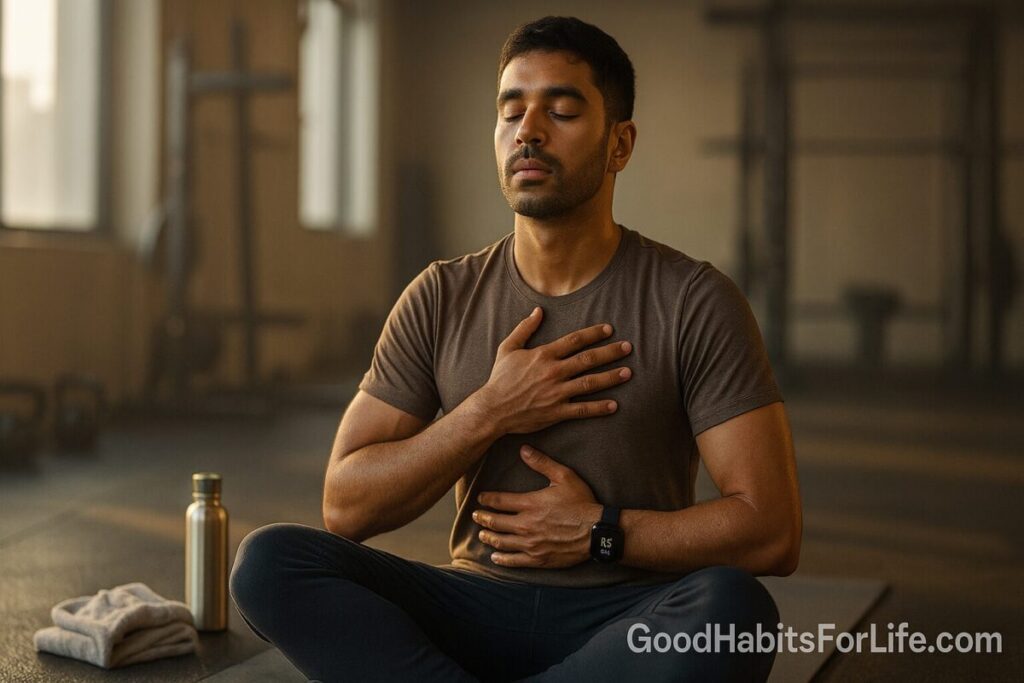
Breath to Downshift After Training
Breath to Downshift After Training: Quick Recovery Guide
Table of Contents
🧭 What “Downshifting” Is & Why It Works
Downshifting is the deliberate switch from a high-arousal, sympathetic “fight/flight” state (typical during hard training) into the parasympathetic “rest/digest” state. You feel this shift as slower heart rate, calmer breathing, warmer hands/feet, and clearer focus.
Why breathing?
-
Direct line to your nervous system. Slow, nasal, diaphragmatic breathing—especially around 5–6 breaths per minute—is repeatedly shown to increase vagal (parasympathetic) activity and raise HRV, a marker of recovery capacity. ScienceDirectFrontiers+1
-
Exhale length matters. Longer, softer exhales bias the parasympathetic branch and reduce arousal and blood pressure. PMC+1
-
Post-exercise effects. Immediately after training, 6-breaths/min pacing has been shown to accelerate parasympathetic reactivation, aiding the “calm-down” transition. PubMed
-
Global benefits. Meta-analyses link slow breathing to reductions in heart rate and blood pressure and improvements in stress and mood—useful when stacking recovery and sleep. PubMedNature
Bottom line: a few focused minutes of the right breathing after your cooldown helps your body switch gears faster and recover smarter.
✅ Quick Start: A 5–8 Minute Post-Training Protocol
Do this immediately after your last working set or final interval.
-
Ease Down (1–2 min)
-
Walk or pedal lightly; nose breathing only. Let heart rate drift down gradually. (Major orgs recommend a gentle cool-down before stretching.) www.heart.org
-
-
Guided Breathing (3–5 min)
-
Sit or stand tall, one hand on the low ribs.
-
Inhale 4 s (nose) → Exhale 6–8 s (nose), minimal effort.
-
Pace: ~6 breaths/min. Mouth stays closed; shoulders quiet; belly/ribs expand 360°. Frontiers
-
-
Finish with Stretching (1–2 min)
-
Light static stretches, 10–30 s each; breathe normally and avoid bouncing. www.heart.orgPMC
-
Time-crunched? Do 2 minutes of Step 2 (about 12 breaths). It still helps.
🛠️ 7-Day Starter Plan (and 30-60-90 Progression)
7-Day Starter (add to every workout this week)
-
Days 1–2: 3 minutes breathing at 4-in / 6-out (∼6 bpm).
-
Days 3–4: 4 minutes at 4-in / 7-out.
-
Days 5–7: 5 minutes at 4-in / 8-out if comfortable (no air hunger).
-
Optional: log RPE (0–10), HR drop in the first minute, and sleep quality that night.
30-60-90 Roadmap
-
Days 1–30: Lock the habit. 5 min post-training every session; learn the feel of low-tension belly and rib movement.
-
Days 31–60: Personalize to your resonance zone (most people near 5–6 bpm). Adjust to 3–6 min based on workout intensity and evening training. Frontiers
-
Days 61–90: Layer in HRV-biofeedback or a brief box-check (see below) on rest days; evaluate effects on sleep latency and next-day readiness. PMC
🧠 Techniques & Frameworks (With Scripts)
1) Resonance Breathing (RB) — Gold Standard for Downshifting
-
Why: Maximizes cardiorespiratory coupling and HRV at ~5–6 breaths/min. Frontiers
-
How:
-
Sit tall; inhale 4 s (nose), exhale 6 s (nose).
-
After a week, test 4.5/5/5.5/6 bpm to find the most calming pace.
-
-
Script (90 seconds): “In…2…3…4…Out…2…3…4…5…6…”
2) Exhale-Biased Paced Breathing
-
Why: Longer exhales enhance relaxation; useful after high-intensity work. PMC
-
How: In 3–4 s / Out 6–8 s. Keep it easy—no breath hunger.
3) Cyclic Sighs (1–2 minutes)
-
Why: Brief sessions improve mood and calm quickly; nice add-on after RB. ScienceDirect
-
How: Two short nasal inhales (second is a “top-off”), then one long, unforced exhale through the nose.
4) Box-Check (Very Short)
-
Why: Quick scan to confirm the downshift: breath, heart, hands, mind.
-
How: After 2–5 minutes of RB, ask: “Is my exhale soft? HR slowing? Hands warm? Head clear?” If not, do one more minute.
5) Breath + Stretch Combo
-
Why: Stretching after a cool-down supports flexibility without spiking arousal. PMC
-
How: Enter each stretch on the exhale; hold 10–30 s; no bouncing. www.heart.org
👥 Audience Variations
-
Students/Young Athletes: Keep it simple: 3 minutes RB after practice. Make it social—whole team cool-down.
-
Parents Training at Night: Prioritize exhale-biased patterns (4-in / 7–8-out) to protect sleep; dim lights, silence notifications.
-
Busy Professionals: Use RB as you walk slowly to the car or train (nasal, lips sealed).
-
Seniors: Seated RB is excellent; research shows older adults respond well to deep slow breathing with increased HF-HRV and lower anxiety. Nature
-
Teens: Keep the cueing playful: “Smell the hot chocolate (inhale), blow to cool it (long exhale).”
⚠️ Mistakes & Myths to Avoid
-
Myth: “More air = more recovery.”
Reality: Over-breathing can increase tension. Aim for quiet, low-effort breaths. -
Mistake: Skipping the gentle movement before breathing.
Fix: 1–2 minutes of easy walking or cycling first. www.heart.org -
Mistake: Forcing long breath holds.
Fix: No strain; if dizzy or uncomfortable, shorten the exhale and sit down. -
Myth: “Only one perfect rate works.”
Reality: 5–6 bpm is a useful starting zone, but individuals vary. Calibrate. Frontiers -
Mistake: Mouth breathing with shoulder lift.
Fix: Nasal, diaphragmatic breathing; feel 360° rib expansion.
💬 Real-Life Examples & Copy-Paste Scripts
After Strength Day (5 min):
“Walk 90 seconds. Sit tall. In 4 / Out 6 for 3 minutes. Finish with calf/hamstring stretch, 20 seconds each, breathing gently.”
After Intervals (6–7 min):
“Air-through-the-nose only. In 3 / Out 7 for 2 minutes, then cyclic sighs for 60–90 seconds, then In 4 / Out 6 for 2 minutes. Short quad/hip-flexor stretch.”
Evening Session (sleep-friendly, 4–6 min):
“Dim lights. Seated. In 4 / Out 8 softly for 4–6 minutes. No phone. Finish with two slow neck/shoulder stretches.”
Team Cool-Down (on the field, 3 min):
“Circle up. One hand on ribs. In 4 / Out 6—coach counts. Close with 30-second hamstring and quad stretch.”
🧰 Tools, Apps & Resources
-
Paced-breathing timers: built-in iOS/Android Health apps, Breathwrk, Othership, Insight Timer.
-
HRV biofeedback: Elite HRV, HRV4Training, Inner Balance—help you find your resonance rate; use sparingly (don’t over-optimize). PMC
-
Low-tech: A metronome at 60 bpm; inhale for 4 ticks, exhale for 6–8.
Pros/Cons (quick):
-
Apps add structure and data (pro), but can increase friction (con).
-
Biofeedback personalizes pacing (pro) but requires sensors (con).
-
A simple count works anywhere (pro).
📌 Key Takeaways
-
Always cool down briefly, then breathe: nasal, diaphragmatic, ~6 breaths/min, long, soft exhales. www.heart.orgFrontiers
-
5 minutes post-workout is enough for most people; more after very intense sessions.
-
Pair with light stretching; avoid bouncing. www.heart.org
-
Track the basics (how you feel, sleep, HR drop). Small, consistent sessions deliver outsized recovery benefits.
❓ FAQs
1) How many minutes do I need?
Most lifters and runners do well with 3–5 minutes. After very hard work, 6–8 minutes feels best.
2) Should I breathe through my mouth if I’m winded?
Start with nasal breathing as soon as feasible; it tends to calm the system faster and reduces air hunger over time.
3) What’s the ideal tempo?
Begin near 5–6 breaths/min. If you feel strain, slow your exhale gently or shorten it—never force. Frontiers
4) Can this lower my blood pressure or heart rate?
Slow breathing produces modest, significant reductions in BP and HR on average—useful across the week. PubMed
5) Is there evidence that this works right after exercise?
Yes—6-breaths/min post-exercise accelerates parasympathetic reactivation compared with usual recovery. PubMed
6) Does longer exhale really matter?
Research comparing exhale-longer-than-inhale vs balanced patterns finds greater relaxation with longer exhales. PMC
7) Should I stretch before or after breathing?
Finish intense work → gentle movement → breathing → light stretch. This order keeps arousal trending down. www.heart.org
8) What if I train late at night?
Use exhale-biased pacing (e.g., 4-in / 8-out), low lights, and avoid screens to support sleep.
9) Do I need tech?
No. A simple count or metronome works. HRV tools can personalize your resonance rate if you like data. PMC
10) Can teens and older adults do this?
Yes; both groups respond well. Older adults, in particular, show increases in HF-HRV with deep, slow breathing. Nature
📚 References
-
Sugimoto T, et al. Slow breathing at six breaths/min accelerates post-exercise parasympathetic reactivation. PubMed (2025). PubMed
-
Zaccaro A, et al. How breath-control changes physiology and psychology. Frontiers in Human Neuroscience (2018). Frontiers
-
Shaffer F, et al. Practical guide to resonance frequency assessment for HRV biofeedback. Frontiers in Neuroscience (2020). Frontiers
-
Laborde S, et al. Voluntary slow breathing increases vagal-mediated HRV: a meta-analysis. (2022). ScienceDirect
-
Birdee G, et al. Extending the exhale increases relaxation effects of slow breathing. PMC (2023). PMC
-
American Heart Association. Warm Up, Cool Down. (2024). www.heart.org
-
American College of Sports Medicine. Physical Activity Guidelines & cool-down recommendations. (accessed 2025). ACSM
-
Magnon V, et al. Deep and slow breathing boosts HF-HRV and reduces anxiety in older adults. Scientific Reports (2021). Nature
-
Chaitanya S, et al. Resonance breathing improves HRV, stress, cognition. (2022). PMC
-
VA Whole Health. Diaphragmatic Breathing (tool overview and physiology). (accessed 2025). Veterans Affairs
⚖️ Disclaimer
This article provides general fitness education. It is not a substitute for medical advice. If you have cardiovascular, respiratory, or other health conditions, consult your clinician before changing your training or breathing practices.