
7Day Itinerary Builder: See More, Rush Less: AI workflows (2025)
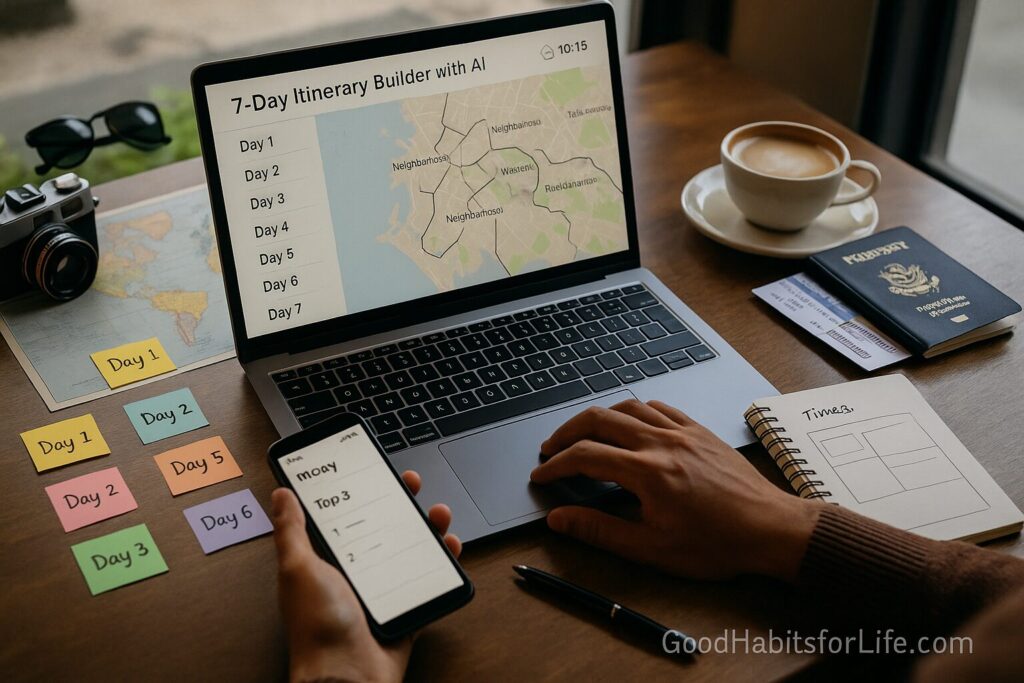
7-Day Itinerary Builder with AI: See More, Rush Less (2025)
Table of Contents
🧭 What & Why
A 7-day AI-assisted itinerary is a realistic, neighborhood-clustered plan that sequences your must-see sights, food stops, and transport with buffers for rest, weather, and serendipity. AI speeds the research and helps counter planning fallacy (we underestimate time) and decision fatigue (too many choices drain willpower) so you preserve energy for the experiences that matter. Evidence-aligned habits—like timeboxing, pacing, and jet-lag management—make the week smoother and healthier.
Benefits
-
Faster research & first draft in minutes, not hours
-
Realistic pacing aligned to opening hours and travel times
-
Lower stress via pre-decided “top 3” priorities each day
-
More recovery: strategic rest blocks reduce burnout and jet-lag impact.
✅ Quick Start: Copy-Paste AI Workflows
Use these prompt skeletons with your preferred chatbot/planner.
1) Trip brief → day themes
“You are my trip planner. City: Tokyo. Dates: 7 days in April. Travelers: 2 adults, 1 child (age 8). Interests: street food, museums, parks. Budget: mid. Fitness: moderate. Output: (a) 7 day themes, (b) 2–3 must-dos per day, (c) typical opening hours, (d) rough timeboxes incl. 25% buffer, (e) rain alternatives.”
2) Cluster by neighborhood
“Cluster these sights by neighborhood/rail line and minimize transfers. Suggest an optimal sequence for each day with walk/ride times and lunch near the midpoint.”
3) Reality check (planning fallacy guard)
“Stress-test each day. If total walking exceeds 10–12 km (6–7.5 mi) or >90 min of transit, propose trims or swaps. Keep one 90-minute rest window.”
4) Jet-lag-aware mornings
“Assume arrival from UTC+1 to UTC+9. Plan moderate mornings (outdoor light exposure, easy walks) for Days 1–2; place intensive activities on Days 3–5. Add brief notes.”
5) Safety, weather, and access
“Add notes for heat/UV precautions and hydration reminders for outdoor days; include indoor alternates if UV index is high or storms expected.”
6) Finalize & export
“Turn the plan into a checklist with start times, tickets-to-book, addresses, and a compact packing list (carry-on). Group bookings by deadline.”
🛠️ 7-Day Starter Plan (Reusable Template)
Use this scaffold and drop in your city’s specifics.
Day 1 — Arrive & Acclimatize (Light)
-
AM: Easy outdoor walk near hotel; daylight exposure; hydrate.
-
PM: Neighborhood dinner; early night. (Skip big museum queues.)
Day 2 — Old Town Core + Signature View
-
AM anchor (must-do #1); coffee & snack nearby.
-
Midday: Rest block (60–90 min) + lunch.
-
PM anchor (must-do #2) + sunset viewpoint.
Day 3 — Museums & Culture Cluster
-
Pre-book timed tickets; 2 major stops max.
-
Short park break between to prevent “museum fatigue.”
Day 4 — Parks/Outdoors + Local Food Crawl
-
Pace for terrain/heat; carry water; shade breaks.
Day 5 — Day Trip
-
Out by 08:00; back by 18:00; dinner near hotel.
-
Keep Day 6 lighter.
Day 6 — Free-form & Shopping
-
Keep morning flexible for discoveries or missed spots.
Day 7 — Wrap & Souvenirs
-
Favorite café revisit, light sightseeing, pack buffers.
Daily guardrails
-
Top 3 must-dos only.
-
Transit cap: ~90 min/day door-to-door.
-
Walking cap: 10–12 km (6–7.5 mi); adjust for group.
-
Buffers: Add 25–30% extra time to every block. (Helps beat the planning fallacy.)
🧠 Techniques & Frameworks (Research-Aligned)
Timeboxing
Assign start–end windows to activities instead of open-ended lists. Switch when the box ends; don’t “borrow” from rest.
Decision fatigue shields
Pre-decide dining candidates (3 options) near each anchor; pick the first with <15-min wait.
Energy mapping
Schedule effortful items (queues, big museums) when you’re alert; keep low-effort scenic walks for late afternoon.
Pacing for outdoors
Plan shade, water, and slower mid-day tempos; heed UV guidance on high-index days.
Jet-lag management
Seek daylight at local morning, short naps (<30 min), avoid heavy evening meals on Days 1–2.
Healthy movement
Aiming for regular light-to-moderate activity supports energy and sleep quality during travel.
🧳 Audience Variations
Families with kids
-
Cap museum time to 90 minutes; add playgrounds every afternoon.
-
Pack snacks; plan bathrooms at anchors.
Solo travelers
-
Lean into spontaneous windows; keep one “social” slot (walking tour, meetup).
Seniors / mobility concerns
-
Prefer level routes, elevator access, and frequent seated breaks; book timed entries.
Business + bleisure
-
Wrap meetings by 16:00; schedule one compact cultural block nightly.
-
Keep carry-on work kit; book hotels near transit hubs.
⚠️ Mistakes & Myths to Avoid
-
Myth: “You can ‘do’ a city in a day.” → You’ll overschedule and remember queues, not moments.
-
Mistake: Back-to-back mega-museums. Alternate heavy/light days.
-
Mistake: No buffers. Aim for 25–30% slack per block.
-
Mistake: Ignoring UV/heat. Build shade breaks and water stops.
-
Mistake: Landing day heroics. Keep Day 1 light to adapt.
🗣️ Real-Life Examples & Prompt Scripts
Neighborhood clustering (Paris)
“Cluster Louvre, Tuileries, Musée d’Orsay, Île de la Cité into a 1-day loop with ≤10 km walking and two café stops. Add timed entry suggestions and a 75-min rest window.”
Rain plan swap
“Replace outdoor Day 4 with indoor alternatives of equal interest. Keep meals similar area to retain bookings.”
Day trip sanity check (Kyoto from Osaka)
“Propose a 09:00–17:30 Kyoto loop with Fushimi Inari + Nishiki Market. Include exact train lines, travel times, and a trimmed version if crowds spike.”
Packing list generator
“Given forecast highs 28–31 °C, UV high, and two temple visits, produce a 30-item carry-on list with sun protection, modest attire, refillable bottle.”
Safety & admin add-ons
“Append country-specific safety checklist and traveler enrollment links; list any compensation/rights for delays.”
🧰 Tools, Apps & Resources (Pros/Cons)
-
AI trip planner/chatbot
-
Pros: Rapid first drafts, clustering, alternatives on demand.
-
Cons: May hallucinate opening hours—verify and bookmark official sites.
-
-
Mapping & transit apps
-
Pros: Live routing, offline maps, line closures.
-
Cons: Battery use; still build analog backups (screenshots).
-
-
Calendar/task apps
-
Pros: Timeboxing, reminders, shareable schedules.
-
Cons: Over-granularity can reduce spontaneity.
-
-
Travel health & safety portals
-
Pros: Current advisories, vaccination/med guidance.
-
Cons: Country-specific; read the official source for your route.
-
📚 Key Takeaways
-
Draft with AI, then human-proof: check hours, distances, and energy demands.
-
Anchor each day with 1–2 must-dos and a Top 3 list.
-
Cluster sights by neighborhood; cap transit and walking; add buffers.
-
Protect sleep and health: jet-lag-aware Days 1–2, hydration, UV care.
-
Keep one open block daily for surprises—you’ll remember the unscripted moments.
❓ FAQs
How much should I plan vs. leave open?
Timebox your anchors and meals; keep 2–3 hours free daily for discoveries.
What’s a good walking target per day?
Plan around 10–12 km (6–7.5 mi) total with seated breaks; adjust for your group and terrain. Use shade/water on hot days.
How do I handle jet lag on a 7-day trip?
Light outdoor exposure in local mornings, short naps, and moderate Day-1/2 schedules help you adapt faster.
Should I pre-book everything?
Pre-book only the bottlenecks (popular museums, special dining, intercity trains). Keep flexible slots for weather/energy.
How big should buffers be?
Add 25–30% extra time to each block to counter the planning fallacy and transit variability.
Any paperwork or safety admin I shouldn’t forget?
Enroll in your government’s traveler program (e.g., STEP for U.S. citizens) and check passenger rights for delays/cancellations in your region.
References
-
NHS. Jet lag. https://www.nhs.uk/conditions/jet-lag/
-
APA Dictionary of Psychology. Planning fallacy. https://dictionary.apa.org/planning-fallacy
-
APA Dictionary of Psychology. Decision fatigue. https://dictionary.apa.org/decision-fatigue
-
WHO. Guidelines on physical activity and sedentary behaviour (2020). https://www.who.int/publications/i/item/9789240015128
-
Met Office (UK). UV index guide. https://www.metoffice.gov.uk/weather/guides/uv
-
U.S. National Park Service. Hike Smart—Hiking Safety. https://www.nps.gov/subjects/trails/hikesmart.htm
-
CDC Travelers’ Health. Pack Smart. https://wwwnc.cdc.gov/travel/page/pack-smart
-
U.S. Dept. of State. Smart Traveler Enrollment Program (STEP). https://step.state.gov/
-
European Union. Air passenger rights. https://europa.eu/youreurope/citizens/travel/passenger-rights/air/index_en.htm
Disclaimer: This guide is for general trip-planning information and is not medical advice; consult a healthcare professional for personal health needs while traveling.