
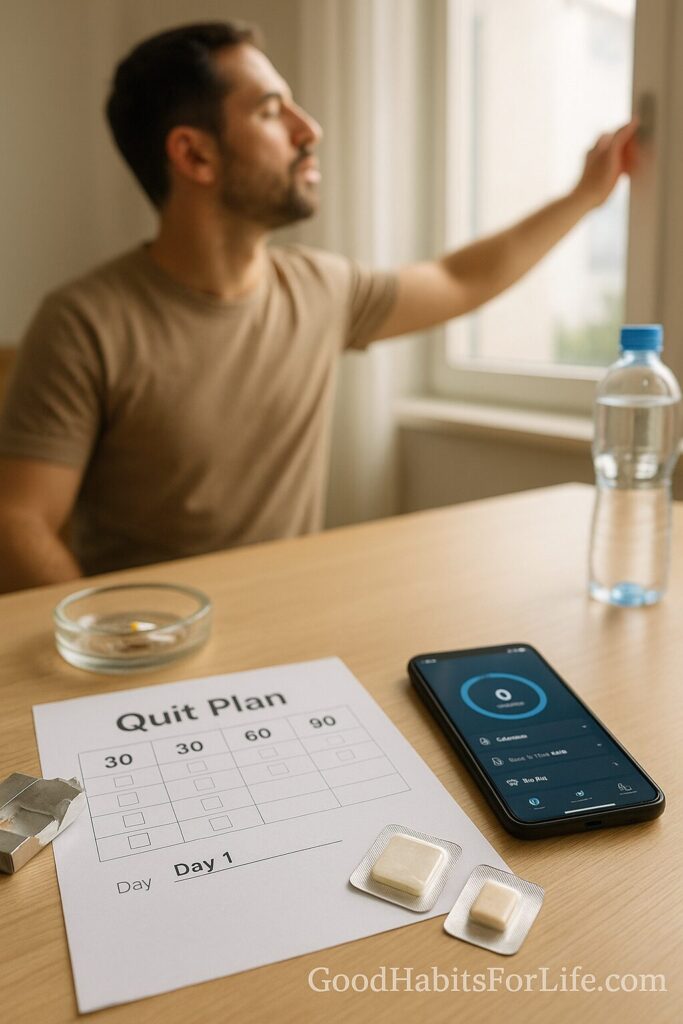
Quit Smoking in 2025: Four EvidenceBacked Paths
Quit Smoking in 2025: 4 Evidence-Backed Paths
Table of Contents
🧭 What This Guide Covers (What & Why)
Quitting smoking is one of the highest-ROI health moves you can make. Evidence shows counseling plus medication more than doubles your chances of long-term success compared with willpower alone. World Health Organization
This guide lays out four evidence-backed paths and gives you a quick start, a 30-60-90 plan, and practical tools you can apply immediately.
✅ The Four Evidence-Backed Paths
Path 1: Medicines-First (highest overall evidence)
Clinically proven options include:
-
Varenicline (tablet; start 1 week before quit day).
-
Combination NRT: a patch for steady nicotine + a fast-acting form (gum/lozenge/spray) for cravings.
-
Bupropion SR (tablet; start 1–2 weeks before quit day).
These are FDA-approved (for adults) and supported by major guidelines; combination NRT outperforms a single NRT. CDC+2CDC+2PMC
When to choose: You want the most robust evidence with clear how-to steps.
Typical usage (summary):
-
Varenicline: Titrate up; take after food with water; set a quit date in week 2. CDC
-
Combination NRT: 21/14/7 mg patch (dose by smoking level) + 2–4 mg gum/lozenge when cravings hit. PMCCochrane
-
Bupropion SR: Start 1–2 weeks pre-quit; may combine with a patch under clinician care. CDC
Pro tip: Pair any medicine with coaching/texting for the best odds. USPSTFCDC
Path 2: Behavioral Coaching & Digital Support
Work with a quitline coach, community program, or evidence-based digital program (texts/apps). Quitlines provide tailored counseling and often free NRT. CDC
Where to start (US examples):
-
1-800-QUIT-NOW (routes to your state quitline). CDC
-
SmokefreeTXT (text QUIT to 47848). smokefree.gov
-
quitSTART app for daily tips and tracking. smokefree.gov
When to choose: You prefer a human guide or your doctor suggests trying counseling first (including during pregnancy). USPSTF
Path 3: Regulated E-Cigarettes as a Cessation Aid (where permitted)
High-quality reviews conclude nicotine e-cigarettes can help more people quit than NRT when combined with behavioral support; local regulations vary. Use regulated devices and aim for complete cigarette cessation with a plan to taper nicotine. cochranelibrary.com
When to choose: Conventional meds didn’t work for you, or you strongly prefer a vaping-assisted quit while working toward nicotine freedom.
Path 4: Structured “Cold-Turkey” (med-free)
If you’re set on no medication, research suggests an abrupt quit with intensive support can outperform gradual reduction for many people. Pair it with quitline coaching, stimulus control, implementation intentions, and urge-surfing. BMJ
🛠️ Quick Start: Do This Today (15–30 minutes)
-
Pick your path above and set a quit date (within 7–14 days).
-
Tell two allies (friend + family) and ask for “no-smoke zones.”
-
Order or pick up supplies: NRT starter kit or your prescribed med; or set up regulated e-cig if choosing Path 3. CDC
-
Join support: Call 1-800-QUIT-NOW or enroll in SmokefreeTXT. CDCsmokefree.gov
-
Trigger sweep: remove lighters/ashtrays; clean car; plan smoke-free routines for coffee/after meals.
-
Craving kit: sugar-free mints, water bottle, gum/lozenges (if on NRT), 4-7-8 breathing card.
-
Write a lapse plan: “If I slip → text coach, use fast-acting NRT (if on Path 1), do 10-minute walk, reset.” Early days are the riskiest—prepare now. CDC Stacks
🗺️ Habit Plan: 30-60-90 Day Roadmap
Days 0–30 (Preparation + Quit)
-
Start medicine per label/doctor (or set up Path 3 plan). CDC+1
-
Daily: urge-surfing (2–3×), implementation intentions (“If I crave at 10:30, then I walk 5 minutes”).
-
Replace cues: coffee outdoors → coffee + 5 deep breaths; commute → playlist + gum.
-
Weekly check-ins with quitline/app goals and CO-free milestones.
Days 31–60 (Consolidation)
-
Review triggers and thin them out: alcohol, social smoking, stress routines.
-
If on NRT, taper patch dose per pack insert; keep fast-acting NRT for spikes. Cochrane
-
Introduce reward loop: small purchases or experiences for each smoke-free week.
Days 61–90 (Maintenance)
-
Continue taper/prescription plan if applicable.
-
Relapse-proofing: rehearse a plan for travel, celebrations, grief, or conflict.
-
Consider strength training or brisk walks 3×/week to blunt cravings and weight concerns (talk to your clinician if you have conditions).
-
Decide on a Nicotine-Free Date (if using Path 3).
🧠 Techniques & Frameworks That Work
-
Combination NRT protocol: steady patch + fast-acting NRT for spikes → higher quit rates than single NRT. PMC
-
Motivational interviewing self-prompts: “On a scale 1–10, why not lower?” → generate your own reasons.
-
Implementation intentions (“If-Then”): automate responses to cues (If coffee → then mint + 10 deep breaths).
-
Stimulus control: design routes and routines that don’t intersect with prior smoking cues.
-
Urge-surfing: notice → name → breathe → wait 5–10 minutes; urges peak and fall like waves.
-
Abrupt vs gradual: if you’re undecided, evidence favors abrupt on average; use it with strong support. BMJ
-
Text-based support: continuous micro-coaching boosts adherence and coping. smokefree.gov
👥 Variations by Audience
-
Pregnancy: prioritize behavioral support; talk to your clinician before using any meds. USPSTF
-
Teens/young adults: combine family/peer support, school resources, and text programs; avoid trading one nicotine source for another long-term.
-
Professionals with high stress: schedule “micro-breaks” (2-minute walk, water, 4-7-8 breathing) at usual smoke times; keep fast-acting NRT handy (Path 1). Cochrane
-
Seniors & people with conditions: quitting is beneficial at any age; coordinate meds and exercise plans with your clinician. CDC
⚠️ Mistakes & Myths to Avoid
-
Myth: “Cutting down slowly is always better.” → For many, abrupt quit with support works better; gradual can still work if it gets you to zero. BMJ
-
Mistake: Using too little NRT or not combining forms. Dose to your dependence and combine for spikes. Cochrane
-
Myth: “A single cigarette won’t matter.” → Early slips often snowball—intervene fast and reset. CDC Stacks
-
Mistake: Going it alone. Add quitline/app coaching even if you’re confident. CDC
-
Myth: “E-cigs never help people quit.” → Evidence shows nicotine e-cigs can improve quit rates vs NRT when supported; regulations and individual fit matter. cochranelibrary.com
💬 Real-Life Scripts (Copy-Paste)
-
Telling your circle:
“I’m quitting on [date]. Please don’t offer me cigarettes. If I look stressed, offer water or a 5-minute walk.” -
At a party:
“No thanks—I don’t smoke anymore. I’m on a quit plan.” (then change location or hold a drink/mint). -
At the pharmacy/GP:
“I’m quitting next week. Can we discuss varenicline or combination NRT and what dose fits my smoking pattern?” CDCPMC -
If you slip:
“That was a lapse, not a relapse. I’m calling my coach, using my plan, and I’m still a non-smoker.” CDC Stacks
🧩 Tools, Apps & Resources (quick pros/cons)
-
Quitlines (e.g., 1-800-QUIT-NOW, US): free coaching; often free NRT; scheduled callbacks (pro). Requires picking up the phone (con). CDC+1
-
SmokefreeTXT / National Texting Portal: nudges all day; great for urges (pro). Messages can feel generic to some (con). smokefree.govCDC
-
quitSTART app (NCI): progress tracking, badges (pro). Works best when you open it daily (con). smokefree.gov
-
WHO “Quit Tobacco: Be Free” app: global tool; ad-free (pro). Feature set varies by region (con). World Health Organization
🧾 Key Takeaways
-
Pick one of four proven paths; combining medication + coaching gives the best odds. World Health Organization
-
Combination NRT, varenicline, or bupropion are top options; follow dosing guidance. CDC+2CDC+2
-
If you go med-free, an abrupt quit with strong support can outperform tapering. BMJ
-
The first weeks are the riskiest—use your craving kit and lapse plan. CDC Stacks
-
Free quitlines, texts, and apps increase success and are easy to start today. CDC
❓ FAQs
1) What’s the single most effective way to quit?
A combination: approved medication plus behavioral support (quitline/app/coach). World Health Organization
2) Should I try to cut down first or quit abruptly?
Evidence favors abrupt for many people; if gradual is the only way you’ll try, pair it with support and a firm zero-smoke date. BMJ
3) Is one type of NRT enough?
Often, patch + fast-acting NRT beats one form alone. Dose to your dependence; ask a clinician or pharmacist. PMC
4) Are e-cigarettes a good quitting tool?
High-quality reviews show nicotine e-cigs can help more people quit than NRT when supported; policies differ by country—follow local guidance. cochranelibrary.com
5) I’m worried about weight gain.
Bupropion may help limit early weight gain; add simple activity (walks, strength) and protein-rich snacks. Talk to your clinician. CDC
6) What if I’m pregnant?
Use behavioral support as first-line; discuss any medication with your prenatal clinician. USPSTF
7) How long do cravings last?
Most urges peak within 5–10 minutes; frequency falls over weeks—ride them with urge-surfing and fast-acting strategies. CDC Stacks
8) Do quitlines really help?
Yes—quitlines deliver evidence-based counseling and often free NRT; they also coordinate with local services. CDC
9) Is medication safe for everyone?
Not always. Review your history and meds with a clinician or pharmacist; follow labels and local guidelines. CDC
10) What official guidelines should I follow?
USPSTF (US) and NICE (UK) both recommend behavioral support; USPSTF endorses FDA-approved meds for nonpregnant adults; NICE (NG209) covers support for those 12+. USPSTFNICE
📚 References
-
CDC. How to Quit Smoking (access to quitlines and resources). https://www.cdc.gov/tobacco/campaign/tips/quit-smoking/ CDC
-
CDC. Quit-Smoking Medicines (overview & approvals). https://www.cdc.gov/tobacco/campaign/tips/quit-smoking/quit-smoking-medications/ CDC
-
CDC. How to Use Varenicline. https://www.cdc.gov/tobacco/campaign/tips/quit-smoking/quit-smoking-medications/how-to-use-quit-smoking-medicines/how-to-use-varenicline.html CDC
-
CDC. How to Use Bupropion SR. https://www.cdc.gov/tobacco/campaign/tips/quit-smoking/quit-smoking-medications/how-to-use-quit-smoking-medicines/how-to-use-bupropion-sr.html CDC
-
Cochrane Review 2025. Electronic cigarettes for smoking cessation. https://www.cochranelibrary.com/cdsr/doi/10.1002/14651858.CD010216.pub9/full cochranelibrary.com
-
Cochrane Review 2023. Different doses, durations and modes of NRT (incl. combination NRT). https://pmc.ncbi.nlm.nih.gov/articles/PMC10278922/ PMC
-
USPSTF (2021). Tobacco Smoking Cessation in Adults, Including Pregnant Persons. https://www.uspreventiveservicestaskforce.org/uspstf/recommendation/tobacco-use-in-adults-and-pregnant-women-counseling-and-interventions USPSTF
-
NICE NG209 (reviewed Feb 2025). Tobacco: preventing uptake, promoting quitting & treating dependence. https://www.nice.org.uk/guidance/ng209 NICE
-
WHO. Quitting tobacco (global overview). https://www.who.int/activities/quitting-tobacco World Health Organization
-
CDC. Quitlines & Other Cessation Support Resources. https://www.cdc.gov/tobacco/hcp/patient-care/quitlines-and-other-resources.html CDC
-
U.S. HHS / NCI. SmokefreeTXT & quitSTART. https://smokefree.gov/tools-tips/text-programs and https://smokefree.gov/tools-tips/quitstart smokefree.gov+1
-
CDC. Surgeon General Report—Relapse Prevention (chapter excerpt). https://stacks.cdc.gov/view/cdc/177089/cdc_177089_DS1.pdf CDC Stacks
-
BMJ (2016). Abrupt quitting vs gradual reduction RCT/report. https://www.bmj.com/content/352/bmj.i1521 BMJ
-
WHO SEARO (2022). Quit Tobacco: Be Free app. https://www.who.int/southeastasia/news/detail/15-02-2022-who-launches-quit-tobacco-app World Health Organization
Disclaimer: This guide is educational and not a substitute for professional medical advice; consult your clinician for personalized recommendations.