
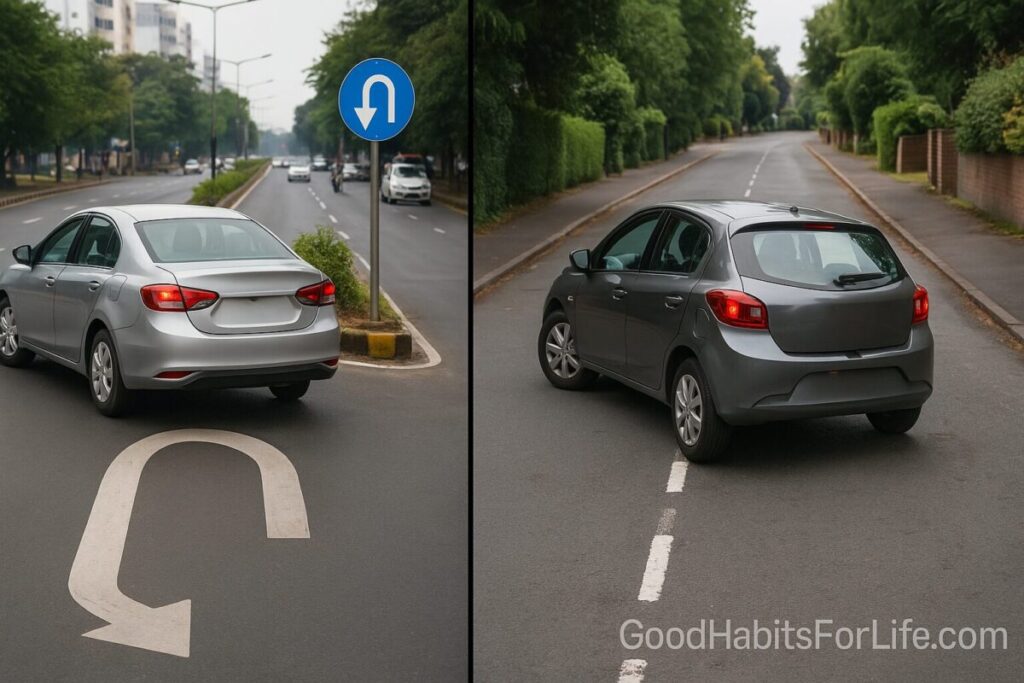
UTurns & 3Point Turns: When and How
U-Turns & 3-Point Turns: When and How (Step-by-Step)
Table of Contents
🧭 What U-Turns & 3-Point Turns Are—and Why They Matter
U-turn: turning your vehicle 180° to proceed in the opposite direction, typically at or near an intersection or a median opening.
3-point turn (“turn in the road”): using forward-reverse-forward movements to turn around on a narrow roadway where a single-sweep U-turn is impossible or unsafe.
Why they matter: Turning around is a core control skill. You’ll need it to correct missed turns, avoid long detours, navigate dead-ends, and respond to closures—without causing conflicts with other road users. Properly planned U-turns can even be safer than risky right/left turns across traffic because engineered U-turn designs reduce conflict points and severe crash types. Federal Highway Administration+1
✅ Quick-Start: Do-This-Today Checklists
U-Turn (1-minute refresher)
-
Position: Move to the correct place (left-turn lane/median opening; never from a straight-through lane). In some regions you may use the center left-turn lane for a U-turn if permitted. dmv.ca.gov
-
Scan 360°: Check mirrors, blind spots, oncoming traffic, pedestrians/cyclists, and cross-traffic.
-
Signal early: Indicate left; brake smoothly.
-
Commit when clear: Choose a gap that lets you complete the turn without forcing others to brake.
-
Steer progressively: Hand-over-hand to full lock if needed; keep speed walking-pace.
-
Finish clean: Straighten, center in the correct lane, cancel signal, mirror check.
3-Point Turn (2-minute refresher)
-
Choose location: Quiet, straight section with good sight lines; not near bends/crests or busy roads. GOV.UK
-
MSM: Mirror-Signal-Manoeuvre; pull close to the left-hand edge/kerb (or right-hand edge where appropriate).
-
Point 1 (Forward): Full-lock toward the opposite side; creep across until just before the edge.
-
Point 2 (Reverse): Select reverse; full-lock the other way; reverse to your original side without touching the kerb.
-
Point 3 (Forward): First gear/Drive; steer toward your exit; straighten and depart.
🛠️ Step-by-Step: Perfecting a Legal U-Turn
1) Set up correctly
-
Approach in the left-turn lane or designated U-turn pocket/median opening where provided. Do not use through lanes or shoulders to “spin around.” In some jurisdictions you may travel briefly in the center left-turn lane to prepare for a U-turn (e.g., California allows ≤200 ft). dmv.ca.gov
2) Read the environment
-
Signs/markings: “No U-turn” sign, double-solid medians, or arrows restricting movement → do not turn. MUTCDGOV.UK
-
Sight lines: You must see far enough to complete the turn without causing others to brake. Avoid crests, curves, rain/fog glare. GOV.UK
3) Gap acceptance
-
Choose a gap that covers your whole maneuver, not just entry. If it’s tight, wait. Rolling-stops in the median or blocking crosswalks are unsafe and may be illegal.
4) Execute smoothly
-
Signal, check mirrors/blind spots, commit at low speed with decisive steering. Keep wheels rolling to maintain control; avoid dry-steering on hot tarmac.
5) Exit and self-check
-
End up centered in the correct lane. Cancel signal; mirror scan for faster traffic behind; be ready to accelerate to the prevailing speed.
🧭 Step-by-Step: Executing a Safe 3-Point Turn
1) Pick the place
-
Quiet residential/side street. Avoid main roads; consider simply driving around the block if easier. GOV.UK
2) Prepare
-
MSM: Mirrors → signal → position near the edge. Check over shoulder for cyclists, scooters, and pedestrians.
3) The three points
-
Point 1 (Forward): Full-lock across; stop 20–45 cm (8–18 in) from the opposite kerb.
-
Point 2 (Reverse): Reverse slowly; full-lock back; stop short of the original kerb.
-
Point 3 (Forward): Drive forward into your new direction; straighten early.
4) Finishing touches
-
Keep wheels off the kerb; keep the car parallel to the lane as you finish; do a quick mirror check and accelerate smoothly.
Why 3-point, not U-turn?
-
Narrow carriageway, parked cars, or restricted turning circle make a 3-point turn the safer, cleaner solution.
⚖️ Legal Basics: Where U-Turns/3-Point Turns Are (Not) Allowed
General rule (many regions): U-turns are allowed unless specifically prohibited by sign/marking or unsafe based on conditions; if a No U-Turn (R3-4) sign is present, you must not turn. MUTCD+1
Common prohibitions:
-
At No U-turn signs, No Turns signs, or where arrows restrict movement. MUTCD
-
Across solid medians/double solids or where lane arrows mandate a turn only.
-
On bends/crests, in heavy traffic, or at signalized junctions where prohibited. GOV.UK
-
Across/into pedestrian crossings or where you would block a crosswalk.
Country examples (for orientation):
-
UK: Choose a safe place; avoid reversing into a main road; follow prohibitory signs such as “No U-turns.” GOV.UK+1
-
Australia (NSW): Specific guidance and legality for U-turns/3-point turns; ensure a clear view and do not impede others. NSW Government
-
U.S. (California example): Use center left-turn lanes correctly for turns/U-turns; follow local prohibitions and right-of-way rules. dmv.ca.gov+1
-
India: Obey “U-turn prohibited” signs per police/traffic authorities; many cities post this at major junctions. traffic.delhipolice.gov.intraffic.haryanapolice.gov.in
Tip: If you’re unsure, don’t guess—drive on and turn around legally at the next safe place.
🧠 Techniques & Frameworks (Scanning, Gap, MSM, Reference Points)
MSM + PSL
-
Mirrors, Signal, Manoeuvre + Position, Speed, Look. A reliable pre-turn ritual to reduce missed checks.
360° scan pattern
-
Rear-view → near-side mirror → far-side mirror → over-shoulder (blind spot) → ahead (oncoming/pedestrians)—repeat just before you turn.
Gap acceptance
-
For a U-turn from a standstill, you typically need a larger gap than a standard left/right turn because you must clear two lanes minimum and complete a wide arc. If you can’t complete the turn without causing others to slow measurably, wait.
Steering & reference points
-
Learn your car’s turning circle and front-corner reference. Use hand-over-hand at <10 km/h (6 mph) for smooth, controlled arcs.
Lane discipline on exit
-
Enter the closest legal lane first; change lanes later if needed. This keeps your path predictable and minimizes conflict.
Why engineered U-turns can be safer
-
Road designs such as Median U-Turn (MUT) and Restricted Crossing U-Turn (RCUT) reduce left-turn conflicts and injury crashes—use signed U-turn bays when provided. Federal Highway Administration+1
📆 Habit Plan: 7-Day Skill Builder
Goal: Consistently safe, legal, smooth U-turns and 3-point turns in varied settings.
-
Day 1: Parking-lot drills: slow full-lock circles; learn your steering rate.
-
Day 2: Empty street U-turns using a wide mouth (driveway or junction) with an observer.
-
Day 3: Add traffic: low-volume residential intersection; practice gap judgments.
-
Day 4: 3-point turns on two different gradients (flat, slight incline).
-
Day 5: Night-time conditions: adjust speed and scanning for reduced visibility.
-
Day 6: Wet conditions: longer gaps; smoother inputs to avoid wheelspin.
-
Day 7: Review + self-test: 5 flawless U-turns and 3 flawless 3-point turns in mixed scenarios; record with a dashcam for feedback.
👥 Audience Variations
Students & new drivers: Drill MSM/PSL aloud; use cones to mark kerb distances; practice with an instructor on progressively busier roads.
Parents/coaches of teens: Pre-plan routes with safe practice spots; use in-car feedback (dashcam or telematics) to review turning decisions. NHTSA
Professionals (delivery/ride-hail): Favor signed U-turn bays or loop the block; avoid mid-block improvisation to save seconds but risk citations.
Seniors: Choose broad turning areas; consider vehicles with 360° cameras and parking sensors to aid situational awareness.
Teens: No passengers or music during early practice; keep speeds walking-pace during maneuvers; master “if in doubt, don’t.” NHTSA+1
⚠️ Mistakes & Myths to Avoid
-
Myth: “If there’s no sign, it’s always fine.” → Not if sight lines are short or you’d impede traffic; “safe and legal” are both required. GOV.UK
-
Mistake: Turning from the wrong lane/shoulder. Use the designated left-turn/U-turn facility where provided. dmv.ca.gov
-
Mistake: Cutting across a crosswalk while pedestrians are present. Yield first—always. dmv.ca.gov
-
Myth: Dry-steering is harmless. → It strains tires/steering; creep while you steer.
-
Mistake: Over-swinging in Point 1 of a 3-point turn and bumping the kerb; stop early and reverse under control.
🗣️ Real-Life Examples & Scripts
Script: U-turn at a median opening (with observer):
“Signal on. Mirrors clear. Over-shoulder clear. Oncoming gap 6–7 seconds. Pedestrians clear. Committing… rolling… full-lock… straightening… centered, cancel signal.”
Script: 3-point turn on a quiet street:
“MSM. Pull to kerb—stop. Signal. Mirror and over-shoulder—clear. Full-lock across to opposite side—stop short of kerb. Reverse—full-lock back—stop. First gear/Drive—signal if needed—pull away clean.”
Decision aid (ask yourself):
-
Can I finish without forcing anyone to brake?
-
Can I see far enough in both directions?
-
Am I allowed here (signs/markings)? If any answer is “no,” don’t turn.
🧰 Tools, Apps & Resources
-
Cones/soft markers: Build kerb-distance judgment safely.
-
Dashcam/telematics: Review turning decisions; many apps offer scoring/alerts (privacy-aware). NHTSA
-
Navigation apps: Prefer routes with legal U-turn bays; avoid mid-block turns during peak.
-
Vehicle aids: 360° cameras, rear cross-traffic alert, and parking sensors reduce low-speed risk (still scan manually).
📌 Key Takeaways
-
Read the signs/markings first; if prohibited or visibility is poor, don’t turn. MUTCDGOV.UK
-
For U-turns, position-scan-signal-commit; for 3-point turns, MSM and control each point. NSW Government
-
Prefer engineered U-turn bays/median openings when available. They’re designed to reduce conflict. Federal Highway Administration
-
If in doubt, drive on and turn around later in a safer place. GOV.UK
❓ FAQs
1) Are U-turns generally legal?
Often yes—unless a sign/marking prohibits them or conditions make them unsafe. Local laws vary; always obey “No U-turn” signs and lane arrows. MUTCD+1
2) Can I make a U-turn from a center left-turn lane?
In some places (e.g., California) you may use it to prepare for a left turn or U-turn—within strict distance limits—if not otherwise prohibited. dmv.ca.gov
3) Is a 3-point turn allowed on a main road?
Usually discouraged. Choose a quiet side road with good visibility; avoid reversing into a main road. GOV.UK
4) What’s a safe minimum gap for a U-turn?
There’s no universal number; choose a gap that lets you complete the maneuver without making others brake. Bigger/wider roads demand longer gaps.
5) Can I U-turn at traffic lights?
Only if signs/markings or signals explicitly allow it. Otherwise assume no. Check your local rules.
6) Do medians with U-turn bays mean it’s always safe?
They’re safer by design but still require scanning, signaling, and right-of-way discipline. Federal Highway Administration
7) What if there’s a “No U-turn” sign but I missed my street?
Continue straight, take the next legal left, and loop the block rather than making an illegal turn.
8) Are U-turns allowed in India/UK/Australia?
Yes, in contexts where not prohibited and when safe—watch for No U-turn signs (India/UK) and follow state rules such as NSW’s guidance. GOV.UKtraffic.delhipolice.gov.inNSW Government
9) Do I need to indicate during a 3-point turn?
Yes—signal as you move across the road and again if you re-enter traffic, while continuously checking mirrors and blind spots.
10) Should I ever choose not to turn around?
If visibility is limited, traffic is heavy, or you’re unsure about legality, don’t turn. Drive on to a safer, legal option. GOV.UK
📚 References
-
California DMV — Driver Handbook: Navigating the Roads (center left-turn lanes & U-turn use). https://www.dmv.ca.gov/portal/handbook/california-driver-handbook/navigating-the-roads/ dmv.ca.gov
-
California DMV — Laws and Rules of the Road. https://www.dmv.ca.gov/portal/handbook/california-driver-handbook/laws-and-rules-of-the-road/ dmv.ca.gov
-
UK Highway Code — Using the road (Rules 159–203): safe places to manoeuvre/turn around. https://www.gov.uk/guidance/the-highway-code/using-the-road-159-to-203 GOV.UK
-
UK Highway Code — Traffic signs (including No U-turns). https://www.gov.uk/guidance/the-highway-code/traffic-signs GOV.UK
-
Transport for NSW — U-turns and three-point turns. https://www.nsw.gov.au/driving-boating-and-transport/roads-safety-and-rules/stopping-giving-way-turning/u-turns-three-point-turns NSW Government
-
FHWA — Synthesis of the Median U-Turn Intersection Treatment: Safety and Operational Benefits. https://www.fhwa.dot.gov/publications/research/safety/07033/ Federal Highway Administration
-
FHWA — Restricted Crossing U-Turn (RCUT) Intersection. https://www.fhwa.dot.gov/publications/research/safety/09059/ Federal Highway Administration
-
FHWA MUTCD — Chapter 2B: Regulatory Signs (No U-Turn R3-4). https://mutcd.fhwa.dot.gov/htm/2009/part2/part2b.htm MUTCD
-
FHWA — Interpretation Letter 2-670(I): Mandatory Left-Turn Lanes and U-turns. https://mutcd.fhwa.dot.gov/resources/interpretations/2_670.htm MUTCD
-
Delhi Traffic Police — New Road Signs (includes Right Turn & U-Turn Prohibited). https://traffic.delhipolice.gov.in/sites/default/files/uploads/2021/LITERATURE/NEW-ROAD-SIGNS.pdf traffic.delhipolice.gov.in