
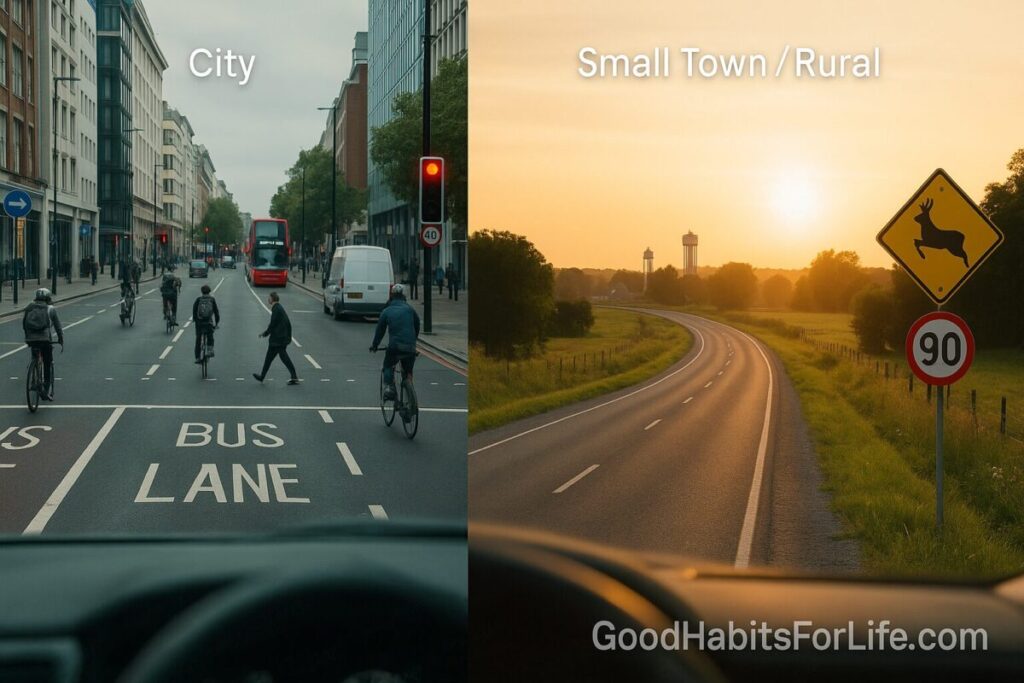
City vs SmallTown Learning: Adjust Your Practice
City vs SmallTown Learning: Adjust Your Practice
Table of Contents
🧭 What’s Different About City vs Small-Town Driving
Why it matters: Crash patterns and road design vary by environment. Urban areas pack in intersections, vulnerable road users, and complex signage; rural/small-town roads often involve higher speeds, mixed surfaces, and longer emergency response times. Evidence from global and national safety bodies shows urban roads carry more conflict points, while rural roads see higher-severity outcomes due to speed and geometry. This aligns with findings from WHO, NHTSA, and FHWA on urban/rural risk patterns.
Side-by-Side Snapshot
| Factor | City Driving | Small-Town / Rural Driving |
|---|---|---|
| Typical speed | Lower (30–60 km/h; 20–40 mph) but with frequent stops | Higher (80–100 km/h; 50–62 mph), fewer stops |
| Main hazards | Intersections, buses, taxis, ride-shares, cyclists, scooters, jaywalking, complex signage | Curves, limited shoulders, wildlife/livestock, gravel/uneven surfaces, narrow bridges, limited lighting |
| Skills emphasized | Lane discipline, mirror timing, gap selection, pedestrian priority, roundabouts, bus lanes | Speed management, cornering lines, safe overtaking, long-range scanning, hazard anticipation at crests |
| Vehicle control | Smooth clutch/creep, stop-and-go, hill starts, parallel/garage parking | Stability at speed, engine braking, emergency stops from 90–100 km/h (55–62 mph) |
| Navigation load | High wayfinding load, signage density, one-way systems | Fewer signs; rely on landmarks and advance planning for distances/fuel |
| Fatigue type | Cognitive overload from constant decision-making | Monotony fatigue; micro-sleep risk; night-glare |
Takeaway: Your practice plan should fit the environment you’ll drive most in the next 3–6 months (work/school/errands), then cross-train for the other setting so you’re not surprised when you travel.
🛠️ Quick Start: Adjust Your Next Week of Practice
Below are one-week drills you can start today. Each session: warm-up checks (mirrors, seating, steering hand position), then a focus skill, then a 5-minute debrief.
If you’re learning in the city
Goal: master intersections, low-speed control, and lane discipline.
-
Day 1 – Mirror Timing Loop (45–60 min): Drive a simple rectangular loop. Every 8–10 seconds: rear-view → left mirror → right mirror, narrating what you see. Add two lane changes using mirror-signal-manoeuvre (MSM).
-
Day 2 – Intersections & Pedestrians: Practice protected and unprotected turns. Count one-two after the light turns green to check cross-traffic red-light runners. Yield to pedestrians and cyclists; rehearse shoulder checks.
-
Day 3 – Low-Speed Control: Tight streets and parking. Creep control, clutch bite (manual), reverse in a straight line, parallel park between cones/cars.
-
Day 4 – Bus & Cycle Lanes: Read road markings; rehearse merges around stopped buses, checking for cyclists before moving off.
-
Day 5 – Roundabouts & Mini-roundabouts: Lane choice on approach, early signaling, maintaining gap discipline.
-
Day 6 – Night City Drive: Glare management, wet roads, reflective signage, pedestrians in dark clothing.
-
Day 7 – Review Route with Supervisor: Attempt a new mixed route. Debrief: 3 wins, 2 improvements, 1 rule to revisit in the driver handbook.
If you’re learning in a small town / rural area
Goal: speed control, cornering, and hazard anticipation.
-
Day 1 – Long-Range Scanning (60 min): Eyes to the horizon; identify crests, curves, farm exits. Call out hazards 10–12 seconds ahead.
-
Day 2 – Speed Management & Following Distance: Maintain 3-second gap at 90 km/h (55 mph). Extend to 4+ seconds in rain or at night.
-
Day 3 – Cornering Basics: Approach-brake-turn-accelerate. Enter at a speed that lets you exit without drifting wide. Practice on signed curves with clear visibility.
-
Day 4 – Overtaking Protocol: Only where legal and with clear sight distance. Use a decision checklist: Can I see? Can I be seen? Can I finish before the hazard? Abort early if any “no.”
-
Day 5 – Surface Changes: Gravel patches, potholes, roadworks. Smooth steering, no sudden braking on loose surfaces.
-
Day 6 – Wildlife & Low Light: Dusk run; adjust speed; scan fence lines/shoulders; high-beam etiquette and quick dip for oncoming traffic.
-
Day 7 – Emergency Stop from 90 km/h (55 mph): Safe empty road. Progressive, firm braking; keep steering straight; ABS feel (pulsing is normal).
📅 30-60-90 Day Habit Plan for New Drivers
Principle: track reps by scenario (intersections, merges, emergency stops) and kilometres—not just hours. Aim for 120–160 km/week (75–100 miles), split across variety.
Days 1–30 — Foundation (Control & Awareness)
-
300–500 km total (185–310 miles) across daylight, dry conditions.
-
City focus: 50+ intersections, 20 lane changes, 10 parking reps (parallel + bay).
-
Small-town focus: 10 signed curves at various speeds, 5 safe overtakes (or simulated), 3 emergency stops.
-
Checkpoints: no curb strikes; clean mirror/shoulder checks; smooth stop-and-go; consistent 3-second following gap.
Days 31–60 — Complexity (Traffic, Weather, Night)
-
Another 400–600 km (250–375 miles).
-
Add night, rain, and peak-hour sessions (at least 6 mixed sessions).
-
City: bus lanes, multi-lane roundabouts, complex signage wayfinding.
-
Small-town: narrow bridges, single-lane roadworks with flaggers, gravel transitions.
-
Checkpoints: zero “surprise braking” events per session; safe gap selection at 90% of turns.
Days 61–90 — Mastery (Highways & Cross-Training)
-
Final 400–600 km.
-
Highway entries/exits; merge at traffic speed; plan two-exit-ahead.
-
Cross-train: if you’re a city learner, spend 4 sessions on rural roads; if rural, spend 4 sessions in urban cores.
-
Mock test (route + manoeuvres).
-
Checkpoints: confident commentary driving for 10 minutes; stable speed control; proactive hazard calls.
Progress metric template (copy-paste):
Kilometres this week: ____
Sessions: ____ (city __ / rural __ / night __ / rain __)
Intersections cleared: ____ | Lane changes: ____ | Parking reps: ____
Emergency stops: ____ | Overtakes (legal/safe): ____
Self-rating (1–5): ____ | 2 improvements for next week: 1) ____ 2) ____
🧠 Techniques & Frameworks That Build Skill Fast
-
SEE / SIPDE (Search–Evaluate–Execute / Scan–Identify–Predict–Decide–Execute): Keep your eyes moving every 2–3 seconds; predict what could happen; decide early; execute smoothly.
-
Commentary Driving: Narrate hazards and decisions out loud (“Bus ahead signaling; I’ll hold lane; slowing to create a gap”). Builds situational awareness and reduces panic.
-
Space Cushioning: Maintain 3 seconds in clear conditions; extend for rain, night, or gravel. Lateral cushioning from cyclists: 1.5 m (5 ft) where required; check local law.
-
Eye-Lead & Peripheral Sweep: Look where you want to go; scan side roads, mirrors, and instruments in a predictable loop.
-
Threshold Braking & ABS Feel: Practice firm, progressive braking without lock-up; understand ABS pulse under foot.
-
Lane Discipline & Markings: In cities, treat lane lines as contracts. In small towns, anticipate faded markings and informal edge lines—slow accordingly.
-
Speed-to-Visibility Match: If you can’t stop in the distance you can see, you’re too fast (especially at night or on crests).
👥 Audience Variations
-
Teens / First-time Drivers: Shorter sessions (30–45 min) but more frequent. Use a written pre-drive checklist and set one focus per session. Avoid peer passengers in early months.
-
Adult Learners / Professionals: Leverage commute routes for repetitions; schedule one “skills only” session weekly (parking, emergency stop, hazard-perception).
-
Seniors Starting Again: Prioritize daytime sessions first; add night gradually. Consider glare-reducing strategies and an optometrist check if night vision feels strained.
⚠️ Mistakes & Myths to Avoid
-
Myth: “Highways are the scariest; I’ll put them off.”
Reality: Freeways have fewer conflict points than busy urban arterials. Get coached early on merges and speed matching. -
Mistake: Treating rural roads like empty racetracks.
Fix: Expect hidden driveways, farm vehicles, wildlife. Manage speed to sight lines. -
Myth: “I’ll learn parking at the end.”
Reality: Parking teaches low-speed control and vision—start in Week 1. -
Mistake: Watching only the vehicle ahead.
Fix: Look 10–12 seconds ahead; use mirrors every 8–10 seconds; scan crosswalks and side roads. -
Myth: “If it’s raining, just drive normally but slower.”
Reality: Extend following gaps, smooth inputs, and anticipate longer stopping distances.
🗣️ Real-Life Examples & Scripts
-
Asking a supervisor for specific practice
“Could we do three loops that include a protected left, an unprotected left, and a bus lane merge? I want to drill mirror-signal-manoeuvre timing.” -
Declining an unsafe overtake
“I can’t confirm sight distance or oncoming speed. I’m holding position and reassessing after this crest.” -
Urban merge script
“Signal on. Mirror, shoulder check. Matching speed with target lane—enter after the taxi passes, then keep a 3-second gap.” -
Wildlife at dusk
“Animal near the fence line—easing to 70 km/h and covering brake. High beam off for oncoming, then back on.”
🧰 Tools, Apps & Resources (Pros/Cons)
-
Official Driver Handbook / Highway Code
Pro: Authoritative, test-aligned. Con: Dense—schedule weekly reviews. -
Navigation apps (Google Maps, Apple Maps, Waze):
Pro: Lane guidance, live traffic. Con: Can overload attention—co-pilot should handle settings. -
Dashcam:
Pro: Post-drive review, learning from mistakes. Con: Don’t fixate on the screen while driving. -
Hazard-Perception Practice (licensed regional apps/tests):
Pro: Trains scanning and prediction. Con: Simulations vary in quality. -
Defensive-Driving Courses (in-person/online):
Pro: Structured drills; insurance discounts in some regions. Con: Costs vary.
📌 Key Takeaways
-
Train for context: Cities demand low-speed precision and high awareness; small towns demand speed management and long-range scanning.
-
Build via reps: Track kilometres and scenarios; mix day/night and weather.
-
Use frameworks: SEE/SIPDE, commentary driving, and space-cushion rules reduce surprises.
-
Cross-train: Even if you’ll mostly drive in one setting, practice the other to avoid being caught out on trips.
-
Stay evidence-based: High speeds and limited visibility drive severity; intersections and vulnerable road users drive urban conflicts.
❓FAQs
1) Which is harder: learning in the city or in a small town?
Neither is universally harder—they’re different. Cities overload you with decisions at low speed; rural roads test speed judgment and anticipation.
2) How many hours or kilometres should I log before a test?
Targets vary by region. As a rule of thumb, aim for 1,200–1,800 km (750–1,100 miles) across varied conditions with specific scenario targets (intersections, night, rain).
3) How do I practice safe overtaking on two-lane roads?
Start with simulations: plan the decision without crossing the line. When legal and supervised, use the three-question check (see/seen/finish), and abort early if unsure.
4) What’s the best following distance for new drivers?
Maintain 3 seconds in clear conditions; extend to 4–5 seconds in rain, at night, or on gravel.
5) Any tips for handling cyclists and scooters in cities?
Use 1.5 m (5 ft) of passing clearance where required, shoulder-check before moving off, and watch for “dooring” in parked-car zones.
6) Is highway driving good practice for beginners?
Yes—with coaching. Highways have fewer intersections; the key is merge speed matching, mirror use, and lane discipline.
7) I keep stalling on hill starts in the city. What should I do?
Practice clutch bite/creep in an empty lot, then add hill-hold drills on a quiet incline before trying busy streets.
8) How can I reduce night-driving stress in small towns?
Slow to your headlight distance, keep a clean windshield, use high beams when legal, and scan shoulders for animals.
📚 References
-
World Health Organization. Global status report on road safety 2023. https://www.who.int/publications/i/item/9789240077611
-
National Highway Traffic Safety Administration (NHTSA). Traffic Safety Facts: Rural/Urban comparisons. https://www.nhtsa.gov/research-data
-
Federal Highway Administration (FHWA). Intersection Safety. https://highways.dot.gov/safety/intersection-safety
-
Insurance Institute for Highway Safety (IIHS). Teenagers — Crash risk and graduated licensing. https://www.iihs.org/topics/teenagers
-
Centers for Disease Control and Prevention (CDC). Teen Drivers: Get the Facts. https://www.cdc.gov/transportationsafety/teen_drivers/
-
National Safety Council (NSC). Defensive Driving. https://www.nsc.org/road/safety-topics/defensive-driving
-
OECD/ITF. Speed and Crash Risk. https://www.itf-oecd.org/speed-crash-risk
-
GOV.UK. The Highway Code. https://www.gov.uk/guidance/the-highway-code
-
Transport for London. Driving in London (guidance and restrictions). https://tfl.gov.uk/modes/driving/
-
AAA Foundation for Traffic Safety. Understanding Young Driver Risks. https://aaafoundation.org
No medical, fitness, finance, or legal advice is provided in this article.