
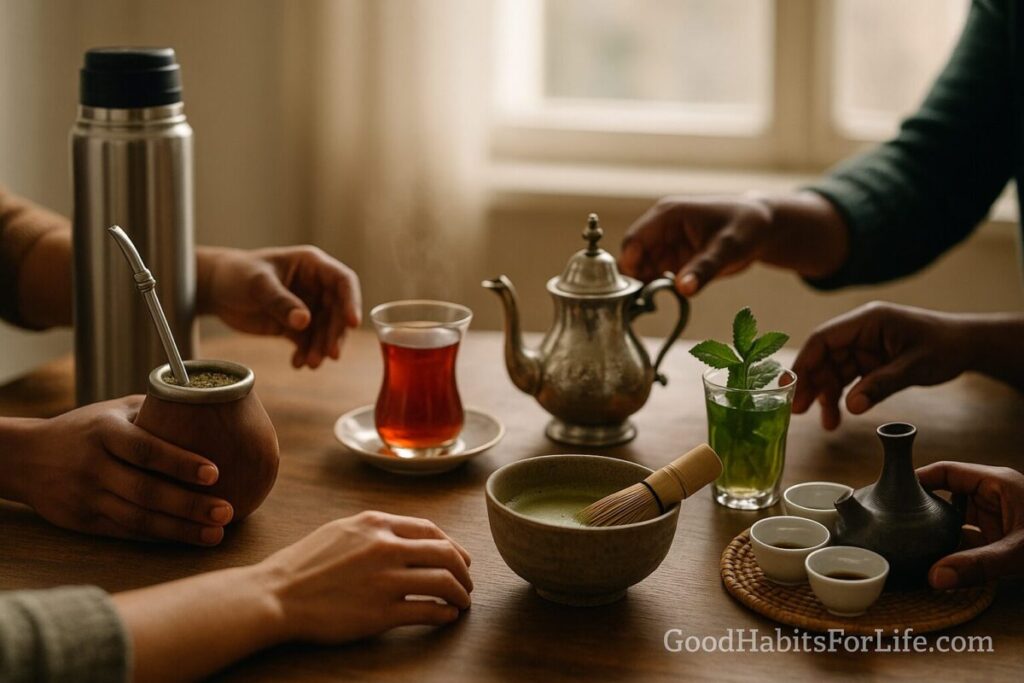
Yerba Maté & Friends: Social Sips from Around the World
Yerba Maté & Friends: Social Sips from Around the World
Table of Contents
🧭 What & Why
What: “Social sips” are intentional, often ceremonial, non-alcoholic drinks shared in company. Examples include yerba maté (Argentina/Uruguay/Paraguay), tereré (cold maté in Paraguay), Turkish çay, Moroccan mint tea, Japanese matcha tea ceremony, and the Ethiopian coffee ceremony. Each tradition blends taste, tempo, and togetherness. Britannica and cultural organizations document these practices and their social roles. Encyclopedia Britannica+2Encyclopedia Britannica+2
Why it’s a powerful habit:
-
Connection: Ritual structure lowers social friction (“we meet, we brew, we share”).
-
Mindful tempo: Step-by-step preparation builds presence and calm.
-
Wellbeing: Moderate caffeine can improve alertness and exercise performance; excessive heat or intake has risks (details below). Office of Dietary SupplementsEFSA JournalIARC
✅ Quick Start: Do This Today
-
Pick a tradition you’re curious about (e.g., maté or mint tea).
-
Invite 1–3 people with a simple line: “Tea at mine Friday? 30 minutes, phones down.”
-
Lay out a tiny “ritual kit” (kettle, teapot/gourd, small glasses/cups, tray).
-
Set a gentle timer (25–30 min) and a topic card (gratitude, weekend plan).
-
Safety basics: Let scalding drinks cool (<65 °C/149 °F). Keep total caffeine within your personal limits (see guidance). IARCEFSA Journal
🧠 7-Day “Social Sips” Starter Plan
Goal: Build a lightweight weekly ritual that strengthens relationships without depending on alcohol or screens.
Day 1 — Choose & Prep (15 min):
Pick one tradition (maté, çay, mint tea, matcha, or Ethiopian coffee). Gather minimal gear.
Day 2 — Solo Rehearsal (20 min):
Practice brew steps; note taste vs. steep time.
Day 3 — Invite (5 min):
Send a one-line invite for a 30–45 min session.
Day 4 — First Session (30–45 min):
Use “two-question” format: What was a win this week? Where do you want support?
Day 5 — Reflect (10 min):
Log energy, sleep, and social vibe. Reduce or swap to low-caffeine if jittery.
Day 6 — Explore a Variant (20 min):
Try tereré (cold maté) or lighten sugar in mint tea. Encyclopedia Britannica
Day 7 — Share & Schedule (10 min):
Pick next week’s tradition. Keep it recurring.
🛠️ Techniques & Frameworks
1) Ritual-Cue-Reward (Habit Loop)
-
Cue: Tray + kettle at the same time of day.
-
Routine: 5–8 brew steps.
-
Reward: 15 device-light minutes + a set closing toast.
2) 3-Part Conversation Arc
-
Warm-up (5 min): One word to describe your week.
-
Depth (15 min): One prompt (below).
-
Close (5 min): One tiny action before next meetup.
3) “Rotate the World” Calendar (monthly)
Week 1: Yerba maté (gourd & bombilla). Week 2: Turkish çay (tulip glass). Week 3: Moroccan mint tea (sweet & fragrant). Week 4: Matcha (whisked). Week 5 (if any): Ethiopian coffee (slow & communal). Cultural notes below. Encyclopedia Britannica+1
4) Caffeine-Smart Levers
-
Dose: Many authorities consider up to ~400 mg/day safe for most adults; start lower and track your response. Pregnant individuals: typically ≤200 mg/day—ask your clinician. EFSA Journal
-
Timing: Avoid caffeine in the late afternoon/evening to protect sleep.
-
Heat: Avoid sipping very hot beverages; let them cool below 65 °C/149 °F. IARC
🧩 Variations by Audience
Students: 25-minute “focus tea” (brew + quiet co-study + 5-min share).
Professionals: Friday 15:00 “stand-down sip” to decompress and plan next week.
Parents: Weekend family “mint tea circle” with device basket + kid-friendly prompts.
Seniors: Low-caffeine or herbal options; slower pacing and lighter cups.
Teens: Decaf/low-caffeine (e.g., mint, barley tea) and short topics.
📚 Drinks at a Glance
| Tradition | Core Ingredients | Typical Flow & Social Notes | Caffeine* | Taste Notes |
|---|---|---|---|---|
| Yerba maté (hot) | Dried leaves of Ilex paraguariensis; gourd + bombilla | One “cebador” serves; shared gourd in some settings | Medium (varies by brand/brew) | Herbal, grassy, slightly bitter Encyclopedia Britannica |
| Tereré (cold maté) | Maté + ice water; often herbs (“pohã ñana”) | Hot-climate, outdoor sharing; Paraguay’s national drink | Lower-to-medium (cold extraction) | Crisp, cooling, herbal Encyclopedia Britannica |
| Turkish çay | Strong black tea; double-kettle; tulip glasses | All-day hospitality; small, frequent pours | Medium | Bright, tannic, often lightly sweet |
| Moroccan mint tea | Gunpowder green tea + fresh mint + sugar | Theatrical, high pour; sweet; guest hospitality | Low-to-medium | Fresh mint, sweet, aromatic |
| Japanese matcha | Powdered green tea whisked with hot water | Formal aesthetics; host-guest roles | Medium | Umami, creamy, mildly astringent Encyclopedia Britannica |
| Ethiopian coffee ceremony | Green coffee beans roasted, ground, brewed in jebena | Multi-round serving; incense; shared time | Medium-to-high | Rich, aromatic; unhurried sharing Encyclopedia Britannica |
*Caffeine varies widely by leaf/bean, grind, dose, temperature, and steep time; manage your total daily intake accordingly. EFSA Journal
⚠️ Etiquette, Safety & Myths
Etiquette quick hits
-
Maté: Don’t stir the bombilla; return the gourd to the server after your sip. Encyclopedia Britannica
-
Matcha: The host sets tempo; cups turned slightly at the end. Encyclopedia Britannica
-
Ethiopian coffee: Three rounds are customary; accept at least the first if you can. Encyclopedia Britannica
Safety
-
Heat hazard: IARC classifies very hot drinks (typically >65 °C/149 °F) as “probably carcinogenic” to the esophagus—let them cool before sipping. IARC
-
Caffeine limits: For most adults, up to ~400 mg/day is considered safe; sensitivity varies. Consider less if pregnant/breastfeeding; ask your clinician. EFSA Journal
-
Hygiene: If anyone is unwell, avoid sharing cups/utensils; basic public-health hygiene applies. archive.cdc.gov
Myths to drop
-
“Caffeine always dehydrates you.” At usual doses, caffeinated beverages contribute to daily fluids; watch individual response rather than blanket rules. (Manage dose/timing.) EFSA Journal
🗣️ Real-Life Scripts (copy-paste)
Invite:
“Tea at mine Thursday, 7:30–8:10 pm? We’ll brew Moroccan mint tea and swap one highlight + one tiny goal.”
Opening toast:
“Thanks for coming—let’s be present for the next 30 minutes. One word to describe your week?”
Boundary (if you’re limiting caffeine):
“I’m keeping under 300 mg today, so I’ll take a half-strength pour—thank you!”
Closing:
“One thing I’m taking from today is ___. Same time next week—Turkish çay rotation?”
🔧 Tools, Apps & Resources
-
Kettle/thermometer (aim below 65 °C/149 °F before sipping hot drinks). IARC
-
Timers (any phone timer or minimalist pomodoro app).
-
Brewing gear:
-
Maté gourd + bombilla (stainless)
-
Çaydanlık (double-kettle)
-
Moroccan teapot + mint bundle
-
Matcha bowl + whisk (chasen)
-
Jebena (for Ethiopian coffee)
-
-
Tracking: Simple log (paper/Notes) for caffeine, sleep, mood.
-
Community: Host a monthly “World Sips Night” with rotating traditions.
🧾 Key Takeaways
-
Rituals create connection. Brewing together = built-in cue for meaningful conversation.
-
Respect culture & limits. Learn small etiquette points; keep caffeine/temperature in safe ranges. EFSA JournalIARC
-
Make it repeatable. One slot/week, 30–45 min, phones down, rotating traditions.
❓ FAQs
1) Is yerba maté “healthier” than coffee?
Different plants, similar stimulant (caffeine). Benefits depend on overall diet, dose, timing, and preparation—no beverage is universally “best.” Mind the heat and total caffeine. EFSA JournalIARC
2) What’s the difference between maté and tereré?
Same plant; tereré is cold-infused and often mixed with herbs—great for hot climates and typically gentler extraction. Encyclopedia Britannica
3) How much caffeine is in a cup?
It varies widely by product and brew. As a daily total, many authorities consider ≤400 mg safe for most adults (less if pregnant/breastfeeding). EFSA Journal
4) Why do some traditions use tiny cups?
Small pours encourage pace and presence—and in çay/matcha ceremonies they help manage strength and temperature. Encyclopedia Britannica
5) Is sharing a gourd safe?
If anyone is sick (or you’re uncomfortable), switch to individual cups; follow basic public-health hygiene and skip sharing. archive.cdc.gov
6) What makes the Ethiopian coffee ceremony special?
Roasting, grinding, and brewing in a jebena plus three rounds of serving—designed for conversation and community. Encyclopedia Britannica
7) Does letting tea cool reduce risk?
Yes—very hot (>65 °C) beverages carry a higher esophageal injury risk; let drinks cool before sipping. IARC
📚 References
-
IARC/WHO. Drinking very hot beverages and cancer risk (press release & overview). IARC
-
Loomis D. et al. Carcinogenicity of drinking coffee, maté, and very hot beverages (Lancet Oncology). The Lancet
-
EFSA. Scientific Opinion on the safety of caffeine (400 mg/day guidance for most adults). EFSA Journal
-
NIH ODS. Dietary Supplements for Exercise & Athletic Performance (caffeine as an ergogenic aid). Office of Dietary Supplements
-
Britannica. Mate (beverage): description, history & preparation. Encyclopedia Britannica
-
Britannica. Tea ceremony (Japan): description & history. Encyclopedia Britannica
-
Britannica. Tereré (beverage) — Paraguay social customs. Encyclopedia Britannica
-
Britannica. History of coffee (social and cultural context). Encyclopedia Britannica
-
CDC (archived). Isolation & precautions: don’t share cups/utensils when sick. archive.cdc.gov
⚖️ Disclaimer
This article provides general information and is not a substitute for medical advice. If you’re pregnant, have health conditions, or take medications, consult your clinician about caffeine and herbal ingredients.