
Wind & Crosswinds: Steering, Speed, Spacing
Wind & Crosswinds: Steering, Speed, Spacing
Table of Contents
🧭 What Are Crosswinds & Why They Matter
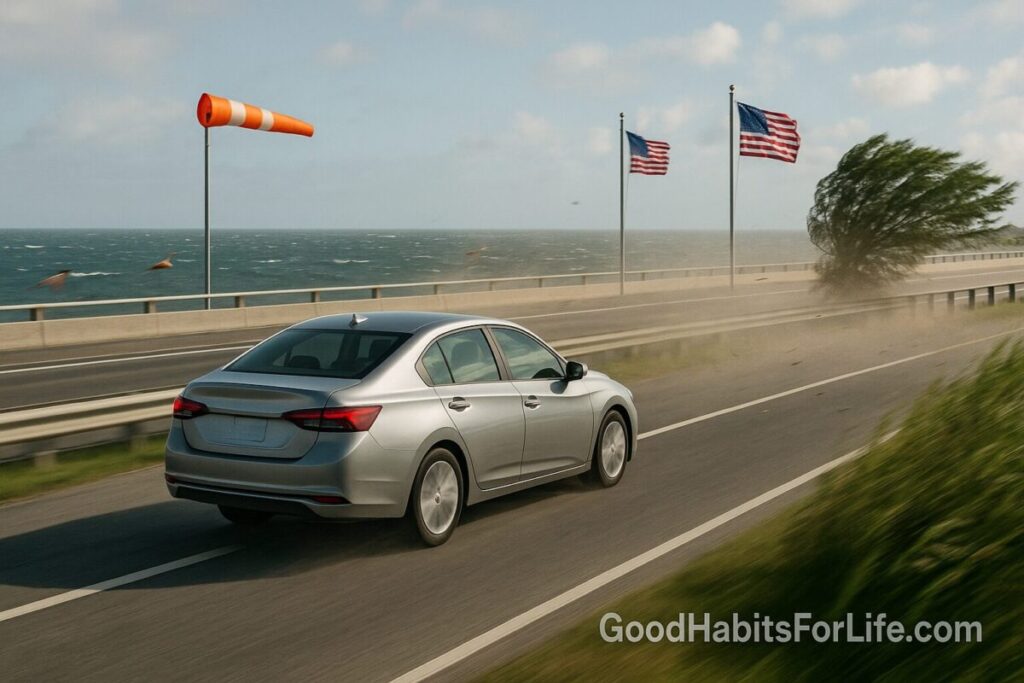
Crosswinds are winds blowing across your direction of travel. They create a side force on the vehicle and can cause yaw (the nose turning off-line), especially during gusts (sudden increases in wind speed).
Why it matters:
-
Lane keeping: Side push makes it harder to hold a straight line.
-
Braking & cornering: Less available grip margin for steering and stopping.
-
Vehicle differences: High-sided or lightly loaded vehicles react more; small, low cars are more stable but still affected.
-
Situational spikes: Bridges, open plains, coastal roads, hill crests, and tunnels amplify gust effects.
Bottom line: Crosswind driving is mostly about anticipation, speed discipline, and space management—with calm, gentle steering.
✅ Quick Start: Do This Today
-
Check conditions: Look up wind advisories before you go. If gusts are strong in your area, consider delaying.
-
Set a calm speed: If you feel frequent nudges, reduce speed in small steps (e.g., −10–15 km/h) until lane-keeping feels easy.
-
Grip & posture: Hands at 9 and 3 on the wheel; sit upright; look far ahead.
-
Spacing: Move to a 5–8 second following gap in gusts.
-
Steer smoothly into the wind: Gentle, progressive inputs; avoid jerks.
-
Avoid cruise control: You need fine control of speed for stability.
-
Mind trucks & riders: Don’t linger alongside; pass decisively and safely with extra room.
-
Secure everything: Roof loads, bike racks, trailer hitches—tighten/redistribute.
🧠 How Wind Affects Your Car (and Different Vehicles)
Aero 101: Wind hitting from the side creates a lateral force and a torque (yaw) around your car’s center of gravity. At higher speeds, these forces grow—and your steering corrections must stay small and early to prevent oscillation (over-correction).
Vehicle risk profile (generalised):
| Vehicle Type | Crosswind Sensitivity | Notes |
|---|---|---|
| High-sided vans/SUVs | High | Large side area; be conservative with speed. |
| Cars (sedan/hatch) | Medium-Low | Lower side area; still vulnerable to gusts & bridge openings. |
| Pickups (empty bed) | High | Light rear axle increases drift/yaw risk. |
| Vehicles with roof loads | High | Higher center of gravity + more side area. |
| Towing a trailer | Very High | Trailer can sway; reduce speed considerably. |
| Motorcycles/Bicycles | Extreme | Very vulnerable—give generous space when overtaking. |
🛠️ Steering, Speed & Spacing: The Core Techniques
Steering
-
Keep two hands at 9 and 3 for best leverage and precision.
-
Anticipate wind gaps: When leaving a sheltered area (trees/buildings) into open space, expect a sudden push—be ready with a light, pre-emptive steering input into the wind.
-
Look far ahead to stabilize micro-corrections; avoid “chasing” the lane lines with abrupt movements.
Speed
-
Slower is safer in crosswinds: speed amplifies side forces and reduces your reaction window.
-
Step speed down gradually (e.g., −5 km/h increments) until holding lane is easy without constant steering effort.
-
Avoid cruise control—gusts require instant, human modulation.
Spacing
-
Extend following distance to 5–8 seconds in gusts.
-
Keep lateral buffer: If safe, favor the windward side of your lane (the side the wind comes from) to create extra leeway downwind.
-
Give vulnerable road users at least 1.5 m (5 ft) when overtaking; more if gusty.
Brakes & throttle
-
Smooth throttle helps keep weight stable on the front tyres (for steering grip).
-
Brake early, lightly, and in a straight line when possible.
Traction & electronics
-
Proper tyre pressures and tread depth matter more in adverse weather.
-
ESC/traction control should be ON; they can correct small yaw moments.
🧭 Passing Trucks & Buses Safely
Large vehicles create aerodynamic disturbances. Expect two effects:
-
Suction near the rear as you approach to pass (the truck’s wake can pull you toward it).
-
Crosswind “release” after you clear the cab—if the wind is blowing from the far side, you might get a sudden push.
How to pass safely
-
Decide early: If you’re going to pass, do it confidently with legal speed and a clear gap. Don’t hover beside the trailer.
-
Space & timing: Wait for a lull in gusts if possible.
-
Steady lane position: Small steering into/against pressure as needed; avoid abrupt corrections.
-
Abort if needed: If buffeting is strong, back off smoothly and try again later or sit well back.
Being passed by trucks
-
Hold steady speed and lane position; avoid edging towards the shoulder.
-
Expect a push/pull as the truck draws level and then clears—keep light, steady steering.
⚠️ High-Risk Zones: Bridges, Open Areas, Tunnels & City Gaps
-
Bridges & viaducts: Unblocked wind over water/valleys; watch for gusts at entry/exit.
-
Open plains/coastal roads: Sustained crosswinds; set a conservative cruising speed.
-
Hill crests: Wind accelerates; be ready for a shove.
-
Tunnels & cuttings: Sudden shelter followed by a gust at the exit.
-
Urban gaps (between tall buildings): Turbulent eddies; keep speeds low and inputs gentle.
🧰 Vehicle Setup: Tyres, Loads, Roof Racks & Trailers
-
Tyres: Keep pressures at the vehicle placard values; under-inflation = sloppy response.
-
Suspension & alignment: Worn shocks or misalignment make crosswind corrections harder—service on schedule.
-
Roof racks & boxes: Remove when not needed; they add side area and raise the center of gravity.
-
Cargo distribution: Keep heavy items low and centered; avoid top-heavy stacks.
-
Trailers:
-
Use an appropriate hitch & sway control.
-
Load 60% of cargo forward of the axle; keep total trailer weight within limits.
-
Reduce speed significantly; if sway begins, ease off throttle (don’t brake hard), hold straight, and let it settle before slowing further and stopping to redistribute weight.
-
📅 7-Day Crosswind Control Plan
Goal: Build calm, automatic habits for windy days.
-
Day 1 — Pre-drive checks (10 min): Tyres, roof rack removed, cargo secured, ESC on; review local wind advisories.
-
Day 2 — Steering drills (15 min): In a quiet, safe road: practice holding 9-and-3, gentle lane-centering, and small “into-the-wind” corrections.
-
Day 3 — Speed modulation (15 min): Feel how −10 km/h improves stability; repeat at −15 km/h.
-
Day 4 — Spacing discipline (drive to errands): Lock in a 5–8 second gap; rehearse early braking.
-
Day 5 — Bridge/open area rehearsal: Choose a short route with an exposed stretch; anticipate the gust at the opening and the shelter at the exit.
-
Day 6 — Overtake simulation: On a multi-lane road with light traffic, practice not lingering beside large vehicles; pass decisively when safe.
-
Day 7 — Review & checklist: Write your personal triggers (e.g., “gusty at bridge entries,” “avoid cruise,” “add gap”) and keep them in your car.
👥 Audience Variations
-
Students/Novice drivers: Practice in moderate wind with an instructor/experienced adult first. Keep speeds low; avoid highways until comfortable.
-
Parents with kids: Secure child seats and cargo; plan routes that avoid high bridges or coastal exposures on windy days.
-
Professionals/Commuters: Check wind forecasts during peak hours; have an alternate, less-exposed route saved.
-
Seniors: Consider earlier daytime travel when winds can be steadier; prioritize vehicles with modern driver assists (ESC, lane-keeping alert).
-
Teens: Use a simple mantra: “Hands steady, speed ready, big gap.” No passing trucks until fully confident.
❌ Mistakes & Myths to Avoid
-
Myth: “I can just grip harder and power through.”
Reality: Over-gripping often leads to jerky inputs; slow down and steer smoothly. -
Mistake: Using cruise control in gusts.
-
Mistake: Sitting beside a truck’s trailer for long.
-
Myth: “Tyre pressure doesn’t matter for wind.”
Reality: It affects steering response and stability. -
Mistake: Over-correcting after a gust, then weaving.
-
Myth: “Only highways are risky.”
Reality: Urban wind tunnels and bridge entries can be sharp surprises.
💬 Real-Life Examples & Driver Scripts
-
Gust at bridge entry (self-talk): “Open stretch ahead—light steering into the wind, small speed trim, eyes up.”
-
Passing a truck: “Clear lane? Yes. Smooth accel, don’t hang beside; expect push as I clear the cab—steady hands.”
-
Trailer sway begins: “Ease off throttle, hold straight—let it settle. Then exit to check load.”
-
Urban gap gust: “Between buildings—short, sharp eddy possible. Keep it tidy, no sudden steering.”
🧩 Tools, Apps & Resources
-
Weather apps (wind layers & gusts): national weather service apps, Windy, Met Office, local meteorological services.
-
Pros: Gust forecasts and warning maps. Cons: Forecasts vary—always drive to what you feel.
-
-
Navigation apps with incident alerts (Google Maps, Waze): reroute away from exposed bridges if restricted.
-
Vehicle tech: ESC (essential), lane-keeping alerts (informative but don’t rely on them), trailer sway control for towing.
🔑 Key Takeaways
-
Slow down early; stability improves immediately.
-
Keep both hands at 9-and-3 and steer smoothly into the wind.
-
Increase following distance to 5–8 seconds and avoid lingering beside trucks.
-
Expect gusts at bridge openings, hill crests, tunnels, and urban gaps.
-
Prep your vehicle: tyre pressures, secure loads, no cruise control; consider delaying travel in severe gusts.
❓ FAQs
1) How much should I slow down in strong crosswinds?
Enough that lane-keeping feels easy without constant correction—often 10–20 km/h less than usual, more if gusts are frequent.
2) Should I steer into the wind?
Yes, with light, progressive inputs. The goal is steady lane position, not fighting the wheel.
3) Is it safe to use cruise control in windy conditions?
Avoid it. You need immediate, fine control of speed to stabilize the car through gusts.
4) What following distance is best in gusts?
Aim for 5–8 seconds to give yourself room for gentle braking and corrections.
5) How do I overtake a truck in crosswinds?
Pass decisively when safe, don’t linger alongside, anticipate push/pull effects, and maintain a steady line.
6) Are bridges really more dangerous?
They’re more exposed, so gusts can be stronger and less predictable—enter/exit with care.
7) What about roof boxes or bikes on racks?
They increase side area and raise the center of gravity—remove if not needed, reduce speed, and double-check mounts.
8) Can lane-keeping assist handle crosswinds?
It can help, but it’s not a substitute for proper speed, spacing, and active steering.
9) When should I postpone a trip?
If you can’t maintain stable lane position despite slowing down—or if authorities issue high-wind warnings for your route—delay until conditions improve.
10) What’s different when towing?
Keep speeds low, distribute weight correctly (more forward), use sway control, and be ready to stop and adjust if sway starts.
📚 References
-
National Weather Service (US). High Wind Safety — guidance on wind hazards and driving considerations. https://www.weather.gov/safety/wind
-
AAA. Driving in Windy Conditions — safe driving tips for high winds and gusts. https://exchange.aaa.com/safety/driving-advice/driving-in-windy-conditions/
-
Met Office (UK). Driving in Strong Winds — practical advice on vehicle control and planning. https://www.metoffice.gov.uk/weather/warnings-and-advice/seasonal-advice/travel/driving-in-strong-winds
-
RoSPA (UK). Driving in Adverse Weather Conditions — techniques for wind, rain, and ice. https://www.rospa.com/leisure-safety/advice/driving/adverse-weather
-
FMCSA (US). Severe Weather Driving Tips for CMV Drivers — crosswind and high-profile vehicle considerations. https://www.fmcsa.dot.gov/safety/driver-safety/severe-weather-driving-tips
-
RAC (UK). Driving in Windy Weather — hazards and step-by-step actions. https://www.rac.co.uk/drive/advice/weather/windy-weather-driving/
-
ICBC (Canada). Learn to Drive Smart (Driver Guide) — crosswind awareness and vehicle control basics (PDF). https://www.icbc.com/driver-licensing/Documents/drivers2.pdf
-
Transport for NSW (AU). Driving in Strong Winds — NSW Government road safety advice. https://roadsafety.transport.nsw.gov.au/stayingsafe/driversafety/driving-conditions/windy-conditions.html