
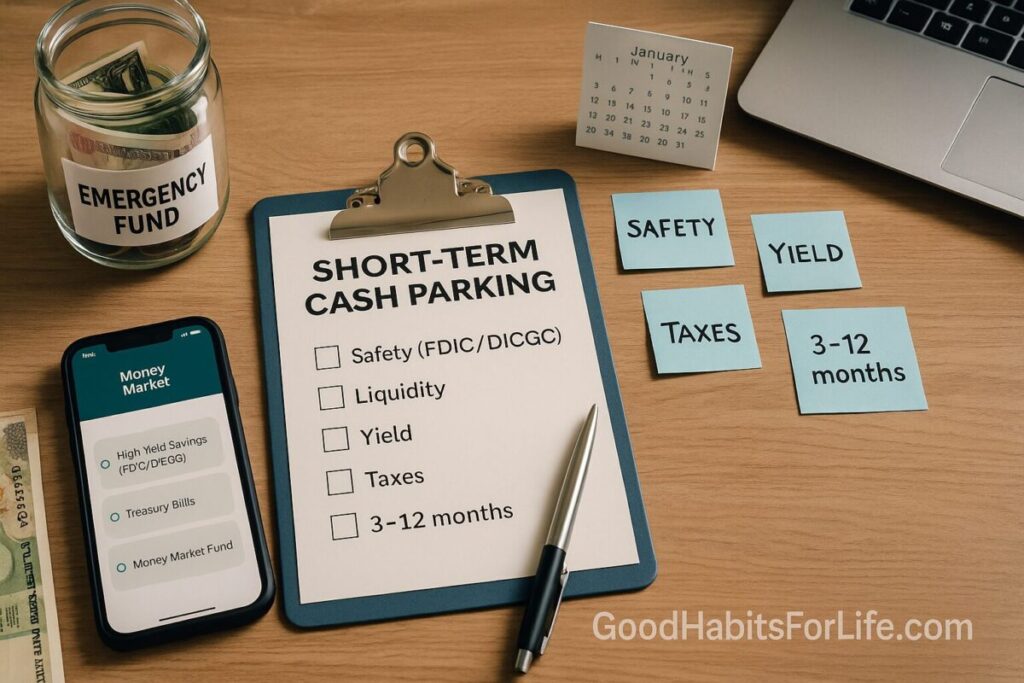
Where to Park ShortTerm Cash (Know the TradeOffs): No-Spend Challenge (2025)
Where to Park Short-Term Cash: Know the Trade-Offs (2025)
Table of Contents
🧭 What Counts as “Short-Term Cash” & Why It Matters
Short-term cash is money you’ll need soon—typically within 3–12 months—for essentials (rent, school fees, premiums), a buffer for emergencies, or planned purchases (travel, appliances). A well-built emergency fund reduces stress, prevents high-interest debt, and boosts financial stability. Guidance from consumer regulators emphasizes having a cushion sized to your situation (e.g., months of expenses, variable income needs). Consumer Financial Protection Bureau
Principles for parking short-term cash
-
Safety first: Prefer insured deposits or government-backed instruments. In the U.S., FDIC-insured deposits are protected up to $250,000 per depositor, per bank, per ownership category. In India, DICGC insures up to ₹5 lakh per depositor per bank (principal + interest). FDICDICGC
-
Liquidity matters: You should access funds quickly with minimal penalties.
-
Don’t chase yield blindly: Understand fees, rate resets, and NAV moves. Money market funds are low risk but not risk-free, and yields change with short-term rates. Investor
-
Mind taxes: In the U.S., Treasury interest is state/local tax-exempt (still federally taxable). Local rules vary elsewhere. Internal Revenue Service
✅ The Cash Stack (Fast Comparison)
| Option | Safety | Liquidity/Access | Typical Use | Rate/Return Behavior | Insurance/Guarantee | Tax Notes (examples) |
|---|---|---|---|---|---|---|
| High-Yield Savings / MMDA (bank) | Very high | Instant/1–2 days | Emergency fund, bills | Variable (tracks policy rates) | FDIC (U.S.) / DICGC (India) limits per bank | Interest taxable; jurisdiction-specific FDICDICGC |
| Treasury Bills (4–52 weeks) | Very high (govt-backed) | Sellable; or wait to maturity | Parking months ahead | Auction-driven discount yield | Full faith/credit of government | U.S.: state/local tax-exempt; check local rules elsewhere treasurydirect.govInternal Revenue Service |
| Money Market Mutual Fund (government/treasury) | High (portfolio quality) | T+0/T+1 settlement | Cash sleeve in brokerage | Yield follows short rates; can change | Not deposit-insured; investment risk applies | Distributions taxable; Treasuries share state/local exemption portion in U.S. Investor |
| Short CD / Fixed Deposit (3–12 mo) | Very high | Early-withdrawal penalties | Known date goals | Fixed (locked) | Bank insurance up to limits | Interest taxable per local law |
| Liquid/Overnight Debt Funds (India) | Market-linked low duration | Typically T+1 | Short-term goals | NAV can move slightly | No deposit insurance | Tax rules change; check current guidance/AY notes |
Tip: Use two or more places to stay under insurance caps and to avoid lock-in surprises. Consider auto-sweep (savings → MMF/T-bill) if your platform supports it.
🛠️ Quick Start: Set Up in 30 Minutes
-
Decide your target (emergency fund or goal) — e.g., 3–6 months’ essential expenses (use a simple calculator or last 90 days’ spend). Consumer Financial Protection Bureau
-
Open/confirm a high-yield savings account at an insured bank (check FDIC/DICGC status). FDICDICGC
-
Create a brokerage or government portal login for safe, short-dated government bills: TreasuryDirect (U.S.) or RBI Retail Direct (India). treasurydirect.govRBI Retail Direct
-
Set your “Cash Stack”:
-
Tier 1 (instant): 1–2 months in HYSA/MMDA.
-
Tier 2 (weeks-ahead): ladder 4–13-week T-bills or a government MMF. treasurydirect.govInvestor
-
Tier 3 (optional): a 3–6-month CD/FD for known-date goals.
-
-
Automate: Split paycheck/direct deposit—e.g., 70% → checking, 20% → HYSA, 10% → T-bill ladder.
-
Name your accounts (“Rent Buffer”, “Emergency 6mo”, “Fees Q1”) to discourage raids.
🧠 30-60-90 Plan + No-Spend Challenge (2025)
Goal: Build or top up short-term cash fast, then stabilize.
Days 1–30 (No-Spend Challenge)
-
Rules: No discretionary spends (eating out, impulse buys, non-urgent Amazon carts). Essentials only.
-
Daily action: Move the saved rupees/dollars to your HYSA the same day.
-
Weekly reset: Unsubscribe/cancel 1 recurring cost; sell 1 unused item.
-
Checkpoint: End of Day 30—transfer 50–70% of the challenge pot into 4–13-week T-bills or a government MMF; keep 30–50% as instant cash.
Days 31–60
-
Build a 4-bill ladder: Buy a T-bill each week (4, 8, 13-week tenors) so one matures monthly. Reinvest matured bills unless a goal is due. treasurydirect.gov
-
Top up Tier 1 to the target “instant cash” amount.
-
Automations: Set paycheck splits and calendar reminders to roll maturing bills.
Days 61–90
-
Right-size the stack (3–6 months in total buffers, or more if income is irregular). Consumer Financial Protection Bureau
-
Add specificity: Create sinking funds (insurance, school fees, travel) with monthly autosaves.
-
Review taxes: If in the U.S., remember state/local exemption on Treasuries; if in India, confirm AY rules for interest/capital gains. Internal Revenue Service
🧪 Techniques & Frameworks (Research-Aligned)
-
Bucket your cash by time horizon:
-
Now (0–30 days): HYSA/MMDA (insured). FDIC
-
Soon (1–6 months): 4–13 week T-bills or govt MMF (watch settlement/redemption times). treasurydirect.govInvestor
-
Date-certain (3–12 months): CDs/FDs timed to mature on-date (mind penalties).
-
-
T-bill laddering: Stagger purchase dates/tenors for rolling liquidity; re-aim maturities at known bills (rent, premiums). treasurydirect.gov
-
Brokerage cash sweeps: Understand if idle cash goes to a government MMF vs. bank sweep; safety differs (SIPC protects custody up to limits, not market value or yields). sipc.org
-
India focus: Consider RBI Retail Direct for G-secs/T-bills; mutual fund riskometer on liquid/overnight funds helps gauge risk. RBI Retail DirectSecurities and Exchange Board of India
👥 Audience Variations
Students: Start with one insured HYSA; automate ₹/$500 per month; keep it boring and separate. FDIC
Parents: Use labeled sub-accounts (medical, school) and bill-date T-bill maturities. treasurydirect.gov
Professionals (variable pay): Larger buffers (closer to 6–12 months) and weekly T-bill ladders during bonus cycles. Consumer Financial Protection Bureau
Seniors/retirees: Prioritize simplicity and same-day access; T-bills/govt MMFs for modest yield without equity risk; mind tax brackets. treasurydirect.govInvestor
⚠️ Mistakes & Myths to Avoid
-
“Money market funds are insured.” Myth. They’re not bank deposits; they hold short-term securities and can fluctuate (low risk ≠ no risk). Investor
-
Breaking insurance limits at one bank. Spread across institutions/ownership categories. FDIC
-
Ignoring taxes. U.S. Treasuries have state/local tax breaks; other instruments may not. Rules change—verify locally each year. Internal Revenue Service
-
Parking at home. Cash at home isn’t insured or earning; consider insured deposits instead. FDIC
💬 Real-Life Examples & Copy-Paste Scripts
Direct-deposit split (to HR):
“Hi Team — please split my salary: 70% → Checking (Acct ####), 20% → Savings (Acct ####), 10% → Brokerage (Acct ####) on payday each month. Thanks!”
Bank message (auto-transfer):
“Please set a standing order of ₹/$ ___ from Checking to Savings every Monday. Reference: ‘Emergency Fund.’”
Broker note (T-bill ladder):
“Buy 4-week T-bill this Friday; set auto-roll at maturity; repeat weekly for four weeks to create a monthly maturity cycle.”
Family agreement (No-Spend Challenge):
“For 30 days we buy essentials only. We track daily saves in a shared sheet and move savings to HYSA nightly. Celebration day = Day 31 picnic (budget ₹/$___).”
🧰 Tools, Apps & Resources (Quick Pros/Cons)
-
TreasuryDirect (U.S.) — Direct purchase of T-bills; simple auctions; no commissions (UI can be dated). treasurydirect.gov
-
RBI Retail Direct (India) — Direct access to G-secs/T-bills; transparent auctions; requires setup. RBI Retail Direct
-
FDIC BankFind / Coverage Estimator — Verify insurance, calculate coverage across accounts. (Pros: clarity; Cons: U.S.-only.) FDIC
-
SIPC — Understand brokerage asset protection limits. (Pros: clear limits; Cons: not a performance guarantee.) sipc.org
-
Regulator education hubs (SEC/SEBI/CFPB) — Plain-language guides on MMFs, savings, and risk. (Pros: trustworthy; Cons: not product-specific.) InvestorSecurities and Exchange Board of IndiaConsumer Financial Protection Bureau
📌 Key Takeaways
-
Use a three-tier Cash Stack: instant bank savings → short T-bills/MMF → optional short CDs/FDs.
-
Stay under insurance caps and know what is (and isn’t) insured. FDIC
-
Automate contributions and rollovers; pair with a 30-day No-Spend Challenge to build momentum.
-
Recheck rates and taxes quarterly; yields and rules evolve. Investor
❓ FAQs
1) Are money market funds “safe”?
They invest in short-term, high-quality debt and aim for stability, but they are not bank-insured and yields vary with short-term rates. Consider government/treasury MMFs for higher credit quality. Investor
2) Is my brokerage cash insured like a bank account?
Brokerage custody has SIPC coverage (up to $500k, cash up to $250k) if a member firm fails; this is not the same as FDIC insurance or a guarantee of market value or yield. sipc.org
3) What’s the simplest T-bill ladder?
Buy one 4- or 8-week bill each week for four weeks. After week 4, one bill matures every week/month, creating rolling liquidity for bills and irregular expenses. treasurydirect.gov
4) How big should my emergency fund be?
It depends; many households target several months of essential expenses and adjust for job stability, health, and dependents. Start smaller and build. Consumer Financial Protection Bureau
5) Are U.S. Treasuries tax-free?
Interest is taxable federally but generally exempt from state and local taxes. Capital gains rules differ. Consult a tax pro for your situation. Internal Revenue Service
6) India: Are my bank deposits insured?
Yes—DICGC insures up to ₹5 lakh per depositor per bank (principal + interest), aggregated across that bank’s branches. DICGC
7) India: Can I buy T-bills directly?
Yes—via RBI Retail Direct. You can bid in auctions and hold G-secs/T-bills in your own account. RBI Retail Direct
8) Should I just keep cash at home during uncertainty?
Home cash isn’t insured and doesn’t earn. Safer to keep essentials in insured deposits and/or short-dated government securities. FDIC
📚 References
-
FDIC — Understanding Deposit Insurance (coverage limits & categories). https://www.fdic.gov/resources/deposit-insurance/understanding-deposit-insurance FDIC
-
SIPC — What SIPC Protects (brokerage asset protection limits). https://www.sipc.org/for-investors/what-sipc-protects sipc.org
-
TreasuryDirect — Treasury Bills (4–52 weeks). https://treasurydirect.gov/marketable-securities/treasury-bills/ treasurydirect.gov
-
SEC/Investor.gov — Money Market Funds: Investor Bulletin (risks, yields vary). https://www.investor.gov/…/money-market-funds-investor-bulletin Investor
-
CFPB — An essential guide to building an emergency fund. https://www.consumerfinance.gov/an-essential-guide-to-building-an-emergency-fund/ Consumer Financial Protection Bureau
-
IRS Topic No. 403 — Interest received (Treasury state/local exemption). https://www.irs.gov/taxtopics/tc403 Internal Revenue Service
-
DICGC (RBI) — FAQs / Guide to Deposit Insurance (₹5 lakh per depositor per bank). https://www.dicgc.org.in/FAQs ; https://www.dicgc.org.in/guide-to-deposit-insurance DICGC+1
-
RBI — RBI Retail Direct (buy G-secs/T-bills online). https://rbiretaildirect.org.in/ RBI Retail Direct
-
SEBI — FAQs for Mutual Fund Investors (category & investor education). https://www.sebi.gov.in/sebi_data/faqfiles/sep-2024/1727242783639.pdf Securities and Exchange Board of India
Disclaimer
This guide is for education only and is not financial or tax advice. Rules and yields change; consider consulting a qualified adviser for your specific situation.