
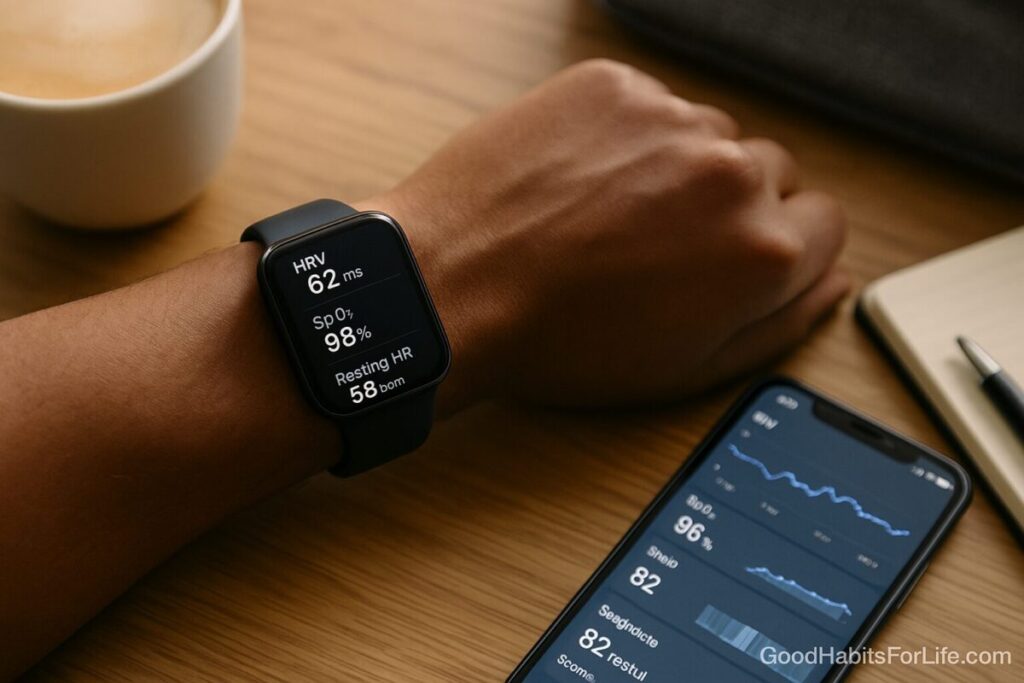
Wearables 2025: HRV, SpO, and What Matters
Wearables in 2025: HRV, SpO₂, and What Matters
Table of Contents
🧭 What This Means & Why It Matters
Wearables put lab-style signals (heart rhythm, oxygen saturation, sleep timing) on your wrist or finger. Used wisely, they can help you:
-
Train smarter (e.g., adjust intensity based on recovery signals),
-
Spot early signs of overreaching, illness, or poor sleep routines, and
-
Keep habits on track through objective, low-friction feedback.
Caution: Consumer metrics aren’t medical diagnoses. Some signals (notably SpO₂ and sleep staging) have known limitations; accuracy varies by device, skin tone, and activity context. Use trends, not single readings.
✅ Quick Start: Do This Today
-
Choose 3 anchors: Resting Heart Rate (RHR), overnight HRV, and total sleep time.
-
Baseline window: Collect 14 nights before making changes. Note illness, alcohol, travel, or heavy training.
-
Morning check-in (2 minutes):
-
If RHR ↑ >5 bpm above your 14-day median or HRV ↓ >15%, reduce intensity that day.
-
If sleep <6 h, cap high-intensity work; walk or do Zone 2.
-
-
SpO₂ sanity check: If awake readings look off (e.g., 88–91% at sea level) but you feel fine, don’t self-diagnose—retest calmly, warm hands, remove polish; seek clinical testing if symptoms exist.
-
Weekly review (10 minutes): Tag your week: training load, stress, alcohol, bedtime regularity. Adjust next week’s plan.
🗺️ 30-60-90 Day Habit Plan
Days 1–30: Build the foundation
-
Set your wear schedule: Wear nightly + during easy workouts (PPG signals are best at rest).
-
Lock routines: Fixed bedtime/wake window (±30 min), 7,000–10,000 steps/day.
-
Metrics: Track RHR, HRV (RMSSD), sleep duration, and subjective energy (1–5 scale).
-
One experiment: Reduce late-evening screens or alcohol; observe HRV/RHR changes.
Days 31–60: Calibrate training to recovery
-
Add VO₂max estimate check (weekly). Expect noise; use 4-week trend.
-
Introduce intensity “gates”:
-
If HRV low & RHR high, choose Zone 2 or mobility.
-
If HRV normal & slept well, schedule intervals/tempo.
-
-
SpO₂: Keep as context-only unless instructed by a clinician.
Days 61–90: Personalization & plateaus
-
Refine workloads with easy/moderate/hard ratios (e.g., 80/20 endurance split).
-
Sleep optimization: Aim 7–9 h; use consistent timing to stabilize HRV.
-
Quarterly check: If you need precise fitness numbers, schedule a lab VO₂max test; keep wearable trends for between-test guidance.
🧠 HRV: What to Track & How to Use It
What it is: HRV is beat-to-beat variability reflecting autonomic balance. On wearables, HRV is usually inferred from PPG (pulse) rather than ECG (electrical). PPG-based PRV isn’t identical to ECG-HRV, and accuracy drops with movement; it’s stronger during sleep/rest. PMC+1
Best practice
-
Use overnight RMSSD (or device default) as your anchor.
-
Compare you-to-you: Look at 7–14-day medians; tag stressors (travel, alcohol, heavy blocks).
-
Decisions:
-
HRV ↓ & RHR ↑: de-load, Zone 1–2, mobility, early night.
-
HRV stable/high & slept well: proceed with quality sessions.
-
Why this works: Wearable HRV at rest correlates acceptably with ECG-derived measures, and day-to-day trends align with training stress/recovery, even if individual datapoints are noisy. PMC
🫁 SpO₂: Strengths, Limits & Safety
What it is: An estimate of blood oxygen via light absorption (PPG). Important limitations: readings can be affected by skin pigmentation, circulation, temperature, nail polish, motion, and more; medical-grade and consumer devices are different categories. U.S. Food and Drug Administration
-
Equity & accuracy: Studies show systematic overestimation of oxygen saturation in darker skin, including in children. The FDA (Jan 2025) proposed updated guidance to improve accuracy across skin tones. These proposals apply to medical pulse oximeters, not general-wellness wearables. New England Journal of MedicinePMCU.S. Food and Drug AdministrationReuters
How to use it in 2025
-
Treat wearable SpO₂ as context, not a diagnosis.
-
For odd low readings: warm hands, sit still, remove polish, retry. If symptoms (e.g., breathlessness, cyanosis), seek medical care regardless of the wearable number. U.S. Food and Drug Administration
📊 Other Metrics That Matter (and what to ignore)
Worth tracking (with caveats):
-
Resting Heart Rate (RHR): Simple, robust trend for fitness and recovery; higher RHR over time can signal stress/illness/overreaching. JMIRPMC
-
VO₂max (estimate): Helpful directionally; consumer estimates vary by device and fitness level (often less valid in highly trained athletes); trends over 4–8 weeks are more meaningful than single values. NatureSpringerLink
-
Sleep timing & duration: Your best levers; consumer sleep staging is less reliable vs polysomnography—use duration/regularity as primary signals. jcsm.aasm.org
-
Irregular rhythm flags / AFib checks: Smartwatches can surface possible AF episodes and prompt clinical follow-up, though not for broad screening. New England Journal of Medicine
Lower-value or noisy:
-
Calories burned: Large device-to-device error; pair with food logs or weight trends if you must.
-
Minute-by-minute HRV while moving: Motion artifacts reduce reliability—prefer overnight windows. PMC
🛠️ Techniques & Frameworks
1) The 3-S Framework: Sleep, Strain, Signals
-
Sleep: 7–9 hours, keep timing consistent.
-
Strain: Periodize training (hard days hard, easy days easy).
-
Signals: If RHR ↑ and HRV ↓, convert a hard day to easy; if both OK and you feel good, proceed.
2) 7-Day Rolling Median
-
For HRV and RHR, watch the rolling 7-day median; ignore day-to-day spikes. This reduces noise and highlights true changes.
3) Zone Gatekeeping
-
Gate 1: Slept <6h? Limit to Zone 2 + mobility.
-
Gate 2: HRV down >15% vs 14-day median? Cut intervals by 30–50% or swap to technique work.
-
Gate 3: Two “red days” in a row? Take a rest or only walk.
4) Trend Trifecta
Combine VO₂max (trend) + RHR (trend) + subjective energy. If VO₂max flat, RHR stable, but energy low → consider life stress/sleep rather than pushing volume.
👥 Audience Variations
-
Students/Teens: Prioritize consistent bedtime and screen curfew. Use HRV as a nudge to keep caffeine earlier and training balanced with exams.
-
Parents: Expect sleep fragmentation. Judge weeks, not days. Use walks and short strength snacks on low-recovery days.
-
Busy Professionals: Protect 2–3 anchor workouts weekly; let HRV guide minor adjustments, not cancellations.
-
Seniors: Focus on balance, strength, and walking cadence. SpO₂ numbers can fluctuate—use symptoms and clinician guidance first.
-
Endurance Athletes: Rely on overnight HRV, RHR, and session RPE for load management; remember VO₂max estimates skew at higher fitness levels. SpringerLink
⚠️ Mistakes & Myths to Avoid
-
Myth: “One low HRV = I’m overtrained.” → Reality: Look for multi-day trends.
-
Myth: “My watch SpO₂ is 90%, so I need oxygen.” → Reality: Consumer SpO₂ can be inaccurate; assess symptoms and seek clinical testing when concerned. U.S. Food and Drug Administration
-
Myth: “Sleep stages are precise.” → Reality: Staging is approximate; focus on duration & timing. jcsm.aasm.org
-
Myth: “VO₂max estimate is gospel.” → Reality: Useful for direction, not precise diagnosis; lab tests are the gold standard. Nature
🗣️ Real-Life Examples & Scripts
A) Post-travel recovery (3 days):
-
Day 1: HRV low, RHR high, sleep 5h → “I’m switching intervals to a 40-minute Zone 2 walk + 10 minutes mobility.”
-
Day 2: HRV trending up, sleep 7h → “I’ll do technique drills + light strides.”
-
Day 3: HRV back to baseline → “Tempo run/HIIT back on.”
B) Cold coming on:
-
Morning check: RHR +6, HRV −20% → “I’ll rest today, hydrate, and aim for 8.5h sleep.” If symptoms persist, consider clinical advice.
C) Plateau in fitness:
-
VO₂max flat 6–8 weeks, RHR stable: “I’ll add one extra Zone 2 hour weekly and a 10-min bedtime wind-down to improve sleep quality.”
🧰 Tools, Apps & Resources (quick pros/cons)
-
Platform hubs (Apple Health, Google Health Connect):
-
Pros: Aggregate multiple devices; trend visibility.
-
Cons: Data overload without a review ritual.
-
-
Training apps (Garmin Connect, Polar Flow, Strava):
-
Pros: Training load, session RPE, VO₂max estimates.
-
Cons: Estimates vary; avoid over-reacting to single scores. Nature
-
-
Sleep apps (device-native, AASM-aligned guidance):
-
Pros: Good for timing & duration; habit prompts.
-
Cons: Sleep staging reliability is limited vs. polysomnography. jcsm.aasm.org
-
-
HRV-focused platforms (overnight RMSSD):
-
Pros: Simple readiness view; baselines over time.
-
Cons: Motion/irregular wear reduces quality. PMC
-
🔑 Key Takeaways
-
Trends beat single numbers. Use 7–14-day medians for HRV/RHR.
-
Rest context matters. Overnight windows give cleaner signals.
-
SpO₂ on wearables is context-only—accuracy varies; heed symptoms and clinician advice.
-
Sleep timing & duration drive nearly everything; protect them.
-
VO₂max estimates are useful as direction; the lab is for precision.
-
Make it a habit: Weekly 10-minute review + small training/sleep adjustments.
❓ FAQs
1) Is wearable HRV as good as ECG?
Not exactly. PPG-based HRV (often called PRV) correlates better at rest/sleep and diverges with motion; use overnight trends for decisions. PMC+1
2) What’s a “good” HRV?
There’s no universal “good.” Track your 14-day baseline and look for relative changes.
3) My SpO₂ reads 90% but I feel fine—panic?
No. Re-measure calmly with warm hands and stillness. If symptoms exist, seek care; consumer SpO₂ can be inaccurate. U.S. Food and Drug Administration
4) Can a watch diagnose AFib?
Watches can flag possible AFib and prompt follow-up; they’re not replacements for clinical diagnosis or continuous ECG monitoring. New England Journal of Medicine
5) Are sleep stages trustworthy?
They’re approximate. Rely more on duration, timing, and regularity for behavior change. jcsm.aasm.org
6) Do VO₂max estimates matter for beginners?
Yes, as a trend—expect variability. For exact values, use a lab test; estimates can be less valid at higher fitness levels. NatureSpringerLink
7) What if my HRV is always low?
Look at sleep, stress, alcohol, and training load first. If concerned, consult a clinician—devices aren’t diagnostic.
8) How much should I exercise overall?
Aim for 150–300 min/week moderate or 75–150 min/week vigorous activity, plus muscle strengthening. PMC
📚 References
-
U.S. FDA. Proposed updated recommendations to improve pulse oximeter performance across skin tones (Jan 6, 2025). https://www.fda.gov/ (press announcement). U.S. Food and Drug Administration
-
U.S. FDA. Pulse Oximeters—limitations and factors affecting accuracy (updated 2025). https://www.fda.gov/ U.S. Food and Drug Administration
-
Sjoding MW, et al. Racial Bias in Pulse Oximetry Measurement. N Engl J Med. 2020. https://www.nejm.org/ New England Journal of Medicine
-
Starnes JR, et al. Pulse Oximetry and Skin Tone in Children (POSTer-Child). 2025. https://pmc.ncbi.nlm.nih.gov/ PMC
-
Kantrowitz AB, et al. Pulse Rate Variability is not the same as Heart Rate Variability. 2025. https://pmc.ncbi.nlm.nih.gov/ PMC
-
Li K, et al. Heart Rate Variability Measurement through a Smart Device. 2023. https://pmc.ncbi.nlm.nih.gov/ PMC
-
Jamieson A, et al. A guide to consumer-grade wearables in cardiovascular practice. Nature Rev Cardiol. 2025. https://www.nature.com/ Nature
-
Sibomana O, et al. Diagnostic accuracy of ECG patches vs PPG smartwatches for AF detection: meta-analysis. BMC Cardiovasc Disord. 2025. https://biomedcentral.com/ BioMed Central
-
Perez MV, et al. Large-Scale Assessment of a Smartwatch to Identify Atrial Fibrillation. N Engl J Med. 2019. https://www.nejm.org/ New England Journal of Medicine
-
J Clin Sleep Med (AASM). Performance of consumer wrist-worn sleep tracking devices vs polysomnography. 2025. https://jcsm.aasm.org/ jcsm.aasm.org
-
Engel FA, et al. Validity of VO₂max estimates from a smartwatch in highly vs moderately trained athletes. Eur J Appl Physiol. 2025. https://link.springer.com/ SpringerLink
-
World Health Organization. 2020 Guidelines on Physical Activity and Sedentary Behaviour. https://pmc.ncbi.nlm.nih.gov/ PMC
Disclaimer: This guide is educational and not a substitute for professional medical advice; consult a qualified clinician for diagnosis or treatment decisions.