
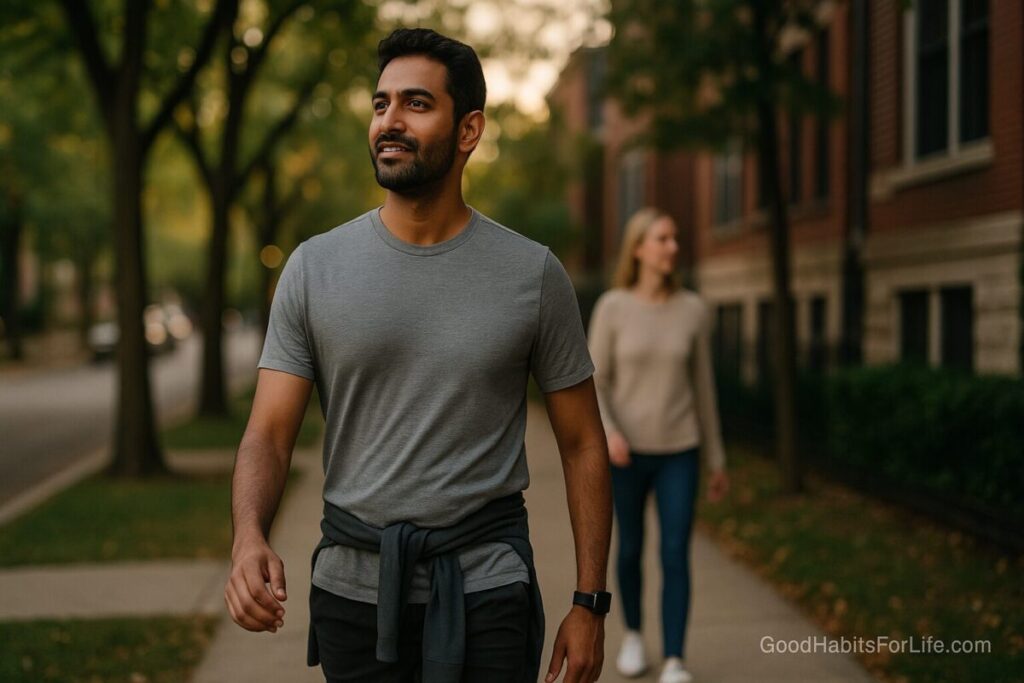
Walking After Meals: The 101010 Rule: Zone 2 + NEAT (2025)
Walking After Meals: The 10-10-10 Rule (Zone 2 + NEAT) 2025
Table of Contents
🧭 What is the 10-10-10 Rule?
Definition: Walk for 10 minutes, at a Zone 2 pace, after each main meal (breakfast, lunch, dinner). That’s three short walks per day. If you routinely eat two larger meals, do two 10-minute walks and add a 10-minute NEAT block (e.g., stairs, light chores, standing desk + pacing).
Why “10-10-10”?
-
Ten minutes is short enough to be doable, long enough to matter.
-
After-meal timing helps blunt post-prandial glucose spikes.
-
Zone 2 is low-stress, sustainable, and stacks with your other training.
-
The extra movement increases NEAT—the biggest, most overlooked lever for daily calorie burn.
✅ Why It Works (Zone 2 + NEAT + Meal Timing)
1) Post-meal walking reduces glucose spikes.
Multiple studies show that brief, moderate walking after meals improves post-prandial glycemia compared with sitting—and is at least as good as longer, single bouts later in the day. Even 2–10 minutes helps; 10–15 minutes is better for many people. PMC+2PMC+2
2) Zone 2 is the metabolic “sweet spot.”
Zone 2 ≈ 60–70% of max heart rate or the talk test (you can talk in sentences, but not sing). It builds your aerobic base, improves fat oxidation, and is gentle on recovery—ideal for daily consistency. Brown HealthCDC
3) NEAT compounds the effect.
NEAT (Non-Exercise Activity Thermogenesis) is the energy you burn outside of formal workouts (walking, chores, fidgeting). Raising NEAT meaningfully increases total daily energy expenditure and supports weight management and cardiometabolic health. PubMedMayo Clinic Proceedings
4) It fits the guidelines—without feeling like “exercise.”
Short, frequent walks nudge you toward the 150–300 minutes/week of moderate activity recommended by WHO and ACSM, especially when combined with other activity. PMCACSM
🛠️ Quick Start Today
Do this now (takes ~10 minutes):
-
After your next meal, step outside or pace a hallway for 10 minutes.
-
Use the talk test to stay Zone 2 (you can talk, not sing). CDC
-
Route: Out-and-back for 5 minutes each way, or loops around your building.
-
Cues: Set a phone alarm called “10-10-10 Walk.”
-
If you’re stuck at a desk: Walk the stairs or corridor. If truly stuck, do standing NEAT: stand, calf raises, gentle marching in place.
-
Stack it: Take a walk-and-talk call or a podcast-pairing habit.
Pace guide: Aim for 3.5–5.5 km/h (2.2–3.4 mph) on flat ground for most adults—adjust to pass the talk test.
📅 7-Day Starter Plan
Goal: Automatic 10-10-10 habit by the end of the week.
-
Day 1—Anchor: After one meal, do 10 minutes. Note how you feel.
-
Day 2—Double: After two meals, 10 minutes each.
-
Day 3—Triple: Hit all three post-meal walks.
-
Day 4—Route Upgrade: Pick two default routes (work + home).
-
Day 5—NEAT Boost: Add one 10-minute NEAT block (stairs, laundry, tidying).
-
Day 6—Zone Check: Use the talk test or a wrist HR (≈60–70% max). CDCBrown Health
-
Day 7—Lock-in: Create calendar repeats + phone alarms for meal times.
Checkpoint: If you miss a slot, do a “catch-up 10” within 60–90 minutes of the meal or add two 5-minute movement breaks later (still valuable). PMC
🧠 Techniques & Frameworks
The 3T Framework: Time, Terrain, Tie-ins
-
Time: 10 minutes x 3 (±5 minutes buffer).
-
Terrain: Prefer flat to gently rolling; stairs if indoors.
-
Tie-ins: Pair with coffee/tea, podcasts, walk-and-talks, or family strolls.
Intensity—3 ways to set Zone 2:
-
Talk test: can talk in sentences, not sing. CDC
-
RPE 4–5/10: comfortable, steady breathing.
-
HR guide: ~60–70% HRmax (220–age is a crude estimate). Brown Health
Habit scaffolds:
-
If-Then: If I put my fork down, then I put my shoes on.
-
Two-Minute Rule: Start with 2 minutes—if it feels easy, keep going to 10.
-
Friction fixers: Keep shoes by the door, use slip-ons, umbrella by the coat rack.
-
Stack NEAT: Waiting for the kettle? Pace. On hold? Walk.
Progression ideas (after 2–4 weeks):
-
Extend a single walk to 15 minutes on two days/week.
-
Add a 4th micro-walk (mid-afternoon) to break up sitting. PMC
-
One optional longer Zone 2 session weekly (30–45 minutes) as schedule allows, still keeping most work easy per endurance best practices. PMC
👥 Variations for Students, Parents, Professionals, Seniors & Teens
-
Students: Walk campus loops after cafeteria meals; review flashcards via audio.
-
Parents: Pram walks after family meals; toddlers can scoot alongside.
-
Professionals: Convert post-lunch meetings into walk-and-talks; set elevator to stairs for at least one flight.
-
Seniors: Choose flat, well-lit routes; use supportive footwear; bring a buddy.
-
Teens: Pair with music; do schoolyard loops with friends.
⚠️ Mistakes & Myths to Avoid
-
Myth: “Only long workouts count.” Short post-meal bouts have unique glycemic benefits. PMC
-
Mistake: Walking too hard. If you can’t talk, you’re likely above Zone 2—slow down. CDC
-
Myth: Standing is enough. Light walking beats standing for glucose control. PMC
-
Mistake: All at once. Three 10s often beat one 30 for glycemic steadiness. PMC
-
Myth: NEAT is trivial. NEAT can vary by hundreds of kcal/day—it matters. PubMed
💬 Real-Life Examples & Scripts
At work:
-
“Team, I’m doing a quick 10-minute lap—ping me if you need me.”
-
“Let’s make our 2 pm sync a walk-and-talk.”
At home:
-
“I’m taking the plates; let’s do one loop around the block before we clean up.”
-
“Kids, grab your scooters—10-minute adventure!”
In bad weather / no outdoor space:
-
Stairs: Up & down for 10 minutes (start slow).
-
Corridor loops: Choose a 40–60 m hallway; walk 10 minutes.
-
Treadmill: 3–4% incline if you want more challenge while staying Zone 2.
Travel script:
-
“I’ll meet you in the lobby for a 10-minute post-breakfast stroll—bonus jet-lag reset.”
🔧 Tools, Apps & Resources
-
Timers/Reminders: Phone alarms named “10-10-10”; smart-watch reminders.
-
Trackers: Any wearable that shows heart rate or RPE logging helps.
-
Route apps: Google Maps “Measure distance” to plan 5-minute out-and-back.
-
Desk helpers: Foldable walking pad (if space allows), under-desk pedals (light use), standing mat.
-
Habit apps: Streaks, Habitica, or Apple/Google Health rings for streak momentum.
Pros/Cons snapshot:
-
Timers: Free, simple / Might ignore notifications.
-
Wearables: Objective feedback / Cost, can over-optimize.
-
Walking pad: Weather-proof / Space + cost.
-
Streak apps: Motivating / Streak-anxiety if you miss days.
📌 Key Takeaways
-
10 minutes after meals at Zone 2 is a high-ROI, low-friction habit.
-
It reduces glucose spikes, raises NEAT, and supports fat loss & metabolic health.
-
Use the talk test to stay in Zone 2; consistency > intensity.
-
Pair with life: walk-and-talks, pram walks, corridor loops.
-
Build the habit in one week with the 7-day plan; then progress.
❓ FAQs
1) When exactly should I start the walk?
Within 10–30 minutes after finishing your meal. If schedules are tight, even 2–5 minutes helps; aim for 10 when you can. PMC
2) Is faster better?
Not necessarily. Zone 2 is the target—comfortably conversational. Too hard may reduce adherence and isn’t needed for the glycemic effect. CDC
3) What if I miss a post-meal walk?
Add a catch-up 10 within 60–90 minutes or two 5-minute movement breaks later. Breaking up sitting still improves post-prandial control. PMC
4) Can I do this with a cane, walker, or pram?
Yes—choose flat routes, bring support if needed, and prioritize safety. Zone 2 is relative to your fitness.
5) Does it replace gym sessions?
No, it complements them. Keep your strength/cardio plan and layer the 10-10-10 walks for metabolic steadiness and extra NEAT. PMC
6) How long until I notice changes?
Some people notice energy and digestion benefits within days; body-composition and cardio-fitness changes typically take weeks with consistency.
7) Do I need a heart-rate monitor?
No. The talk test is enough for most; HR can be helpful if you like numbers. CDC
8) Is after-meal walking safe for diabetes?
Often yes, but check with your clinician—especially if you use insulin or medications that can cause hypoglycemia.
9) Can I split the 10 minutes (e.g., 2 x 5 minutes)?
Yes—micro-bouts still help, though the single 10 is a simple default. PMC
10) Does incline matter?
Use gentle inclines if you like, but stay in Zone 2. Prioritize consistency over intensity.
📚 References
-
DiPietro L, et al. Three 15-min Bouts of Moderate Postmeal Walking… Diabetes Care. 2013. (PMC open-access). https://pmc.ncbi.nlm.nih.gov/articles/PMC3781561/ PMC
-
Bellini A, et al. The Effects of Postprandial Walking on the Glucose Response… Nutrients. 2022. (PMC open-access). https://pmc.ncbi.nlm.nih.gov/articles/PMC8912639/ PMC
-
Buffey AJ, et al. Acute Effects of Interrupting Prolonged Sitting… Sports Med. 2022. (Meta-analysis). https://pmc.ncbi.nlm.nih.gov/articles/PMC9325803/ PMC
-
World Health Organization. 2020 Guidelines on Physical Activity & Sedentary Behaviour. https://pmc.ncbi.nlm.nih.gov/articles/PMC7719906/ PMC
-
CDC. Measuring Physical Activity Intensity (Talk Test). https://www.cdc.gov/physicalactivity/basics/measuring/index.html CDC
-
Levine JA. Non-exercise Activity Thermogenesis (NEAT)… Proc Nutr Soc. 2004. https://pubmed.ncbi.nlm.nih.gov/15102614/ PubMed
-
Villablanca PA, et al. Nonexercise Activity Thermogenesis in Obesity Management. Mayo Clin Proc. 2015. https://www.mayoclinicproceedings.org/article/S0025-6196(15)00123-8/fulltext Mayo Clinic Proceedings
-
Stöggl TL, Sperlich B. Training Intensity Distribution Among Endurance Athletes. Front Physiol. 2015. https://pmc.ncbi.nlm.nih.gov/articles/PMC4621419/ PMC
⚖️ Disclaimer
This article provides general fitness and health information and is not medical advice. Consult a qualified professional for personal guidance, especially if you have medical conditions or take glucose-lowering medications.