
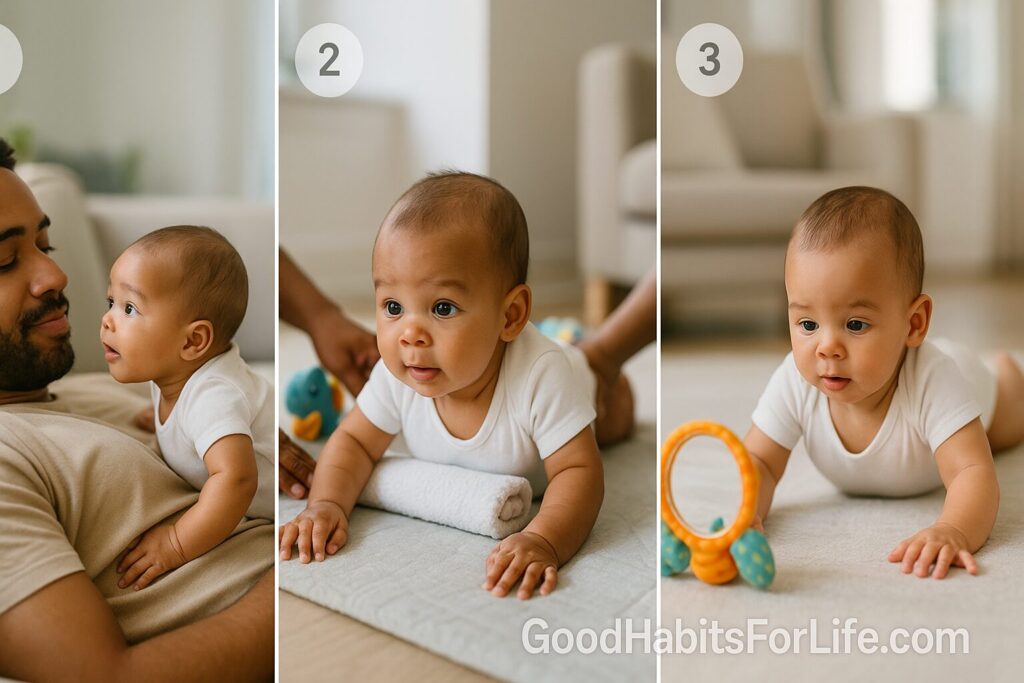
Tummy Time Without Tears: 123 Progression
Tummy Time Without Tears: 1-2-3 Progression
Table of Contents
🧭 What & Why
Tummy time is supervised play while your baby is awake and on their stomach. It builds neck, shoulder, and back strength, helps head control, supports rolling/crawling later, and protects head shape. A systematic review shows positive associations with gross motor development and reduced risk of brachycephaly (flat head). PubMed
When to start & how much: You can begin as soon as baby is home—tiny bursts multiple times a day—and gradually increase. For infants not yet mobile, global guidance recommends at least 30 minutes of tummy time across the day while awake and supervised. The AAP encourages starting from birth with short 3–5 minute sessions, working up as your baby enjoys it. World Health OrganizationHealthyChildren.org
Safety bottom line: Tummy time is for play only. For sleep, always place baby on the back on a firm, empty surface. Safe to Sleep
✅ The 1-2-3 Tummy Time Progression
Make tummy time easy with this three-step flow. Move forward as fussiness decreases and strength improves.
1) Chest-to-Chest (Newborn-friendly)
-
Recline at 30–45°. Place baby tummy-down on your chest, head turned to the side.
-
Support shoulders under the collarbone with your hand.
-
Talk, sing, and make eye contact—this is bonding and strength work. nhs.uk
Goal: Calm, happy 30–90 seconds × several times/day.
2) Supported Floor (Rolled Towel or Small Pillow Under Chest)
-
On a firm play mat, place a rolled towel under baby’s chest (nipple line) with arms forward over the roll, hips down.
-
Position a mirror or high-contrast card 20–30 cm (8–12 in) from the face.
-
Short sets, frequent breaks. Royal Children’s Hospital
Goal: 1–3 minutes per set, several sets/day.
3) Flat Floor with Reach & Pivot
-
Remove the prop. Encourage mini push-ups, reaching for toys, and head turns to both sides.
-
Place toys slightly off-center to promote weight shift and early pivoting.
-
Add side-lying breaks between sets to reset.
Goal: String sets together to reach your daily total comfortably. (WHO suggests ≥30 min/day for non-mobile infants.) World Health Organization
🛠️ Quick Start: Do-This-Today Plan
-
After each diaper change, do 30–60 seconds of Chest-to-Chest.
-
Two play windows today: try Supported Floor for 1–2 minutes each.
-
Place a mirror or your face at baby’s eye level; narrate what you see.
-
End on a win—stop before tears. Roll to side, cuddle, or feed.
-
Log total tummy time (notes app or paper). Tomorrow, add 30–60 seconds overall.
Tip: NICHD’s Safe to Sleep program notes you can start tummy time a day or two after birth—your baby sets the pace. Safe to Sleep
🗓️ 7-Day Starter Schedule (Spread Across the Day)
Target: reach ~15–30 min/day by around 7 weeks, per AAP patient education. Go by comfort: lots of short, happy attempts beat one long session. HealthyChildren.org
-
Day 1: 8–10 × 30–45 sec (mix of Chest-to-Chest and Supported Floor).
-
Day 2: 8–10 × 45–60 sec.
-
Day 3: 6–8 × 1 min (begin Flat Floor for 1–2 attempts).
-
Day 4: 6–8 × 1–2 min.
-
Day 5: 6–8 × 2–3 min (more Flat Floor; add reach-for-toy).
-
Day 6: 5–6 × 3–4 min.
-
Day 7: 5 × 4–5 min (aim 20–25 min total).
Checkpoint cues: less head bobbing, more eye contact, brief hand pushes, smoother head turns to both sides.
🧠 Techniques & Frameworks That Work
The “H.A.P.P.Y.” framework
-
High-contrast targets: black-and-white cards, bold stripes.
-
Angle & assist: change your angle (floor, chest, lap), add a towel roll to make it easier. Royal Children’s Hospital
-
Pair with routines: diaper changes, wake windows, after burps.
-
Pause before tears: stop early; reset in side-lying or over your forearm (“football hold”).
-
You near the floor: lie beside baby—your face is the best toy.
Make it engaging
-
Narrate (“I see your strong arms!”), sing, or count reps (“3 tiny push-ups”).
-
Use a mirror; babies love faces.
-
Alternate head turns to prevent side preference.
Safety guardrails
-
Awake + supervised only. Keep the surface firm and uncluttered.
-
For sleep, always Back to Sleep (supine). Safe to Sleep
-
Avoid wedges/positioners marketed for sleep. Follow manufacturer guidance for mats/gyms.
👶 Age-by-Age Tweaks
0–3 months
-
Prioritize Chest-to-Chest and Supported Floor.
-
Keep sets short (30–90 sec), increase frequency.
-
Use high-contrast visuals and gentle cheek-to-cheek encouragement.
3–6 months
-
More Flat Floor time with reach, grasp, and weight shifts.
-
Place toys in an arc to encourage pivoting.
-
Try mini-circuits: 2 min tummy → 30 sec side-lying → 2 min tummy.
(Track progress alongside developmental milestones with the CDC Milestone Tracker app.) CDC
⚠️ Mistakes & Myths to Avoid
-
Myth: “My baby hates tummy time, so we’ll skip it.”
-
Truth: Most babies fuss at first; the fix is shorter, more frequent, and starting on your chest. nhs.uk
-
-
Mistake: Waiting weeks to begin.
-
Fix: Start in the newborn period with seconds, not minutes. Safe to Sleep
-
-
Mistake: Only doing flat-floor tummy time.
-
Fix: Use the 1-2-3 progression; props like a towel roll reduce effort early on. Royal Children’s Hospital
-
-
Myth: Tummy sleeping will speed development.
-
Truth: Never place baby prone for sleep; risk outweighs any perceived benefit. Safe to Sleep
-
🧪 Real-Life Examples & Scripts
-
During diaper changes (script): “Strong time! We’ll do 30 seconds on tummy, then cuddle.”
-
If baby fusses (script): “You told me ‘all done’—rolling to your side now for a hug.”
-
Siblings help: “Show the rattle to the left… now right!”
-
Grandparent routine: Sit reclined; place baby tummy-down on your chest and sing one short song.
-
Mini-workout circuit (3–5 minutes total):
-
45 sec Supported Floor with mirror
-
15 sec side-lying reset
-
45 sec Flat Floor with reach to a soft ring
-
15 sec cuddle/reset
-
Repeat once
-
🧰 Tools, Apps & Resources
-
Firm play mat or blanket — stable surface for all three stages.
-
Rolled towel — easiest prop for Stage 2. (Avoid commercial wedges for sleep.) Safe to Sleep
-
Mirror or high-contrast cards — boost attention and head lifts.
-
Play gym with dangly toys — place slightly off-center to encourage head turns.
-
CDC Milestone Tracker (iOS/Android) — log skills and prompts for well-child checks. CDC
-
Reliable guides — AAP “Back to Sleep, Tummy to Play,” NHS “Tummy time,” and Royal Children’s Hospital fact sheets for variations and pictures. HealthyChildren.orgnhs.ukRoyal Children’s Hospital
Pros/Cons snapshot
-
Props (towel/mat): +Easier starts, –Need supervision.
-
Mirrors/toys: +Engagement, –Overstimulation if too close/bright.
-
Play gyms: +Reach/pivot targets, –Remove for sleep and never leave baby unattended.
📌 Key Takeaways
-
Start early, keep it short + frequent, and end on a happy note. Safe to Sleep
-
Build toward ~30 min/day total for non-mobile infants, spread across playtimes. World Health Organization
-
Follow the 1-2-3 path: chest → supported floor → flat floor with reach. nhs.ukRoyal Children’s Hospital
-
Tummy time supports motor development and head shape. PubMed
-
Sleep is always on the back, on a clear, firm surface. Safe to Sleep
❓ FAQs
How soon after birth can we start?
A day or two after birth is fine—begin with seconds on your chest and build gradually. Safe to Sleep
What’s a realistic daily goal?
For infants who aren’t yet mobile, aim for ≥30 minutes total/day, spread across many mini-sessions. World Health Organization
My baby cries on the floor. What now?
Return to Chest-to-Chest or add a rolled towel under the chest, then try the floor again later. nhs.ukRoyal Children’s Hospital
Does tummy time prevent flat spots?
More awake prone time is linked to better head shape and less brachycephaly risk; also vary head turns in supine. PubMed
How do I know tummy time is “working”?
You’ll see longer head lifts, smoother side-to-side turns, brief arm pushes, and eventually reaching/pivoting—skills that align with typical motor milestones. Track with the CDC Milestone Tracker. CDC
Is tummy time safe for preemies?
Ask your pediatric provider for individualized guidance. The principles (awake, supervised, gentle progression) still apply. AAP Publications
Can I do tummy time after feeding?
Yes—wait ~10–15 minutes, keep it short, and stop if baby spits up or shows discomfort.
What if my baby prefers turning the head one way?
Place toys on the less-favored side, switch arm positions, and do extra side-lying on the other side. If it persists, discuss at your well-child visit.
📚 References
-
American Academy of Pediatrics (HealthyChildren). Back to Sleep, Tummy to Play. https://www.healthychildren.org/English/ages-stages/baby/sleep/Pages/back-to-sleep-tummy-to-play.aspx HealthyChildren.org
-
World Health Organization. To grow up healthy, children need to sit less and play more (2019). https://www.who.int/news/item/24-04-2019-to-grow-up-healthy-children-need-to-sit-less-and-play-more World Health Organization
-
NICHD Safe to Sleep®. Tummy Time for a Healthy Baby. https://safetosleep.nichd.nih.gov/reduce-risk/tummy-time Safe to Sleep
-
Hewitt L, et al. Tummy Time and Infant Health Outcomes: A Systematic Review. Pediatrics. 2020;145(6):e20192168. https://pubmed.ncbi.nlm.nih.gov/32371428/ PubMed
-
AAP Pediatric Patient Education. Back to Sleep, Tummy to Play (2022). https://publications.aap.org/patiented/article/doi/10.1542/peo_document285/80192/Back-to-Sleep-Tummy-to-Play AAP Publications
-
NHS Start for Life. Baby moves — Tummy time. https://www.nhs.uk/start-for-life/baby/baby-moves/ nhs.uk
-
Royal Children’s Hospital Melbourne. Tummy time for your baby. https://www.rch.org.au/kidsinfo/fact_sheets/Tummy_time_for_your_baby/ Royal Children’s Hospital
-
Canadian Paediatric Society / ParticipACTION portal. How much for babies (0–1 year). https://cps.ca/en/active-actifs/how-much-for-babies cps.ca
-
CDC. Developmental Milestones & Milestone Tracker App. https://www.cdc.gov/ncbddd/actearly/milestones/index.html CDC
Disclaimer: This guide is educational and not a substitute for personalized medical advice—consult your pediatric clinician for concerns about your infant’s development or safety.