
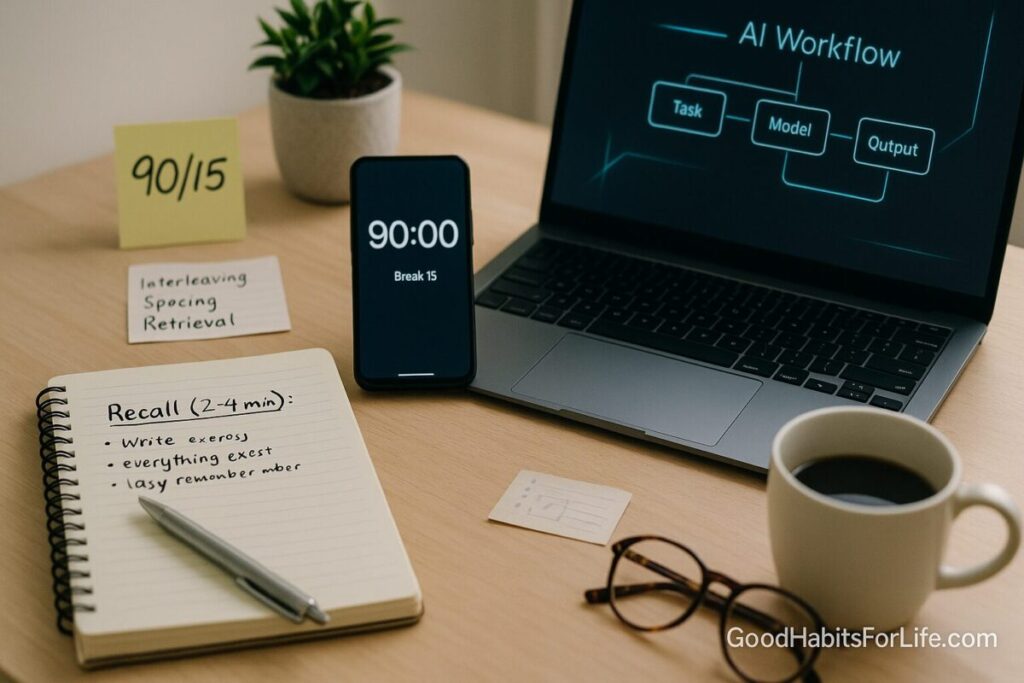
Study Sprints: 90 On / 15 Off with a Recall Break: AI workflows (2025)
Study Sprints 90/15 with Recall Break (2025 AI Workflow)
Table of Contents
🧭 What & Why
Study sprints 90/15 = work deeply for ~90 minutes, then 15 minutes off, beginning the break with a 2–4-minute closed-book recall (write or say everything you remember; then check and patch). This combo leverages three high-evidence levers:
-
Retrieval practice (“testing effect”) outperforms rereading for durable learning. Psychnet+1
-
Spacing (reviewing after delays) improves retention over massed practice; optimal gaps scale with your test horizon. PubMed+1
-
Interleaving (mixing problem types/topics) helps discriminate similar concepts and transfers better than blocking. ERIC+1
Why 90/15? Human attention and energy tend to ebb in ultradian-length waves (~90 minutes). A brief, purposeful break reduces the vigilance drop and can restore focus; micro-breaks improve well-being and performance when used wisely. PubMed+1
Recall at the start of the break adds a desirable difficulty that strengthens memory traces; wakeful rest right after learning can also aid consolidation. bjorklab.psych.ucla.edu+1
✅ Quick Start (Do This Today)
-
Pick one outcome. e.g., “Master equilibrium problems Ch. 6 Q1–12.”
-
Set your timers. 90-minute focus → 15-minute break (first 2–4 min = recall).
-
Block noise. Silence phone, close tabs, full-screen your source, use a site blocker.
-
Work in “questions.” Turn headings into questions; solve/answer from memory first, then verify. (Retrieval > reread.) Psychnet
-
Mid-sprint micro-reset (optional, 20–30 sec). Stand, inhale/exhale, note next sub-task—then continue.
-
Break (15 min):
-
2–4 min recall dump: write/say everything remembered; mark gaps.
-
6–8 min move & hydrate: short walk, mobility, water.
-
2–3 min plan the next sprint: list first two tasks you’ll do.
-
-
End-of-day spaced pinning (5–10 min): log 5–10 Qs you struggled with; schedule a 24-hour review.
AI in 60 seconds (today):
-
“Quiz me on Ch. 6 with 12 short-answer questions; hide answers until I say ‘reveal.’ Then generate 10 cloze deletions for flashcards.”
-
“Create an interleaved problem set mixing stoichiometry & equilibrium (30% easy, 50% medium, 20% hard).”
🛠️ Habit Plan: 30-60-90 Roadmap
First 30 Days — Build the base
-
Days 1–7: 1 sprint/day (90/15) on your hardest course. Start every break with recall; capture 8–12 flashcards/day.
-
Days 8–14: 2 sprints/day on different topics; interleave related skills in Sprint 2. ERIC
-
Days 15–30: 2–3 sprints/day max. Add spaced reviews: 0-1-3-7-14-28 days after first exposure. PubMed
Days 31–60 — Sharpen transfer
-
Add weekly mixed sets that force choosing the right method (not pattern-matching). ERIC
-
Replace one reread session each week with free-recall + concept check.
Days 61–90 — Exam-grade performance
-
Simulate exam blocks (2–3 sprints back-to-back), closed-book first, timed.
-
Use AI to generate “trick” variants of your weakest problems; answer aloud, then write.
Workload guardrails: 1–3 sprints/day (quality over volume). Keep breaks restorative; avoid social media during breaks (attention residue).
🧠 Techniques & Frameworks
Retrieval First, Read Second
Start every learning chunk with a low-stakes test (what can I recall now?), then read to patch gaps. It feels harder, but it’s more effective than rereading or highlighting. Science+1
Spacing That Matches Your Timeline
If your exam is in 4 weeks, space reviews across that horizon (e.g., 1, 3, 7, 14, 28 days). Longer goals → longer gaps. PubMed
Interleaving to Discriminate Similar Ideas
Mix problem types (e.g., derivatives, limits, integrals) so you choose the method from the problem itself—exactly what exams demand. ERIC
Desirable Difficulties
Make it productively hard: test yourself, vary contexts, and interleave topics. The struggle is a feature that improves long-term retention. bjorklab.psych.ucla.edu
Recall Break Protocol (2–4 minutes)
-
Close the book. List key ideas, steps, formulas, and “why” links.
-
Tag uncertainties. Star anything fuzzy.
-
Patch. Open notes/text to correct and tighten.
Wakeful Rest (optional add-on)
After intense encoding, 5–10 minutes of quiet rest (no phone) can boost later recall—especially when you resist new stimuli. PLOS
👥 Audience Variations
-
Students (school/uni): Keep to 2 sprints on class days; add a third only on light days. Use interleaving across courses M/W/F vs T/Th. ERIC
-
Professionals / cert exams: Use one daily sprint for new material and one for spaced review of weak domains.
-
Parents supporting teens: Encourage recall break demos (have them teach you for 3 minutes).
-
Seniors returning to study: Prefer 60–75 min sprints if 90 feels taxing; keep recall + spacing as non-negotiables.
-
ADHD-friendly tweak: Try 60/15 or 45/10 for endurance, keep the recall break, and gradually extend.
⚠️ Mistakes & Myths to Avoid
-
Myth: “90 minutes is magic.” It’s a guideline tied to natural attention cycles; adjust to 60–90 as needed. The key is deep focus + recall + spacing, not an exact number. ScienceDirect
-
Rereading > testing. False. Retrieval practice and spaced review beat rereading for long-term learning. Science+1
-
Break = phone time. Doomscrolling adds cognitive residue; prefer movement or quiet rest. PMC
-
Blocking forever. Interleave to learn when to use which method. ERIC
💬 Real-Life Examples & Scripts
A 3-Hour Block (2 sprints)
-
Sprint 1 (90):
-
0–5: Write 5 recall Qs from memory.
-
5–75: Deep work (problems/outline/essay).
-
75–90: Self-test (timed).
-
-
Break 1 (15): 2–4 min recall dump → 6–8 min walk/stretch → 2–3 min next-steps.
-
Sprint 2 (90): Interleave with a related unit; end with a 10-minute mixed quiz.
AI Prompt Scripts (copy-paste)
-
Retrieval: “Create 12 short-answer questions from [topic]. Hide answers until I say ‘reveal.’ After each answer, rate me 0–2 and keep a running ‘weak list.’”
-
Cloze Cards for Anki: “From this text, generate 20 cloze deletions (max 12 words each), include source line numbers if present.”
-
Interleaved Set: “Mix 20 problems across [A], [B], [C] so I must pick the method. Label each with the method only in the answer key.”
-
Spaced Plan: “Schedule my reviews for 28 days using expanding gaps (1,3,7,14,28). Output as CSV: date, task, duration.”
“Teach-Back” Script (2 minutes)
“I’m going to explain [concept] without notes, then check gaps. If I stall, prompt me with just a verb or the first formula symbol.”
🧰 Tools, Apps & Resources
-
Flashcards: Anki / RemNote (spaced repetition; keyboard-friendly; steep learning curve). PubMed
-
Note/Q&A pipelines: Notion/Obsidian + AI to generate recall Qs; export to CSV for Anki import.
-
Focus: Forest, Focus To-Do, or system DND + site blockers (Cold Turkey, Freedom) to protect 90 minutes.
-
Practice sources: Past papers, textbook end-problems, and AI-generated interleaved sets (check against your syllabus). ERIC
-
Audio recall: Use device TTS to hear notes and pause to answer aloud (hands-free retrieval).
📌 Key Takeaways
-
Retrieval beats rereading; spacing and interleaving multiply the gains. Science+2PubMed+2
-
90/15 with a recall start to the break is a practical way to apply the science.
-
Keep breaks restorative; avoid feeds. Micro-breaks help performance and energy. PMC
-
Scale with the 30-60-90 plan; cap at 1–3 high-quality sprints/day.
-
Use AI as a question generator and coach, not a crutch—always answer before revealing.
❓FAQs
1) Is 90/15 better than 25/5 (Pomodoro)?
It depends on task depth and endurance. For reading/problem-solving that benefits from long immersion, 60–90 minute blocks often work better, provided you protect the break and include recall. Use 25/5 when ramping up or on low-energy days.
2) How many sprints per day?
Most learners thrive on 1–3 quality sprints/day with spaced reviews. Consistency beats marathon days.
3) What exactly happens in the recall break?
Close your sources; list/teach back what you remember for 2–4 minutes, then patch gaps. It’s fast, effortful, and effective. Psychnet
4) What if 90 minutes is too long?
Use 60/15 or 45/10 and keep recall + spacing; lengthen as endurance improves.
5) How do I interleave without chaos?
Pick 2–3 related skills (e.g., algebraic manipulation, graph interpretation, word problems). Mix them in one set; label solutions, not questions. ERIC
6) Can I use music?
If lyrics distract you, try instrumental/ambient at low volume—or silence. Protect attention for complex reasoning.
7) Should breaks be active or restful?
Light movement and hydration are great. For consolidation after new learning, brief wakeful rest can also help. PLOS
8) How do I use AI without over-relying on it?
Have AI ask, you answer. Keep answers closed-book first; reveal solutions only after your attempt.
📚 References
-
Roediger, H. L., & Karpicke, J. D. (2006). The Power of Testing Memory. (Psychological Science in the Public Interest). PDF. Psychnet
-
Karpicke, J. D., & Blunt, J. R. (2011). Retrieval practice produces more learning than elaborative studying with concept mapping. Science. Science
-
Cepeda, N. J., et al. (2006). Distributed practice in verbal recall tasks: A meta-analysis. Psychonomic Bulletin & Review. PubMed
-
Cepeda, N. J., et al. (2008). Spacing effects in learning: A temporal ridgeline of optimal intervals. Psychological Science. PubMed
-
Rohrer, D. (2012). Interleaving helps students distinguish among similar concepts. Educational Psychology Review. (PDF). ERIC
-
Rohrer, D., Dedrick, R. F., & Stershic, S. (2015). Interleaved practice improves mathematics learning. Journal of Educational Psychology. (ERIC PDF). ERIC
-
Dunlosky, J., Rawson, K. A., Marsh, E. J., Nathan, M., & Willingham, D. (2013). Improving Students’ Learning with Effective Learning Techniques. Psychological Science in the Public Interest. SAGE Journals
-
Albulescu, P., et al. (2022). “Give me a break!” A systematic review and meta-analysis of micro-breaks and performance. PLOS ONE. PMC
-
Ariga, A., & Lleras, A. (2011). Brief and rare mental “breaks” keep you focused. Cognition. PubMed
-
Dewar, M., et al. (2012/2014). Brief wakeful rest boosts new memories; Boosting long-term memory via wakeful rest. Psychological Science; PLOS ONE. SAGE Journals+1