
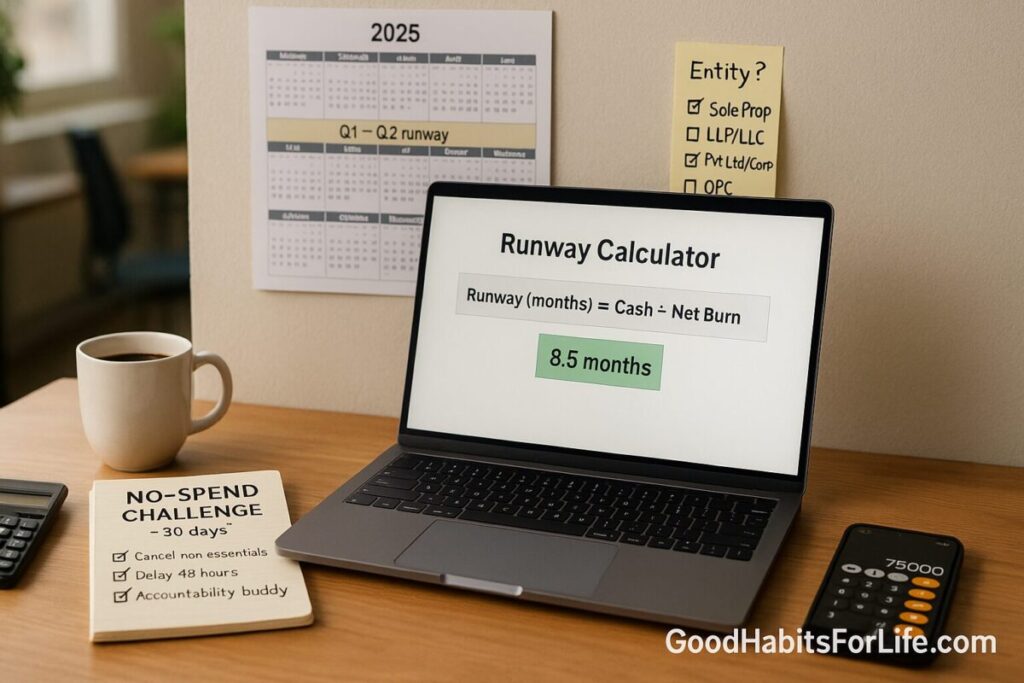
Starting a Business: Runway, Entity, Essentials: No-Spend Challenge (2025)
Starting a Business: Runway, Entity & No-Spend (2025)
Table of Contents
🧭 What & Why: Runway, Entities, and Lean Starts
Runway is how many months your business can operate before running out of money:
Runway (months) = Cash on hand ÷ Net monthly burn (expenses minus revenue). A longer runway buys time to iterate, find product-market fit, and survive financing cycles that have been tight for small firms since 2022. OECD
Survival odds improve with strong cash management. In recent U.S. data, roughly half of new employer firms survive five years and about one-third survive ten years—sobering numbers that make disciplined runway planning essential. Office of AdvocacyBureau of Labor Statistics
Entity choice shapes liability, tax, fundraising, and admin burden. Common options include sole proprietorship/sole trader, LLC/LLP, and corporations/limited companies. Government guidance summarizes the core trade-offs; choose with an accountant/lawyer based on risk, ownership, and expansion plans. IRSGOV.UK
India note (if you’re incorporating there): Private Limited Company, LLP, and One Person Company (OPC) are popular; Startup India/DPIIT recognition adds benefits if you qualify. Startup India+1
Why a no-spend challenge? Behavioral science shows that implementation intentions (“If it’s non-essential, then I delay 48 hours”) and commitment devices (public pledges, accountability) meaningfully improve goal follow-through—powerful tools to cut burn and extend runway. SPARQhoudekpetr.cz
✅ Quick Start: 10 Steps This Week
-
Confirm your runway. Tally bank cash + receivables; subtract committed outflows; divide by average monthly burn. Set a minimum runway goal (e.g., 12 months).
-
Price your startup costs. Use official calculators/templates to list one-time and ongoing costs; stress-test with pessimistic scenarios. Small Business Administration
-
Pick a provisional entity. Draft a 1-pager with your goals (liability shield, owner count, fundraising plan, admin tolerance). Map that to a likely entity; book the professional consult. IRSGOV.UK
-
Draft a lean 90-day budget. Prioritize revenue-critical line items; defer everything else 30–60 days.
-
Launch a 30-day no-spend sprint (personal + business) targeting discretionary outflows.
-
Create if-then rules (e.g., “If an expense > ₹5,000 / $100, then seek 2 quotes + delay 48 hours”). SPARQ
-
Build your break-even map with price, variable cost, and fixed cost estimates. Small Business Administration
-
Open business banking and separate accounts from day 1; set weekly cash reviews.
-
Pilot revenue. Ship a testable offer to 5–10 target customers; invoice same week.
-
Document decisions. Use a simple “Operating Memo” you update weekly (runway, burn, top risks, next experiments).
🧠 Techniques & Frameworks (Behavioral and Financial)
Financial
-
Burn-down ladder: Reduce burn by 10–20% every 30 days via a ranked list (cancel/replace/renegotiate/automate).
-
Break-even & unit economics: Calculate contribution margin; focus marketing on positive-margin SKUs/services first. Small Business Administration
-
Cash conversion cycle: Shorten invoice terms, request deposits, and negotiate longer payables.
Behavioral
-
Implementation intentions (If-Then). Pre-decide responses to spending triggers (e.g., “If I’m tempted to buy a tool, then I first borrow/rent/test free for 7 days”). Robust evidence supports if-then planning for goal attainment. SPARQ
-
Commitment devices. Make a public pledge to team/investors; use a shared dashboard; allow others to see spend exceptions. Commitment devices increase follow-through across savings and habit domains. houdekpetr.cz
-
Temptation bundling. Pair less-pleasant tasks (vendor negotiations) with rewards (favorite playlist/coffee) to reduce procrastination friction. PMC
🛠️ 30-60-90 Day Runway Plan + No-Spend Challenge
Days 0–30 (Stabilize)
-
Runway snapshot + goal. Example: ₹6,00,000 / $7,500 cash, burn ₹1,20,000 / $1,500 → runway = 5 months. Target 9 months in 90 days.
-
No-Spend Challenge (30 days).
-
Rules: No discretionary SaaS, ads, gear, meals, or travel. Essentials only (hosting, compliance, core tools).
-
Allowance: One pre-approved “needle-mover” expense cap per week.
-
If-Then Plan: “If a purchase is not legally required or directly revenue-producing this week, then it waits 30 days.” SPARQ
-
-
Entity progress. Confirm provisional structure and required registrations/IDs (e.g., EIN in the U.S.). IRS
-
Pricing & break-even. Validate contribution margins; adjust prices or scope. Small Business Administration
Checkpoint: Burn ↓ 10–15%; at least one paid pilot.
Days 31–60 (Extend)
-
Renegotiate fixed costs (workspace, SaaS tiers, suppliers).
-
Speed collections: upfront deposits; net-7 terms; auto-invoicing.
-
Pilot 2 more revenue streams (e.g., tiered service, small course/workshop).
-
Banking hygiene: weekly cash meeting; move idle cash to interest-bearing account where appropriate.
-
Market reality check: Financing remained tougher for SMEs post-2022—plan for slower credit cycles. OECD
Checkpoint: Burn ↓ 20–25%; runway +2 months.
Days 61–90 (Grow)
-
Selective spend re-introductions tied to proven ROI (ads with CAC < contribution margin).
-
Entity finalized (filed/registered), operating agreement/shareholder agreement in place (jurisdiction-appropriate). IRSGOV.UKStartup India
-
Metrics cadence: Weekly KPI (cash, burn, AR, pipeline), monthly board-style memo.
-
Buffer build: Aim for 2–3 months extra cash through deposits/pre-sales.
Checkpoint: Runway ≥ 9–12 months.
👥 Audience Variations
-
Students: Start as sole trader/sole prop while validating; keep costs minimal; switch to LLP/LLC or company when liability/funding needs arise. IRSGOV.UK
-
Parents/Caregivers: Favor entities that separate personal assets (LLC/LLP/company) and automate cash cushions. IRS
-
Professionals (consulting/freelance): Start lean with service pilots; invoice upfront retainers; consider LLP/LLC for liability. IRS
-
Seniors/Encore founders: Emphasize low-burn models; use no-spend and if-then filters to avoid tool sprawl. SPARQ
-
Teens/Young adults: Validate with micro-offers first; use parent/guardian guidance for compliance.
⚠️ Mistakes & Myths to Avoid
-
Myth: “I need big funding first.” Many businesses reach break-even through lean pilots and deposits. Macro data show financing conditions tightened after 2021; resilience and cash discipline matter. OECD
-
Mistake: “Entity later.” Delay can expose personal assets; pick a provisional structure early (even if you upgrade later). IRS
-
Mistake: “Marketing before margin.” Ads without clear unit economics burn precious runway; model break-even first. Small Business Administration
-
Myth: “Willpower will handle spending.” Pre-commitment and if-then plans outperform vague intentions. SPARQhoudekpetr.cz
💬 Real-Life Scripts & Templates
Vendor negotiation (email):
Hi [Name], we’re a bootstrapped startup testing [product/service]. To proceed this week, we need a leaner plan: [option A: –20% for 3 months] or [option B: same price with usage-based billing + 30-day termination]. If this works, we’ll expand volume. Could you confirm today?
Customer pre-sale (message):
We’re offering [outcome] for [who]. Early access is [price] with [bonus] if you join by [date]. We start [start date] and cap at [X] spots to ensure attention. Reply “YES” to reserve; I’ll invoice with a refund guarantee if we miss the kickoff.
If-Then spending rule (team charter):
If an expense is not legally required and won’t generate revenue within 30 days, then we defer it and revisit in the weekly cash review. SPARQ
🧰 Tools, Apps & Resources (Pros/Cons)
-
SBA Startup Costs Worksheet & Break-Even Calculator — Pro: official, simple; Con: U.S.-centric terminology. Small Business Administration+1
-
IRS Business Structures (U.S.) — Pro: clear tax/structure overviews; Con: doesn’t replace legal advice. IRS
-
GOV.UK Set up a business (UK) — Pro: step-by-step entity guidance; Con: UK-specific. GOV.UK
-
Startup India / DPIIT (India) — Pro: local structures & recognition info; Con: requirements change; verify current rules. Startup India+1
-
OECD SME Finance 2024 — Pro: global view of financing conditions; Con: not tactical. OECD
📌 Key Takeaways
-
Calculate runway and defend it with weekly cash reviews.
-
Choose an entity that matches risk, ownership, and fundraising plans; revisit as you scale. IRSGOV.UK
-
Use a no-spend challenge plus if-then and commitment tactics to cut burn without stalling momentum. SPARQhoudekpetr.cz
-
Model break-even and unit economics before scaling spend. Small Business Administration
-
Expect tighter financing cycles; cash buffers are strategic. OECD
❓ FAQs
1) How much runway is “safe”?
Aim for 9–12 months post-launch where feasible; uncertainty in financing markets since 2022 makes longer buffers prudent for SMEs. OECD
2) Which entity is best for a solo founder?
Often a sole prop/sole trader for early testing, then an LLC/LLP or company for liability and growth; check local rules and taxes. IRSGOV.UK
3) What proves I’m ready to spend on marketing?
When CAC < contribution margin and you’re ≥80% confident in repeatability; verify with your break-even math. Small Business Administration
4) Do no-spend challenges actually work?
They work best with if-then plans and commitment devices (public pledge, accountability, friction to break rules). Evidence shows higher follow-through vs. vague intentions. SPARQhoudekpetr.cz
5) Is fear of failure rising?
Global entrepreneurship monitors reported increased fear of failure among potential founders in 2024/25—another reason to de-risk through lean pilots. GEM Global Entrepreneurship Monitor
6) Where can I get official cost templates?
The SBA provides free cost worksheets and calculators to estimate startup costs and break-even. Small Business Administration+1
7) What about India-specific steps?
Choose between Pvt Ltd, LLP, or OPC; consider Startup India/DPIIT recognition if eligible. Register through MCA portals and keep up with compliance. Startup India+1
8) Are my survival odds terrible?
Not terrible—just demanding. About half of new employer firms reach five years; a third reach ten. Strong cash discipline improves your chances. Office of AdvocacyBureau of Labor Statistics
📚 References
-
U.S. Small Business Administration — Calculate Startup Costs and Break-Even Calculator. https://www.sba.gov/business-guide/plan-your-business/calculate-your-startup-costs ; https://www.sba.gov/business-guide/plan-your-business/calculate-your-startup-costs/break-even-point/calculate Small Business Administration+1
-
IRS — Business Structures & Starting a Business (U.S.). https://www.irs.gov/businesses/small-businesses-self-employed/business-structures ; https://www.irs.gov/businesses/small-businesses-self-employed/starting-a-business IRS+1
-
GOV.UK — Set up a business (entity guidance, UK). https://www.gov.uk/set-up-business GOV.UK
-
Startup India / DPIIT — Types of Businesses; Startup Recognition (India). https://www.startupindia.gov.in/content/sih/en/international/go-to-market-guide/types-of-businesses.html ; https://www.startupindia.gov.in/content/sih/en/startupgov/startup_recognition_page.html Startup India+1
-
OECD — Financing SMEs and Entrepreneurs 2024. https://www.oecd.org/en/publications/2024/03/financing-smes-and-entrepreneurs-2024_015c0c26.html OECD
-
U.S. Bureau of Labor Statistics — TED: 34.7% of establishments born in 2013 still operating in 2023; BDS/BED survival datasets. https://www.bls.gov/opub/ted/2024/34-7-percent-of-business-establishments-born-in-2013-were-still-operating-in-2023.htm ; https://www.bls.gov/bdm/bdmage.htm Bureau of Labor Statistics+1
-
SBA Office of Advocacy — Frequently Asked Questions About Small Business (2024) (five- and ten-year survival rates). https://advocacy.sba.gov/wp-content/uploads/2024/12/Frequently-Asked-Questions-About-Small-Business_2024-508.pdf Office of Advocacy
-
Global Entrepreneurship Monitor (GEM) — 2024/25 Global Report (press) (fear of failure insights). https://www.gemconsortium.org/reports/latest-global-report GEM Global Entrepreneurship Monitor
-
Gollwitzer, P. — Implementation Intentions & Goal Pursuit (meta/overview). https://sparq.stanford.edu/sites/g/files/sbiybj19021/files/media/file/gollwitzer_brandstatter_1997_-_implementation_intentions_effective_goal_pursuit.pdf SPARQ
-
Milkman, K. et al. — Temptation Bundling (field experiment). https://pmc.ncbi.nlm.nih.gov/articles/PMC4381662/ PMC
Disclaimer: This guide is educational and not financial, tax, or legal advice; consult a qualified professional for your situation.