
Standard Drink 101: A Visual Guide for Home Pours
Standard Drink 101: A Visual Guide for Home Pours
Table of Contents
🧭 What is a “Standard Drink” (and why it matters)
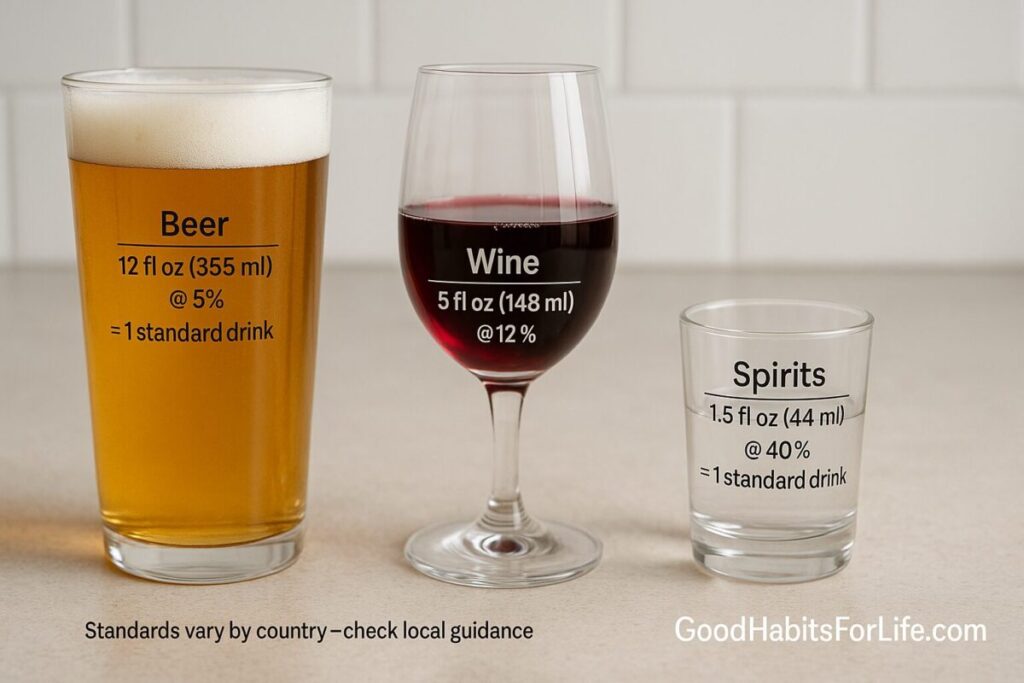
A standard drink is a public-health measuring unit that equals a specific amount of pure alcohol. In the United States, it’s 14 g (≈0.6 fl oz) of ethanol—roughly the amount found in 355 ml of 5% beer, 148 ml of 12% wine, or 44 ml of 40% spirits. Using a common unit helps you compare different beverages and pour consistently at home. CDCNIAAA
Standards differ by country: Canada 13.45 g, Australia 10 g, and in the UK one “unit” equals 10 ml (≈8 g) of pure alcohol. These differences are why bottle labels and calculators vary—so always apply your local standard. Government of CanadaHealth Department Australianhs.uk
From a health perspective, the safest approach is less is better: multiple health authorities note that there is no “safe” level of alcohol for cancer risk; risk increases from the first drink. Knowing your real pour size helps you keep intake lower and more deliberate. World Health Organization+1
✅ Quick Start: Set up accurate home pours today
-
Pick your three go-to glasses (beer, wine, spirits).
-
Measure once: Using a measuring cup or jigger, pour:
-
Beer: 355 ml (US) at ~5% as 1 standard drink (adjust for your country).
-
Wine: 148 ml at 12% (US baseline).
-
Spirits: 44 ml at 40% (US baseline). NIAAA
-
-
Mark discreet fill-lines: Use a small piece of clear tape or a glass pen on each glass at the 1-drink level (and optionally a ½-drink line).
-
Check your bottle ABV: If ABV is higher, the 1-drink line is lower; if lower ABV, it’s higher.
-
Pour-Pause-Confirm: Pour to the line, pause, confirm ABV, and enjoy slowly.
-
Track for one week with a simple tally or an app (see tools).
🗓️ 7-Day Starter Habit Plan
-
Day 1 – Calibrate: Mark your glassware lines for 1 drink (and ½ drink).
-
Day 2 – Label literacy: Scan 3 favorite brands; note ABV% and container size.
-
Day 3 – Measure spirits: Use a 30–45 ml jigger; practice ½-drink pours for cocktails.
-
Day 4 – Swap once: Replace one alcoholic drink with a no-/low-alcohol option you like.
-
Day 5 – Event rule: Pre-decide a personal cap (e.g., 2 standard drinks) and stick to it.
-
Day 6 – Mindful pacing: Alternate each drink with water; sip for at least 20–30 minutes.
-
Day 7 – Review: Tally your week in standard drinks/units; set a realistic goal for next week.
🛠️ Techniques & Frameworks for foolproof measuring
-
The Universal Formula (works anywhere):
grams of ethanol = ml × ABV% × 0.789 / 100.
Then convert to your country’s measure:-
US drinks = grams / 14
-
Canada drinks = grams / 13.45
-
Australia drinks = grams / 10
-
UK units = ml × ABV% / 1000 (since 1 unit = 10 ml ethanol). CDCGovernment of CanadaHealth Department Australianhs.uk
-
-
Pour–Pause–Check (PPC): Pour to your line → Pause 5 seconds → Check ABV on the label → Adjust if needed.
-
Half-Drink Habit: Make ½-pours your default at home; top up only if you still want it after 10 minutes.
-
Cocktail Math: Add the pure alcohol from each spirit (and fortified wine) ingredient, then convert with the formula above. Use an official calculator when unsure. Rethinking Drinking
-
Event Envelope: Before social events, set a specific budget of standard drinks (e.g., 2) and carry a water bottle to pace.
📊 Visual Equivalents: Common drinks at a glance
Estimates using the formula above; actual ABV varies by brand. “US drink” uses 14 g; “UK unit” uses 10 ml (≈8 g).
| Drink & Serve | Approx. pure alcohol (g) | US drinks | Canada drinks | Australia drinks | UK units |
|---|---|---|---|---|---|
| Beer, 355 ml @ 5% | 14.0 g | 1.00 | 1.04 | 1.40 | 1.77 |
| IPA, 355 ml @ 7% | 19.6 g | 1.40 | 1.46 | 1.96 | 2.48 |
| Wine, 148 ml @ 12% | 14.0 g | 1.00 | 1.04 | 1.40 | 1.78 |
| Wine, 180 ml @ 13.5% (big home pour) | 19.2 g | 1.37 | 1.43 | 1.92 | 2.43 |
| Spirits, 44 ml @ 40% | 13.9 g | 0.99 | 1.03 | 1.39 | 1.76 |
| Strong beer, 500 ml @ 7.5% | 29.6 g | 2.11 | 2.20 | 2.96 | 3.75 |
Tip: Big wine glasses and higher-ABV beers change the math fast; a 500 ml strong beer can be two+ US standard drinks. CDC
🧑🤝🧑 Audience Variations
-
Students/Teens (legal-age contexts only): Use the Half-Drink Habit and a buddy check-in; never mix with driving or exams.
-
Parents: Model measured pours at home; explain “straight line on the glass = one drink.”
-
Busy Professionals: Pre-commit your cap before work events; alternate with sparkling water.
-
Seniors: Alcohol effects increase with age and may interact with medicines; speak with your clinician and consider lower caps. (General health risk rises with any alcohol.) World Health Organization+1
-
Pregnancy & Trying to Conceive: Avoid alcohol completely; if you need support, talk with your healthcare provider.
⚠️ Mistakes & Myths to avoid
-
“A glass = a drink.” Not necessarily—home wine pours often exceed 150 ml; check the line.
-
Ignoring ABV. The same glass size at a higher ABV can double your intake.
-
Free-pouring spirits. Home shots are often 50–60 ml; use a jigger (30–45 ml) to stay consistent.
-
Assuming “moderate” = safe. Cancer risk begins at low levels; “less is better.” World Health Organization+1
-
Skipping water and food. Pace with water; eat before/during to slow absorption.
🗣️ Real-Life Examples & Scripts (copy-paste)
-
At a dinner party: “I pour to a line at home—mind if I grab a measuring jigger? I’m keeping it to one tonight.”
-
At a bar: “Could you make that a single measure, please? And a water on the side.”
-
With friends: “I’m tracking standard drinks this month—going for two max.”
-
Hosting: “Glasses are marked; one line = one drink. Mixers and no-alcohol options are on the left.”
📱 Tools, Apps & Resources
-
NIAAA Drink Size & Cocktail Calculator — reliable US tool to estimate drinks by ABV and recipe. (Web) Rethinking Drinking
-
CDC: Standard Drink Sizes — clear US reference visuals. (Web) CDC
-
UK Unit Calculators (NHS/Alcohol Change UK) — track by UK units easily. (Web) nhs.ukAlcohol Change UK
-
Australia: Standard Drinks Guide — local label examples and counts. (Web) Health Department Australia
-
Canada: Guidance on Alcohol & Health — Canadian standard drink and updated risk framing. (Web) Government of CanadaCCSA
Pros: evidence-based, easy comparisons; Cons: estimates vary with brand/recipe and pour size—calibrate your own glassware.
🔑 Key Takeaways
-
A standard drink is a fixed amount of pure alcohol (US 14 g; other countries vary). CDC
-
Calibrate your home glasses once and use the same fill-lines to pour consistently.
-
Use the grams-of-ethanol formula (or official calculators) to compare drinks across ABVs. Rethinking Drinking
-
Health risk increases with any alcohol; keeping pours honest helps you keep intake lower. World Health Organization+1
❓ FAQs
1) What exactly counts as one standard drink in the US?
About 14 g pure alcohol: 355 ml of 5% beer, 148 ml of 12% wine, or 44 ml of 40% spirits. CDCNIAAA
2) Why do “units” in the UK look different?
The UK uses units (10 ml ≈ 8 g ethanol). Units = ml × ABV% / 1000. nhs.uk
3) I don’t have a jigger. How can I measure?
Use a kitchen measuring cup (ml) once to mark a fill-line on each glass. Re-use that line every time.
4) Do big wine glasses change anything?
Yes—larger glasses invite bigger pours. A 180 ml @ 13.5% wine ≈ 1.37 US drinks (not one). (See table.)
5) How do I calculate a cocktail’s standard drinks?
Add the pure alcohol from each spirit/fortified ingredient using the formula; or use the NIAAA calculator. Rethinking Drinking
6) How long does it take to “process” a drink?
Roughly one UK unit per hour is a common rule of thumb, but it varies with body size, sex, food, and health; never use this to time driving. nhs.uk
7) What about “healthy” or “safe” drinking levels?
Authorities note cancer risk rises from any amount; many countries now emphasize “the less, the better.” World Health Organization+1
8) Do alcohol-free or low-alcohol beers count?
≤0.5% ABV options are great for pacing and typically count as near zero standard drinks—check labels and local definitions.
9) Are country guidelines different?
Yes—both “what is a standard drink” and low-risk recommendations vary by country; use local references in the tools section. CDCGovernment of CanadaHealth Department Australia
📚 References
-
Centers for Disease Control and Prevention. “About Standard Drink Sizes.” https://www.cdc.gov/alcohol/standard-drink-sizes/ CDC
-
National Institute on Alcohol Abuse and Alcoholism (NIAAA). “What Is a Standard Drink?” https://www.niaaa.nih.gov/alcohols-effects-health/what-standard-drink NIAAA
-
NIAAA. “Alcohol Drink Size Calculator.” https://rethinkingdrinking.niaaa.nih.gov/tools/calculators/alcohol-drink-size-calculator Rethinking Drinking
-
NHS. “Alcohol units.” https://www.nhs.uk/live-well/alcohol-advice/calculating-alcohol-units/ nhs.uk
-
Australian Government Department of Health. “Standard drinks guide.” https://www.health.gov.au/topics/alcohol/about-alcohol/standard-drinks-guide Health Department Australia
-
Health Canada. “Low-risk alcohol drinking guidelines (Standard drink = 13.45 g).” https://www.canada.ca/en/health-canada/services/substance-use/alcohol/low-risk-alcohol-drinking-guidelines.html Government of Canada
-
Canadian Centre on Substance Use and Addiction (CCSA). “Canada’s Guidance on Alcohol and Health (2023).” https://www.ccsa.ca/Canadas-Guidance-on-Alcohol-and-Health CCSA
-
World Health Organization (Europe). “No level of alcohol consumption is safe for our health.” https://www.who.int/europe/news/item/04-01-2023-no-level-of-alcohol-consumption-is-safe-for-our-health World Health Organization
-
WHO. “Alcohol – Fact sheet (carcinogen, global burden).” https://www.who.int/news-room/fact-sheets/detail/alcohol World Health Organization
Disclaimer: This guide is for general information only and is not medical advice; speak with a qualified health professional about alcohol use, medications, pregnancy, or specific health conditions.