
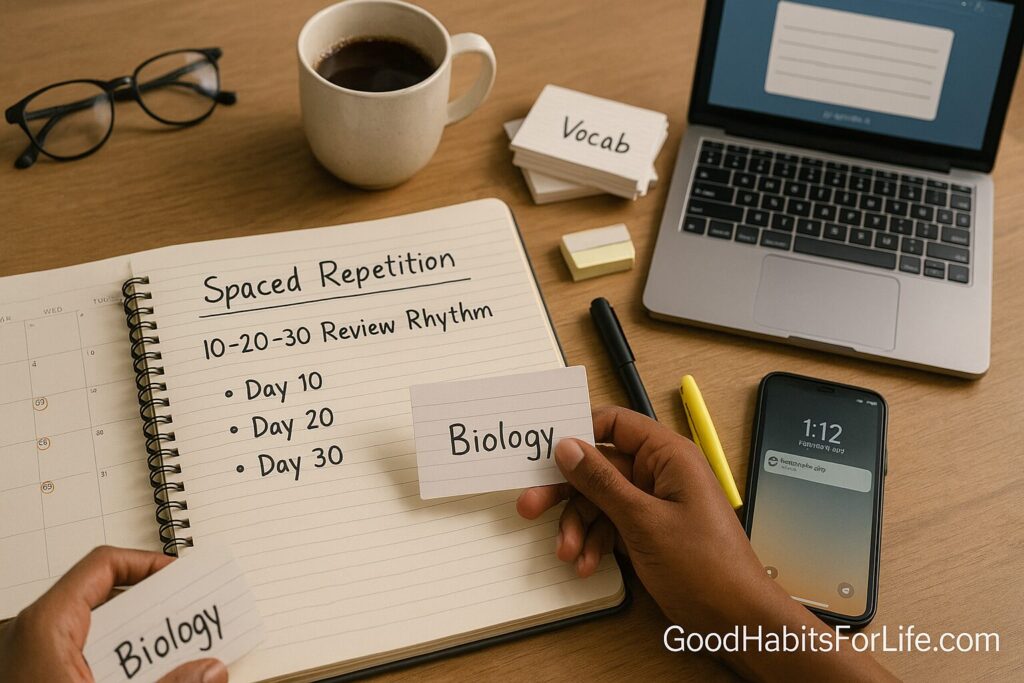
Spaced Repetition 2025: A 10-20-30 Review Rhythm
Spaced Repetition 2025: A 10-20-30 Review Rhythm
Table of Contents
🧠 What & Why: The Science of Spaced Repetition
Spaced repetition schedules multiple, expanding reviews of the same material. Instead of massed practice (“cramming”), you test yourself after increasing intervals, which strengthens the memory trace and retrieval routes. Dozens of studies show that spaced practice paired with retrieval practice (testing yourself) reliably improves long-term retention across ages and subjects compared with rereading or cramming. The effect holds for vocabulary, facts, concepts, and procedures.
Two core principles power the gains:
-
Spacing effect: Reviewing after a delay is more effective than reviewing immediately; gradually increasing the gap further improves efficiency.
-
Testing effect: Active recall (trying to remember) changes memory more than passive exposure. Quizzes and flashcards aren’t just assessments—they are learning events.
A practical rule from research: if you want to remember for a target duration, space reviews roughly 10–30% of that interval (e.g., if you need one-month retention, review after ~3–9 days); then expand. The 10-20-30 rhythm below is a simple, memorable starting template you can adapt.
⚡ Quick Start: Do This Today
Goal: learn 10–15 items (concepts, definitions, problems, words) with a minimal setup.
-
Pick content: 1 chapter/lecture or 10–15 facts.
-
Create atomic prompts: One idea per card (Q→A), or problems with worked steps hidden.
-
First pass (Learn): Read/skim actively; explain out loud in your own words.
-
Build cards/quiz: 10–15 items; add a hint and example where useful.
-
T+10 minutes: Do your first test cycle (until you hit ~80–90% correct).
-
Schedule T+20 hours (next day): Put a calendar nudge or app reminder.
-
Batch growth: Add 5–10 new items/day, keep total daily reviews ≤20–30 minutes.
-
T+30 days: Do a monthly consolidation review; archive mastered items.
🗓️ Habit Plan: The 10-20-30 Rhythm
Use this as a starter cadence; adjust based on difficulty, stakes, and your results.
When you first learn something (T0):
-
T0 + 10 minutes: Quick retrieval check. Fix weak spots immediately.
-
T0 + ~20 hours (next day): Deeper test. If ≥90% correct, extend next gap; if ≤70%, shorten.
-
T0 + ~30 days: Monthly consolidation: mix items from the month; prune or elaborate.
Weekly cadence (example):
-
Mon: New material (10–15 items). T+10 min review.
-
Tue: T+20h review (Mon set) + add 5–10 new.
-
Wed–Fri: Keep adding small sets; each day includes short reviews from prior days.
-
Sat: Light mixed review (15–20 min).
-
Sun: Off or catch-up.
Scaling up (semester/exam prep):
-
For 3-month retention: aim gaps around 1–3 days, 1–2 weeks, 1–2 months.
-
For language/vocab: daily micro-reviews, with app-driven intervals that expand automatically.
Targets & dials:
-
Accuracy: Aim 80–90% on reviews.
-
Load: Keep new cards/day ≤20 until you see stable completion.
-
Time box: 20–30 min/day beats occasional marathons.
🛠️ Techniques & Frameworks
Active recall patterns
-
Closed-book Q→A: Write a question; hide the answer; recite before revealing.
-
Worked example→blank step: Hide a key step; say/solve it, then check.
-
Elaboration: Answer “Why?” or “How does X differ from Y?” in one sentence.
-
Dual coding: Add a simple diagram or timeline to pair with text.
Frameworks you can mix in
-
Leitner system (paper flashcards): Boxes 1–5; correct answers move forward (less frequent); wrong answers move back (more frequent).
-
Interleaving: Shuffle related topics (A-B-C-A-B-C) to improve discrimination.
-
Desirable difficulties: Keep effortful recall—slightly hard, not impossible.
-
Two-pass method: Day-0 understanding pass → Day-1 retrieval pass.
Design better cards
-
One fact per card; no multi-clause monsters.
-
Prefer questions over statements; avoid vague “remember that…” prompts.
-
Add context cues (units, typical ranges, exceptions).
-
Create minimal pairs for confusable ideas (e.g., mitosis vs. meiosis).
-
For procedures, use “When I see… I will…” triggers.
👥 Variations by Audience
Students (school/uni):
-
Convert lecture outcomes into cards the same day.
-
For problem-solving courses, use step-masked cards plus weekly cumulative problem sets.
Professionals & certifications:
-
Keep decks role-based (e.g., “Cloud Networking — IAM”, “Auditing — Controls”).
-
Use scenario cards (“A client asks X; I should… ”) and monthly mock exams.
Language learners:
-
Mix production (L1→L2) with comprehension (L2→L1).
-
Add audio and example sentence; tag by theme (“food”, “travel”).
Seniors or return-to-learning:
-
Smaller daily loads (5–10 items), more context, and multisensory cues (audio, pictures).
-
Keep wins visible (progress bars/checklists) to fuel motivation.
Teens:
-
Gamify with streaks and small rewards; pair with a study buddy for weekly check-ins.
⚠️ Mistakes & Myths to Avoid
-
Myth: “More reviews = better.” Over-reviewing wastes time; expand gaps instead.
-
Rereading ≠ learning. Highlighting and passive rereads feel fluent but add little.
-
Bloated cards. Split them; “atomic” cards drive faster reviews.
-
No retrieval on Day-0. Always close the book and try to recall within minutes.
-
Ignoring confusion. Mark “hard” items; add a hint or example; shorten the next gap.
-
Deck explosion. Start with one deck per course/project; tag within the deck.
✍️ Real-Life Examples & Scripts
Definition card
-
Q: What is opportunity cost?
-
A: The value of the next best alternative foregone; e.g., choosing overtime over family time.
Concept contrast
-
Q: Mitosis vs. meiosis—one key difference?
-
A: Mitosis: 2 identical diploid cells; meiosis: 4 non-identical haploid cells.
Procedure trigger
-
Q: When a Docker container won’t start, first three checks?
-
A:
docker logs, image tag/version, port conflicts.
Script: 5-minute recap
-
Close notes. 2) List 3 big ideas from memory. 3) Add one example each. 4) Check gaps. 5) Make 2 cards from the gaps.
Script: exam morning
-
10-item mixed deck of weak points. Stop when you hit 80–90% and rest.
🧰 Tools, Apps & Resources
Flashcard & spaced apps (quick compare)
| Tool | Best for | Pros | Cons |
|---|---|---|---|
| Anki | Power users | Free, highly customizable, add-ons, great scheduler | Learning curve; plain UI |
| RemNote | Notes + spaced | Bidirectional notes + cards, tags, portals | Subscription for some features |
| Quizlet | Quick start/classes | Easy sets, class sharing | Limited true spaced in free tier |
| Mochi | Minimalist | Markdown, inline images, simple scheduler | Smaller ecosystem |
| SuperMemo | Advanced spacing | Research-grade algorithms | Steep learning; Windows-centric |
| Obsidian + plugins | Note-centric workflows | Keep content in Markdown; plugins add spaced recall | Setup time; plugin variance |
Low-tech: Index cards + Leitner boxes; wall calendar for 10-20-30 checkpoints.
✅ Key Takeaways
-
Space + test beats cramming; short, daily sessions win.
-
Start with 10-20-30 (10 minutes → 20 hours → 30 days), then adapt.
-
Build atomic, question-driven items; aim for 80–90% accuracy.
-
Keep the load sustainable (≤30 min/day) and prune/merge aggressively.
-
Use any tool you like—as long as it forces retrieval and expands intervals.
❓FAQs
1) Is 10-20-30 “optimal”?
No single schedule is universally optimal. 10-20-30 is a practical starting heuristic; tune gaps based on difficulty and your retention goal.
2) What accuracy should I aim for?
Around 80–90% correct keeps retrieval effortful without being discouraging.
3) Do I need flashcards?
No—you can quiz yourself with paper, outlines, or problem sets. Cards are popular because they enforce retrieval quickly.
4) How many new cards per day?
Start with 5–20 depending on time. Watch your review queue; if it balloons, lower intake.
5) What if I miss a day?
Don’t cram everything. Do a mixed review of due + hardest items, then resume normal spacing.
6) Can spaced repetition help concepts, not just facts?
Yes—use concept contrast, examples, and “explain-it-to-a-friend” prompts.
7) How long should I keep reviewing?
As long as you want reliable access to the knowledge. For semester exams, continue at least until exam week; for languages, keep light maintenance indefinitely.
8) How does this compare to Pomodoro?
Use Pomodoro (25/5) to time sessions; use spaced repetition to schedule what to review across days.
9) Is interleaving the same as spacing?
They’re complementary. Interleaving mixes topics; spacing separates reviews over time. Use both.
10) What’s a quick monthly check?
One 30–40-minute mixed review of the month’s material; archive or extend intervals for mastered items.
📚 References
-
Cepeda, N. J., et al. (2008). Spacing effects in learning: A temporal ridgeline of optimal intervals. Psychological Science. https://doi.org/10.1111/j.1467-9280.2008.02017.x
-
Cepeda, N. J., et al. (2006). Distributed practice in verbal recall tasks: A review and quantitative synthesis. Psychonomic Bulletin & Review. https://link.springer.com/article/10.3758/BF03193961
-
Dunlosky, J., et al. (2013). Improving Students’ Learning With Effective Learning Techniques. Psychological Science in the Public Interest. https://doi.org/10.1177/1529100612453266
-
Roediger, H. L., & Karpicke, J. D. (2006). Test-enhanced learning: Taking memory tests improves long-term retention. Psychological Science. https://doi.org/10.1111/j.1467-9280.2006.01693.x
-
Karpicke, J. D., & Roediger, H. L. (2008). The critical importance of retrieval for learning. Science. https://doi.org/10.1126/science.1152408
-
Kang, S. H. K. (2016). Spaced Repetition Promotes Efficient and Effective Learning. Policy Insights from the Behavioral and Brain Sciences. https://doi.org/10.1177/2372732215624708
-
Pashler, H., et al. (2007/2008). Organizing Instruction and Study to Improve Student Learning (IES Practice Guide). U.S. Dept. of Education. https://ies.ed.gov/ncee/wwc/Docs/PracticeGuide/20072004.pdf
-
Bjork, R. A., & Bjork, E. L. (2011). Making things hard on yourself, but in a good way: Creating desirable difficulties to enhance learning. Psychology and the Real World (chapter accessible via UCLA). https://bjorklab.psych.ucla.edu/publications/