
Smart Bottles in 2025: Do Reminders Really Help You Drink?
Smart Bottles in 2025: Do Reminders Really Help You Drink?
Table of Contents
🧭 What Are Smart Bottles & Do They Work?
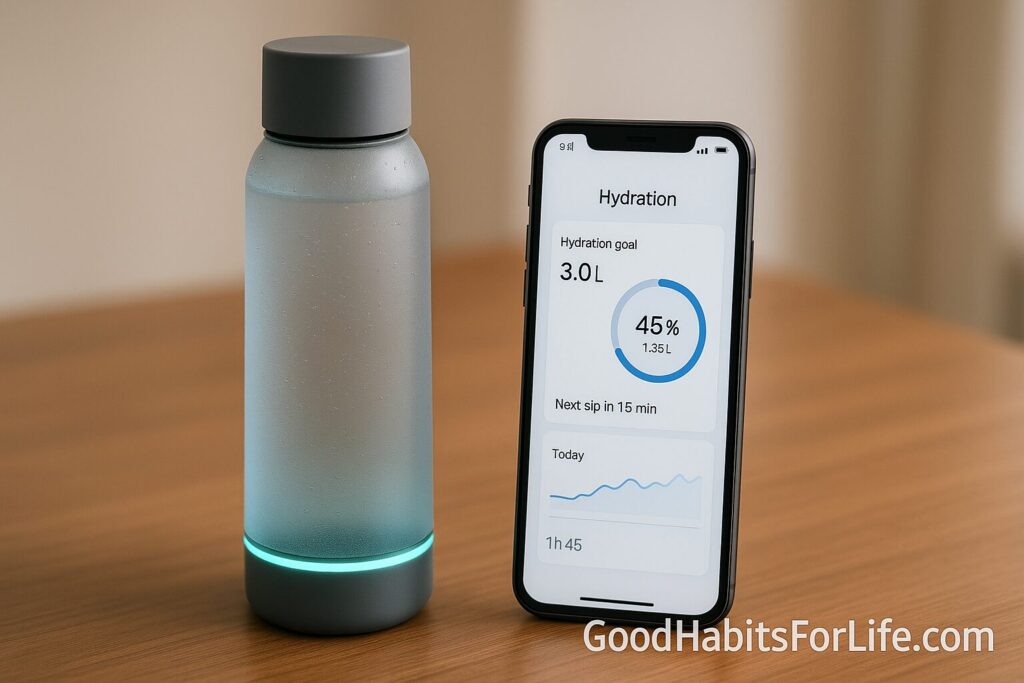
Smart bottles track how much you drink (via weight, flow or capacitive sensors) and nudge you with LEDs, vibrations, or phone notifications. Many sync to apps or wearables so you can set goals and view trends.
Do reminders help?
-
In a randomized trial with kidney-stone formers trying to drink more, those using a smart bottle with app reminders increased 24-hour urine volumes more than standard advice alone—suggesting reminders help people who forget. PubMedScienceDirect
-
Still, reminders aren’t magic. App studies show notifications spark short-term engagement, but the effect fades if prompts are too frequent or poorly timed. PMC
How much water do most people need?
Daily needs vary by climate, diet, activity and health status. As benchmarks: ~3.7 L/day for men and ~2.7 L/day for women (total water from foods + beverages); the EU sets AIs at 2.5 L for men, 2.0 L for women. Use these as flexible targets, not rigid quotas. National Academies PressEuropean Food Safety Authority
Practical self-check: pale-yellow urine usually signals adequate hydration; darker shades suggest you need fluids. Validated urine-color charts can help. PMC
✅ Quick Start: Set Up Yours for Real-World Success
-
Pick a realistic goal. Start with your 3-day average intake, then add +250–500 mL.
-
Enable 3–5 smart prompts/day—morning, mid-morning, lunch, mid-afternoon, evening—then tune down if they annoy you. (Too many alerts → you’ll ignore them.) PMC
-
Turn on context rules if your app supports them (e.g., only prompt when idle or at desk). That’s closer to “just-in-time” support. PMC
-
Place the bottle in your flow: desk (work), kitchen counter (home), backpack side pocket (commute).
-
Use a color check once/day: aim for urine color ~2–3 on an 8-shade chart. PMC
-
Log drinks you don’t track automatically (tea/coffee/soups count toward totals).
-
Set a “refill ritual”—every meal, refill to the line.
🛠️ 7-Day Starter Plan
Goal: Add ~300–600 mL/day without feeling forced.
-
Day 1–2 – Baseline + Setup
Track everything. Set alerts at 10:30, 13:00, 16:00. Place bottle where you’ll see it. -
Day 3 – Breakfast Anchor
Drink 250 mL on waking and another 250 mL with breakfast. Add a sticky note: “Sip before email.” -
Day 4 – Work Blocks
Before each meeting, take 5–10 sips. Refill at lunch. -
Day 5 – Afternoon Dip
Add a lightly flavored water (slice of lemon/cucumber) if plain water bores you. -
Day 6 – Activity Pairing
Pair water with an existing habit (e.g., after brushing teeth, sip 200 mL). -
Day 7 – Review & Tweak
Check bottle/app logs and urine color. If you ignored alerts, reduce frequency or shift times.
🧠 Techniques & Frameworks That Make Reminders Stick
-
Just-In-Time Adaptive Interventions (JITAI): Deliver help when you’re most receptive (e.g., at your desk, not in meetings). Use app features like “quiet hours,” geofencing, or activity-based prompts to time nudges. PMC
-
Implementation intentions: “If it’s lunchtime, then I refill the bottle.” Pair cues with specific actions to automate behavior. Wiley Online Library
-
Self-monitoring: A quick urine-color check provides immediate feedback and correlates reasonably with hydration state in everyday settings. PMC
-
Right-sized goals: Use weekly increments (e.g., +250 mL) rather than big jumps to avoid bathroom overload and drop-off.
-
Reduce friction: Keep water within arm’s reach; pre-chill in the fridge; choose a mouthpiece you like.
👥 Audience Variations
Students:
-
Put the bottle on your desk; alerts between classes. Create a “refill on entry” habit at the library.
Professionals (desk-based):
-
Use calendar-linked micro-prompts between meetings. Silence during presentations.
Seniors:
-
Favor larger sips more often; consider a straw-lid if grip strength is lower. Watch for medications that influence fluid balance (talk to your clinician).
Athletes/Outdoor workers:
-
Use activity-adjusted goals and consider electrolytes for long, sweaty sessions. (Hydration strategies differ for endurance events—seek sport-specific guidance.)
⚠️ Mistakes & Myths to Avoid
-
Myth: “8 glasses fits everyone.” Needs vary; use evidence-based ranges and personal cues. National Academies PressEuropean Food Safety Authority
-
Over-alerting. Too many pings → alert fatigue → you stop responding. Keep 3–5/day and adjust. PMC
-
Chugging liters at once. Overconsumption in short bursts can be dangerous (hyponatremia). Space intake and respect thirst. Cleveland Clinic
-
Ignoring urine color. It’s a simple, validated self-check; use it. PMC
-
Assuming the bottle will do the habit for you. You still need cues, routines, and reviews.
🗣️ Real-Life Examples & Handy Scripts
-
Desk reminder: “At 10:30 & 16:00 I take 10 sips and top up if <¼ left.”
-
Meal anchor: “After each meal, refill to the line.”
-
Commute cue: “When I unlock my phone on the train, I take 5 sips.”
-
Meeting micro-rule: “Before I unmute, I sip.”
-
Weekend check: “Sunday evening, I review my weekly graph and move alerts if I skipped them.”
📚 Tools, Apps & Resources
-
Smart bottle features to look for:
-
Reliable sensor + manual add for tea/coffee
-
Silent/LED prompts for meetings
-
Context rules (quiet hours, location)
-
App weekly trend view, export to Apple/Google Health
-
-
Low-tech backup:
-
1-L marked bottle with tape lines
-
Urine-color chart (aim for 2–3 most days) PMC
-
🧾 Key Takeaways
-
Smart bottles help most when forgetting is your main barrier; they’re less useful if timing/placement is wrong. PubMed
-
Keep prompts few and well-timed; adapt them as your routine changes. PMC
-
Use benchmarks (3.7 L men / 2.7 L women; EU 2.5 L/2.0 L) + urine color + how you feel to guide intake. National Academies PressEuropean Food Safety Authority
-
Pair tech with simple habit design (anchors, placement, review) for lasting change. Wiley Online Library
-
Don’t overdrink—space intake and know warning signs of hyponatremia. Cleveland Clinic
❓ FAQs
1) Are smart bottles better than phone-only apps?
Often they’re more visible—the bottle itself is a cue. But many benefits come from timely prompts + self-monitoring, which you can also achieve with a good app and a marked bottle. PMC
2) How many reminders should I use?
Start with 3–5/day and adjust; more is not better if you start ignoring them. PMC
3) What daily target should I set?
Use 3.7 L (men) / 2.7 L (women) as flexible benchmarks (total water from foods + drinks), or EU AIs 2.5 L / 2.0 L. Tune for heat, activity, and your doctor’s advice. National Academies PressEuropean Food Safety Authority
4) Is urine color a reliable guide?
Yes—urine-color charts are a practical tool for everyday use; aim for pale yellow. PMC
5) Can I drink too much water?
Yes. Rapid, excessive intake can cause hyponatremia (low sodium). If you notice confusion, severe headache, vomiting, or seizures, seek urgent care. Cleveland Clinic
6) Do smart bottles help everyone?
Evidence shows benefits especially when remembering is the barrier; if you already drink enough, the added value may be minimal. PubMed
7) Why do I still fall off after a few weeks?
Notification effects fade. Refresh your prompt times, change bottle placement, and review weekly. PMC
8) What about coffee and tea—do they count?
Yes. All beverages contribute to total water intake. Focus on overall fluids unless your clinician says otherwise. National Academies Press
📚 References
-
National Academies of Sciences, Engineering, and Medicine. Dietary Reference Intakes: Water. (3.7 L men; 2.7 L women). https://nap.nationalacademies.org/read/11537/chapter/15 National Academies Press
-
EFSA Panel on Dietetic Products, Nutrition and Allergies. Dietary Reference Values for water (AIs 2.5 L men; 2.0 L women). https://www.efsa.europa.eu/en/efsajournal/pub/1459 European Food Safety Authority
-
Stout TE, et al. A Randomized Trial Evaluating the Use of a Smart Water Bottle… (HidrateSpark; higher urine volumes vs advice alone). PubMed / ScienceDirect. PubMedScienceDirect
-
Bell L, et al. How Notifications Affect Engagement With a Behavior Change App: Micro-Randomized Trial. JMIR mHealth. https://pmc.ncbi.nlm.nih.gov/articles/PMC10337295/ PMC
-
Nahum-Shani I, et al. Just-in-Time Adaptive Interventions (JITAIs) in Mobile Health. https://pmc.ncbi.nlm.nih.gov/articles/PMC5364076/ PMC
-
Wardenaar FC, et al. Athletes’ Self-Assessment of Urine Color… IJERPH 2021. https://www.mdpi.com/1660-4601/18/8/4126 PMC
-
Perrier ET, et al. Urine colour change as an indicator of change in daily total fluid intake. https://pmc.ncbi.nlm.nih.gov/articles/PMC4949298/ PMC
-
Cleveland Clinic. Water Intoxication: Toxicity, Symptoms & Treatment. https://my.clevelandclinic.org/health/diseases/water-intoxication Cleveland Clinic
-
CDC/NCHS Data Brief. Daily Water Intake Among U.S. Men and Women, 2009–2012. https://www.cdc.gov/nchs/products/databriefs/db242.htm CDC
-
Lally P, et al. How are habits formed: Modelling habit formation in the real world. (habit automation over ~66 days). https://onlinelibrary.wiley.com/doi/abs/10.1002/ejsp.674 Wiley Online Library
Disclaimer: This article is for general information and is not medical advice; if you have a health condition or fluid restriction, follow your clinician’s guidance.