
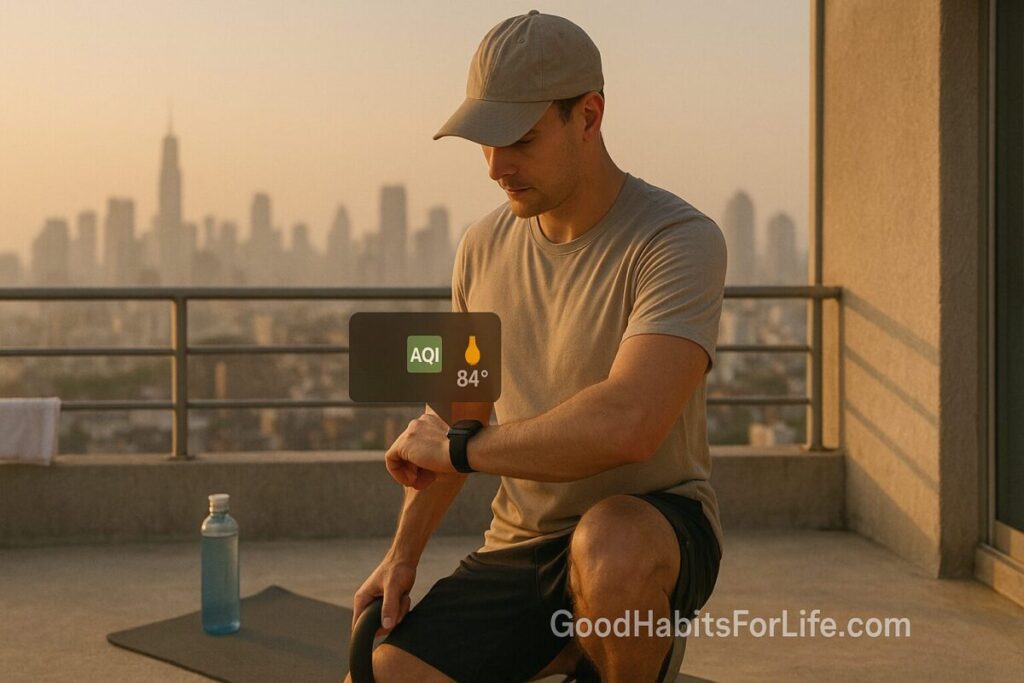
Rooftop Workouts: Heat & Air Tips
Rooftop Workouts: Heat and Air Tips
Table of Contents
🧭 What This Guide Covers & Why It Matters
Rooftop workouts are convenient, free, and flexible. But heat, sun, wind, and urban air can turn a great idea into a risky one. This guide shows you how to read the Heat Index, Air Quality Index (AQI/PM2.5), and UV Index, then pick the right session—so you keep fitness gains while protecting your heart, lungs, and skin.
Benefits when done right
-
Better adherence: no commute, low friction.
-
Extra Vitamin D with sun protection.
-
Functional conditioning (stairs, carries, sprint-style drills).
-
Mental refresh from training outdoors.
✅ Safety Baselines for Rooftop Training
Use this pre-session checklist. If any line flags red, modify or move indoors.
-
Heat Index (HI):
-
Green: <32 °C (<90 °F) → normal plan
-
Yellow: 32–40 °C (90–104 °F) → shorten, lower intensity, add rests
-
Red: ≥41 °C (≥105 °F) → avoid intense/long outdoor sessions
-
-
AQI (PM2.5 focus):
-
0–100: generally OK; sensitive people monitor symptoms
-
101–150: cut intensity/duration; consider mask or indoors
-
≥151: move indoors
-
-
UV Index:
-
0–2 low; 3–7 protect (hat/long sleeves/SPF)
-
≥8 very high/extreme: prefer shade or early/late training
-
-
Wind & Edge Safety: Avoid near edges; use a 1–2 m buffer; anchor bands; no loose plates on gusty days.
-
Surface: Dry, even, non-slip; rubber mat if tiles heat up.
-
Hydration: 150–250 mL every 15–20 min; for >60 min in heat, add electrolytes.
-
Buddy/Alert: Tell someone, carry a phone; know heat-illness signs (cramps, dizziness, confusion—stop immediately).
🌡️ Heat Index: Train, Modify, or Move Indoors
The Heat Index merges temperature and humidity to estimate how hot it feels to your body. Humidity blocks sweat evaporation, raising core temperature risk.
Guidelines
-
Warm-up smarter: 5–7 min easy mobility; pace by breath, not ego.
-
Work-to-rest: In yellow HI, use 1:2 or 1:3 work:rest (e.g., 30 s work, 60–90 s rest).
-
Cooling: Shade, cold bottle on neck, wet towel on forearms, and post-set hand cooling.
-
Signs to stop: Headache, chills, goosebumps, nausea, confusion.
🌫️ Air Quality (AQI & PM2.5): When to Dial It Back
PM2.5 particles travel deep into lungs; high levels make vigorous exercise risky.
Rules of thumb
-
AQI ≤100: Proceed; keep nasal breathing in warm-ups.
-
AQI 101–150: Shift to low-impact strength, mobility, breath-led cardio.
-
AQI ≥151: Train indoors; use HEPA/ventilated space.
-
Masks: If you must be outside in moderate AQI, a well-fitted N95/FFP2 reduces PM2.5 exposure during low-to-moderate work.
🌞 Sun & UV: Timing, Clothing, Sunscreen
-
Best times: Sunrise to ~9:00 and late evening; avoid 10:00–16:00 on high-UV days.
-
Clothing: Light, long-sleeve UPF top, brimmed cap, sunglasses (UV400).
-
Sunscreen: Broad-spectrum SPF 30+, 15 min before; reapply if >60 min or heavy sweat.
-
Shade hacks: Use a canopy/umbrella; rotate stations to keep bodies in shade.
🌬️ Wind, Surface & Space: Make the Roof Work For You
-
Wind: Great for cooling; dangerous near edges. Place stations away from parapets, and avoid overhead moves with bands on gusty days.
-
Surface temperature: Tiles can exceed air temperature by 10–20 °C (18–36 °F). Test with your palm; deploy a mat.
-
Space zoning: 3 zones—strength (stable), cardio (clear lane), mobility (mat/shade). Keep a clutter-free escape path.
⚡ Quick Start: A 15-Minute “Green-Light” Session
Do this when HI<32 °C, AQI≤100, UV≤7 (with protection).
-
Warm-up (3 min): March in place → arm circles → hip hinges.
-
Circuit (10 min AMRAP):
-
10 step-ups (sturdy step)
-
8 incline push-ups (railing/bench)
-
10 goblet squats (backpack with books)
-
30-sec brisk walk/jog shuttle
Rest 30–45 s between rounds.
-
-
Cool-down (2 min): Calf/hamstring/quadriceps stretch + 6 slow breaths.
Yellow HI tweak: Halve reps, double rests, move to shade.
🗓️ 7-Day Rooftop Starter + 30-60-90 Progression
7-Day Starter (20–30 min/day)
-
Day 1 (Strength A): Squats, step-ups, incline push-ups, plank (2–3 rounds).
-
Day 2 (Mobility + Zone 2): 15 min easy walk + hips/shoulders flows.
-
Day 3 (Intervals Light): 6×(30 s brisk/60 s easy) walking shuttles.
-
Day 4 (Strength B): Hip hinge (backpack deadlift), rows (band or table), split squats, side plank.
-
Day 5 (Mobility): Ankles, T-spine, hamstrings; breathing drills.
-
Day 6 (Mix): 4 rounds: 8 squats, 8 push-ups, 20-sec jog, 20-sec bear crawl walk-back.
-
Day 7 (Rest/Check): Bodyweight, sleep, and hydration review.
30-60-90 Roadmap
-
Days 1–30 (Foundation): 3×/wk strength (full-body), 2×/wk Zone-2 walks; cap intensity in heat; master form.
-
Days 31–60 (Build): Add 1 interval day; progress loads (backpack, water jugs); practice nasal breathing on easy work.
-
Days 61–90 (Perform): Introduce sprints only in green conditions; add carries (farmer/overhead with light weights), and 1 skill (jump rope or agility ladder).
Checkpoints (every 30 days): RPE during same workout, morning resting heart rate, and 1-min push-up/air-squat counts—only in green or mild conditions.
🛠️ Techniques, Frameworks & Sample Workouts
Heat-Smart Pacing Framework (RPE-First)
-
Yellow HI: Keep sets at RPE 5–6/10; add 50–100% rest.
-
Red HI: Swap to mobility, activation, breathwork indoors.
AQI-Aware Session Swap
-
Strength bias: Squats, hinges, pushes, pulls (low ventilatory demand).
-
Skip: Extended sprints, long jump-rope sets, high-rep burpees.
Two Sample Circuits
-
Strength-First (25 min):
3 rounds—12 backpack deadlifts, 10 incline push-ups, 12 step-ups/leg, 30-sec suitcase carry/arm; rest 60–90 s. -
Conditioning-Light (20 min):
EMOM 20:-
Odd minutes: 12 kettlebell swings (or hip hinge with band)
-
Even minutes: 30-sec brisk walk + 30-sec rest
(Yellow HI → reduce to 8 swings; add 30 s rest.)
-
👥 Variations by Audience
-
Students: Short 10–15 min “study breaks”; resistance bands fit in a backpack.
-
Parents: Nap-window 20-min circuits; keep a mat ready, avoid noisy plyometrics.
-
Professionals: Early-morning habit; set weather/AQI alerts the night before.
-
Seniors: Prioritize balance (tandem stands, heel-to-toe walks), chair support; stay in green HI/AQI only; longer rests.
🚫 Mistakes & Myths to Avoid
-
“Cloudy means safe.” UV can still be high; check the index.
-
Over-hydrating plain water. Long, hot sessions need electrolytes to avoid hyponatremia.
-
Training near edges. Always keep a buffer and avoid overhead moves in wind.
-
Black tiles with bare hands/knees. Use mats or gloves; surfaces can be far hotter than air.
-
Ignoring recovery. Heat raises strain; reduce weekly volume in hot spells.
🗣️ Real-Life Scripts & Checklists
Text yourself the night before:
“HI? AQI? UV? If any yellow/red → modify or indoor plan. Pack hat, SPF, 1 L bottle, electrolytes, towel, band.”
Pre-session 30-sec check:
“Surface dry? Shade set? Phone charged? Water ready? Edge buffer clear? Good—start easy.”
Post-session log (1 min):
“RPE ___/10, water ___ mL, rests felt ___, any symptoms? Next session tweak: ______.”
🧰 Tools, Apps & Resources
-
Weather/Air: Local weather app with Heat Index; AirNow or equivalent for AQI/PM2.5.
-
Pros: Real-time risk; Cons: Micro-climates vary on rooftops.
-
-
UV: Official UV Index apps; watch complications for alerts.
-
Gear: UPF hat/shirt, 2–3 mm rubber mat, collapsible shade, insulated bottle, electrolyte packets, mini-bands.
-
Tracking: RPE scale note, morning HR from a basic wearable or pulse check.
✅ Key Takeaways
-
Check HI, AQI, UV—then choose the right session.
-
Prefer early/late; use shade + hydration + electrolytes.
-
Keep edge/surface/wind safety non-negotiable.
-
Strength and mobility shine on poor-air or moderate-heat days.
-
Log RPE and adjust weekly volume during hot spells.
❓ FAQs
1) Is it safe to run sprints on the roof in summer?
Only in green conditions (HI<32 °C, AQI≤100, reasonable UV). Otherwise, swap to technique drills, short strides, or indoor intervals.
2) What should I drink and how much?
Aim for 150–250 mL every 15–20 min. For sessions >60 min or in heat, include electrolytes (sodium 300–600 mg/h depending on sweat).
3) Can a mask help when AQI is moderate?
A well-fitted N95/FFP2 can reduce PM2.5 during low-to-moderate work. For vigorous intervals, move indoors.
4) Do I still need sunscreen at 7 am?
If UV is ≥3 or you’ll be out >20–30 min, yes—apply SPF 30+ and wear UPF clothing.
5) My rooftop tiles are blazing. What now?
Lay a rubber mat, wear shoes with grip, avoid ground-based moves, and move stations into shade.
6) How do I acclimate to heat safely?
Increase outdoor exposure gradually over 1–2 weeks, starting with easy sessions and extra rest. Stop if symptoms arise.
7) What if only AQI is bad but heat/UV are fine?
Keep sessions strength-focused and shorter, or train indoors with filtration. Skip long intervals.
8) Are kids/teens okay to join?
Yes—with green conditions, lots of water, shade, and playful circuits. Keep sessions brief; avoid heat peaks.
📚 References
-
U.S. National Weather Service — Heat Index & heat safety guidance: https://www.weather.gov/safety/heat
-
CDC — Heat-related illness: signs, prevention & hydration: https://www.cdc.gov/disasters/extremeheat/heattips.html
-
EPA AirNow — AQI basics & PM2.5 health guidance: https://www.airnow.gov/aqi/aqi-basics/
-
World Health Organization — UV radiation & sun protection: https://www.who.int/news-room/q-a-detail/radiation-uv
-
OSHA — Outdoor work in heat: prevention & acclimatization: https://www.osha.gov/heat
-
American College of Sports Medicine — Exercise in the heat & hydration position statements: https://www.acsm.org
⚖️ Disclaimer
This guide is educational and not a substitute for personal medical advice; stop exercise and seek care if you experience symptoms of heat illness or respiratory distress.