
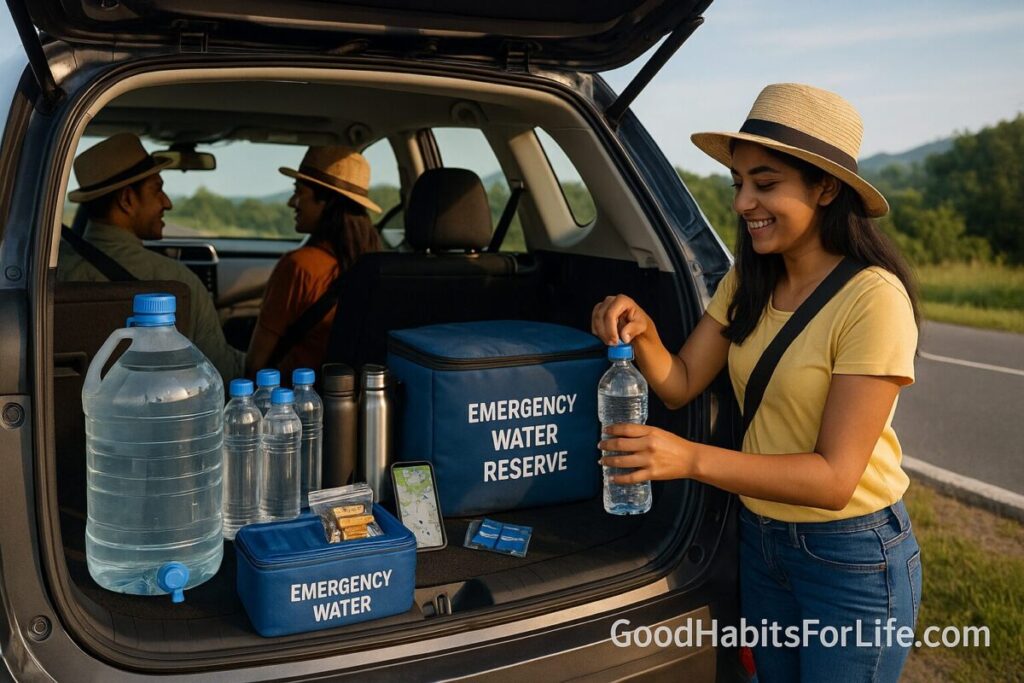
Road Trips: Pack Water First, Then Snacks: AI workflows (2025)
Road Trip Hydration: Pack Water First + AI Workflows (2025)
Table of Contents
🧭 What & Why (definition + benefits)
Road trip hydration means planning water intake, storage, and refill points so drivers and passengers stay alert, comfortable, and safe. Mild dehydration (even ~1–2% body mass) can reduce alertness and mood—bad news behind the wheel. Authoritative bodies suggest ~3.7 L/day for men and ~2.7 L/day for women (from all beverages/foods); hotter weather, AC airflow, altitude, caffeine, and salty snacks can raise needs. Keeping food cold (≤4 °C / ≤40 °F) and carrying an emergency water reserve are core safety steps for long drives.
Benefits: steadier energy, fewer headaches, better reaction time, safer temperature regulation, less impulse buying of sugary drinks, and smoother trip logistics.
Use rule of thumb: 0.5–1 L every 2–3 hours of driving for most adults; more in heat or sun.
✅ Quick Start (Do This Today)
-
Calculate water: total drive hours × 0.5 L (minimum) + 1–2 L buffer per person.
-
Pack water first: fill trunk floor with frozen bottles (double duty as ice packs), add room-temp bottles on top.
-
Cooler control: use a hard-sided cooler with thermometer; keep ≤4 °C (≤40 °F).
-
Stop cadence: schedule sip reminders every 30–45 min and pit stops every 2–3 hours.
-
Snack logic: salty snacks increase thirst—balance with fruit (oranges, grapes), cut veg, yogurt.
-
Refill plan: mark supermarkets, fuel stations with water dispensers, and rest areas on your route.
-
Emergency kit: 3–4 L spare water in the car + first-aid, flashlight, charger, reflective triangle.
🧠 30-60-90 Roadmap (habit you can keep)
Days 1–30 (Starter)
-
Build a reusable “Hydration First” packing list (water, cooler, ice packs, cups, trash bags).
-
Try 1 AI reminder workflow (e.g., phone reminder: “Sip 150–250 mL now” every 45 min while driving).
-
Practice two hydration stop types: restroom + refill; stretch + snack.
Days 31–60 (Upgrade)
-
Add heat-aware planning: if forecast highs >32 °C (90 °F), increase water by 25–50% and shorten stop intervals.
-
Standardize cooler loading: bottom frozen bottles, middle perishables, top quick-grab fruit.
-
Create a default route template with pre-marked refill stations every 150–200 km.
Days 61–90 (Automatic)
-
Use automation to geofence reminders (ping at rest areas).
-
Track personal intake (bottle tally or app) and adjust: clear urine, no headaches = on target.
-
Maintain a trunk kit: spare 4 L water, paper cups, electrolyte tabs, extra ice packs.
🛠️ Techniques & Frameworks
1) The 3-Layer Water Plan
-
Carry: 1–2 L/person accessible + frozen reserves as cooler ice.
-
Refill: map high-reliability points (supermarkets, large gas stations).
-
Emergency: sealed 4-8 L in trunk; replace quarterly.
2) Cooler Discipline (≤4 °C)
-
Pre-chill cooler; add block ice/frozen bottles; open sparingly.
-
Use a fridge thermometer inside. Meat/dairy in a leak-proof top bin.
3) Sip-Stop-Scan
-
Sip 150–250 mL every ~30–45 min.
-
Stop every 2–3 hours for restroom/stretch/refill.
-
Scan for heat stress: dry mouth, dark urine, fatigue, dizziness—act early.
4) Beverage Ladder
-
Tier 1: Water (still/sparkling).
-
Tier 2: Electrolyte tabs (heat, heavy sweaters).
-
Tier 3: Tea/coffee in moderation (not dehydrating in normal amounts).
-
Tier 4: Sugary drinks/juices—occasional; count toward fluids but watch calories.
-
Avoid alcohol while driving/road tripping.
5) Quantify for Your Trip
-
Example: 6-hour drive, 2 adults, 1 teen
-
Base: 6 hr × 0.5 L × 3 ppl = 9 L
-
Buffer: +2 L → 11 L total (carry 12–14 L incl. frozen bottles)
-
👥 Audience Variations
Students/Young Adults: budget refills (supermarkets vs convenience stores); use shared Google Map with refill pins.
Parents & Kids: pack spill-proof bottles; offer sips every 20–30 min; include high-water snacks (melon, cucumber). Watch for irritability and fewer wet diapers in toddlers.
Professionals on Work Trips: keep a compact soft cooler; avoid heavy caffeine pre-meeting to reduce restroom stress; schedule shorter, more frequent stops.
Seniors: age can blunt thirst; set stricter reminders; pack electrolyte drinks for hot days; keep meds cool per label.
Athletes/Outdoor Stops: if hiking at stops, use sports-drink mix for >60-min exertion in heat; weigh before/after if possible to replace ~100–150% of sweat loss.
⚠️ Mistakes & Myths to Avoid
-
Packing snacks first. Salty snacks without water increase thirst and fatigue.
-
“Caffeine dehydrates you.” Moderate intake doesn’t cause net dehydration for habituated adults.
-
Letting cooler drift >4 °C (40 °F). Food safety risk rises fast in the “danger zone.”
-
No emergency reserve. Traffic jams and breakdowns happen—carry extra sealed water.
-
Ignoring early signs. Headache, dark urine, dry mouth, and dizziness need immediate fluids and shade.
💬 Real-Life Scripts & Examples
-
At the store: “We’ll grab 12 liters of water first, then choose snacks that don’t fight hydration—fruit, yogurt, nuts.”
-
Driver reminder: “Hey Siri/Assistant, every 45 minutes on this drive, remind me to drink 200 milliliters.”
-
Kids cue: “Two sips at every song change; sticker for each bottle finished.”
-
Travel buddy check: “Color check—clear to light straw? If not, let’s sip and stop at the next rest area.”
📱 Tools, Apps & AI Workflows
Route & Refill
-
Google Maps / Apple Maps: Create a custom list: supermarkets, big-box stores, highway rest areas, parks with fountains.
-
Park/Highway apps: Rest-stop locators; national/state park fountain info.
Hydration Tracking
-
Water-tracking apps (free): bottle counters, daily goals, Apple Health/Google Fit sync.
-
Wearables: set vibration prompts every 45–60 min.
Cooler Safety
-
Fridge thermometer (analog/digital).
-
Packing checklist saved in Notes/Notion/Trello.
Automation (iOS Shortcuts / Android Routines/Tasker / IFTTT)
-
Drive-Start Workflow:
-
Trigger: connect to car Bluetooth OR start navigation.
-
Actions: start 45-min repeating reminder → “Drink ~200 mL”; open navigation list “Refill Points”; log start time.
-
-
Heat-Aware Boost:
-
Trigger: weather forecast max >32 °C.
-
Actions: add “+50% water” to packing list; shorten reminders to every 30 min; notify “Carry electrolyte tabs.”
-
-
Geofenced Refill:
-
Trigger: arriving at rest area radius 500 m.
-
Actions: pop checklist “Refill all bottles, check cooler temp.”
-
-
Family Trip Pack-Check:
-
Trigger: 7 pm the night before.
-
Actions: ask ChatGPT: “Given a 7-hour drive with 2 kids, generate a water & snack list within 1,500 ₹ budget,” then paste result into Notes.
-
Copy-Paste Prompts
-
“Plan my water for a [X-hour] drive with [Y people], max temp [°C]. Return liters to carry, refill stops every 150–200 km, and a shopping list under [budget].”
-
“Turn this route [origin → destination] into a hydration plan: where to refill, fruit stops, and cooler items keeping ≤4 °C.”
📚 Key Takeaways
-
Water first, snacks second. Pack 0.5–1 L per 2–3 hours per person + reserves.
-
Stop on schedule. Sips every 30–45 min; breaks every 2–3 hours.
-
Keep food cold. Cooler ≤4 °C; minimize openings; use frozen bottles.
-
Automate it. AI reminders, heat-aware boosts, geofenced refills.
-
Adapt for heat, kids, and seniors—and carry an emergency buffer.
❓ FAQs
1) How much water should I pack per person?
Start with 0.5–1 L per 2–3 hours of drive time, plus 1–2 L buffer per person, and more in heat.
2) Do coffee and tea count toward hydration?
Yes—moderate caffeine isn’t dehydrating for most adults and counts toward daily fluids.
3) When do I need electrolytes?
Use for hot conditions, heavy sweating, or exercise at stops (>60 min). Otherwise, water is enough.
4) What cooler temperature is safe?
Keep ≤4 °C (≤40 °F). Use a thermometer; pre-chill and limit openings.
5) Best snacks for hydration?
Fruit (melon, oranges, grapes), cut veg, yogurt, nuts; balance salty items with water.
6) How often should I stop?
Every 2–3 hours for restroom/stretch/refill; sip 150–250 mL every 30–45 min.
7) What’s an emergency water reserve?
Carry 4–8 L sealed in the trunk; replace quarterly.
8) How do I plan refills on unfamiliar routes?
Create a map layer of supermarkets, large gas stations, and rest areas; set geofenced reminders.
9) Any special tips for toddlers or older adults?
Offer frequent small sips; watch for fewer wet diapers (toddlers) or confusion/fatigue (seniors); increase fluids in heat.
10) Can sparkling water replace still water?
Yes—if you tolerate it and it doesn’t cause bloating; both hydrate.
References
-
National Academies of Sciences, Engineering, and Medicine. Dietary Reference Intakes for Water, Potassium, Sodium, Chloride, and Sulfate (2005). https://nap.nationalacademies.org/catalog/10925
-
EFSA Panel on Dietetic Products, Nutrition and Allergies (NDA). “Scientific Opinion on Dietary Reference Values for water.” EFSA Journal 2010;8(3):1459. https://efsa.onlinelibrary.wiley.com/doi/10.2903/j.efsa.2010.1459
-
CDC. “Extreme Heat — Stay Hydrated.” https://www.cdc.gov/extreme-heat/ (see hydration guidance pages)
-
NHTSA. “Summer Driving Tips & Emergency Kit.” https://www.nhtsa.gov/summer-driving-tips
-
USDA FSIS. “Refrigeration and Food Safety.” https://www.fsis.usda.gov/food-safety/safe-food-handling-and-preparation/food-safety-basics/refrigeration-and-food-safety
-
FDA. “Picnic and Food Safety.” https://www.fda.gov/consumers/consumer-updates/picnic-food-safety
-
Mayo Clinic. “Caffeinated drinks and dehydration: myth or fact?” https://www.mayoclinic.org/healthy-lifestyle/nutrition-and-healthy-eating/expert-answers/caffeinated-drinks/faq-20058349
-
American College of Sports Medicine. “Exercise and Fluid Replacement.” Med Sci Sports Exerc. 2007;39(2):377–390.
-
American Academy of Pediatrics. “Dehydration in Children.” https://www.healthychildren.org/English/health-issues/conditions/chest-lungs/Pages/Dehydration.aspx
-
National Institute on Aging (NIH). “Dehydration and Older Adults.” https://www.nia.nih.gov/health/dehydration-older-adults
Disclaimer
This guide is educational and not a substitute for personalized medical advice; seek professional care if you have health conditions or dehydration symptoms.