
Read Music Faster: Interval Thinking
Read Music Faster with Interval Thinking
Table of Contents
🧭 What & Why
What is “interval thinking”?
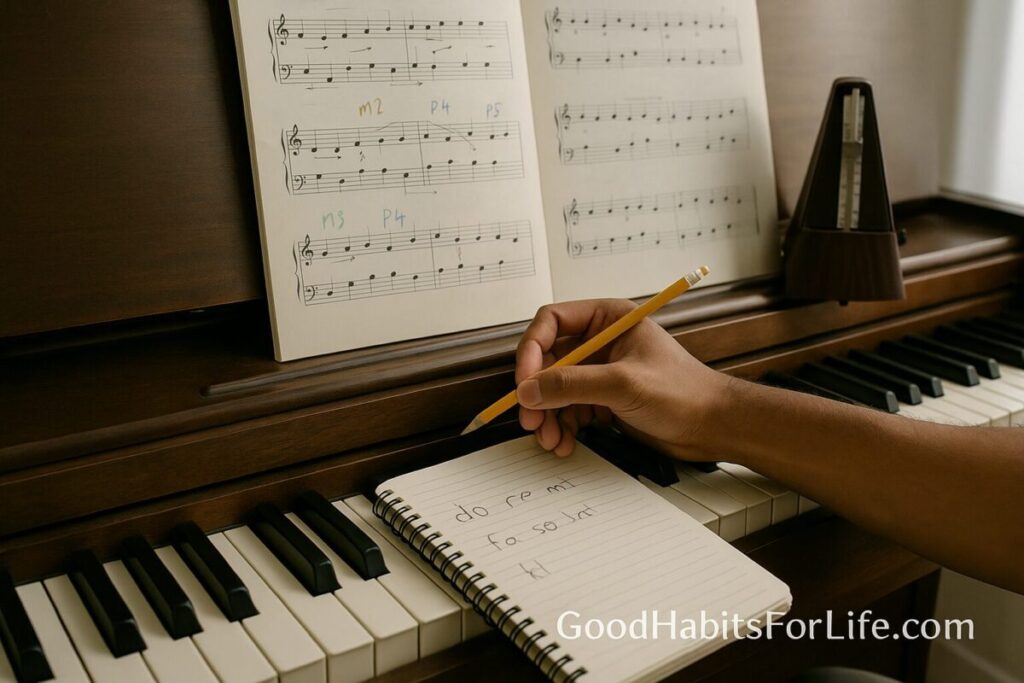
It’s reading by relative distance between notes (2nds, 3rds, 4ths…) instead of naming every note. Your eyes spot where the line moves (up/down, step/skip/leap), your ear anticipates the sound of that interval, and your hands map familiar shapes. This reduces cognitive load and speeds decoding.
Why it works (evidence):
-
Expert readers don’t read one note at a time. Eye-tracking shows they look ahead, grouping notes into meaningful chunks; better readers have longer preview spans and fewer fixations. JSTOR+2PMC+2
-
Building recognizable patterns (intervals, motives, chord shapes) accelerates recognition—classic work on chunking in music reading underpins this approach. ResearchGate
-
Layout can even change fluency: adding clear spacing between fragments improved sight-reading speed/accuracy in experiments. PMC
-
Integrated aural training (intervals, solfège) is linked with better sight performance in studies and reviews. PMC
🚀 Quick Start (Do This Today)
-
Pick a key & find tonic. Hum or play the scale once. Hearing “home” (do/1) anchors intervals.
-
Landmarks first. Mark (mentally or lightly) melodic peaks, lowest notes, repeats, and any leaps ≥ a 4th.
-
Think “to the target.” From each note, ask: next is up/down? step/skip/leap? Say the interval (e.g., “up a 3rd”).
-
Count out loud (1-&-2-&…). Subdivide anything tricky; clap or tap rhythm once before playing.
-
Sing-then-play. Lightly sol-fa (do-re-mi) or count scale degrees (1-2-3) for the first bar to “prime” your ear.
-
Set difficulty for growth. Choose excerpts where you hit about 85% accuracy—hard enough to stretch, not so hard you crash. Nature+1
-
One pass only (no stopping), then annotate 3 things you’ll watch next time (e.g., “watch descending 3rds,” “anticipate syncopation”).
🗓️ 30-60-90 Habit Plan
Days 1–30: Interval Foundations
-
Daily (10–15 min):
-
Interval ladder: in your key, alternate step (2nd) → 3rd → step → 4th → step → 5th, etc. Sing, then play.
-
Direction drills: random card/app prompts “up m3,” “down P4” from a given note.
-
1 page/day sight-read at ~85% accuracy; log tempo and error types (pitch vs rhythm). Nature
-
-
Checkpoint: You can label every move in a simple 8-bar melody as step/skip/leap, and keep pulse at 60–72 BPM.
Days 31–60: Patterns, Chords & Rhythm Layers
-
Add triad shapes (blocked/broken) and common sequences (e.g., stepwise + skip back).
-
Rhythm layer day: read only rhythm on a single pitch; then add intervals.
-
Look-ahead training: silently scan one beat ahead before playing (proven strategy in skilled readers). PMC+1
-
Checkpoint: Comfortable with 3rds/4ths/5ths in two keys; steady at 72–88 BPM with syncopations.
Days 61–90: Repertoire & Real Tempos
-
Style mixing: hymns/chorales (chord shapes), folk tunes (interval motifs), études (leaps).
-
Two-clef alternation (piano/choral) or position shifts (strings/guitar).
-
Performance rep: record one first-take read each session; reflect on chunking and tone.
-
Checkpoint: 85–100 BPM with moderate leaps and common accidentals, maintaining pulse and phrasing.
🧠 Techniques & Frameworks
TTT: Tonic → Target → Travel
-
Tonic: feel the key center.
-
Target: hear/sing the next note before you play it.
-
Travel: name the interval (“up m3”) and let fingers move by shape.
SCAN Method (before playing):
-
Signature (key/time), Cliffs (leaps), Accidentals, Nests (repeats/sequences). A 10-second scan reduces surprises and supports longer eye–hand spans. PMC+1
Interval Ladders & Shapes
-
Piano: map 3rd/6th “gaps,” 4th as “same color to next,” 5th as “skip one.”
-
Strings: pair interval names with positions; practice “down a 3rd” with guide fingers.
-
Winds/Brass: pair interval jumps with fingering groups (e.g., P4 = this set).
-
Voice: sol-fa degrees (1→3 = M3), keeping tonic sensation constant.
Layout & Notation Tips
-
Where possible (your own practice sheets), use clear vertical spacing between phrases; experiments show spacing can facilitate fluency. PMC
Rhythm-First Layering
-
Clap/tap rhythms alone, then add interval paths. (Curricula from ABRSM/RCM integrate rhythm + pitch for exams.) abrsm.org+1
👥 Audience Variations
-
Students/Teens: Short, daily 10-minute reads; make it a game (score 85%+ to “level up”).
-
Adult Beginners/Parents: Use sol-fa or 1–7 numbers; choose folk tunes with limited range.
-
Professionals: Increase look-ahead (scan 1–2 beats), diversify styles, and add transposition drills. PMC
-
Seniors/Returners: Favor larger notation, moderate tempos, and more rhythm-only passes before full reads.
-
Singers vs Instrumentalists: Singers anchor in scale-degree hearing; instrumentalists map interval→shape on their instrument.
⚠️ Mistakes & Myths to Avoid
-
Myth: “You must name every note letter while reading.”
Reality: Experts rely on relative motion and chunks; spelling comes later for analysis. JSTOR+1 -
Mistake: Practicing too easy or too hard.
Fix: Aim for ~85% accuracy for fastest learning. Nature -
Myth: Ear training is separate from reading.
Reality: Aural-skills work (intervals, dictation) is associated with better sight performance. PMC -
Mistake: Ignoring rhythm layers; most errors are rhythmic under pressure.
-
Mistake: Stopping to fix; sight-reading is real-time. Mark it, move on, review patterns later.
🗣️ Real-Life Examples & Scripts
Example 1: First-take melody in G major (common-time)
-
Scan: “Key G (1 sharp), ends on G; biggest leap looks like a 5th in bar 2; syncopation in bar 3.”
-
Play-through script:
-
“Bar 1: up a step, up a 3rd, step down.”
-
“Bar 2: leap up a 5th → step → step.”
-
“Bar 3: hold syncopation, then down a 3rd.”
-
“Bar 4: scalar finish.”
-
-
Reflect (10 sec): “Lost pulse at syncopation—tomorrow do rhythm-only; watch leaps ≥ 5th.”
Example 2: Chordal reading (piano/choral)
-
“Root-position triad → broken 3rds → first inversion → cadence V–I.”
-
Label the interval content (“two stacked 3rds”) and shape (“closed → open voicing”).
Copy-paste scripts you can use before every read:
-
“Key/time? Biggest leap? Where are repeats? Any accidentals?”
-
“Hear tonic → sing first interval → count-in → go.”
-
“No stops; annotate 3 fixes; recycle tomorrow.”
🧰 Tools, Apps & Resources
-
SightReadingFactory — infinite, graded excerpts; quick class codes; web-based. Pro: endless fresh material. Con: subscription. sightreadingfactory.com+1
-
RCM Online Sight Reading & Ear Training — graded pathways aligned to exams. Pro: integrated ear+reading. Con: piano-centric focus. rcmusic.com+1
-
metronome + audio recorder — enforce pulse; review first-takes.
-
Ear-training apps (interval ID + solfège): use daily 5–7 minutes.
-
Public-domain score libraries (e.g., hymnals, folk tunes) — rich in stepwise motion for interval practice.
-
Teacher check-ins or peer duets — accountability + ensemble rhythms.
✅ Key Takeaways
-
Intervals first → faster recognition, steadier pulse.
-
Chunk patterns (interval motives, triad shapes) instead of single letters.
-
Practice at ~85% success for optimal learning; track tempo & errors. Nature
-
Layer rhythm → add intervals → perform once; reflect and move on.
-
Integrate ear training (sing degrees/sol-fa) to lock in intervals. PMC
❓ FAQs
1) Is it better to read by intervals or by note names?
Use intervals for speed, then confirm note names during study. Experts rely on relative motion and chunking while sight-reading. JSTOR
2) How do I practice intervals daily in 10 minutes?
Run a key scale, then a 2–3-minute interval ladder (2nds/3rds/4ths/5ths), one rhythm-only read, and one full read at ~85% accuracy.
3) What about big leaps (6ths/7ths/octaves)?
Hear the target first (sing), visualize the shape (hand position/shift), and keep pulse—don’t stop. Add them gradually in Weeks 5–8.
4) Does ear training really help reading?
Yes. Reviews and studies link aural-skills work with better sight performance, including sight-singing and instrument reading. PMC
5) How fast will I improve?
If you read daily and keep difficulty at the sweet spot, most players notice steadier pulse and fewer pitch misses within 4–6 weeks. University of Arizona News
6) Should I clap rhythms first or add pitch right away?
Clap first for tricky passages; major exam frameworks (ABRSM/RCM) integrate rhythm + pitch, and rhythm control predicts fluency. abrsm.org+1
7) What tempo should I use?
Start where you can keep continuous pulse with ~85% accuracy; increase 5–10 BPM when your first-take meets that bar. Nature
8) Any layout tips to make reading easier?
Clear spacing between phrases can improve fluency; avoid cluttered scores when practicing. PMC
9) Do these ideas apply to singers, strings, winds, guitar, and piano?
Yes. The interval → shape (or interval → sol-fa) mapping is instrument-agnostic; only the physical execution differs.
📚 References
-
Goolsby, T. W. (1994). Eye Movements in Music Reading: Effects of Notational Complexity and Reading Ability. Music Perception. (JSTOR PDF). JSTOR
-
Puurtinen, M. (2018). Eye on Music Reading: A Methodological Review of Eye-Tracking Research. Frontiers in Psychology. PMC
-
Waters, A. J. (1998). Eye Movements in a Simple Music Reading Task. Psychology of Music. SAGE Journals
-
Sloboda, J. A. (1977/1985). The Psychology of Music Reading (overview of chunking in music reading). ResearchGate
-
Stenberg, A. (2019). White spaces, music notation and the facilitation of sight-reading. Frontiers in Psychology. PMC
-
Pomerleau-Turcotte, J., et al. (2022). Relationships between strategy choice and sight-singing performance in university-level musicians. Frontiers in Psychology (notes meta-analytic links between aural skills and instrumental sight-reading). PMC
-
Wilson, R. C., et al. (2019). The Eighty Five Percent Rule for Optimal Learning. Nature Communications. Nature
-
Royal Conservatory of Music — RCM Online Sight Reading & Ear Training (program structure/tools). rcmusic.com
-
ABRSM — Exam Preparation (sight-reading integrated with rhythm & key skills). abrsm.org
-
Sight Reading Factory — product page and NAfME discussion on software-assisted sight-reading practice. sightreadingfactory.com+1