
Order FamilyStyle: Share More, Waste Less: Dopamine Detox (2025)
Order Family Style: Share More, Waste Less (2025)
Table of Contents
🧭 What “Order Family Style” Means & Why It Works
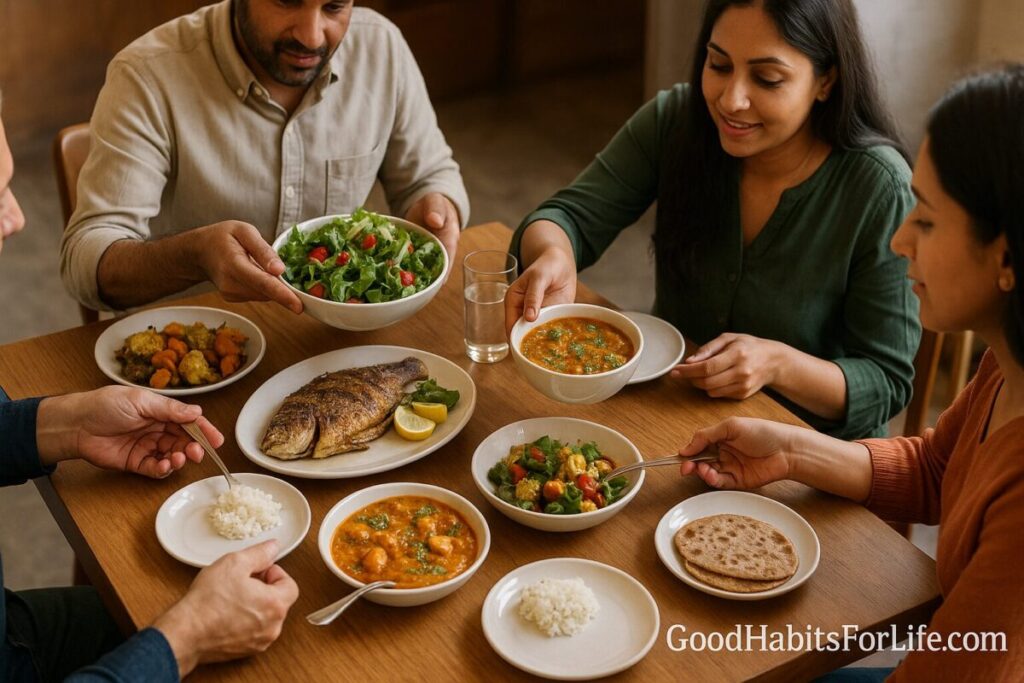
Definition. Ordering family style means choosing a few dishes for the table, placing them centrally, and sharing. Think 2–3 mains plus veg-forward sides for a party of 3–4, instead of individual entrées.
Why it works (evidence-aligned):
-
Portion sanity. Restaurant portions are often larger than home portions. Sharing helps align intake with appetite and reduces calories per person without feeling deprived (see CDC guidance on portion size awareness).
-
Less decision fatigue. Pre-setting a “share rule” trims choices, which research links to improved satisfaction and less impulsive decisions under choice overload.
-
Waste reduction. Restaurants and households together generate large amounts of food waste; sharing and pre-boxing leftovers cut plate waste and packaging.
-
Budget control. Splitting 2 mains + 1–2 sides usually costs less than four separate entrées, especially where service charges apply.
-
Social connection. Passing bowls and talking about dishes can slow pace, increasing mindful bites and enjoyment.
About “dopamine detox”: the phrase is pop-culture shorthand for reducing overstimulation and novelty-chasing. Here, it simply means simplify choices, slow down, and enjoy shared dishes—not a medical protocol.
✅ Quick Start: Do-This-Today Checklist
-
Set a rule before you go: “We’ll order family style: 2 mains + 2 veg sides for 3–4 people.”
-
Scan the menu once: Circle one protein, one plant-heavy main, and two veg/whole-grain sides.
-
Ask for share plates and serving spoons when you’re seated.
-
Right-size carbs: “Half rice, extra vegetables,” or swap fries for salad.
-
Avoid duplicate flavors: Pick different cuisines/techniques to keep interest high without excess plates.
-
Box early: When ~⅓ remains (≈150–200 g), ask for a box; this reduces mindless picking.
-
Split one dessert or choose fruit/tea to close the meal.
🛠️ 7-Day Starter Plan (with checkpoints)
Goal: Make “order family style” your default for restaurants, travel, and group meals.
Day 1 – Micro-commit. Tell your dining partner: “This week let’s share dishes and avoid over-ordering.”
Day 2 – Script & shareware. Save two scripts (below) in notes. Request share plates up front.
Day 3 – Veg anchor. Choose at least one veg-forward main (e.g., tofu/legume curry, grilled vegetables) + one whole-grain side (brown rice, roti, quinoa).
Day 4 – Carbs smart. Ask for half rice or no refill bread; add extra non-starchy veg.
Day 5 – Box early. At 30–40 minutes in, pre-pack excess; note how much you saved.
Day 6 – Travel test. At a food court/airport, pick 2 dishes to share instead of 2 combos each.
Day 7 – Review. Check savings: money (₹/$), leftover meals created, fewer regret calories, less waste.
Checkpoint: If you over-ordered twice, reduce by 1 dish next outing; if hungry, add 1 veggie side next time.
🧠 Techniques & Frameworks
1) The 2-3-2 Rule (per 3–4 diners)
-
2 mains: one lean protein, one plant-heavy or mixed.
-
3 sides: 2 veg (steamed/roasted/salad) + 1 whole grain or starchy side.
-
2 “holds”: Hold duplicate carbs and sugary beverages.
2) Choice Architecture
-
Decide the structure first (family-style, dish counts, veg anchor).
-
Highlight menu sections: “grilled,” “tandoor,” “steamed,” “seasonal veg.”
-
Default to water/unsweetened tea; add one shared specialty drink if desired.
3) Plate-First Mindfulness
-
Build a small sampler plate (≈½ veg, ¼ protein, ¼ grain).
-
Eat slowly for 10–12 minutes, then reassess hunger before seconds.
4) Variety Without Excess
-
Choose variety by vegetables and spices, not by doubling mains.
-
If cuisine portions are large (e.g., 350–500 g curries), one main per 2 people is enough.
5) The Early Box
-
Ask for a takeaway container when dishes land; reserve a third for tomorrow’s lunch.
-
Store within 2 hours; refrigerate at ≤4 °C (≤40 °F).
🧩 Variations by Audience
Families with kids:
-
Add a familiar kid-friendly side (plain rice, roti, veggies with yogurt dip).
-
Serve kids first from the shared bowls; invite them to “vote” on the next dish.
Students & young professionals:
-
Use the 2-3-2 rule to stretch budgets; tomorrow’s lunch is pre-paid.
-
Water + one shared dessert often beats two sodas.
Busy professionals traveling:
-
In hotels, two mains + salad beats a heavy buffet.
-
Ask for “no bread basket” and “half rice.”
Seniors:
-
Prioritize lean protein (fish, dal, eggs, tofu) and soft-textured veg.
-
Consider sodium-savvy sides (steamed/roasted vs. pickled/fried).
Teens:
-
Let them pick one dish; set the share rule first to avoid over-ordering.
-
Use the opportunity to try new veg sides together.
⚠️ Mistakes & Myths to Avoid
-
Myth: Sharing = too little food. Reality: most restaurants overserve; add a veg side if still hungry.
-
Mistake: Four mains for four people. Start with two; you can always add.
-
Myth: Family style is messy or rude. It’s normal—just request share plates and spoons.
-
Mistake: Duplicating carbs. Fries + naan + rice add up; keep one.
-
Myth: “Dopamine detox” is a clinical treatment. It’s a lifestyle simplification, not medical care.
💬 Real-Life Examples & Copy-Paste Scripts
At seating:
-
“Could we have 4 share plates and 2 serving spoons, please?”
-
“We’ll share a couple of mains with veg sides. What portions best suit 3 people?”
Right-size carbs:
-
“Half portion of rice and extra mixed vegetables, please.”
-
“Swap fries for a side salad with dressing on the side.”
Veg anchor:
-
“Which seasonal vegetable dish is most popular?”
-
“Can we get the curry with extra vegetables and less oil?”
Early box:
-
“This is perfect—can we box a third now so we don’t waste it?”
Bill check:
-
“Thanks! We shared dishes—could you confirm we weren’t double-charged for sides?”
🧰 Tools, Apps & Resources
-
Menu note apps: Keep a “Family-Style Defaults” note (2 mains + 2 veg + grain).
-
Food-rescue apps: Too Good To Go, OLIO (availability varies by city).
-
Health resources: Harvard T.H. Chan’s Healthy Eating Plate; CDC portion tips.
-
Travel tip: Carry collapsible containers or compostable boxes where allowed.
-
Budget tracker: Track per-meal spend; compare family-style vs. individual orders over 4 weeks.
Pros & Cons (quick):
-
Pros: Less waste, lower cost, better variety, social connection.
-
Cons: Needs coordination; not ideal for strict dietary restrictions without planning.
📌 Key Takeaways
-
Decide the share structure first, then pick dishes.
-
Anchor meals with vegetables and whole grains; customize carbs.
-
Two mains for three to four people is usually enough—add sides, not duplicate entrées.
-
Ask for share plates and an early box to prevent waste.
-
Treat “dopamine detox” as choice simplification, not medicine.
❓ FAQs
1) Is family-style ordering hygienic?
Yes—use serving spoons and share plates. Many cuisines traditionally serve this way.
2) Will I feel hungry later?
Unlikely if you anchor with veg + protein and whole grains. If you do, add one more veg side next time.
3) How does this reduce waste?
Fewer duplicate dishes means fewer untouched portions; early boxing turns excess into a planned meal.
4) What if our tastes differ?
Pick one familiar dish and one “new” dish; agree to try two bites of everything.
5) Does sharing help with weight goals?
It can—by moderating portions and pace. Combine with mindful eating and active living.
6) How do I handle buffets?
Recreate family-style on your plate: ½ veg, ¼ protein, ¼ grain; one small dessert shared.
7) Can this work with dietary needs (vegan, gluten-free)?
Yes—decide the constraints first and build the 2-3-2 within them.
8) Is “dopamine detox” real?
As used here, it’s a lifestyle simplification (fewer choices, slower eating), not a clinical treatment.
9) What about service charges?
Sharing often reduces the number of mains, which can offset service charges; check local policies.
10) How many grams is a reasonable share?
A sampler plate of ~350–450 g per round (½ veg, ¼ protein, ¼ grain) suits most adults; adjust to appetite.
📚 References
-
Centers for Disease Control and Prevention (CDC). Healthy Eating—Portion Size. https://www.cdc.gov/healthyweight/healthy_eating/portions.html
-
Harvard T.H. Chan School of Public Health. Healthy Eating Plate & Guide. https://www.hsph.harvard.edu/nutritionsource/healthy-eating-plate/
-
United Nations Environment Programme (UNEP). Food Waste Index Report 2024. https://www.unep.org/resources/report/food-waste-index-report-2024
-
U.S. Environmental Protection Agency (EPA). Wasted Food Programs & Resources Across the U.S. https://www.epa.gov/sustainable-management-food
-
American Psychological Association. The power of choices: When more is less (choice overload overview). https://www.apa.org/monitor/2016/01/choice
-
Raynor, H. A., & Epstein, L. H. (2001). Dietary variety, energy regulation, and obesity. Psychological Bulletin. https://pubmed.ncbi.nlm.nih.gov/11316099/
-
Rolls, B. J. (2014). What is the evidence for portion size effect? Proceedings of the Nutrition Society. https://pubmed.ncbi.nlm.nih.gov/24828194/
-
Brondel, L., et al. (2009). Variety enhances food intake in humans: role of sensory-specific satiety. Physiology & Behavior. https://pubmed.ncbi.nlm.nih.gov/19121318/
Disclaimer: This article is for general information only and isn’t medical, nutrition, or mental-health advice.