
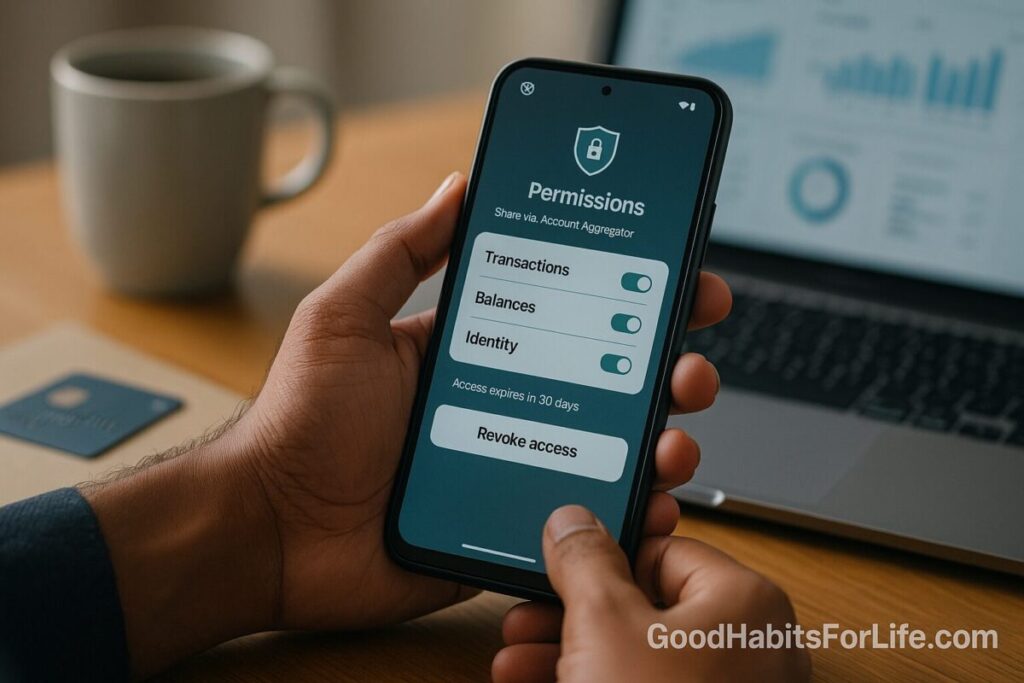
Open Banking: Permissions, Privacy, Power: Dopamine Detox (2025)
Open Banking 2025: Permissions, Privacy & Dopamine Detox
Table of Contents
🧭 What Is Open Banking & Why It Matters
Open banking is a regulated way to share your financial data with trusted apps via secure APIs and your explicit consent (no password sharing). It enables services like budgeting dashboards, loan underwriting, and payment initiation while letting you see and revoke access at any time. Open BankingDepartment of Financial Services
Globally, rules are tightening to give you more control:
-
EU: PSD3/PSR update PSD2 and strengthen authentication, fraud prevention, and data access standards. European Parliament
-
US: The CFPB’s Personal Financial Data Rights rule (Sec. 1033) defines consumer data access and safe data-sharing; the Bureau is reconsidering portions in 2025 amid litigation. Consumer Financial Protection Bureau+1
-
India: The Account Aggregator (AA) framework + DPDP Act 2023 power consented, revocable data flows under a techno-legal model. Press Information BureauMeitY
Bottom line: Open banking can boost competition and convenience without trading away privacy—if you manage permissions like a pro. Financial Times
✅ Quick Start: Fix Your Permissions Today
Do these in 20–30 minutes:
-
List your connections. In each banking/fintech app, open Connected apps / data sharing / consent dashboard and list who has access, what data, and for how long. (In India, check your AA dashboard; in the UK, Open Banking customer-experience flows standardize this view.) SahamatiOpen Banking
-
Revoke stale access. Remove any app you haven’t used in 90 days or that doesn’t state purpose clearly.
-
Tighten scopes. Prefer “read-only” access for budgeting; enable “payment initiation” only where necessary—and set low limits.
-
Turn on strong security. Enable 2-factor login, app-level PIN/biometrics, and per-payment confirmations.
-
Swap out screen-scraping. If any service asks for your bank password, stop. Look for API-based “Connect” flows (OAuth/FAPI). Axway BlogOpen Banking Standards
-
Start a “dopamine detox” for money. Silence non-critical finance notifications; batch alerts to 1–2 windows/day; disable “streaks,” confetti, and leaderboards where possible. (These “digital engagement practices” can influence risky behavior.) SEC
🧠 30–60–90 Day Roadmap (Privacy & Focus)
Days 1–30 (Baseline & Clean-up)
-
Audit all consents; revoke/renew as needed.
-
Enable biometric + PIN for each finance app.
-
Consolidate alerts: only suspicious activity, payment approvals, low-balance, and bill-due remain.
-
Track 3 metrics: # of connected apps, # of notifications/day, time in finance apps/day.
Days 31–60 (Hardening & Rules)
-
Switch any lingering connections to API/FAPI-secured flows.
-
Use approval chains for large payments (e.g., dual-confirmation).
-
Weekly “permission review” (15 min).
-
Introduce Focus Windows (e.g., 08:00–09:00 & 19:00–19:30) for money tasks; all other alerts are silent.
-
Add a spending friction: 24-hour “cool-off” for new credit/loan offers.
Days 61–90 (Automation & Reviews)
-
Automate savings/investments on payday; cut manual taps.
-
Quarterly consent renewal for high-risk data (income, statements).
-
Export and archive a Permission Log (who/what/why/duration) for compliance peace of mind.
-
Re-measure metrics; aim for ≥50% fewer alerts and ≤30 min/day in finance apps.
🛠️ Techniques & Frameworks (Consent, Security, Dopamine Hygiene)
Consent Design: “4W Model”
-
Who gets access (named provider).
-
What data/payments scope (read-only vs. initiate).
-
Why purpose statement (e.g., underwriting).
-
When duration/expiry + frequency (one-time vs. periodic).
This mirrors AA consent artefacts (India) and Open Banking customer-experience guidance. SahamatiOpen Banking
Security Standards to Prefer
-
OAuth 2.0 + OpenID with FAPI profiles (v1 Advanced / v2.0 Security). These reduce token theft and enforce hardened flows for high-value data and payments. OpenID Foundation+1
Replace Screen-Scraping
-
Use providers that do not collect your bank credentials; prefer certified API connections (less fraud, clearer audit trails). Axway Blog
Dopamine Detox ≠ “Resetting Dopamine”
-
There is no medical “dopamine reset.” Use behavioral detox: fewer cues, fewer variable rewards (flashing P&L, confetti), and deliberate, scheduled money time. Harvard Health
Watch Out for “Dark Patterns” & Gamification
-
Regulators have flagged design tactics that nudge risky trading or trap subscriptions; learn to spot them and opt out. SECFederal Trade Commission
📚 Audience Variations
Students
-
Use read-only connections for budgeting; lock payments behind a second device approval.
-
Auto-save small amounts each week; mute all “promo” alerts.
Parents/Caregivers
-
Create a family finance focus window; no ad-push alerts after 20:00.
-
For teens, require view-only app access and a spend cap.
Professionals
-
Quarterly consent and vendor reviews; export a permission log for HR/finance audits.
-
Use separate devices/profiles for trading vs. banking to avoid reflex taps.
Seniors
-
Minimal app list; whitelist only essential providers.
-
Enable transaction SMS + email confirmations reviewed by a trusted contact.
Teens
-
Use prepaid accounts with low limits and instant notifications to guardians.
-
Education first: show what consent means before linking any app.
⚠️ Mistakes & Myths to Avoid
-
Myth: “Dopamine detox resets my brain.” → No. Use notification hygiene and friction, not pseudoscience. Harvard Health
-
Mistake: Sharing bank passwords with apps. → Use API connections only (OAuth/FAPI). Open Banking Standards
-
Mistake: Perpetual “read + write” scopes. → Time-box critical scopes; renew consciously using consent artefacts/dashboards. Sahamati
-
Mistake: Ignoring design nudges. → Watch for gamified prompts, streaks, pre-ticked boxes, and “hard-to-cancel” UIs flagged by regulators. Federal Trade Commission
💬 Real-Life Examples & Scripts
Revoke stale access (email/app message):
“Please confirm that [App Name]’s access to my [Bank] account via open banking APIs has been revoked as of [date]. This includes all scopes beyond read-only. Kindly share confirmation and data-deletion steps.”
Tighten scope (support chat):
“I want read-only access for budgeting only—no payment initiation or income verification. Can you confirm the current scopes and expiry?”
Batch notifications (device settings):
“Allow: security alerts, payment approvals.
Silence: promotions, price nudges, streaks, leaderboards, daily P&L.”
Household rule:
“Money time = 08:00–08:30 daily. No finance app alerts outside this window.”
🧩 Tools, Apps & Resources
-
Consent dashboards inside your bank/fintech/AA app (India) to view/revoke access and duration. Sahamati
-
Security profiles: Providers referencing FAPI 1 Advanced / FAPI 2.0 Security and Open Banking security guidance. OpenID Foundation+1Open Banking Standards
-
Regulator hubs:
-
EU PSD3/PSR explainer (European Parliament Think Tank). European Parliament
-
US CFPB 1033 rule hub and 2025 reconsideration notice. Consumer Financial Protection Bureau+1
-
India DPDP Act (2023) + AA framework overview. MeitYDepartment of Financial Services
-
-
Notification hygiene: Use iOS Screen Time / Android Digital Wellbeing to enforce finance “focus windows.”
📌 Key Takeaways
-
Treat data sharing like lending your car: verify the driver, the route, and return date.
-
Prefer API-based connections secured by FAPI over password-based scraping. Open Banking Standards
-
Schedule finance time; batch alerts; remove gamified triggers. SEC
-
Audit permissions monthly; time-box high-risk scopes; keep a simple permission log.
-
Follow local rules (EU/US/India) to assert your rights and stay safe. European ParliamentConsumer Financial Protection BureauPress Information Bureau
❓ FAQs
1) Is open banking safe?
Yes—when you use regulated providers and secure API connections (OAuth/OpenID + FAPI), not password scraping. Always verify scopes and expiry. OpenID Foundation
2) What’s the difference between read-only and payment initiation?
Read-only lets apps view data; payment initiation lets them trigger payments after your authorization. Keep initiation limited and well-guarded.
3) How do I find and revoke old app access?
Open your bank/fintech’s Connected apps / Data sharing / Consent area. India’s AA and UK Open Banking flows offer dashboards with clear revoke/renew. SahamatiOpen Banking
4) Is “dopamine detox” real?
Not as a medical “reset.” Use a behavioral detox: fewer cues, scheduled engagement, and kill the confetti. Harvard Health
5) Are regulators acting on gamification and dark patterns?
Yes. The SEC has warned on digital engagement practices; the FTC and India’s CCPA have issued dark-patterns guidance and enforcement. SECFederal Trade Commissiondoca.gov.in
6) What about US rules—are they final?
The CFPB finalized an open banking rule, with parts being reconsidered in 2025 due to legal challenges. Check the CFPB hub for status. Consumer Financial Protection Bureau+1
7) Do I need to re-consent regularly?
Yes—time-box sensitive scopes (income, statements) and renew consciously; many frameworks support periodic consent. Sahamati
8) How do I know an app uses screen-scraping?
If it asks for your bank login directly, that’s a red flag. Look for “Connect with your bank” OAuth-style flows instead. Axway Blog
References
-
European Parliament Think Tank. Payment Services Framework (PSD3/PSR) Briefing, 29 Aug 2025. https://www.europarl.europa.eu/thinktank/en/document/EPRS_BRI%282025%29775891 European Parliament
-
CFPB. Personal Financial Data Rights (Section 1033) — Rule Hub & Reconsideration (Aug 2025). https://www.consumerfinance.gov/personal-financial-data-rights/ and https://www.consumerfinance.gov/rules-policy/rules-under-development/personal-financial-data-rights-reconsideration/ Consumer Financial Protection Bureau+1
-
Government of India (PIB). Account Aggregator launch and DPI note (Sept 2025). https://www.pib.gov.in/PressReleasePage.aspx?PRID=2162953 Press Information Bureau
-
MeitY. Digital Personal Data Protection Act, 2023 (official text). https://www.meity.gov.in/static/uploads/2024/06/2bf1f0e9f04e6fb4f8fef35e82c42aa5.pdf MeitY
-
Open Banking (UK). Customer Experience Guidelines (V3.1.3). https://www.openbanking.org.uk/wp-content/uploads/2021/04/Customer-Experience-Guidelines-V3.1.3-web.pdf Open Banking
-
OpenID Foundation. FAPI 2.0 Security Profile (Final, Feb 2025). https://openid.net/specs/fapi-security-profile-2_0-final.html OpenID Foundation
-
OpenID Foundation. FAPI 1.0 Advanced Security Profile. https://openid.net/specs/openid-financial-api-part-2-1_0.html OpenID Foundation
-
Harvard Health. Dopamine fasting: Misunderstanding science spawns a maladaptive fad. https://www.health.harvard.edu/blog/dopamine-fasting-misunderstanding-science-spawns-a-maladaptive-fad-2020022618917 Harvard Health
-
SEC Investor Advisory Committee. Recommendation on Digital Engagement Practices (2023–2024). https://www.sec.gov/files/approved-20240214-draft-recs-use-dep.pdf SEC
-
FTC. Bringing Dark Patterns to Light (Staff Report, 2022) and Enforcement Policy. https://www.ftc.gov/system/files/ftc_gov/pdf/P214800%2BDark%2BPatterns%2BReport%2B9.14.2022%2B-%2BFINAL.pdf Federal Trade Commission
-
India CCPA (DoCA). Guidelines for Prevention and Regulation of Dark Patterns, 2023. https://doca.gov.in/ccpa/guidelins.php doca.gov.in
-
Government of India — Financial Services. Account Aggregator Framework Overview. https://financialservices.gov.in/beta/en/account-aggregator-framework Department of Financial Services
Disclaimer: This guide is for general information and education, not financial advice; always follow your local regulations and consult a qualified advisor for personal decisions.