
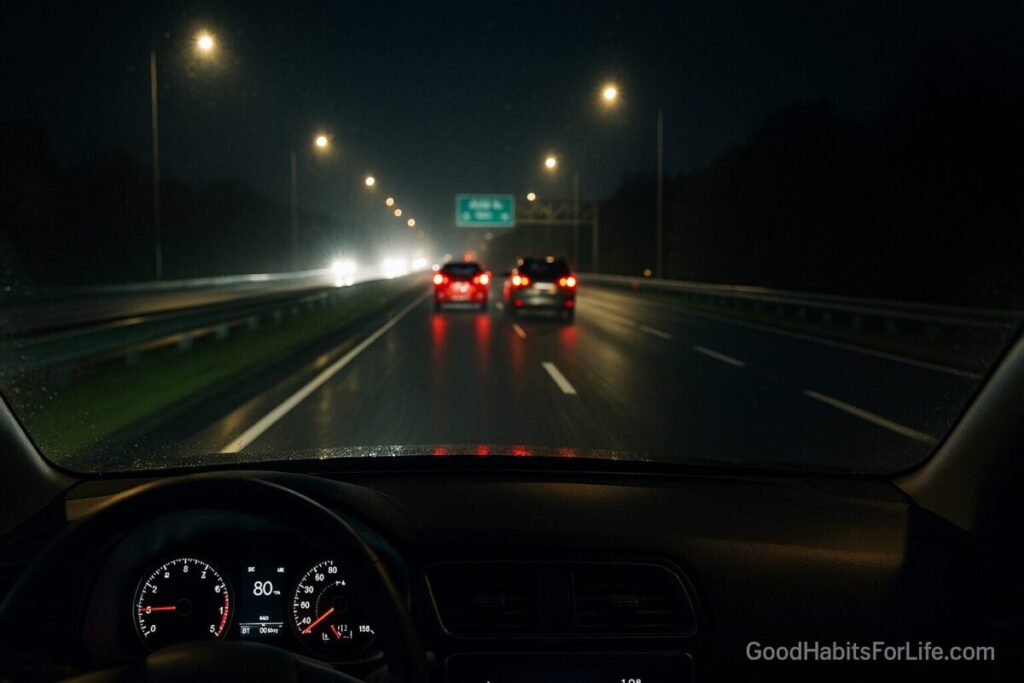
Night Highway Driving: Glare, Speed, and Spacing
Night Highway Driving: Glare, Speed & Spacing
Table of Contents
🧭 What “night highway driving” really demands
Night highway driving isn’t just “day driving in the dark.” Your visual range shrinks, contrast drops, glare rises, and fatigue peaks. Good night driving is a habit stack: (1) seeing farther (lighting), (2) stopping sooner (speed/spacing), and (3) staying sharper (fatigue & focus).
Your golden rule: Don’t outrun your vision. If you can’t stop within what your lights reveal, your speed/spacing is wrong.
⚠️ Risk at night: why it’s different
-
Crash severity and risk increase at night. Reduced visibility and fatigue raise the odds of serious outcomes.
-
Glare hurts contrast sensitivity, especially for older drivers and those with dirty windscreens or scratched lenses.
-
Drowsy driving spikes after midnight and in the early morning hours; long, straight highways lull the brain.
(See References for evidence and further reading.)
✅ Quick start: do this tonight
-
Lights: Use high beams whenever legal; dip for oncoming traffic or when following closely.
-
Dash & mirrors: Dim your dashboard to keep pupils wide; set auto-dimming or “night” position on the rear-view mirror.
-
Glass & lenses: Wipe inside & outside of the windscreen; clean headlamp lenses. Tiny films scatter light and multiply glare.
-
Spacing: Lock in a 4-second gap (count “one-one-thousand…”). Add seconds for rain/fog/rough roads or if you feel tired.
-
Speed: Match speed to sight distance. If your low beams show ~60 m ahead and your total stopping distance is longer—slow down or use high beams where legal.
-
Route & rest: Plan a 10-minute break every ~2 hours. Swap drivers if possible.
-
Eyes: Look slightly right of oncoming headlights (use the edge line) to cut glare; scan far, then near.
🚗 Speed, spacing & stopping distances (with examples)
Don’t overdrive your headlights
Typical low-beams illuminate about 50–70 m ahead, high-beams roughly 100–150 m (varies by vehicle/aim). Your total stopping distance = reaction distance (time to perceive & move foot) + braking distance.
Approximate stopping distances on dry, level pavement (passenger car, 1.5 s reaction):
| Speed | Reaction distance | Braking distance | Total |
|---|---|---|---|
| 50 km/h (31 mph) | ~21 m | ~15 m | ~36 m |
| 70 km/h (43 mph) | ~29 m | ~35 m | ~64 m |
| 90 km/h (56 mph) | ~38 m | ~62 m | ~100 m |
| 110 km/h (68 mph) | ~46 m | ~98 m | ~144 m |
Implication: On low beams (~50–70 m), 90–110 km/h can exceed what you can safely stop within. Either raise your visible distance (use high beams where legal), or reduce speed until what you can see ≥ what you need to stop.
Spacing you can trust
-
Baseline: 4-second following gap at night.
-
Increase to 5–6 seconds in rain, fog, or when you’re behind a heavy vehicle/coach, or if you’re fatigued.
-
Side & escape room: Don’t box yourself in. Keep lateral clearance and maintain an escape lane (usually the left shoulder in right-hand traffic / the right shoulder in left-hand traffic).
-
Overtaking: Use high beams to confirm a clear, extended gap ahead. Abort early if the far field isn’t crystal clear.
🔦 Glare management & lighting setup
Technique during oncoming glare
-
Look to the right-edge line (or left, in LHD countries) and keep your lane position steady.
-
Avoid staring into the light; blink normally.
-
Lift off early to create margin if vision feels compromised.
Vehicle setup & care
-
Aim headlights correctly. Mis-aim = poor reach and extra glare for others.
-
Clean lenses (headlamps & fog lamps) and the inside of the windscreen—micro-film dramatically increases scatter.
-
Use fog lights only in fog/spray/snow. In clear air, they add foreground light that reduces distance vision.
-
Auto-dimming mirror (interior/exterior) cuts trailing glare. If you have manual “night” mode, set it.
-
Avoid blue-tinted “night glasses.” Evidence does not show consistent night-vision benefits; they reduce overall light reaching the eye.
-
Dim the dash and center display; switch to night mode maps.
-
Corrective lenses: Drive with current prescription; anti-reflective coatings can help reduce reflections.
🧰 Car prep checklist (2 minutes before you roll)
-
Wipe windscreen (inside & out) and side mirrors
-
Quick wipe of headlamps/taillamps
-
Set auto-dimming/night mode mirrors
-
Dim dash & map display
-
Test high/low beam & fog lamps
-
Adjust seat (eye height high enough to see far) & steering
-
Route check: next rest stop/time window noted
🛠️ Techniques & frameworks that work
The “Sight > Stop” rule
-
Sight distance (SD) must be greater than stopping distance (SSD).
-
If SD < SSD, you have two levers: slow down or extend sight (high beam, cleaner glass, better aim).
The 4-6-8 spacing ladder
-
4 s: dry, light traffic, alert.
-
6 s: night + rain/spray/older driver/tired.
-
8 s: heavy vehicles, towing, fog, wildlife-dense areas.
The 20-10 micro-refresh
-
Every ~20 minutes: a 10-second reset—deep breath, posture check, far-near scan, sip of water.
-
Every 2 hours: short break; quick walk/light stretch.
Lane discipline at night
-
Hold a steady central lane position; avoid edge drift when using the right-edge line to mitigate glare.
-
On multi-lane highways, prefer the middle lane(s) where available to buffer from merging headlights.
👥 Audience variations
Teens & novice drivers
-
Practice at lower speeds first on familiar routes; build night-driving hours gradually.
-
Double down on the 4-second rule; skip late-night drives after long days.
Older drivers
-
Expect more glare sensitivity and slower dark adaptation. Use high beams more often (legally), keep glass spotless, and consider earlier evening travel.
Professionals/long-distance drivers
-
Pre-plan rest cycles; caffeine is a bridge, not a solution.
-
Use audible nav prompts over bright displays.
Motorcyclists
-
Use retro-reflective gear and auxiliary conspicuity lighting within legal limits.
-
Extend spacing further; your braking margin is smaller.
Parents with kids onboard
-
Keep the cabin calm and dim; prep snacks/water to minimize reach-around distractions.
-
Plan shorter legs and scheduled stops aligned with kids’ sleep.
❌ Mistakes & myths to avoid
-
Myth: “Yellow/blue-tinted ‘night glasses’ help everyone.” → They often reduce overall light and don’t reliably improve vision.
-
Mistake: Driving at the daytime speed limit on low beams across unlit stretches.
-
Mistake: Chasing tail lights as your guide. You’re outsourcing vision to a stranger.
-
Mistake: Using fog lights in clear weather—adds foreground glare, robs distance vision.
-
Mistake: Ignoring headlight aim after load changes, suspension work, or bulb swaps.
🗓️ 7-Day habit plan
Day 1 – Glass & lights reset (20 min): Deep-clean windscreen (inside/out), mirrors, headlamp/taillamp lenses; set mirror night mode.
Day 2 – Spacing practice: On a short night drive, hold a 4-second gap for 15 minutes; notice stress drop.
Day 3 – High-beam etiquette: Practice legal high-beam use on a quiet road; dip early for oncoming/when following.
Day 4 – Speed vs sight: Find an unlit stretch; with low beams, choose a speed where you can clearly stop within what you see. Repeat with high beams.
Day 5 – Glare drill: Practice eyes to edge line when a car approaches; keep steering steady, breathe out.
Day 6 – Break cadence: Drive 90–120 minutes with a planned 10-minute stop; try a brisk walk and water.
Day 7 – Full run-through: Combine all: clean glass, set mirrors, spacing ladder, high-beam etiquette, planned break.
💬 Real-life scripts you can copy
-
Passenger reassurance: “I’m dropping to 85 until I can see farther—don’t want to overdrive the beams.”
-
Polite overtake setup (radio/convoy): “Car 2 overtaking in 10 seconds; clear ahead, lights dipped after pass.”
-
Glare self-talk: “Eyes to edge line, hands steady, lifting off a little until it passes.”
-
Fatigue boundary: “I’m yawning twice a minute; we’re stopping at the next services for a 15-minute nap.”
📱 Tools, apps & resources
-
Auto-dimming interior/exterior mirrors — Pro: big glare cut. Con: cost; may be OEM-only.
-
Headlamp aim kits / alignment checks — Pro: more reach, less glare for others. Con: Needs careful setup.
-
Lens restoration kits — Pro: restore clarity on aged plastic lenses. Con: Results vary; may need re-coat.
-
Navigation with dark mode & voice — Pro: eyes stay dark-adapted. Con: Over-detailed screens can distract.
-
Driver drowsiness alerts (some vehicles/apps) — Pro: prompts breaks. Con: Not a substitute for sleep.
🧾 Key takeaways
-
Use high beams whenever legal; dip early for others.
-
Sight distance must exceed stopping distance—adjust speed to what you can actually see.
-
Keep a 4–6 s gap at night; more in bad weather or when tired.
-
Cut glare with clean glass, correct aim, dimmed dash, and proper mirror settings.
-
Plan rest every ~2 hours; if you’re drowsy, stop—no exceptions.
❓ FAQs
1) What’s the safest following distance at night?
Start with 4 seconds. Increase to 5–6 seconds in rain/fog, when tired, or behind large vehicles.
2) Should I use high beams on divided highways?
Yes, when legal and when you won’t dazzle others—dip for oncoming traffic and when you’re closing on a vehicle ahead.
3) Do “night driving glasses” help?
Evidence doesn’t support broad benefits. They often reduce total light, which can hurt visibility.
4) How fast is too fast on low beams?
If your total stopping distance is longer than what your low beams reveal (often ~50–70 m), you’re overdriving. Slow down or use high beams where legal.
5) Why dim the dashboard?
Bright interiors make pupils constrict, reducing distance vision. Dim displays and use map night mode.
6) How often should I rest on long night drives?
Plan 10 minutes every ~2 hours (more often if sleepy); swap drivers when possible.
7) Should fog lights be on at night?
Only in fog, spray, or snow. Otherwise they add near-field glare and reduce your distance vision.
8) What if an oncoming driver won’t dip high beams?
Slow slightly, look to the edge line, avoid staring into the glare, and keep lane position steady.
9) Is cruise control safe at night?
Use with caution. It can mask speed creep into overdriving on unlit roads; be ready to disengage quickly.
10) How do I check headlight aim?
Consult your manual or a service shop. After bulb/suspension changes or heavy loads, re-check aim.
📚 References
-
National Safety Council. Night Driving Safety. https://www.nsc.org/road/safety-topics/night-driving
-
NHTSA. Headlights & Night Driving Tips. https://www.nhtsa.gov/road-safety/headlights
-
IIHS. Headlights: Visibility and Glare. https://www.iihs.org/topics/headlights
-
AAA Foundation for Traffic Safety. Asleep at the Wheel—Prevalence of Drowsy Driving Crashes. https://aaafoundation.org
-
Transport for NSW — Centre for Road Safety. Speeding & Stopping Distances. https://roadsafety.transport.nsw.gov.au
-
RoSPA. Driving at Night. https://www.rospa.com/leisure-safety/advice/drivers/night-driving
-
American Academy of Ophthalmology. Do Night Driving Glasses Work? https://www.aao.org/eye-health/tips-prevention/night-driving-glasses
-
GOV.UK. The Highway Code: Stopping Distances & Headlights. https://www.gov.uk/guidance/the-highway-code
-
CDC. Drowsy Driving: Asleep at the Wheel. https://www.cdc.gov/sleep/features/drowsy-driving.html
-
Transport Canada. Headlamp Glare & Visibility (technical resources). https://tc.canada.ca