
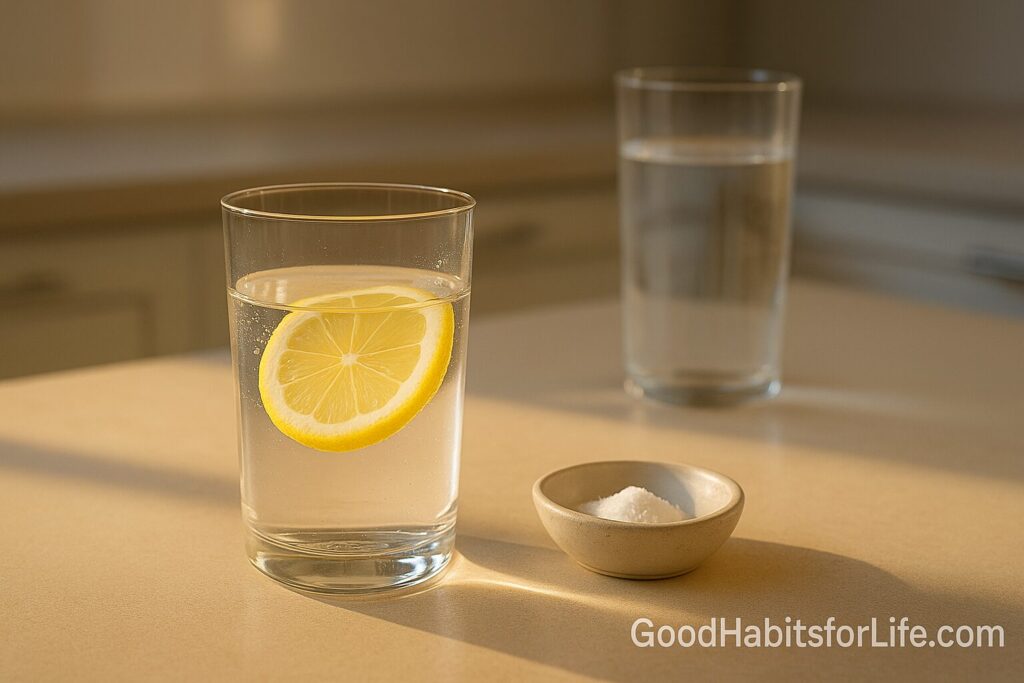
Morning Hydration: Lemon, Salt, or Just Water?: Protein-Forward Plan (2025)
Morning Hydration: Lemon, Salt, or Just Water?
Table of Contents
🧭 What “Morning Hydration” Really Means
Hydration is about fluid balance—replacing overnight water losses from breathing and urination so your brain, blood volume, temperature control, and digestion work smoothly. Most healthy people rehydrate well with plain water at breakfast time. How much? A simple starting point is ~300–500 ml (10–17 fl oz) on waking, then drink to thirst across the morning and at meals. Your total daily fluid target typically lands around 30–35 ml per kg of body weight (e.g., 70 kg → ~2.1–2.5 L), higher in heat, with exercise, or during illness.
Protein doesn’t “hydrate,” but pairing hydration with a protein-forward breakfast improves the morning outcome: steadier energy, better satiety, and fewer mid-morning cravings. That’s the practical edge of this plan.
🧪 Lemon vs. Salt vs. Just Water: When Each Makes Sense
Just water (default):
-
Best, safest first choice for most mornings.
-
Zero calories, zero dental erosion risk, zero sodium.
Lemon water (optional):
-
Adds flavor and small vitamin C; may help you drink more if you dislike plain water.
-
Doesn’t “detox.” Your liver and kidneys do that.
-
Use a straw and rinse after to reduce enamel exposure.
Salt water (rarely indicated):
-
Only helpful when you’ve lost sodium through heavy sweating (e.g., hot climates, >60–90 min intense training), heat exposure, or certain GI illnesses.
-
Routine morning salt shots can push sodium intake beyond healthy limits. Use measured electrolyte solutions or a small pinch of salt only when warranted.
-
If you have high blood pressure, kidney disease, or are salt-sensitive, avoid unless a clinician directs.
Electrolyte drink (situational):
-
Useful before/after long morning runs, manual labor in heat, or post-illness rehydration.
-
Choose mixes with ~200–500 mg sodium per 500 ml when truly needed; otherwise stick to water.
✅ Quick Start: A 3-Step AM Routine
-
Rehydrate (0–2 minutes): Drink 300–500 ml water upon waking. Optional: a squeeze of lemon for taste.
-
Move (2–5 minutes): Light mobility or a short walk to cue thirst and circulation.
-
Protein-forward breakfast (within 60 minutes): Aim 20–30 g protein + fiber + fluids. Examples:
-
3 eggs + sautéed veg + 1 cup water
-
Greek yogurt (200 g) + berries + water or unsweetened tea
-
Protein smoothie (20–25 g protein) + banana + oats + water
-
📅 7-Day Protein-Forward Hydration Plan
Daily baseline: 300–500 ml water on wake + 20–30 g protein at breakfast. Adjust fluids up if it’s hot or you exercise.
-
Day 1 (Mon): Water on waking → Omelet (3 eggs), spinach, tomatoes.
-
Day 2 (Tue): Water + lemon → Greek yogurt bowl (200 g), nuts, berries.
-
Day 3 (Wed): Water → Cottage cheese (200 g) + fruit; add whole-grain toast.
-
Day 4 (Thu): Water → Protein smoothie (milk or soy milk + 1 scoop protein + oats + banana).
-
Day 5 (Fri): Water → Tofu bhurji/scramble (200 g) + veg + roti; or paneer bowl.
-
Day 6 (Sat): Water → Leftover chicken/fish + veg + small rice; unconventional but effective.
-
Day 7 (Sun): Water → Idli/dosa + sambar plus a side of eggs or dal to hit protein.
If training ≥60–90 min in heat: Consider 300–500 ml electrolyte drink containing 200–500 mg sodium after the session. Otherwise, continue with water.
🧠 Techniques & Frameworks
-
Habit stacking: Anchor “drink water” to a fixed cue—after brushing teeth or when you open the curtains.
-
2-bottle rule: Keep 1 bedside bottle (finished by breakfast) and 1 desk bottle (finished by lunch).
-
Cue–Routine–Reward: Cue = alarm/curtains; Routine = drink water; Reward = 60-sec stretch + favorite playlist.
-
Measure once: For a week, pour your morning water into a measuring cup to learn what 300–500 ml looks like.
-
Friction-killers: Set out a clean glass and filled bottle at night; pre-slice lemon if you plan to use it.
👥 Audience Variations
-
Students: Pair water with a simple protein (yogurt, eggs, dal-cheela) before classes; carry a 500 ml bottle between lectures.
-
Professionals: Keep a 750 ml bottle at your workstation; calendar-block a mid-morning refill. Breakfast: eggs on toast, tofu scramble wrap, or a ready-to-drink high-protein milk.
-
Parents: Pre-fill bottles for the whole family. Offer kids water or milk with breakfast; avoid routine sugary juices.
-
Seniors: Thirst cues decline with age—schedule fluids, but monitor if on fluid-restricted plans. Add protein via dairy, soy, or soft textures.
-
Teens: Smoothies work well—milk or soy + protein + fruit; avoid energy drinks as a hydration strategy.
⚠️ Mistakes & Myths to Avoid
-
Myth: Lemon water “detoxes” you.
Fact: Your liver and kidneys do detox; lemon is just a flavor boost and minor vitamin C source. -
Mistake: Daily salt water “for health.”
Fix: Only use electrolytes when sweat losses warrant it; otherwise you may exceed healthy sodium limits. -
Mistake: Skipping protein at breakfast.
Fix: 20–30 g protein improves satiety and helps control late-morning snacking. -
Myth: You must chug 1 L on waking.
Fact: 300–500 ml is plenty to start; then drink to thirst and with meals. -
Mistake: Counting only water.
Fix: Total fluids include water, milk, tea/coffee (watch caffeine and sugar), soups, and high-water foods.
🛠️ Real-Life Examples & Scripts
-
One-minute script: “Alarm → bathroom → 350 ml water → stretch 60 sec → coffee brewing → eggs + toast.”
-
Office script: “Log in → finish 300 ml → schedule stand-up → refill bottle.”
-
Heat-wave training: “Easy sip 200 ml pre-run → electrolyte 300–500 ml post-run → protein smoothie within 60 min.”
Sample Breakfasts (~20–30 g protein)
-
3 eggs + veg (≈ 18–21 g; add 150 g yogurt to reach 30 g)
-
200 g Greek yogurt + 30 g nuts (≈ 25–30 g)
-
Smoothie: 250 ml milk/soy (8–12 g) + 1 scoop whey/pea (20–25 g)
📚 Tools, Apps & Resources
-
Water reminders: Waterllama, WaterMinder, Apple/Google Health (simple, low-friction logging).
-
Electrolytes (as needed): Choose mixes with transparent sodium/potassium labeling; avoid added sugar for routine use.
-
Protein aids: Greek yogurt, cottage cheese/paneer, eggs, tofu/tempeh, lentils/dal, high-protein milk, or protein powder.
-
License-free images for your habit tracker or blog: Pexels, Pixabay, Unsplash.
✨ Key Takeaways
-
Start simple: 300–500 ml water when you wake.
-
Lemon is for taste; salt is situational, not daily.
-
Add a protein-forward breakfast for steadier energy and satiety.
-
Use electrolytes when you actually sweat a lot or are ill.
-
Make it automatic with cues, pre-filled bottles, and habit stacking.
❓ FAQs
1) Is lemon water better than plain water?
Not for hydration. It’s mainly flavor; drink whichever helps you meet your fluid needs.
2) Should I drink warm, room-temperature, or cold water?
Temperature is personal preference—no strong advantage. Choose what helps you drink consistently.
3) How much should I drink in total per day?
A reasonable range is 30–35 ml/kg/day, adjusting for heat, activity, pregnancy/breastfeeding, and health conditions.
4) When is a pinch of salt helpful?
After heavy sweating (long/hot workouts, outdoor labor) or certain illnesses with fluid loss. Otherwise, unnecessary.
5) Do tea or coffee count toward hydration?
Yes, they contribute to fluids. Watch caffeine and added sugar.
6) What about apple cider vinegar in the morning?
It’s not a hydration need; it can irritate teeth and stomach. If you use it, dilute well and limit frequency.
7) Can I overhydrate?
Yes—rare but possible (hyponatremia). Don’t force liters at once; spread intake and follow thirst.
8) How do I hit 20–30 g protein fast?
Greek yogurt (200 g), 3 eggs plus a side of yogurt/milk, tofu/paneer scramble, or a measured protein smoothie.
9) Are sports drinks good for daily use?
Generally no; they’re for prolonged exercise or heat. For desk days, water is best.
10) I wake up not thirsty—should I still drink?
Try a modest 300 ml to kickstart fluids. If you truly dislike water, use lemon for taste.
References
-
Harvard T.H. Chan School of Public Health — The Nutrition Source: Water. https://www.hsph.harvard.edu/nutritionsource/water/
-
Centers for Disease Control and Prevention — Water & Healthier Drinks. https://www.cdc.gov/healthyweight/healthy_eating/water-and-healthier-drinks.html
-
American Heart Association — How Much Sodium Should I Eat Per Day? https://www.heart.org/en/healthy-living/healthy-eating/eat-smart/sodium/how-much-sodium-should-i-eat-per-day
-
World Health Organization — Guideline: Sodium intake for adults and children. https://www.who.int/publications/i/item/9789241504836
-
European Food Safety Authority — Scientific Opinion on Dietary Reference Values for water. https://efsa.onlinelibrary.wiley.com/doi/10.2903/j.efsa.2010.1459
-
American College of Sports Medicine — Exercise and Fluid Replacement (Position Stand). https://www.acsm.org (search: Exercise and Fluid Replacement position stand)
-
International Society of Sports Nutrition — Position stand: Exercise & hydration. https://jissn.biomedcentral.com/ (search: hydration position stand)
-
National Institutes of Health, Office of Dietary Supplements — Sodium Fact Sheet. https://ods.od.nih.gov/factsheets/Sodium-Consumer/
-
Phillips, S.M., et al. Protein “Leverage” and breakfast protein for appetite control (review). https://jissn.biomedcentral.com/articles/10.1186/1550-2783-11-20
-
NHS — Is lemon water good for you? https://www.nhs.uk (search: lemon water)
Disclaimer: This article is educational and not a substitute for personalized medical advice. If you have a medical condition or take medications, consult your clinician about hydration and electrolytes.