
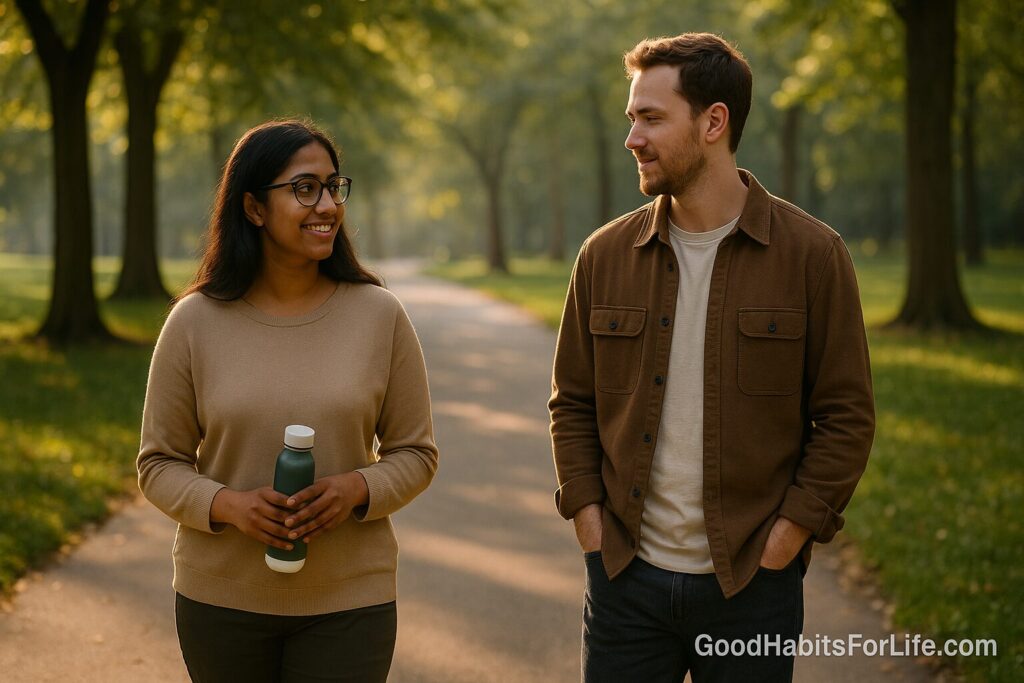
IntrovertFriendly Socializing: EnergySmart Moves: Dopamine Detox (2025)
Introvert-Friendly Socializing & Dopamine Detox (2025)
Table of Contents
🧭 What “Introvert-Friendly Socializing” Means
Introvert-friendly socializing is connection by design: you deliberately shape who, where, and how long you socialize so it adds energy instead of draining it. It favors:
-
Smaller groups or 1:1s over loud crowds
-
Clear start/stop times (e.g., “20-minute walk & talk”)
-
Spaces with lower sensory load (quiet cafés, park walks)
-
Purposeful prompts so conversation flows without performing
Introversion isn’t shyness or social anxiety. It’s a preference for lower stimulation and for recharging alone. With a few guardrails, introverts can build strong networks—without the Sunday social hangover.
Evidence-backed benefits of healthy connection
-
Better mental and physical health; social disconnection is linked with higher risks for depression and early mortality.
-
Belonging and frequent positive contact are protective for well-being and resilience.
-
Light interactions (friendly small talk, neighbor hellos) can lift mood more than we expect.
(See References for Surgeon General/WHO advisories and research.)
🔁 Why a “Dopamine Detox” (Reset) Helps
“Dopamine detox” (a popular term) doesn’t literally flush dopamine. It’s a behavioral reset: taking a short break from high-stimulation, low-effort rewards (doomscrolling, compulsive short-form video, constant notifications) so your natural interest in slower, human rewards—conversation, shared activities, deep work—can surface again.
What it does:
-
Reduces overstimulation and decision fatigue
-
Recalibrates your attention so real-world socializing feels less “too much”
-
Creates room for values-aligned connection
What it doesn’t do:
-
It doesn’t starve your brain of dopamine or “cure” problems overnight. Think of it as digital decluttering plus clear social intentions, not a medical protocol.
✅ Quick Start: Today, This Week, This Month
Today (≤30 minutes)
-
Mute & Move: Silence non-essential notifications for 48 hours. Move social apps off the home screen.
-
Pick One Person: Send a 2-line check-in: “Thinking of you. Fancy a 20-minute tea or walk this week?”
-
Choose a Low-load Slot: Identify one 30–45 minute window you naturally have energy (e.g., 17:30–18:15).
This Week
-
One 1:1, max 45 minutes, in a quiet place.
-
One micro-interaction daily (doorstep hello, short voice message, post-meeting chat).
-
Two recovery blocks (15–20 minutes of solitude after any social plan).
This Month
-
Build a tiny circle of 3–5 regulars for rotating coffees/walks.
-
Join one interest group (board games, running, book club) with predictable cadence (bi-weekly or monthly).
🗓️ 7-Day Starter Plan
Goal: Reset overstimulation + restart warm, repeatable social contact.
Day 1 – Reset & Map (25 min)
-
Notification cleanse (mute/move).
-
Write two lists: Energizers (e.g., 1:1 walk, cooking with a friend) and Drainers (noisy bars, back-to-back events).
-
Text one friend for a 20-minute meet-up on Day 4–6.
Day 2 – Micro-hello (10 min)
-
Do two quick human touches (smile & hello to a neighbor; message a colleague “great point in the meeting”).
-
20-minute “no-scroll” block in the evening; read or prep a conversation prompt.
Day 3 – Solo Recovery + Prep (20–30 min)
-
Quiet activity: walk, journaling, light stretching.
-
Choose a 2-topic menu for your next chat (e.g., “What’s one small win from your week?” “What book/podcast did you enjoy recently?”).
Day 4 – First 1:1 (30–45 min)
-
Meet in a low-noise space; set expectation: “I’ve got 40 minutes—keen to catch up.”
-
Close with a next-time hook (“Next Thursday same time?”).
Day 5 – Skill Drill (15–20 min)
-
Practice one technique (below): the 70/30 talk ratio or ORBIT question chain.
-
One micro-hello.
Day 6 – Group Lite (30–60 min)
-
Try a 2–4 person activity (walk, board game, coworking).
-
Keep an exit line ready: “I need to head at 6 sharp.”
Day 7 – Review & Repeat (20 min)
-
Rate energy after each social moment (–2 drained → +2 energized).
-
Lock next week’s one 1:1 + one micro-hello/day.
-
Treat yourself to a quiet recharge ritual.
🧠 Techniques & Frameworks that Work
1) Energy Budgeting (E-BUDGET)
-
Earmark: Reserve your highest-energy time for your best-fit people.
-
Buffers: 10–20 minutes before/after any plan.
-
Under-schedule: Say yes to one anchor event per day.
-
Defaults: Keep 2–3 go-to venues/routes.
-
Guardrails: Hard stop (“I’m free 17:30–18:15”).
-
Exit lines: “I’ve had a lovely time—let’s pick this up next week.”
-
Track: Note what energized/drained you.
2) ORBIT Questions (open → reveal → bridge → invite → tie-off)
-
Open: “What’s something small that made your week?”
-
Reveal (you): “Mine was a perfect cup of chai.”
-
Bridge: “Curious—do you have a go-to spot?”
-
Invite: “Want to try it together next time?”
-
Tie-off: “Great—let’s pencil next Wednesday.”
3) 70/30 Talk Ratio
Aim for the other person speaking ~70%. Use reflect + nudge:
-
Reflect: “Sounds like the new project is intense.”
-
Nudge: “What’s the most satisfying part so far?”
4) The 20-Minute Social Sprint
Commit to just 20 minutes. You can extend if it’s great; you can leave guilt-free if your battery dips.
5) Dopamine Reset Rules (48-hour version)
-
Silence non-urgent notifications; uninstall one “slot-machine” app (you can reinstall later if needed).
-
Replace scroll blocks with social seeds (2 messages/day).
-
Evening slow reward: analog hobby, mindful walk, or a long-form article.
👥 Variations by Audience
Students
-
Use campus micro-anchors (library coffee line, weekly study group).
-
Join one low-commitment society; stay 45 minutes, then dip.
Professionals
-
Convert a meeting into a walk-and-talk.
-
Book “office hours”: a 25-minute weekly slot for quick catch-ups.
Parents
-
Pair kid activities with parent side-chat (park bench, class pickup).
-
Keep family-first buffers before bedtime routines.
Seniors
-
Prefer daylight meetups and shorter travel.
-
Community centers, hobby clubs, and phone check-ins work well.
Teens
-
Keep groups small; mix online with short IRL activities (basketball shootaround, craft hour).
-
Use screen-time limits during school nights; schedule friend time on weekends.
⚠️ Mistakes & Myths to Avoid
-
Myth: “Introverts don’t like people.”
Reality: Many love people—just not constant stimulation. -
Mistake: Overbooking a single day.
Fix: One anchor social plan per day. -
Myth: “Dopamine detox” eliminates dopamine.
Reality: It’s a behavior reset; dopamine is essential to normal brain function. -
Mistake: Waiting for perfect energy.
Fix: Use 20-minute social sprints; action builds momentum. -
Mistake: Pure text-only friendships.
Fix: Move to voice notes or short calls—richer, but still low-effort.
🛠️ Real-Life Examples & Copy-Paste Scripts
Invite (short & clear)
“Free for a 20-minute chai on Thu between 17:30–18:00? Quiet café near MG Road.”
Boundary (warm + firm)
“I can do 45 minutes today—I’ve got a hard stop at 6. Looking forward to catching up!”
Reschedule (keep momentum)
“Today’s a low-battery day. Could we switch to a 15-minute phone chat tomorrow?”
Exit (graceful)
“I’m heading out but this was lovely. Let’s pick a date for next week.”
Group Lite (2–4 ppl)
“Game night at mine—7 to 8:30, just two rounds and tea. You in?”
After-Action Text (reinforce bond)
“Loved our walk. Next Wed same time works for me—want to try the lake path?”
📚 Tools, Apps & Resources
-
Focus modes / Do Not Disturb (iOS/Android): Quiet the noise; schedule auto-on in evenings. Pros: free, automatic. Con: initial setup.
-
Screen-time/Wellbeing dashboards: Track and cap high-stim apps. Pros: awareness. Con: easy to bypass.
-
Meetup / Eventbrite / local clubs: Low-stakes, repeatable events. Pros: recurring cadence. Con: quality varies.
-
Bumble For Friends / Friended-style apps: Find 1:1 local connections. Pros: targeted. Con: takes filtering.
-
Notion/Obsidian/Google Keep: Keep a People & Prompts page (interests, next hooks). Pros: memory extension. Con: needs upkeep.
-
Voice notes (WhatsApp/Telegram): Richer than text, shorter than calls. Pros: human warmth; async. Con: some prefer text.
🧾 Key Takeaways
-
Protect your energy budget with buffers, limits, and low-noise venues.
-
Use a behavioral dopamine reset to make real-life social rewards shine again.
-
Favor 1:1s and micro-hellos; stack small wins weekly.
-
Scripts + 20-minute sprints make starting easy and exits graceful.
-
Track what energizes you and build a 3–5 person core circle you see regularly.
❓ FAQs
1) Is “dopamine detox” safe?
Yes—when defined as a short break from high-stimulation media and habits. It’s not a medical treatment, and you still eat, sleep, and live normally.
2) How many social plans per week is ideal for introverts?
Start with one 1:1 + one small group weekly. Adjust by energy tracking (–2 to +2 scale).
3) What if I feel awkward?
Use ORBIT questions and the 20-minute sprint. Awkward fades with repetition and familiar venues.
4) Can I do this if I’m socially anxious?
Yes—start smaller (voice notes, short calls). If anxiety blocks daily life, consider CBT-based support from a licensed professional.
5) How long should a dopamine reset be?
Try 48 hours first. Keep a few app limits afterward (e.g., 30–45 minutes/day total social media).
6) How do I find compatible people?
Choose activity-based groups (board games, hiking, volunteering). You’ll talk less about “what to talk about” and more about the shared activity.
7) What if I work in an open-plan office?
Book quiet huddle rooms, wear noise-reducing earbuds, and schedule micro-walks with one colleague instead of big group lunches.
8) How do I leave a party early without offending?
State a clear hard stop upfront, thank the host, suggest a next small plan, and go.
9) Can online friends count?
Absolutely. Add voice/video sometimes and plan occasional IRL light meetups if feasible.
10) How do I keep momentum?
End every meetup with a next-time hook (“Same time next Wednesday?”) and jot a one-line note about what they enjoy.
📖 References
-
U.S. Surgeon General. Our Epidemic of Loneliness and Isolation (2023). https://www.hhs.gov/surgeon-general/priorities/loneliness/index.html
-
World Health Organization. Social connection: a global public health issue (2024). https://www.who.int/teams/social-determinants-of-health/social-connection
-
American Psychological Association. Introversion (APA Dictionary of Psychology). https://dictionary.apa.org/introversion
-
National Institutes of Health / NCBI. The Neuroscience of Reward and Motivation (overview). https://www.ncbi.nlm.nih.gov/books/NBK538340/
-
University of Chicago Booth Review. Why Talking to Strangers Makes Us Happier (Epley & Schroeder research summary). https://www.chicagobooth.edu/review/why-talking-strangers-makes-us-happier
-
Harvard Health Publishing. Social media and mental health: benefits, risks, and how to use wisely. https://www.health.harvard.edu/blog/social-media-use-and-mental-health-2023
-
Stanford Medicine News / Scope Blog. “Dopamine fasting”: what it is (and isn’t) (expert commentary). https://scopeblog.stanford.edu/2019/11/20/dopamine-fasting-what-it-is-and-isnt/
-
Mayo Clinic. Social anxiety disorder: symptoms and causes. https://www.mayoclinic.org/diseases-conditions/social-anxiety-disorder/symptoms-causes
Disclaimer: This guide is educational and not a substitute for personalized medical or mental-health advice; consult a qualified professional for diagnosis or treatment.