
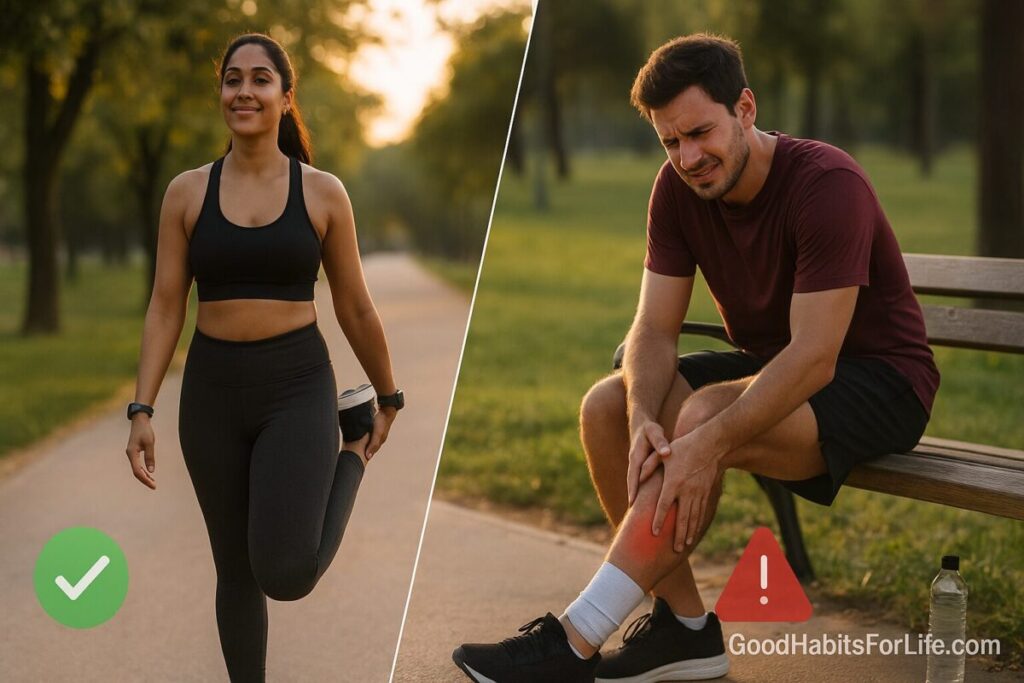
Injury Red Flags vs Normal Soreness: Zone 2 + NEAT (2025)
Injury Red Flags vs Normal Soreness (Zone 2 + NEAT)
Table of Contents
🧭 What Counts as Normal Soreness vs Injury Red Flags
Normal soreness (DOMS)
-
Dull, diffuse ache or stiffness in the worked muscles, usually bilateral/symmetrical
-
Peaks 24–72 hours after an unaccustomed or intense session, then fades
-
Improves with light movement and gentle stretching
-
No significant swelling, bruising, or loss of joint function
Injury warning signs
Stop training that area and consider medical evaluation if you notice any of the below:
-
Sharp, localized pain at rest or with light loads
-
Rapid swelling, heat, or visible deformity/bruising
-
Loss of strength or range of motion; joint feels unstable or “gives way”
-
Night pain that wakes you or pain that worsens day to day
-
Neurologic signs: numbness, tingling, weakness, altered reflexes
-
Back/neck red flags: bladder/bowel changes, saddle anesthesia, fever, unexplained weight loss, recent major trauma
-
Stress fracture clues: pinpoint bone tenderness, pain with hopping, swelling after impact activity
Rule of thumb: if pain forces you to change your gait/form, persists >3–5 days, or intensifies, treat it as an injury until proven otherwise.
✅ Quick Start: 10-Minute Self-Check + Today’s Plan
Step 1: Pain traffic light (0–10 scale)
-
Green (0–3/10): mild, settles within 24h → train easy; favor Zone 2 + NEAT
-
Yellow (4–5/10): modify volume/intensity; avoid pain-provoking moves; keep Z2/NEAT if tolerable
-
Red (≥6/10): stop the painful activity; switch to pain-free cardio (bike/elliptical/swim) and active recovery; seek assessment if persists
Step 2: 10-minute test
Walk or spin easily for 10 minutes. If pain decreases and gait is normal → proceed with light session. If pain increases or form compensates → rest that area and cross-train.
Step 3: Today’s micro-plan
-
20–40 min Zone 2 (conversational pace; 60–70% HRmax or RPE 4–6/10)
-
NEAT target: add 2,000–3,000 steps to your normal day (aim 7,000–10,000 total)
-
Mobility: 5–10 min gentle range-of-motion for the worked joints
-
Recovery basics: protein 20–40 g, fluids, and 7–9 h sleep
🛠️ 30-60-90 Recovery & Return-to-Training Plan
Days 1–30: Reset & Base
-
Frequency: 4–6 days/week easy movement
-
Cardio: 2–4 h/week Zone 2 split into 20–40 min blocks
-
Strength: 2–3 sessions/week at RPE 5–6; stop 2–4 reps in reserve (RIR)
-
NEAT: Daily step goal ≥7,000 (8–12k if already active)
-
Pain rule: Keep discomfort ≤3/10 during and after; next-day soreness resolves within 24–36h
Days 31–60: Progressive Load
-
Cardio: Maintain 2–4 h/week Z2; add short Zone 3 intervals if pain-free
-
Strength: Raise volume by ≤10%/week; introduce variety (tempo, unilateral work)
-
Checks: If soreness lingers >72h or pain ≥4/10, deload 1 week
Days 61–90: Specificity & Resilience
-
Cardio: Keep Z2 as recovery backbone; add sport-specific drills
-
Strength: Cycle heavier weeks (RPE 7–8) with deloads; prehab 10 min/session
-
Outcome: You can train hard days 1–2×/week while staying pain-smart
🧠 Techniques & Frameworks (RPE, Pain Scale, PEACE & LOVE)
-
RPE (Rate of Perceived Exertion):
4–6/10 = Zone 2; can speak full sentences. 7–8/10 = hard but sustainable. -
Pain scale with “24-hour rule”: OK if pain ≤3/10 and returns to baseline by next day.
-
PEACE & LOVE for soft-tissue injuries:
-
PEACE (acute): Protect, Elevate, Avoid anti-inflammatories early, Compression, Educate
-
LOVE (after 48–72h): Load, Optimism, Vascularisation (easy cardio), Exercise
-
-
Load management: Increase sets/reps/mileage by ≤10% per week; rotate high-impact days with low-impact Z2.
Traffic-Light Guide
| Status | Typical signs | What to do |
|---|---|---|
| 🟢 Green | Mild, diffuse soreness; normal function | Train easy; Z2 + NEAT; light strength |
| 🟡 Yellow | Achy spot; stiffness >48h; small swelling | Modify load; technique check; keep Z2 if pain-free |
| 🔴 Red | Sharp/localized pain; swelling/bruising; neuro signs | Stop provoking activity; seek assessment |
💙 Zone 2 Cardio & NEAT: Why They Help
-
Zone 2 (roughly 60–70% HRmax, conversational pace) increases mitochondrial density and capillary perfusion, improving recovery capacity without stressing joints/tendons.
-
NEAT (Non-Exercise Activity Thermogenesis)—all the walking, standing, and daily movement—reduces stiffness, elevates blood flow, and supports weight management during deloads.
-
Pairing Z2 + NEAT gives you circulation without overload, the sweet spot when you’re sore or returning from a niggle.
Practical targets
-
Z2: 3–5 sessions/week, 20–40 min each (or 10-min “movement snacks”)
-
NEAT: 7,000–10,000 steps/day (≈5–8 km), plus posture breaks every 30–60 min
🧑🤝🧑 Audience-Specific Tips
-
Students/Desk workers: Timer breaks every 50 minutes; 3×10-min walks; backpack fit check.
-
Professionals/Lifters: Warm-up 8–12 min (pulse, dynamic ROM, 1–2 ramp sets); log RPE/RIR.
-
Parents: Stroller walks as Z2; floor mobility with kids (crawls, shin boxes).
-
Seniors: Emphasize balance drills (tandem stands); choose low-impact Z2 (cycle/elliptical); monitor meds interactions.
-
Runners: Add cadence drills and soft-surface easy runs; watch for stress-fracture red flags.
⚠️ Mistakes & Myths to Avoid
-
“No pain, no gain” — Progress does not require pain; aim for mild soreness only.
-
Chasing PRs while sore — raises injury risk; build consistency first.
-
Skipping sleep/nutrition — recovery tanks without 7–9 h sleep and adequate protein.
-
Icing everything — use strategically for pain modulation; prioritize load management and early vascularisation.
-
Jumping from zero to hero — follow ≤10% weekly progression.
🗣️ Real-Life Scripts & Examples
-
Modifying leg day (Yellow light):
“Back squats irritate my knee at 5/10. I’ll swap to goblet squats at RPE 5–6, reduce depth to pain-free range, and finish with 20 min Z2 bike.” -
Returning after calf strain (PEACE & LOVE):
Week 1: Protect (no running), Compression sleeve, Z2 cycle 15–20 min/day.
Week 2: Begin isometrics (calf holds), progress to eccentrics, walk-jog only if ≤3/10 pain.
Week 3+: Build plyometrics and mileage by ≤10% if symptom-free. -
At-work NEAT:
Set a phone reminder: every hour, stand 2 minutes and walk 150–300 steps.
📚 Tools, Apps & Resources
-
HR monitor / smartwatch for Z2 (polar/garmin/apple)—track heart rate & steps.
-
Pain & training log (Sheets/Notion/Strava) to record RPE, sets, next-day soreness.
-
Mobility apps (e.g., GOWOD, pliability) for short guided ROM.
-
Technique checks: phone slow-mo or coach once a month.
Pros/Cons:
-
Wearables make Z2/steps easy to hit (pro), but can tempt you to do more than tissues tolerate (con). Stick to the traffic-light rule.
🧾 Key Takeaways
-
DOMS is dull and temporary; injuries show sharp, escalating, or function-limiting signs.
-
Use traffic-light pain + 24-hour rule to decide when to train, modify, or rest.
-
Zone 2 + NEAT speed recovery and maintain cardio while reducing injury risk.
-
Progress loads gradually (≤10%/week) and prioritize sleep, protein, hydration.
-
Seek professional care for red flags or pain that persists or worsens.
❓ FAQs
1) How do I know if it’s DOMS or a strain?
DOMS is diffuse, peaks at 24–72h, and improves with light movement. A strain feels sharp/localized, may swell or bruise, and limits strength or range.
2) Can I do cardio when sore?
Yes—prefer Zone 2 or other easy, pain-free modalities. It promotes blood flow and recovery without adding tissue stress.
3) What step count helps recovery?
Aim for 7–10k steps/day. If you’re very sore, start with short walks (3×10-min) and build back.
4) When should I see a doctor or physio?
Immediately for red flags (deformity, severe swelling, neuro signs, night pain, trauma) or if pain persists/worsens after 3–5 days.
5) Should I stretch sore muscles?
Gentle range-of-motion and light dynamic work is fine. Avoid painful, aggressive stretching in the first 24–48h.
6) Is ice or heat better?
Both can modulate symptoms. In the first 24–48h of an acute soft-tissue injury, many guidelines emphasize protection + gentle loading over passive modalities.
7) What is Zone 2 exactly?
Typically 60–70% of HRmax (220–age is a rough estimate) or RPE 4–6/10 where you can speak in full sentences.
8) How fast should I return to heavy lifting?
Increase volume/intensity by ≤10% weekly, ensuring next-day pain stays ≤3/10 and resolves within 24–36h.
9) Does massage help DOMS?
It can reduce perception of soreness short-term. Active recovery (Z2/NEAT) and sleep are still your biggest levers.
10) Are anti-inflammatories OK after a tweak?
Discuss with a clinician. Some models (PEACE & LOVE) advise caution early after soft-tissue injury; prioritize load management and education.
📚 References
-
World Health Organization. Guidelines on physical activity and sedentary behaviour. https://www.who.int/publications/i/item/9789240015128
-
American College of Sports Medicine. ACSM’s Guidelines for Exercise Testing and Prescription (current ed.). https://www.acsm.org
-
CDC. How much physical activity do adults need? https://www.cdc.gov/physicalactivity/basics/adults/index.htm
-
Cleveland Clinic. Heart Rate Zones: What They Are & How to Calculate. https://my.clevelandclinic.org/health/articles/24881-heart-rate-zones
-
Dubois B, Esculier J-F. “PEACE & LOVE” for soft-tissue injuries (Br J Sports Med). https://bjsm.bmj.com/content/54/2/72
-
NHS. Muscle, bone and joint injuries—when to get help. https://www.nhs.uk/conditions/muscle-bone-and-joint-injuries/
-
NICE. Low back pain and sciatica in over 16s: assessment and management (red flags). https://www.nice.org.uk/guidance/ng59
-
APTA ChoosePT. Red Flags for Serious Spinal Conditions. https://www.choosept.com
-
Levine JA. Non-exercise activity thermogenesis (NEAT). Proc Nutr Soc. 2004;63(4):829-36. https://doi.org/10.1079/PNS2004398
-
Schwellnus MP et al. DOMS—Risk factors and recovery. Sports Med. 2011;41(3):185-205. https://doi.org/10.2165/11584320-000000000-00000
-
American Heart Association. Target Heart Rates Chart. https://www.heart.org/en/healthy-living/fitness/fitness-basics/target-heart-rates
-
Sleep Foundation. How Much Sleep Do You Really Need? https://www.sleepfoundation.org/how-sleep-works/how-much-sleep-do-we-really-need
Disclaimer: This article is for general education on fitness and injury prevention and is not a substitute for personalized medical advice; see a qualified clinician for diagnosis and treatment.