
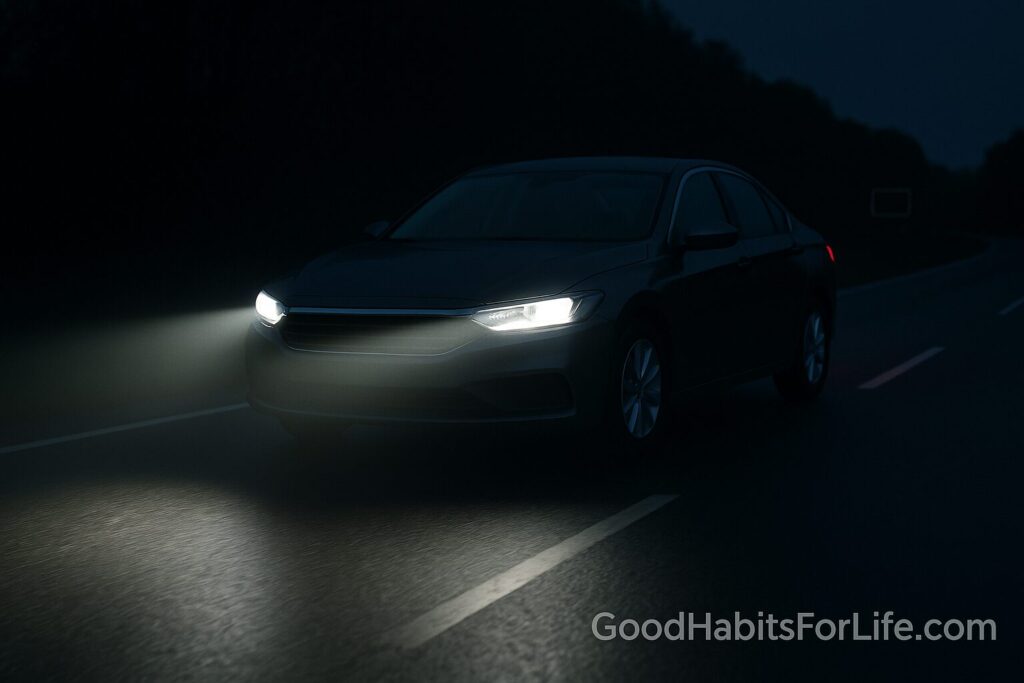
Headlights 2025: LEDs, AutoHighBeam, and Aiming
Headlights 2025: LEDs, Auto High Beam & Aiming
Table of Contents
🧭 What & Why: Headlights in 2025
Night driving is still where a disproportionate share of serious crashes occur, and headlight performance meaningfully affects risk. Vehicles with “Good” headlight ratings have ~20% lower nighttime single-vehicle crash rates than those with “Poor” headlights. IIHS HLDI
Independent organizations test both illumination distance and glare to oncoming drivers—two sides of the same safety coin. IIHS HLDI
Regulations continue to evolve. In the U.S., FMVSS 108 is the federal lighting standard, and NHTSA has recently updated it to allow adaptive driving beam (ADB) headlamps with specific performance criteria. eCFRFederal Register
Bottom line: Pick a vehicle/headlight system that’s proven to light where you need without dazzling others—and keep your lights clean, aimed, and used correctly.
💡 LED, Halogen, HID: What’s Different
-
Halogen: Cheap, warm color, shorter life; adequate in well-designed optics but less efficient.
-
LED: Efficient, fast on/off, long life, compact modules that designers can shape for better optics; in general lighting, LEDs use far less energy than incandescent lamps (context for why automakers love them). The Department of Energy’s Energy.gov
-
HID (xenon): Bright with long throw; slower on/off, can produce glare if mis-aimed.
Important legality note (U.S.): LEDs are fine when part of a certified headlamp assembly (OE or compliant replacement). Drop-in LED “bulbs” for halogen-type replaceable-bulb headlamps are not permitted under FMVSS 108 as of 2024 NHTSA guidance. Check your state laws for enforcement. NHTSA
🧠 Auto High Beam vs Adaptive Driving Beam (ADB)
-
Auto High Beam (AHB): Uses a camera to switch between low/high beams based on traffic and lighting conditions—so you use high beams more often without manual toggling. NHTSA
-
Adaptive Driving Beam (ADB): Keeps a continuous high-beam pattern while shading out portions to avoid glare for others—expanding your forward visibility compared with AHB alone. The U.S. finalized rules permitting certification of ADB (2022), with clarifications in 2024 on how portions of the beam must meet intensity limits. NHTSAFederal Register
Tip: If your car offers both AHB and ADB (some 2023+ models), keep the camera/windshield area clean and the system enabled in Settings. Dirty sensors = worse decisions.
🛠️ Quick Start: Check, Clean, Aim
Before you aim:
-
Park on level ground, tires at correct pressure, normal fuel, driver in seat (or equivalent weight). Remove trunk cargo that isn’t typical. (Setup conditions are part of official test/aiming protocols.) Federal Register
1) Check & Clean (5 minutes)
-
Wash lenses; remove condensation if possible.
-
If lenses are yellowed/hazy, use a restoration kit or replace—restoration can roughly double maximum light intensity in testing. AAA
2) Aim at a Wall (15–20 minutes)
-
Find a flat area facing a wall/door. Measure 7.6 m (25 ft) from headlamps to wall; mark a horizontal line at each lamp’s center height and a vertical line at each center. Connect NCDOT
-
Switch on low beams. Adjust vertical aim so the top of the cutoff is at or just below the lamp-center line (some SUVs/high lamps should aim slightly low; see “25-5” rule below). Federal Highway Administration
-
Adjust horizontal aim only if your headlamp has a horizontal adjuster (many U.S. low beams don’t). NHTSA
-
Road-test on a dark, empty street. Re-check after loading changes (towing/cargo).
3) Use Your High Beams Smartly
-
On unlit roads, high beams dramatically extend seeing distance—use them whenever legal and safe; dim for oncoming traffic and when following closely. (Typical driver manuals echo this convention.) dmv.nebraska.gov
🗺️ 30-60-90 Day Headlight Habit Plan
Day 0 (Today)
-
Clean lenses; enable Auto High Beam; perform the 25-ft aim check; replace burnt bulbs in pairs; verify headlight fuse/relays.
Days 1–30
-
Night-drive once weekly on a familiar unlit road: check reach, foreground, and signs. Log any “dark gaps” or glare reports from family members.
-
If restoration didn’t help, price new assemblies (often a major upgrade on older cars).
Days 31–60
-
If your model offers better trims or accessory headlights rated higher by independent tests, consider upgrading to that complete assembly. (Assemblies, not bulb swaps, preserve legal compliance.) IIHS HLDI
-
Book a professional aim if DIY results are inconsistent (especially after suspension/ride-height work).
Days 61–90
-
Seasonal check: clean sensors/camera for AHB/ADB; re-aim if you’ve changed tire size, springs, or typical load.
-
Create an annual reminder (pre-monsoon/winter): clean → aim → test.
🧪 Techniques & Frameworks (DIY Aim, When to See a Pro)
The “25-5 Rule” (for vertical aim):
-
Measure lamp optical center height (OCH). If ≤ 90 cm (36 in), aim the cutoff at that height on the wall at 7.6 m (25 ft). If > 90 cm, aim about 5 cm (2 in) below. Federal Highway Administration
The “SEE” Checklist for night trips:
-
Settings: AHB/ADB on; instrument dimmer low (improves dark adaptation).
-
Elevation: Vehicle level; auto-leveling sensor arms intact.
-
Environment: Clean windshield, cameras, and headlamps; avoid smoked/tinted covers (can cut light badly).
When to see a pro:
-
Persistent glare complaints from others; asymmetric patterns; collision repairs; new springs/lift/level kits; water inside lamps; ADB calibration faults.
👥 Audience Variations
New drivers/students: Add a pre-departure “lights on wall” check in your routine. Practice toggling high beams when no cars are within ~150–200 m.
Seniors: Prioritize glare-controlled systems and anti-reflective windshield care; consider night-driving glasses only if they don’t reduce light too much.
Professionals with long commutes: Keep AHB enabled, but confirm it doesn’t “bounce” in heavy rain/fog (temporarily disable if it misbehaves).
EV owners: LEDs reduce electrical load vs halogen in general lighting contexts—less strain on 12 V systems is handy in cold weather. (Vehicle energy savings from lamps are modest but non-zero.) The Department of Energy’s Energy.gov
SUV/Truck owners: Your higher lamp height often requires slightly lower vertical aim to avoid glare—recheck after loading/towing. Federal Highway Administration
⚠️ Mistakes & Myths to Avoid
-
Myth: “Brighter is always better.” Reality: Too much foreground light reduces distance vision and can create glare for others; balance and aim matter. IIHS HLDI
-
Mistake: Installing LED retrofit bulbs in halogen housings. Risk: Non-compliant and glare-prone; instead, replace the entire assembly with a compliant unit. NHTSA
-
Mistake: Ignoring lens haze. Fix: Restore or replace; tests show large gains after restoration. AAA
-
Mistake: Aiming with a loaded trunk or soft tires; you’ll “bake in” bad aim. Federal Register
🗣️ Real-Life Scripts (Copy-Paste)
-
Service request: “Please perform a headlamp aim per manufacturer specs and verify AHB/ADB calibration. Headlamp OCH is ___ cm; set vertical cutoff accordingly.”
-
Body shop pickup check: “Can we park 7.6 m (25 ft) from a wall and check the cutoffs for level and symmetry before I leave?” Connect NCDOT
-
Family reminder: “Before tonight’s trip, wipe lenses/camera, enable Auto High Beam, and do a quick wall check.”
🧰 Tools, Apps & Resources
-
DIY: Tape, tape-measure/laser, spirit level, chalk line, Torx/Phillips/hex driver, restoration kit, microfiber cloths.
-
Info sources:
-
FMVSS 108 (official standard) for U.S. headlamp requirements. eCFR
-
IIHS headlight ratings & methodology (helps shoppers compare). IIHS HLDI
-
State inspection manuals or DOT aiming charts for the 25-ft method. Connect NCDOT
-
NHTSA driver-assistance page for Auto High Beam basics. NHTSA
-
✅ Key Takeaways
-
Choose vehicles/headlamps with strong independent ratings—they’re linked to fewer night crashes. IIHS HLDI
-
Use Auto High Beam/ADB to maximize seeing distance without dazzling others. NHTSAFederal Register
-
Keep lenses clear, sensors clean, and aim checked at 7.6 m (25 ft) on level ground. Connect NCDOT
-
Stay legal: avoid LED “retrofit bulbs” in halogen housings; use compliant assemblies. NHTSA
❓ FAQs
1) Are LED headlight bulbs legal to install in any car?
Not as drop-in “retrofit bulbs” for halogen replaceable-bulb headlamps in the U.S.; full LED assemblies are fine if certified compliant. NHTSA
2) What distance should I use for DIY aiming?
Use 7.6 m (25 ft) from the lamp to a flat wall/screen on level ground; mark lamp center height and adjust the low-beam cutoff to at/just below that line. Connect NCDOT
3) My SUV’s lights sit high—should I aim lower?
Often yes. If the lamp optical center is > 90 cm (36 in), aim about 5 cm (2 in) lower at 25 ft to control glare. Federal Highway Administration
4) Do better headlights really reduce crashes?
Yes. Vehicles with Good headlight ratings show ~20% lower nighttime single-vehicle crash rates vs Poor. IIHS HLDI
5) What’s the difference between Auto High Beam and ADB?
AHB toggles high/low automatically; ADB keeps a high beam and dynamically shades oncoming traffic—now permitted under FMVSS 108 with detailed requirements. NHTSAFederal Register
6) My lights seem dim but are aimed right—what else helps?
Restore cloudy lenses (proven gains), consider new compliant assemblies, and keep the windshield and sensors clean. AAA
7) Does using LEDs save EV range or fuel?
LEDs draw less power than incandescent/halogen in general lighting contexts; savings at the vehicle level are modest but real over time. The Department of Energy’s Energy.gov
8) Who checks glare?
Independent tests evaluate both reach and glare toward oncoming traffic to balance visibility and courtesy. IIHS HLDI
9) Can I adjust horizontal aim?
Only if your headlamp has a horizontal adjuster; many U.S. low beams lack one by design. NHTSA
10) Do I need a shop to aim ADB?
ADB systems may require calibration to manufacturer specs after repairs or suspension changes; follow the owner’s manual or seek a qualified shop. Federal Register
📚 References
-
NHTSA — FMVSS No. 108 (49 CFR §571.108), U.S. lighting standard. eCFR
-
Federal Register (2024) — Adaptive Driving Beam clarifications under FMVSS 108. Federal Register
-
NHTSA (2022) — Final Rule permitting certification of ADB headlamps. NHTSA
-
NHTSA — Driver Assistance Technologies: Automatic High Beams definition. NHTSA
-
IIHS (2021) — Good headlight ratings linked to lower nighttime crash rates. IIHS HLDI
-
IIHS — Headlight test protocol & what’s measured (illumination and glare). IIHS HLDI+1
-
AAA — Headlight safety, maintenance & restoration results. AAA
-
NCDOT — Headlight Wall-Chart Aiming Requirements (25-ft screen method). Connect NCDOT
-
FHWA — Headlamp aiming procedure; OCH thresholds and 5 cm (2 in) drop for high-mounted lamps. Federal Highway Administration
-
NHTSA Interpretation (2024) — LED replaceable bulbs in halogen headlamps not permitted under FMVSS 108. NHTSA
Disclaimer
Regulations vary by country/state and change over time; this guide is informational and not legal advice.