
Gamify Your Focus: Streaks, Stakes & Social: AI workflows (2025)
Gamify Your Focus (2025): Streaks, Stakes & Social—AI Workflows
Table of Contents
🧭 What & Why
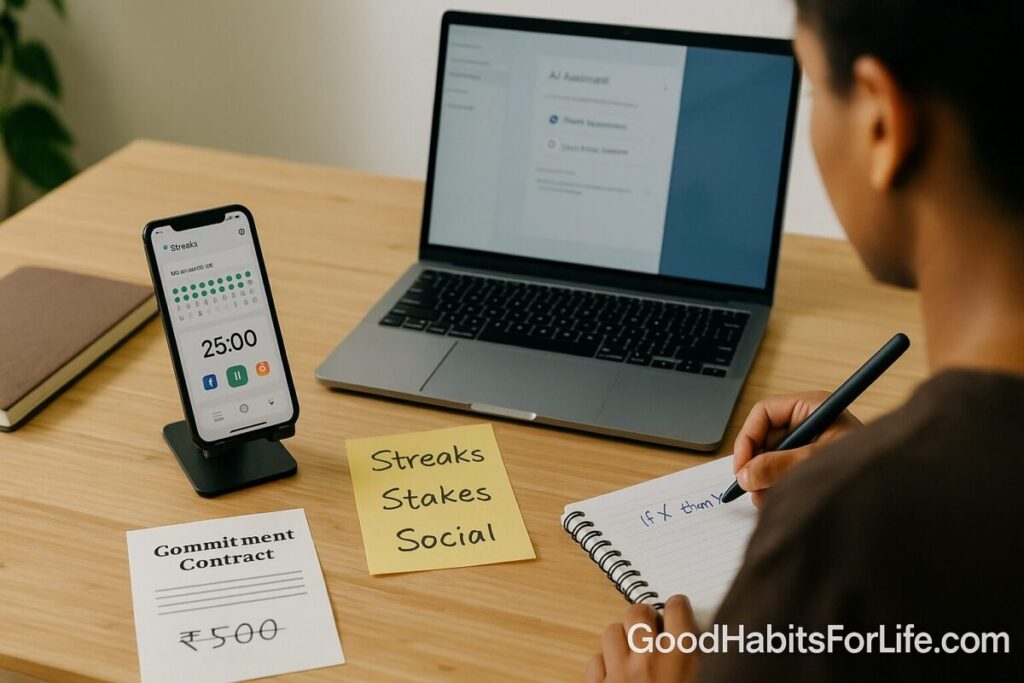
Gamifying focus means layering game-like mechanics—streaks (consecutive days), stakes (money or reputation on the line), and social (public commitment, buddy systems)—on top of plain study or work sessions. Done right, these nudge you to show up, reduce friction, and make progress feel rewarding.
Does it work?
-
Meta-analyses show small-to-moderate effects of gamification on motivation, engagement and learning outcomes when thoughtfully designed [1].
-
Implementation intentions—simple “If X, then I will Y” plans—reliably increase goal attainment across many tasks [2][3].
-
Habits build via consistent cue-action pairing; automaticity typically rises over weeks, not days (median ≈ 66 days; wide range) [4].
-
Loss aversion means people hate losing more than they like winning; commitment contracts leverage this to improve adherence [5][6].
-
Public commitments & accountability can enhance follow-through—especially when visible to close others [7].
Bottom line: Combine streaks (show up), stakes (care more), social (be seen), and AI (reduce admin) so your daily focus routine is almost automatic.
✅ Quick Start (Do This Today)
-
Pick one target: e.g., 2×25-min deep-work blocks on calculus / literature review / coding.
-
Write the plan (implementation intention):
-
If it’s 07:30 at my desk, then I start a 25-min session on [Unit X].
-
-
Create a 7-day streak tracker: simplest is a one-line daily ✅ in Notes or a checkbox column in Google Sheets.
-
Add a soft stake: tell a friend you’ll post a daily “done” screenshot; if you miss, you owe them ₹200 (≈$2.50).
-
Book a social slot: schedule one Focusmate/virtual coworking or library meet-up this week.
-
Use AI to de-admin your focus:
-
Paste your syllabus/brief and ask: “Create 7×25-min focus tasks with micro-milestones and 1 sentence of why each matters.”
-
Ask AI to summarize yesterday’s session into 3 bullets + next action.
-
-
End-of-day reflection (3 minutes): Win, stuck point, fix for tomorrow.
🛠️ 7-Day Starter Plan
Goal: prove the system, not perfection.
Daily Core (≈70–90 min total):
-
Warm-up (2 min): open materials + checklist; phone on DND.
-
Deep block A (25 min) → 2-min log (what progressed).
-
Micro-break (3–5 min); water, short walk.
-
Deep block B (25 min) → 2-min log.
-
Close-out (5 min): tick streak, share proof with buddy, draft tomorrow’s “If-Then”.
Add one booster each day:
-
Day 1: Build your tracker and invite your accountability buddy.
-
Day 2: Set a fail-safe buffer: 1 “streak freeze” you can use once this week.
-
Day 3: Add a tiny stake (₹200) to a friend or a Beeminder/StickK pledge.
-
Day 4: Try temptation bundling (only play your favorite playlist/audiobook during focus) [8][9].
-
Day 5: Publish your goal & time slot in a small group chat.
-
Day 6: Ask AI to rewrite notes into a 5-question quiz; take it.
-
Day 7: Review: wins, misses, bottlenecks; adjust next week’s plan.
🧠 30-60-90 Roadmap (Scale What Works)
Days 1–30 (Build automaticity)
-
Keep to 2×25-min blocks on weekdays + 1 block weekends.
-
Protect one “streak freeze” per 14 days (use for illness/travel).
-
AI weekly: generate task batches, reading orders, and “one-pager” briefs.
-
Add small stakes (₹200–₹500 per miss).
-
Milestone: 20+ sessions logged; friction feels lower.
Days 31–60 (Raise challenge carefully)
-
Bump to 3×25-min blocks 3 days/week.
-
Upgrade stake: use a commitment contract for the next 4 weeks.
-
Make commitments visible to a close peer group (not the whole internet).
-
Milestone: deliverable shipped (chapter, prototype, practice test).
Days 61–90 (Sustain & personalize)
-
Choose either longer blocks (2×50 min) or more reps (4×25 min).
-
Add a stretch goal with clear, challenging, specific metrics (Locke & Latham principles) [10].
-
Tighten your If-Then library (5–10 fallback plans for common obstacles).
-
Milestone: second deliverable shipped + feel comfortable skipping a day without derailing.
🛠️ Techniques & Frameworks that Work
Implementation Intentions (“If X, then Y”)
-
Example: If it’s 07:30, then I open Chapter 4 and answer 3 problems. Strong evidence supports these plans for closing the intention-action gap [2][3].
Streaks (with sanity guards)
-
Benefits: simple, visual momentum; boosts “I’m the kind of person who shows up.”
-
Risks: perfection pressure; use buffers (e.g., 1–2 freezes per month). Research finds intact logged streaks can increase engagement; broken streaks can discourage, so design for recovery [11].
Stakes & Loss Aversion
-
Put small money or reputation at risk. Loss aversion amplifies motivation [5]. Field experiments show commitment devices can improve adherence in health behaviors [6].
-
Keep stakes proportional and temporary (4–8 weeks), then reassess.
Social Accountability
-
Use buddy check-ins or virtual coworking; make progress visible to a small, supportive circle. Public commitments can help, but too-public can backfire—close-tie visibility often works best [7].
Temptation Bundling
-
Pair a “want” (favorite playlist/podcast) with a “should” (problem sets). Field studies show bundling increases workout adherence; apply the same idea to study/work [8][9].
Goal Setting (Clarity > Intensity)
-
Set specific, challenging goals with clear metrics and deadlines (e.g., finish 20 Anki cards + 2 problem sets by Friday)—a robust finding in goal-setting research [10].
👥 Audience Variations
-
Students: Anchor streak to class timetable; use AI to turn lecture notes into practice questions and memory prompts.
-
Professionals: Time-box email/Slack outside deep-work blocks; ask AI to condense meeting notes into 3 action items.
-
Parents/Caregivers: Use micro-blocks (15–20 min) synced to nap/school windows; keep a “restart in 60 seconds” checklist for interruptions.
-
Teens: Gamify with XP points for finished tasks; reward = screen time or hobby time tied to XP. Keep stakes reputational, not financial.
-
Seniors/Lifelong Learners: Prefer consistent light cadence over intensity (1–2 blocks/day), add gentle social accountability (book club, class group).
⚠️ Mistakes & Myths to Avoid
-
Myth: “Streaks must be unbroken forever.” Reality: use planned freezes; design for life events.
-
Mistake: Over-public commitments. Big audiences can add anxiety; choose a small, supportive group.
-
Mistake: All-or-nothing stakes. Start small; huge penalties can trigger avoidance.
-
Myth: “AI should decide everything.” Keep AI as a copilot, not a boss; you remain the planner.
-
Mistake: Tracking too much. Measure inputs (minutes/blocks) and outputs (pages/problems), not every micro-metric.
🗣️ Real-Life Examples & Scripts
Public micro-commitment (buddy DM):
“7:30–8:30 I’m doing 2×25 on Chapter 4 (Calculus). I’ll send a done emoji after.”
If-Then library (copy/paste):
-
If I wake late, then I’ll do 1×25 at lunch and 1×25 at 18:00.
-
If noise at home, then I move to the library/quiet room within 10 minutes.
-
If I hit a blocker for 5 min, then I write the specific question and switch to the next sub-task.
Temptation bundle:
“My podcast only plays during deep-work blocks. When timer stops, podcast pauses.”
Gentle stake:
“If I miss a weekday session, I donate ₹300 to a cause I don’t love.”
Social proof (weekly post in small group):
“This week: 12 blocks logged, draft submitted, 2 practice quizzes—next: polish references.”
🧩 Tools, Apps & Resources (quick pros/cons)
-
Habitica / Streaks / Loop Habit Tracker — fun streaks & XP; pro: playful; con: can over-optimize for checking boxes.
-
Forest / Focus To-Do (Pomodoro) — timers with light gamification; pro: simple; con: still need a task plan.
-
Beeminder / StickK (stakes) — money at risk for missed goals; pro: real stakes; con: can feel punitive if mis-scoped.
-
Focusmate (virtual coworking) — social presence; pro: high accountability; con: fixed slots.
-
Notion / Obsidian / Google Sheets — custom trackers, “done” logs, and streak formulas; pro: flexible; con: initial setup.
-
AI copilot (any LLM) — draft plans, summarize notes, generate quizzes, create weekly schedules; pro: huge admin reduction; con: requires good prompts.
🤖 Suggested AI Workflows (copy-ready)
1) Daily Focus Plan (90 seconds)
Prompt: “Here’s my syllabus/brief. Create 3×25-min tasks for today with exact pages/problems, a 1-line why for each, and an If-Then for my start time 07:30.”
2) Session Logger → Quiz
Prompt: “Summarize what I covered today into 5 key bullets and make a 5-question self-test (answer key at bottom).”
3) Weekly Roadmap
Prompt: “Given these deadlines, map a 5-day plan with 2×25 blocks/day, specify materials, add one review day, and include a contingency if I miss Tuesday.”
4) Streak & Metrics Sheet
Prompt to AI + Sheets: “Create a CSV with columns: Date, Blocks Planned, Blocks Done, Minutes, Focus Topic, Win, Stuck, Next Action. Add formulas for 7-day streak and completion %.”
5) Accountability Messages
Prompt: “Write three friendly check-in templates I can send to my study buddy (start, midweek, weekend) with emojis but professional tone.”
📚 Key Takeaways
-
Design for showing up. Streaks + If-Then plans make starts automatic.
-
Make it matter. Small stakes harness loss aversion.
-
Be seen. Social visibility drives follow-through—keep it to a supportive circle.
-
Let AI handle admin. Offload planning, logging, and light prompts to a copilot.
-
Scale slowly. 7-day proof → 30-60-90 build → personalize.
❓ FAQs
1) Won’t streaks make me anxious?
Use planned freezes (e.g., 1–2 per month). If anxiety rises, switch to weekly consistency goals (e.g., 5 of 7 days) instead of unbroken streaks.
2) How big should my stake be?
Small is fine (₹200–₹500 per miss). Stakes should nudge, not punish. Review after 4 weeks.
3) Is public posting necessary?
No. Research suggests close-tie accountability is often more effective than broad public posts. Use a small group or one buddy.
4) Can AI over-optimize my day?
Yes—keep human priorities first. Use AI to propose, not dictate, your plan. Edit ruthlessly.
5) What’s better: 2×50 or 4×25?
Both work. If you struggle to start, do 4×25. If you hate switching, try 2×50. Track which yields more finished work.
6) How long to make it a habit?
Expect weeks to months. Median estimates around ~66 days, but it varies widely; focus on consistent cues and small wins.
7) Do rewards undermine intrinsic motivation?
Over-controlling rewards can, but autonomy-supportive design aligned with your goals tends to help (see Self-Determination Theory).
8) What if I break the streak?
Resume next slot; log a brief post-mortem and use your If-Then fallback. Consider a “broken-streak recovery badge” to normalize restarts.
9) Are commitment contracts safe?
They’re tools—start small, set clear rules, and pair with supportive accountability.
10) How do I measure progress?
Track inputs (blocks/minutes) and outputs (pages/problems/quiz scores). Review weekly; adjust scope, not the habit.
References
-
Sailer, M., & Homner, L. (2020). The Gamification of Learning: A Meta-analysis. Educational Psychology Review. https://link.springer.com/article/10.1007/s10648-019-09498-w
-
Gollwitzer, P. M., & Sheeran, P. (2006). Implementation Intentions and Goal Achievement: A Meta-analysis of Effects and Processes. Advances in Experimental Social Psychology. https://www.sciencedirect.com/science/article/pii/S0065260106380021
-
Wieber, F., Gollwitzer, P. M., & Sheeran, P. (2015). Promoting the translation of intentions into action by implementation intentions. European Review of Social Psychology (overview). https://pmc.ncbi.nlm.nih.gov/articles/PMC4500900/
-
Lally, P., van Jaarsveld, C. H. M., Potts, H. W. W., & Wardle, J. (2010). How are habits formed: Modeling habit formation in the real world. European Journal of Social Psychology. https://onlinelibrary.wiley.com/doi/abs/10.1002/ejsp.674
-
Kahneman, D., & Tversky, A. (1979/1992). Prospect Theory & Loss Aversion. Econometrica; Journal of Risk and Uncertainty (cumulative representation). https://web.mit.edu/curhan/www/docs/Articles/15341_Readings/Behavioral_Decision_Theory/Kahneman_Tversky_1979_Prospect_theory.pdf ; https://psych.fullerton.edu/mbirnbaum/psych466/articles/Tversky_Kahneman_JRU_92.pdf
-
Giné, X., Karlan, D., & Zinman, J. (2010). A Commitment Contract for Smoking Cessation. Field experiment paper. https://poverty-action.org/sites/default/files/publications/put_your_money_where_your_butt_is.pdf
-
Munson, S. A., & Consolvo, S. (2015). Effects of Public Commitments and Accountability in a Technology-Supported Physical Activity Intervention. CHI Proceedings. https://dl.acm.org/doi/10.1145/2702123.2702524
-
Milkman, K. L., Minson, J. A., & Volpp, K. G. (2014). Holding the Hunger Games Hostage at the Gym: An Evaluation of Temptation Bundling. Management Science. https://pubsonline.informs.org/doi/10.1287/mnsc.2013.1784
-
Kirgios, E. L., et al. (2020). Teaching Temptation Bundling to Boost Exercise: A Field Experiment. Organizational Behavior and Human Decision Processes. https://www.sciencedirect.com/science/article/pii/S074959782030385X
-
Locke, E. A., & Latham, G. P. (2002). Building a Practically Useful Theory of Goal Setting and Task Motivation. American Psychologist (retrospective paper). https://med.stanford.edu/content/dam/sm/s-spire/documents/PD.locke-and-latham-retrospective_Paper.pdf
-
Silverman, J., & Barasch, A. (2022). On or Off Track: How (Broken) Streaks Affect Consumer Behavior. Journal of Consumer Research. https://academic.oup.com/jcr/article/49/6/1095/6623414