
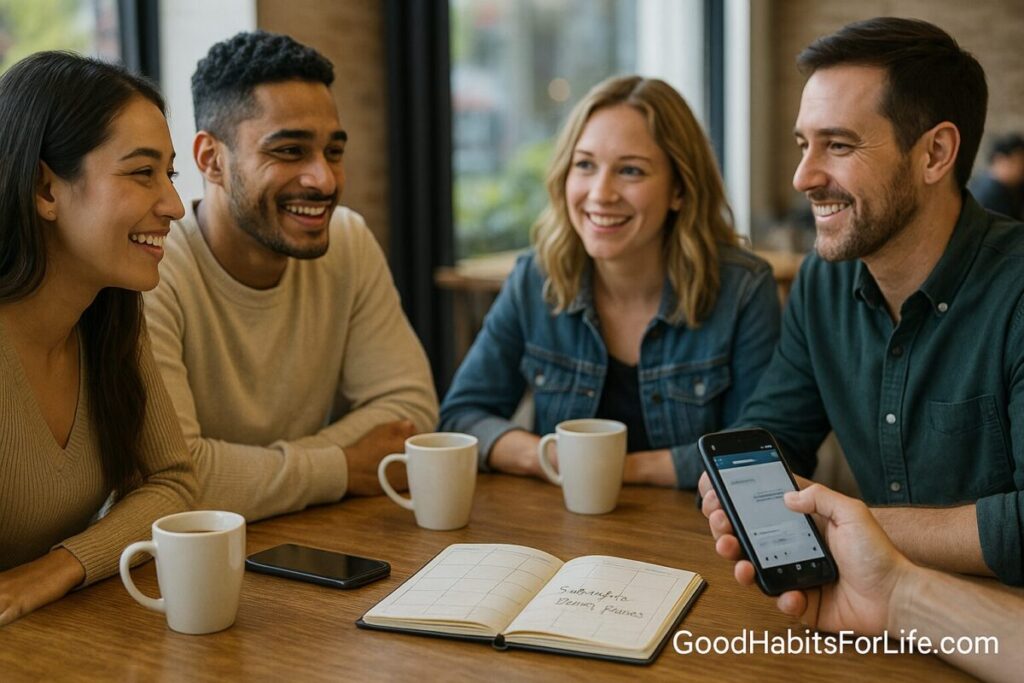
Friend Funnels: Events DMs Plans
Friend Funnels: Events, DMs & Plans That Stick
Table of Contents
🧭 What & Why
What is a “friend funnel”?
A friend funnel is a simple system for growing friendships in three steps: (1) Events (top-of-funnel: meet people), (2) DMs (mid-funnel: follow up and build rapport), (3) Plans (bottom-funnel: convert to recurring hangouts). It turns “I should make more friends” into small, repeatable moves.
Why it works (evidence-aligned):
-
Depth needs time. Studies estimate ~50 hours to shift from acquaintance→casual friend, ~90 to “friend,” and ~200+ to “close friend.” A funnel ensures you keep putting in the hours with a few people rather than scattering attention. SAGE Journals
-
Repeated exposure increases liking. Seeing someone more often (events, group chats, standing plans) boosts familiarity and affinity (the “mere exposure” effect). LMU Psychology
-
Reciprocal self-disclosure builds intimacy—even online. Thoughtful, back-and-forth DM exchanges can intensify closeness and prime easy in-person plans. bpb-us-e1.wpmucdn.com
-
Planfulness turns intent into action. If-then planning (“If it’s Friday 5 pm, I’ll DM two people”) reliably increases follow-through. Cancer ControlPMC
-
Balanced social “portfolio.” People naturally keep layers (≈5, 15, 50, 150). A funnel helps you nurture a few “core” ties while still adding new acquaintances. PMC
-
Friendship matters for health. Robust social ties are linked with better health and longevity; conversely, social disconnection is a public-health concern. PMCNCBI
✅ Quick Start (Do This Today)
-
Pick one event in the next 7 days (club run, coworking meetup, class, faith or hobby group).
-
Set a 30-minute “follow-up block” on your calendar the day after the event to send 3 DMs (“Great to meet you—want to grab coffee Thursday?”). Use copy-paste scripts below.
-
Create a “go-to invite” menu of 3 light plans (15–60 min): coffee walk, co-work hour, badminton knock-about.
-
Track your pipeline in a tiny sheet: Name | Where we met | Last touch | Next touch | Depth (A/B/C).
-
Schedule one simple plan for this week with anyone you clicked with.
🗓️ 30-60-90 Habit Plan
Goal: A steady rhythm of meeting a few people, following up, and keeping 3–8 active friendships growing.
Days 1–30 (Build the pipeline)
-
Events: 1–2 per week, aim to exchange contacts with 3 people weekly.
-
DMs: 2 short follow-ups per week (“Nice meeting you! Coffee Wed?”). bpb-us-e1.wpmucdn.com
-
Plans: 1 micro-plan per week (≤60 min, low-friction).
-
System: 2 calendar blocks/week: DM Friday 17:00, Plan Sunday 11:00 (if-then). Cancer Control
Days 31–60 (Deepen a few)
-
Events: 1/week to keep new inputs coming (weak ties widen opportunities). Science
-
DMs: Start light self-disclosure reciprocity (“I’m training for a 5K—what’s your weekend hobby?”). bpb-us-e1.wpmucdn.com
-
Plans: 1 longer plan (90 min) or a standing plan (e.g., Wed walk).
-
Portfolio: Intentionally focus on 5–10 promising connections (align with Dunbar layers). PMC
Days 61–90 (Stabilize & stack)
-
Events: Only those you enjoy; invite a friend to join you (bridge groups).
-
Plans: Convert one plan to recurring (biweekly game night / Sunday run).
-
Habits: Expect ~2–3 months for the social routine to feel automatic. Wiley Online Library
🛠️ Techniques & Frameworks
1) The Friend Funnel (E-D-P):
-
E—Events: Low-pressure spaces with repeated exposure (clubs, classes, volunteer). LMU Psychology
-
D—DMs: 24–72-hour follow-ups that reciprocate tone and depth; ask one specific question; propose one light option. bpb-us-e1.wpmucdn.com
-
P—Plans: Short, concrete, time-boxed invites; confirm day-of; iterate.
2) If-Then Planning for Social Life:
-
Example: “If it’s Friday 17:00, then I message two people and propose a coffee next week.” Proven to boost action vs. vague intentions. Cancer ControlPMC
3) The 3×3 Method:
-
Keep 3 go-to events, 3 go-to DM openers, 3 go-to plans. This reduces decision fatigue and increases consistency (habits thrive on repeatable contexts). PMC
4) Layered Portfolio Check (5/15/50/150):
-
Review quarterly: Do you have a healthy mix of a core 5, close 15, active 50, and wider 150? Adjust your funnel accordingly. PMC
5) The “Fast Friends” Booster (for small groups):
-
Try a few of the famous 36 questions during a walk or tea; escalating, reciprocal self-disclosure increases closeness. SAGE Journals
🧠 Audience Variations
-
Students: Join recurring activities (societies, clubs). Keep a weekly “study + snack” open invite.
-
Parents: Leverage kid-anchored routines (park hour, sports sideline coffee). Short windows, standing plans.
-
Professionals: Schedule a “networked lunch” block biweekly. Use weak ties for cross-industry serendipity. Science
-
Seniors: Choose consistent community events (walking groups, library clubs). Emphasize routine and proximity.
-
Teens: Activity-based hangs (sports, maker clubs). Encourage group chats that convert to small in-person plans.
⚠️ Mistakes & Myths to Avoid
-
Myth: “Real friends happen naturally.” Truth: closeness correlates with shared hours and intentionality. SAGE Journals
-
Mistake: Only going to big events. Without DMs and small plans, contacts evaporate (mere exposure helps, but you still need follow-through). LMU Psychology
-
Mistake: Oversharing in DMs. Use gradual reciprocity; match the other person’s tone and depth. bpb-us-e1.wpmucdn.com
-
Myth: “I need tons of friends.” A few strong ties beat many loose ones for wellbeing; maintain a balanced portfolio. PMC
✉️ Real-Life Examples & Scripts (Copy-Paste)
After an event (24–72 hours):
-
“Hey Priya—really enjoyed chatting after the language meetup about Tamil cinema. I’m free Thu 18:00 for a chai walk near MG Rd—want to join?”
-
“Hi Omer—loved your tips at run club. I’m doing an easy Zone-2 loop Sat 7:30 at Cubbon. Low-pressure pace—keen?”
DM to re-spark a warm acquaintance:
-
“Hey Mina—your note on morning writing stuck with me. How did last week go? Coffee + 30-min co-write Tue 8:00?” bpb-us-e1.wpmucdn.com
Light self-disclosure (reciprocal):
-
“I’m learning fingerstyle guitar—still clumsy, but fun. What’s your current mini-project?” bpb-us-e1.wpmucdn.com
Group plan → recurring:
-
“Had fun at board-games night. Want to make it first-Fridays? I can host next time—19:00–21:00, bring any snack.”
Graceful decline (keep door open):
-
“This week’s packed, but I’d love to next Wed or Thu. Does 18:30 at Blue Tokai work?”
🧰 Tools, Apps & Resources (Pros/Cons)
-
Meetup / Eventbrite: Easy discovery; quality varies—sample a few before committing.
-
Bumble BFF / Friender / Geneva: 1:1 or small-group matching; requires proactive filtering and safety habits.
-
Discord / WhatsApp Communities: Great for repeated exposure; mute noisy channels and DM intentionally. PMC
-
Google Calendar / Notion / Airtable: Blocks for DMs & plans; simple pipeline table keeps you consistent (habits love stable cues). PMC
-
Parks, Libraries, Faith & Volunteer Orgs: Built-in routine and values alignment; start with low-commitment roles.
Your tiny tracking sheet:
-
Columns: Name | Where we met | Last touch | Next touch | Depth A/B/C | Notes
-
Weekly review: Promote 1–2 people to a standing plan; prune stale contacts kindly.
📚 Key Takeaways
-
System beats spurts: Events feed DMs; DMs feed plans; plans create hours together. SAGE Journals
-
Consistency > intensity: Two short invites weekly > one elaborate party monthly. PMC
-
Reciprocity is your compass: Match tone and depth; ask specific, doable invites. bpb-us-e1.wpmucdn.com
-
Grow layers, not just numbers: Keep a balanced 5/15/50/150 portfolio. PMC
❓ FAQs
How many new people should I meet weekly?
1–2 events (or new contexts) is plenty; focus more on follow-ups than volume. Weak ties widen options; a few will become strong ties. Science
How soon should I suggest a plan after meeting?
Within 72 hours. Keep it short (≤60 min) and specific (place/time). Pair with one genuine, light self-disclosure. bpb-us-e1.wpmucdn.com
Is it okay to start online?
Yes—reciprocal, considerate self-disclosure can intensify closeness in text. Move to a brief in-person plan quickly. bpb-us-e1.wpmucdn.com
How do I avoid flaking (mine or theirs)?
Use if-then plans and calendar blocks; confirm the morning of; always propose one fallback time. Cancer Control
How many close friends do people usually have?
Surveys vary, but many adults report 1–4 close friends; some have 5+; a minority have none—hence the value of a steady funnel. Pew Research Center
How long until this feels natural?
Expect ~2–3 months for the habit of DMs/plans to stick; deep friendship takes longer (hundreds of hours). Wiley Online LibrarySAGE Journals
How do I avoid awkwardness in DMs?
Mirror their vibe, ask one question, and give one concrete option (“Thu 18:30 coffee?”). Avoid essays; prioritize clarity. bpb-us-e1.wpmucdn.com
References
-
Hall, J. A. (2019). How many hours does it take to make a friend? Journal of Social and Personal Relationships. (Peer-reviewed summary of hour thresholds.) SAGE Journals
-
Office of the U.S. Surgeon General. (2023). Our Epidemic of Loneliness and Isolation (advisory). (Health impact of social connection.) NCBI
-
Zajonc, R. B. (1968). Attitudinal Effects of Mere Exposure. Journal of Personality and Social Psychology. (Familiarity principle.) LMU Psychology
-
Jiang, L. C., Bazarova, N. N., & Hancock, J. T. (2013). Disclosure reciprocity & intimacy in CMC. Communication Research. (DM reciprocity intensifies closeness.) bpb-us-e1.wpmucdn.com
-
Aron, A. et al. (1997). The Experimental Generation of Interpersonal Closeness. Personality and Social Psychology Bulletin. (36 Questions / “Fast Friends”.) SAGE Journals
-
Dunbar, R. (2016). Do online social media cut through constraints… Royal Society Open Science. (Social layers ≈5/15/50/150.) PMC
-
Rajkumar, K. et al. (2022). A causal test of the strength of weak ties. Science. (Value of weak ties for opportunity.) Science
-
Gollwitzer, P. – NCI summary. Implementation Intentions. (If-then planning overview.) Cancer Control
-
Wang, G. et al. (2021). Meta-analysis: Mental contrasting with implementation intentions. (Planning effectiveness.) PMC
-
Lally, P. et al. (2010). How are habits formed? European Journal of Social Psychology. (≈66-day habit formation median.) Wiley Online Library
-
Pew Research Center. (2023). What does friendship look like in America? (Distribution of close-friend counts.) Pew Research Center
-
Yang, D. et al. (2019). The Channel Matters: Self-disclosure, reciprocity and support. (Public vs private channels insight.) PMC