
EmergencyOnly Card: Build a Rule, Not a Temptation: No-Spend Challenge (2025)
No-Spend Challenge 2025: The EmergencyOnly Card Rule
Table of Contents
🧭 What Is the “EmergencyOnly Card” Rule (and Why it Works)
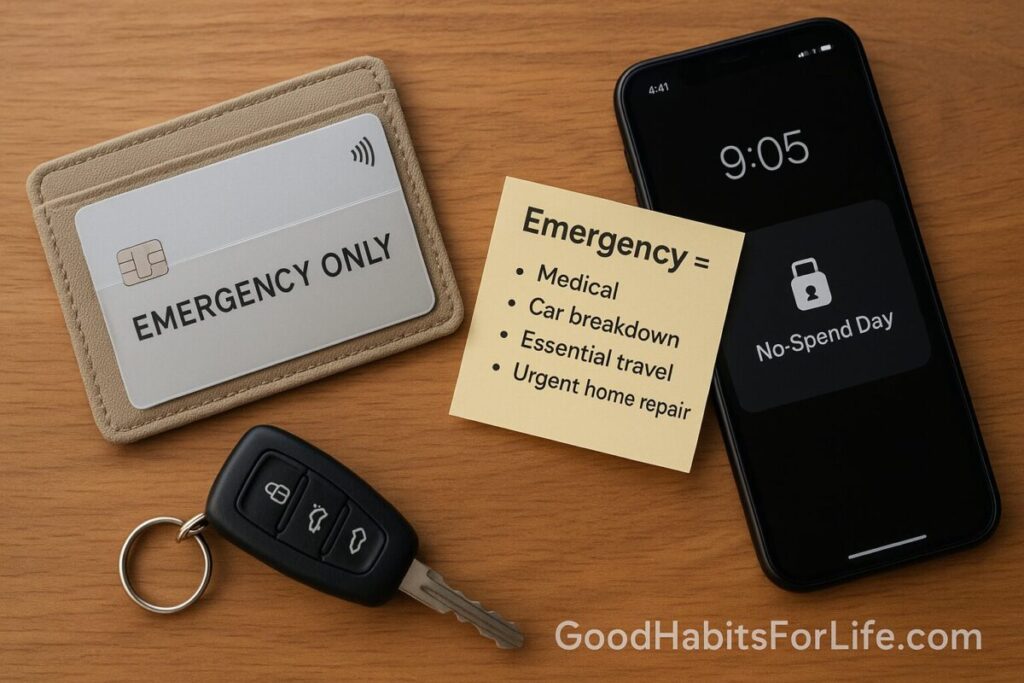
Definition: The EmergencyOnly Card is a single debit or credit card reserved strictly for true emergencies (medical treatment, car breakdown, essential travel, urgent home repair). It sits outside your daily spending system and is only used when predefined unlock criteria are met.
Why it works:
-
Pre-commitment: You choose constraints in advance so that future-you can’t talk present-you into impulse buys. Research shows pre-commitment boosts follow-through on savings and behavior change.
-
Mental accounting: Creating a separate “bucket” for emergencies reduces fungibility—the brain treats those funds differently, which curbs temptation.
-
Smart friction: Small inconveniences (not carrying the card, app-locking) significantly lower spur-of-the-moment purchases without harming genuine emergencies.
-
Emergency fund accelerator: Combining a no-spend challenge with automation channels freed-up cash into a dedicated emergency account—most guidance recommends building several months of expenses.
Outcome: A clear rule + built-in friction = fewer leaks from your budget, faster emergency savings growth, and less stress during real crises.
✅ Quick Start: Do This Today (15–30 Minutes)
-
Pick the card. Choose one card with broad acceptance and a manageable limit. Rename it in your banking app to “EmergencyOnly – Do Not Use.”
-
Write your unlock criteria. Example: “Health emergency, vehicle breakdown, essential travel to aid dependent, or urgent home repair that prevents loss or danger.”
-
Create friction.
-
Remove from wallet; store in a sealed envelope at home.
-
Enable card lock or freeze in your app.
-
Set a 24-hour rule (cooling-off period) for any borderline case.
-
-
Start a 14-day mini no-spend. No discretionary buys (clothes, gadgets, dining out). Essentials only.
-
Automate savings. Schedule an immediate transfer (e.g., ₹1,000–₹5,000 or 5–10% of income) into an Emergency Fund sub-account.
-
Log one exception note. If you’re tempted, write the reason, amount, and whether it truly meets the rule.
-
Tell an accountability buddy. Share your rule and dates for your no-spend challenge.
🛠️ Build Your Rule: The B.U.I.L.D. Framework
B – Boundaries
-
Define exactly what counts as an emergency.
-
List 3–5 examples and 3–5 non-examples (e.g., “flight deals” and “festival sales” are not emergencies).
U – Unlock Criteria
-
Require two conditions minimum: (1) Meets emergency definition, (2) No cheaper safe alternative within 24 hours.
-
Prefer two-person unlock: you + accountability partner (text confirmation).
I – Inconvenience by Design
-
Keep the physical card at home, sealed with your written rules on the envelope.
-
Use app lock + merchant category blocking (if offered by your bank).
-
Disable one-tap online checkout for this card; remove it from shopping accounts.
L – Logging & Cool-Down
-
24-hour wait for non-life-threatening situations.
-
Maintain a Temptation Log: date, item, amount, feeling (1–5), decision, 7-day reflection.
D – Debrief & Deposit
-
If you don’t buy something, immediately transfer the amount saved into the emergency fund.
-
If you do use the card for a valid emergency, plan a repayment schedule and update your emergency fund goal.
🗓️ 30-60-90 Day Roadmap to a Real Emergency Fund
Goal: Reach 1–3 months of essential expenses, starting with a ₹50,000–₹1,00,000 buffer (or local equivalent) and scaling from there.
Days 1–30: Lock Temptations, Prime Cash Flow
-
Launch a 30-day no-spend (essentials only).
-
Automate transfers on payday + 1 day (reduces perceived loss).
-
Cancel/pauses: duplicate subscriptions, unused memberships.
-
Introduce Weekly Reset (15 minutes): reconcile accounts, move leftovers to Emergency Fund.
-
Win condition: ₹15,000–₹30,000 saved (illustrative—adjust to income/costs).
Days 31–60: Stabilize Habits, Add Income Boosters
-
Keep no-spend for weekdays; allow 1 planned treat per week.
-
Add micro-income: sell 5 items, one freelance task, or a weekend gig cycle.
-
Increase automation by 1–2% of income.
-
Win condition: ₹30,000–₹60,000 saved.
Days 61–90: Scale to Your Target Buffer
-
Move to a 50/30/20-ish setup or envelope system with a dedicated Emergency sub-account.
-
Add “Windfall rule”: 80% of any bonus/refund goes to Emergency Fund.
-
Re-price fixed bills (insurance, internet, mobile) and lock in cheaper plans.
-
Win condition: 1–3 months of expenses in Emergency Fund.
🧠 Techniques & Frameworks that Boost Success
-
Pre-commitment devices: Opt into constraints before temptation hits (card lock, envelope, buddy approval).
-
Mental accounting: Label money by job—Emergency Fund vs. Fun Fund. The label changes your decisions.
-
Habit formation timing: Expect ~2+ months for a spending habit to feel automatic; track cues and rewards.
-
Temptation bundling: Pair budget review with a pleasurable activity (your favorite coffee or playlist).
-
Implementation intentions: “If I see a sale notification, then I mute the brand and move ₹X to Emergency Fund.”
-
Default automation: Pay yourself first; make the “right” behavior the easiest one.
👥 Audience Variations
Students:
-
Cap discretionary micro-spends (snacks, rideshares). Use cash envelopes for non-essentials.
-
Keep the EmergencyOnly card with a parent/guardian or roommate as the second unlocker.
Parents/Caregivers:
-
Add child-related emergencies to criteria (urgent medicine, transport).
-
Pre-stock essentials (diapers, meds) to reduce emergency swipes.
Professionals (early/mid-career):
-
Link the Emergency Fund to income volatility (commission, bonuses).
-
Use virtual cards for subscriptions; reserve the physical card as EmergencyOnly.
Seniors/Retirees:
-
Focus on health-related criteria and quick-access contacts.
-
Consider a smaller limit to reduce exposure to fraud and misuse.
Teens (with parental oversight):
-
Use a prepaid card as EmergencyOnly with SMS approval from a parent.
-
Set a tiny cap and clear examples of what qualifies.
⚠️ Mistakes & Myths to Avoid
-
“I’ll just rely on willpower.” Willpower drains under stress; design systems, not promises.
-
Keeping the card in your wallet. Accessibility = temptation. Add distance + delay.
-
No definition of “emergency.” If it’s vague, everything qualifies. Write it down.
-
Ignoring debt interest. If you use a credit card for a valid emergency, make a repayment plan immediately.
-
Thinking no-spend = zero joy. Plan free/low-cost rewards and a tiny fun budget to prevent rebound splurges.
-
Assuming one month is enough. Most guidance suggests multiple months of expenses; keep scaling.
💬 Real-Life Examples & Copy-Paste Scripts
Envelope text (stick on your card):
EmergencyOnly Card — Break Seal Only If:
Health/vehicle/home safety issue, and
No safe, cheaper alternative within 24 hours, and
[Name] approves by text.
If “No”: transfer ₹X to Emergency Fund.
“Borderline purchase” script (text to buddy):
“I want to use the EmergencyOnly card for [reason]. It costs ₹[amount]. It meets criteria because [X]. I’ve checked alternatives. Approve? Y/N.”
Post-temptation journal prompt:
What triggered the urge? What emotion (1–5)? What did I do? What will I change next time?
Repayment plan after a valid emergency:
“Total: ₹24,000. I’ll repay in 3 months at ₹8,000/month. Pausing dining out and redirecting mobile plan savings.”
No-spend calendar rule:
Weekdays = no discretionary spend. Saturday 4–7 pm = one planned treat under ₹500.
🔧 Tools, Apps & Resources (Pros/Cons)
-
Bank card controls (lock/freeze, spend limits, merchant blocking)
-
Pros: Built-in, instant friction; easy to toggle.
-
Cons: Features vary by bank; don’t rely on them for discipline.
-
-
Separate savings sub-accounts or “buckets” (most banks, neobanks)
-
Pros: Clear mental accounting; automate transfers.
-
Cons: Interest rates and transfer limits differ.
-
-
Budgeting apps (YNAB, Monarch Money, Goodbudget, Tiller via Google Sheets)
-
Pros: Envelope-style planning; strong automation/reporting.
-
Cons: Paid or setup time; keep it simple at first.
-
-
Spending blockers & website filters (browser/mobile screen-time settings)
-
Pros: Removes instant shopping triggers.
-
Cons: Can be bypassed; pair with the buddy system.
-
-
Accountability buddy (friend/partner, community)
-
Pros: Social commitment boosts follow-through.
-
Cons: Needs the right person and quick response time.
-
📌 Key Takeaways
-
One clearly labeled EmergencyOnly card + strict unlock rules = fewer impulse purchases.
-
Combine with a no-spend challenge and automatic transfers to grow your emergency fund quickly.
-
Use smart friction (distance, delay, app locks) to protect yourself from “just this once.”
-
Follow the 30-60-90 plan to reach 1–3 months of expenses.
-
Keep iterating with logs, debriefs, and buddy approvals.
❓ FAQs
1) Is a debit card or credit card better for EmergencyOnly?
Either can work. Debit avoids debt; credit may offer protections. If using credit, set a lower limit, keep it locked, and plan repayments.
2) What qualifies as a true emergency?
Anything that protects health, safety, shelter, or essential income (e.g., urgent medical need, car repair that enables work). Sales and “limited-time deals” are not emergencies.
3) Can I keep EmergencyOnly details on my phone wallet?
Prefer no. Convenience weakens the rule. If you must, keep it frozen/locked with 2-step unlocks.
4) How big should my emergency fund be?
Start with a small target (e.g., ₹50,000–₹1,00,000) then build towards 1–3 months of essential expenses, and ideally 3–6 months over time.
5) What if I live paycheck-to-paycheck?
Automate a tiny transfer (₹200–₹500) every payday and capture found money (refunds, side gigs). Consistency beats size.
6) How do I handle a borderline case fast?
Use the 24-hour rule + text your buddy with your criteria checklist. Most borderline urges fade within a day.
7) Won’t I miss out on good deals?
Deals reappear. Financial resilience beats FOMO. If it’s truly essential, it will still be essential tomorrow.
8) What happens after I use the card?
Debrief, set a repayment plan, and continue automated contributions. The rule isn’t broken—it worked for a real emergency.
9) Can couples share one EmergencyOnly card?
Yes. Agree on criteria, both hold the envelope seal, and require two-party approval for unlocks.
10) How do I make the no-spend challenge fun?
Create a free-fun list (parks, library, home cooking night), track streaks, and pre-plan one tiny weekly treat.
📚 References
-
Consumer Financial Protection Bureau (CFPB). How much should I save in my emergency fund? https://www.consumerfinance.gov/ask-cfpb/how-much-should-i-save-in-my-emergency-fund-en-1107/
-
Board of Governors of the Federal Reserve System. Survey of Household Economics and Decisionmaking (SHED) – Report on the Economic Well-Being of U.S. Households. https://www.federalreserve.gov/consumerscommunities/shed.htm
-
FINRA Investor Education Foundation. Emergency Fund: Why You Need One and How to Build It. https://www.finra.org/investors/insights/emergency-fund
-
MoneyHelper (UK Government-backed). Emergency savings: how much is enough? https://www.moneyhelper.org.uk/en/savings/types-of-savings/emergency-savings
-
Lally, P., van Jaarsveld, C. H. M., et al. (2010). How are habits formed: Modelling habit formation in the real world. European Journal of Social Psychology. https://doi.org/10.1002/ejsp.674
-
Thaler, R. H., & Benartzi, S. (2004). Save More Tomorrow™: Using Behavioral Economics to Increase Employee Saving. American Economic Review. https://doi.org/10.1257/0002828041307395
-
Milkman, K. L., Minson, J., & Volpp, K. G. (2014). Holding the Hunger Games Hostage: The Impact of Temptation Bundling on Exercise. Management Science. https://doi.org/10.1287/mnsc.2014.1901
-
American Psychological Association (APA). Willpower and self-control. https://www.apa.org/topics/personality/willpower
Disclaimer
This content is for educational purposes only and does not constitute financial advice; consider your circumstances or consult a qualified professional before making decisions.