
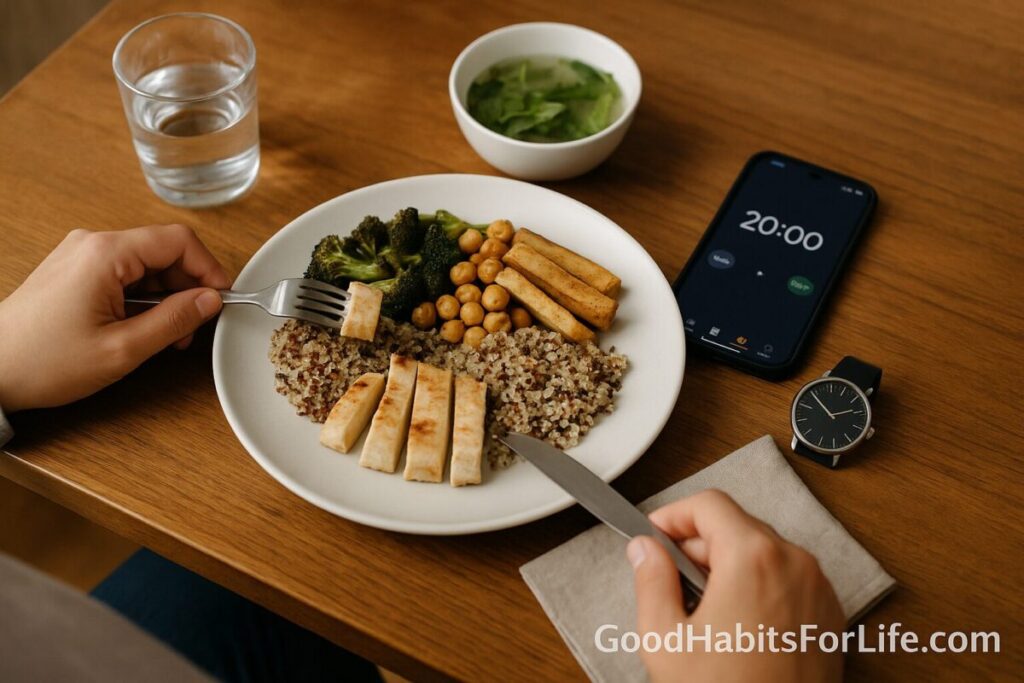
Eat Slower Without Trying: Tools & Tiny Tweaks: Protein-Forward Plan (2025)
Eat Slower Without Trying: Protein-Forward Tiny Tweaks
Table of Contents
🧭 What & Why: Slow the pace, feel fuller, enjoy more
“Eating slower” is simply increasing the time between bites and spreading a meal over ~20 minutes so your internal “I’m getting full” signals can register. Across controlled studies, a slower eating rate leads to lower energy intake compared with fast eating—without demanding willpower. PubMed
Why it helps:
-
Satiety signaling: Stretch and nutrient signals reach the brain over minutes, so pace matters. Practical tip: treat the first 5–10 minutes as the “slow phase.”
-
Protein-forward satiety: Meals that deliver ~25–30 g high-quality protein tend to curb appetite better and support lean mass, which stabilizes appetite long-term. PMC
-
Low-energy preloads: A glass of water or a light soup/salad before the main course reduces how much you eat at the meal. PMC+1
-
Balanced plates: Using a plate template (½ veg/fruit, ¼ protein, ¼ whole grains/starches) naturally moderates portions and chewing time. The Nutrition Source
✅ Quick Start: Do this today
-
Time your meal for ~20 minutes (phone timer). First 5 minutes = smallest bites, longest pauses. Harvard Public Health
-
Pre-meal buffer (optional): 300 ml water or a light veg soup 10–15 min before eating. PMC+1
-
Protein-first bites: Start with a protein portion (palm-size: ~100–150 g chicken/fish/tofu/paneer; 2 eggs; ¾ cup cooked lentils/chana/rajma). Target 25–30 g protein. PMC
-
Put-down rule: Fork/spoon down between bites; add one sip of water or a breath.
-
Smaller tools: Try a smaller spoon/fork or chopsticks to auto-slow.
-
Plate build: ½ veg/fruit, ¼ protein, ¼ whole grains or potatoes; add healthy fats sparingly. The Nutrition Source
-
Finish at ~7/10 fullness (pleasantly satisfied, not stuffed).
📅 Habit Plan
7-Day Starter
-
Day 1–2: One meal/day with a 20-minute timer + put-down rule.
-
Day 3–4: Add pre-meal water or soup; keep the timer. PMC+1
-
Day 5: Make breakfast or lunch protein-forward (25–30 g). PMC
-
Day 6: Use the Harvard Healthy Eating Plate template at dinner. The Nutrition Source
-
Day 7: Do a full day of paced meals; note energy, hunger, and mood.
30-60-90 Protein-Forward Roadmap
-
Days 1–30: Pace one meal/day; 25–30 g protein at that meal; pre-meal water/soup on busy days.
-
Days 31–60: Pace two meals/day; hit 25–30 g protein at two meals; add veg to fill ½ plate.
-
Days 61–90: Pace all main meals; consistent plate template; adjust snacks toward fruit/curd/boiled chana/roasted makhana for extra protein/fiber.
🧠 Techniques & Frameworks (effort-lite)
P.A.U.S.E.
-
Place utensil down after each bite
-
Attend to texture/flavor for 3–5 breaths
-
Use sips (water/herbal tea) as tiny speed bumps
-
Stage your plate (protein & veg visible = slower chew)
-
End at enough (7/10)
First-Bite Focus: Make the first 5 minutes your slowest—tiny bites, long chews, talk between bites.
Preload Playbook:
-
300–500 ml water 10–15 min pre-meal
-
or 150–250 kcal veg soup/salad starter
Both consistently reduce meal energy intake. PMC+1
Protein-Forward Defaults (per meal ~25–30 g): 2 eggs + curd; 150 g paneer/tofu; 120–150 g fish/chicken; ¾–1 cup cooked lentils/chickpeas/kidney beans + 150 g curd. PMC
👥 Audience Variations
-
Students/Teens: Breakfast protein (eggs/curd + fruit) improves morning satiety and attention; pack nuts/roasted chana for breaks. PMC
-
Busy Professionals: Book 25-minute calendar blocks for lunch; keep a soup mug and protein snack (Greek yogurt/paneer cubes).
-
Parents & Kids: Family “put-down” game—utensils on the table after each bite until someone says a color; make it fun, not a lecture.
-
Seniors: Protein at each meal supports muscle maintenance; softer high-protein options: dahi, paneer, dal, fish. American Journal of Clinical Nutrition
⚠️ Mistakes & Myths to Avoid
-
Myth: “You must chew 32 times.”
Reality: Chew well, but the pace and pauses matter more than a fixed count. -
Mistake: Skipping meals to “save calories,” then wolfing down dinner. Use a preload and pace instead. PMC
-
Myth: “Slow eating automatically causes weight loss.”
It helps lower intake, but your overall pattern (protein, fiber, plate balance) still matters. PubMedThe Nutrition Source -
Mistake: Eating with phone/TV. Distraction shortens chew time; go distraction-free for the first 10 minutes. Harvard Public Health
💬 Real-Life Examples & Scripts
-
Restaurant script: “Could you bring a small soup first and the mains 10 minutes later?” (builds in a preload & pacing) PMC
-
Office lunch: Set a 20-minute timer, take 10 slow bites first, then continue at a natural rhythm. Harvard Public Health
-
Family table: “Let’s try the put-down game—forks on the table between bites; first to seven wins.”
-
Protein swap: “I’ll take extra dal/tofu and half the rice.” (keeps satiety higher) PMC
🛠️ Tools, Apps & Resources
-
Kitchen tools: smaller cutlery, chopsticks, 20-minute sand timer, portion-guide plate.
-
Apps: any basic interval or countdown timer; mindfulness apps for a 1-minute pre-meal pause.
-
Prep aids: soup jars, pre-cut salad kits, boiled eggs/paneer cubes, ready-to-eat dals/beans.
📌 Key Takeaways
-
Slow the first 5–10 minutes; finish meals around 20 minutes total. Harvard Public Health
-
Go protein-forward at main meals (≈25–30 g). PMC
-
Use preloads (water or veg soup/salad) to prevent ravenous eating. PMC+1
-
Build balanced plates (½ veg/fruit, ¼ protein, ¼ whole grains/starches). The Nutrition Source
-
Tiny tools > willpower: put-down bites, smaller utensils, zero-screen meals.
❓ FAQs
1) How long should a meal take to “eat slower”?
About 20 minutes works well for most people—especially if you slow the first 5–10 minutes. Harvard Public Health
2) Does slow eating really reduce calories?
Yes. Meta-analysis shows slower eating reduces energy intake versus fast eating, across different ways of changing pace. PubMed
3) Is protein necessary to eat slower?
Protein doesn’t slow you by itself; it keeps you satisfied so you’re comfortable pacing the meal. Aim 25–30 g at main meals. PMC
4) Will drinking water before meals help?
Pre-meal water often reduces meal energy intake—especially in people who tend to overeat when very hungry. PMC
5) What about soup or salad starters?
Low-energy soup/salad starters usually lead to lower total meal intake (preload + main). PMC
6) How do I pace meals with kids?
Make a game of the put-down rule and model slow first bites; keep screens off for the first 10 minutes. Harvard Public Health
7) I’m vegetarian—how do I hit 25–30 g protein?
Options: 150 g paneer or tofu, ¾–1 cup cooked lentils/chana/rajma with curd, 2 eggs + dal/veg.
8) What if I’m always starving at dinner?
Add a protein-rich afternoon snack and use a preload before dinner; then pace. PMC
📚 References
-
Robinson E, et al. A systematic review and meta-analysis examining the effect of eating rate on energy intake. Am J Clin Nutr (2014). https://pubmed.ncbi.nlm.nih.gov/24847856/ PubMed
-
Paddon-Jones D, et al. Dietary protein recommendations and the prevention of sarcopenia. Curr Opin Clin Nutr Metab Care (2009). https://pmc.ncbi.nlm.nih.gov/articles/PMC2760315/ PMC
-
Davy BM, et al. Water consumption reduces energy intake at a breakfast meal in overweight and obese older adults. Obesity (2008). https://pmc.ncbi.nlm.nih.gov/articles/PMC2743119/ PMC
-
Flood JE, Rolls BJ. Soup preloads in a variety of forms reduce meal energy intake. Appetite (2007). https://pmc.ncbi.nlm.nih.gov/articles/PMC2128765/ PMC
-
Harvard T.H. Chan School of Public Health. Healthy Eating Plate. https://nutritionsource.hsph.harvard.edu/healthy-eating-plate/ The Nutrition Source
-
Harvard T.H. Chan School of Public Health. How to practice mindful eating. (2023). https://hsph.harvard.edu/news/how-to-practice-mindful-eating/ Harvard Public Health
-
U.S. Departments of Agriculture & Health and Human Services. Dietary Guidelines for Americans, 2020–2025. https://www.dietaryguidelines.gov/resources/2020-2025-dietary-guidelines-online-materials Dietary Guidelines
-
Rains TM, et al. Randomized crossover trial: higher-protein meals improve appetite control and reduce subsequent intake. Nutrition Journal (2015). https://nutritionj.biomedcentral.com/articles/10.1186/s12937-015-0002-7 BioMed Central
Disclaimer: This article is educational and not a substitute for personalized medical or nutrition advice; consult a qualified professional for your situation.