
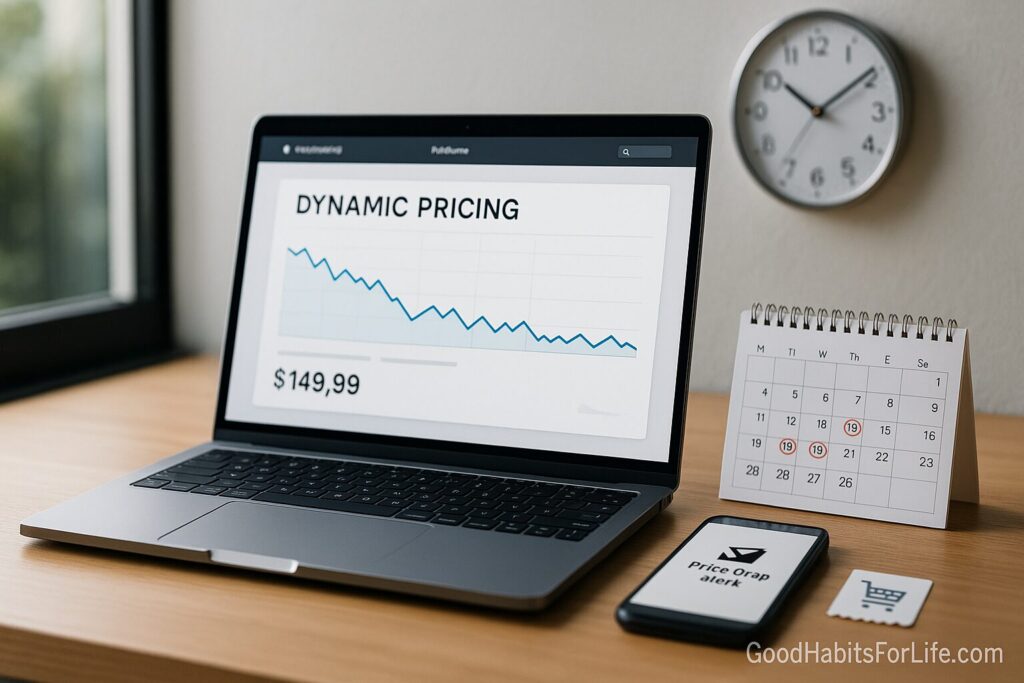
Dynamic Pricing 101: Best Times of Day to Buy: No-Spend Challenge (2025)
Dynamic Pricing 101: Best Times to Buy & No-Spend Challenge
Table of Contents
🧭 What Is Dynamic Pricing & Why It Matters
Dynamic pricing means retailers and platforms automatically adjust prices based on demand, inventory, time of day, competitor moves, and your behavior (e.g., repeat visits). It’s common in e-commerce, flights, ride-hailing, and even groceries. Research and regulators have documented the rapid growth of algorithmic pricing and its implications for consumers, competition, and transparency. See overviews from the OECD (personalised pricing), UK CMA (pricing algorithms), and academic work on algorithmic pricing and surge models. (References)
Why it matters for your wallet
-
Prices can swing hourly. Large marketplaces update millions of prices daily; catching a “calm” window can shave 5–20% off.
-
Algorithms react to demand spikes (events, holidays, paydays, evenings). You save by shopping outside those spikes.
-
Timing works best when paired with price history, alerts, and cart strategies to trigger discounts.
✅ Quick Start: Save Money Today
-
Check price history. Before buying, look up the product on a price-history tracker and note its 30–90 day low.
-
Set an alert at your target price. Choose a trigger ~5–10% below today’s price; many products dip to that level regularly.
-
Shop during calmer windows. Try Tue–Thu mornings (local time) and avoid late evenings or right after big promotions end.
-
Abandon cart once. Add to cart, reach email step, then close. Watch for a follow-up coupon; act only if it meets your target.
-
Compare across devices/browsers. Use a clean browser (guest mode) or mobile app to check for different offers.
-
Use stacked savings. Apply coupons, loyalty points, cashback portals, and gift card discounts only after the base price drops.
-
Delay on non-essentials. Use a 24-hour rule. If it’s still needed, buy in a known “deal window” for that category (see below).
🧠 7-Day No-Spend + Smart-Buy Challenge
A one-week reset that (a) freezes impulse spending and (b) lines up your buys with better price windows.
Rules: No discretionary purchases for 7 days. Essentials only (food staples, medicines). Everything else goes to a Wish List with price alerts.
Day 1 – Audit & Alerts (60 min)
-
Export last 60–90 days of transactions; tag categories.
-
Create a Wish List doc with item, current price, 90-day low, target price, and alert link.
-
Install one price tracker + one coupon extension.
-
Block email promos for the week; unsubscribe or filter to a “Deals Later” folder.
Day 2 – Dynamic Pricing 101 (30 min)
-
Learn your top stores’ rhythm: when they restock, mark down, and run sitewide promos.
-
Note weekly “buy windows” in your calendar (e.g., Wed 10:00–12:00 for tech; Thu morning for household).
Day 3 – Pantry & Substitutes (45 min)
-
For groceries, build a 7-day meal plan using pantry items.
-
Identify substitutes (generic vs. brand) and set alerts for both.
Day 4 – Cart Strategy (20 min)
-
Add items to carts on two retailers. Reach the email step and bail out.
-
Wait 24–48 hours for potential nudge coupons.
Day 5 – Micro-negotiations (20 min)
-
Use live chat to ask for a better price (scripts below).
-
If price is close to your target, add a coupon/cashback stack.
Day 6 – The Buy Window
-
Check your alerts during your chosen window (Tue–Thu mid-morning).
-
Only purchase items that meet or beat your target price.
Day 7 – Review & Lock Habits (20 min)
-
Log savings vs. original prices; note which tactics worked.
-
Create a recurring monthly Deal Day with alerts 24 hours before.
🛠️ Techniques & Frameworks
1) The Calm Window heuristic
-
When: Mid-week mornings tend to be less “spiky” for e-commerce traffic; prices are less influenced by after-work demand surges.
-
How to use: Check price history to validate the window for your retailer; schedule a recurring reminder.
2) Event-Avoidance
-
Avoid buying right before big holidays, new product drops, or major sport/cultural events in your region (higher demand → higher prices).
3) Payday Shields
-
Prices or offers can become stickier when many people have cash on hand (end/beginning of month; salary days). Shift discretionary buys to mid-cycle.
4) Cart Abandon + Re-entry
-
Add to cart once, exit, and wait for a nudge email. Re-enter via a cashback portal when you return to buy.
5) Anchors & Targets
-
Compute your Target Buy Price = 90-day low or last seasonal low × (1.00–1.05).
-
Set alerts; act only when current ≤ target.
6) Multi-Channel Check
-
Compare app vs. desktop vs. mobile browser. Some retailers A/B-test channels; one may show a lower base price or exclusive coupon.
7) Bundle & Subscribe Wisely
-
Subscriptions can be cheaper but lock you in. Use pre-paid gift cards + coupons when subscribing; calendar a 25-day reminder to re-check price.
🛒 Best-Time Windows by Category
These are patterns, not promises. Always verify with price history and alerts for your region/store.
Tech & Electronics
-
Windows: Tue–Thu mornings; also 48–72 hours after a major sale ends (retailers clear leftover promo inventory).
-
Avoid: Launch days, evenings, and pre-holiday hype weeks.
-
Tip: Track accessories separately (they often get deeper discounts).
Airfare
-
Windows: Book well in advance (varies by route) and check prices mid-week mornings; many datasets show Sunday can be the cheapest day to book overall, but time-of-day matters less than lead time.
-
Avoid: Last-minute for leisure routes; popular departure days (Fri/Sun).
-
Tip: Set route alerts; consider shifting departure to Tue/Wed for lower fares.
Ride-hailing
-
Windows: Off-peak times between rush hours; check 10–15 minutes later if surge is active.
-
Avoid: Weather spikes, event end-times, school run windows.
-
Tip: Walk a block or two away from venue exits to reduce surge.
Groceries
-
Windows: Late evening or early morning for markdowns on bakery, meat, and produce; mid-week for weekly cycle lows.
-
Avoid: Weekends and just before store closing on paydays.
-
Tip: Ask staff when they sticker markdowns; buy and freeze.
Clothing & Home
-
Windows: Mid-week mornings; end-of-season clearance; 2–3 weeks after a big fashion drop.
-
Avoid: Evenings of influencer-driven drops; first day of a promo.
-
Tip: Filter by size first—deepest discounts often have limited sizes.
👥 Audience Variations
Students
-
Use student programs (e.g., education pricing) + mid-week windows. Share premium subscriptions with roommates where allowed.
Parents
-
For diapers and staples, track multi-pack prices; buy during grocery mid-week cycles; set subscribe-and-save with calendar reminders.
Professionals
-
Plan a monthly Deal Hour (calendar block). Use corporate perks portals for electronics and travel.
Seniors
-
Ask for senior days in supermarkets/pharmacies; combine with markdown times. Prefer stores with clear price-match policies.
⚠️ Mistakes & Myths to Avoid
-
Myth: “There’s a universal best day/time for everything.”
Reality: Patterns differ by category, retailer, and region; use price history + alerts. -
Mistake: Chasing every sale.
Focus on a target price anchored to historical lows. -
Mistake: Ignoring total cost.
Shipping, warranty, and return fees can erase “wins.” -
Myth: “Clearing cookies always gives lower prices.”
Sometimes true, often not; it’s one diagnostic, not a rule. Compare in guest mode and another device. -
Mistake: Waiting too long on limited-inventory essentials.
For items that stock out, buy at your target when it appears.
💬 Real-Life Examples & Copy-Paste Scripts
Electronics (headphones)
-
Price history low: ₹6,999; today: ₹7,999.
-
Script (chat): “Hi! I’m seeing these at ₹6,999 last month. If you can do ₹6,899 today, I’ll order now with pickup instead of delivery.”
Groceries (meat markdowns)
-
In-store ask: “What time do you usually sticker today’s meat? I’m planning my weekly shop and prefer to come then.”
Ride-hailing (surge):
-
Self-check: Open the app, wait 10 minutes, refresh; compare with another app. If surge persists, walk 2–3 blocks and recheck.
Airfare (flex dates)
-
Search: Enable “±3 days” and “nearby airports.”
-
Email to self: “If I can depart Tue/Wed and save ≥15%, I’ll shift dates.”
📚 Tools, Apps & Resources
-
Price-history trackers (web/app): Track 30–365-day lows; set target alerts.
Pros: Data-driven; Cons: Not all sites covered. -
Coupon/Rewards extensions: Automatically try codes at checkout.
Pros: Fast savings; Cons: Can conflict with cashback cookies—pick one per purchase. -
Cashback portals: Extra 1–12% back on top of sale prices.
Pros: Stacks well; Cons: Payout delays. -
Calendar + Reminders: Block recurring “Deal Day” windows.
-
Airfare trackers: Route alerts; flexible date maps.
-
Grocery apps: Show markdowns, loyalty prices, and weekly cycles.
🧾 Key Takeaways
-
Dynamic pricing changes often—pair timing with price history and alerts.
-
Favor mid-week morning checks; avoid demand spikes (events, evenings, paydays).
-
Use the 7-Day No-Spend + Smart-Buy plan to reset habits and capture better windows.
-
Work from a target price; stack coupons and cashback only after base price drops.
-
Review monthly and log savings to reinforce the habit.
❓ FAQs
1) Is there a single best time of day to buy online?
No. Patterns vary by store and category. Mid-week mornings are commonly calmer, but verify with price history and alerts.
2) Do retailers raise prices if I visit repeatedly?
Some do run experiments or segment offers. Compare in guest mode, another device, and an app to be sure.
3) Are “abandon-cart” coupons guaranteed?
No. Many retailers send them, many don’t. Use it as a bonus tactic, not a plan.
4) Is Sunday really the cheapest day to book flights?
Large datasets have found Sunday averages lower prices to book (not necessarily to fly), but lead time and route matter more than time-of-day. Check alerts and be flexible.
5) How do I stop impulse buys during the challenge?
Use a 24-hour hold, remove saved cards from browsers, and keep a Wish List with target prices.
6) Do price-match policies work with dynamic prices?
Often yes, but read the fine print (same SKU, seller, and timing). Take screenshots.
7) Is dynamic pricing legal?
Generally yes. Regulators watch for unfair or deceptive practices; transparency rules vary by country.
8) Will clearing cookies lower prices?
Sometimes it shows a different test group; not a guaranteed discount. Use it as one diagnostic.
9) What if I need an item now?
Buy essential items when needed; timing tactics are for discretionary purchases.
10) Can I stack coupons, cashback, and gift cards?
Yes—if the merchant allows it. Always click the cashback portal last before paying.
References
-
OECD. Personalised Pricing in the Digital Era. https://www.oecd.org/daf/competition/personalised-pricing-in-the-digital-era.htm
-
UK Competition & Markets Authority. Pricing algorithms: Economic working paper on the use of algorithms to facilitate collusion. https://www.gov.uk/government/publications/pricing-algorithms-economic-working-paper-on-the-use-of-algorithms-to-facilitate-collusion
-
Adobe. Digital Price Index. https://business.adobe.com/resources/digital-price-index.html
-
Airlines Reporting Corp. (with Expedia). Air Travel Hacks Report (latest edition). https://www.expedia.com/lp/b/air-travel-hacks
-
Chen, M., Mislove, A., & Wilson, C. Peeking Beneath the Hood of Uber Surge Pricing. Northeastern University (2015). https://www.ccs.neu.edu/home/cbw/static/pdf/surge-TR.pdf
-
Consumer Reports. Smart Supermarket Shopping: Ways to Save. https://www.consumerreports.org/money/saving-money/grocery-store-shopping-tips-to-save-money-a2525382062/
-
Profitero. How often Amazon changes prices (and why it matters). https://www.profitero.com/blog/amazon-changes-prices
-
NBER (Calvano, Calzolari, Denicolò, Pastorello). Artificial Intelligence, Algorithmic Pricing, and Collusion. https://www.nber.org/papers/w26260
-
Uber Marketplace. Pricing. https://www.uber.com/marketplace/pricing/
Disclaimer: This article offers general budgeting and shopping guidance, not individualized financial advice.