
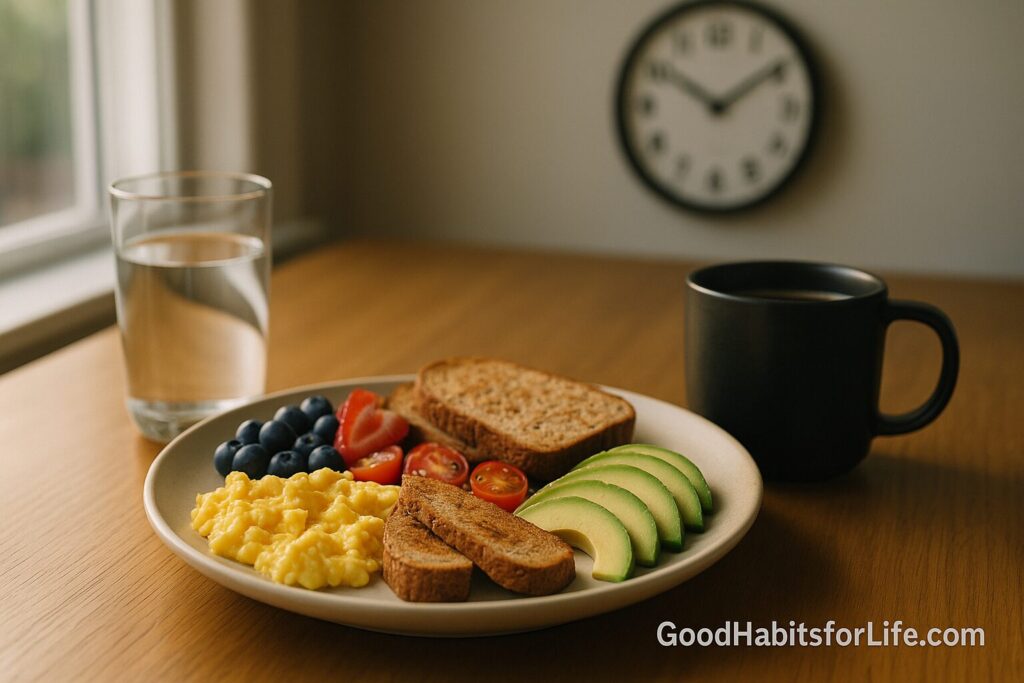
Circadian Eating: Early vs LateWhats Practical: Protein-Forward Plan (2025)
Circadian Eating: Early vs Late & Protein Plan (2025)
Table of Contents
🧭 What Is Circadian Eating & Why It Matters
Circadian eating aligns your meal timing with your internal 24-hour body clock. Metabolic processes—glucose tolerance, insulin sensitivity, digestive hormones, and energy expenditure—work better earlier in the day and tend to slow later at night. Research shows that concentrating calories earlier (especially breakfast and lunch) and finishing dinner well before bedtime can improve appetite control, insulin sensitivity, and body-weight regulation. Meanwhile, eating late can increase hunger, lower energy expenditure, and impair glucose handling.
Protein-forward plates strengthen this effect by increasing satiety, preserving lean mass during weight loss, and slightly raising energy expenditure due to protein’s higher thermic effect. Together, earlier timing + higher protein is a practical, sustainable combination for most adults.
Key principles
Front-load calories (e.g., 40–50% by lunch).
Finish the last meal 3–4 hours before sleep.
Keep a consistent daytime eating window (e.g., 10–12 h; some do 8–10 h).
Anchor protein at each meal (20–40 g), plus fiber-rich produce and slow carbs.
✅ Quick Start: Do This Today
-
Pick a daytime window that fits your life: e.g., 08:00–18:00 or 09:00–19:00 (10–12 h).
-
Eat a real breakfast within 1–2 h of your natural wake time:
-
30–40 g protein + produce + slow carbs + healthy fat.
-
-
Front-load lunch: Make it your biggest meal; aim to finish by ~14:00–15:00.
-
Light, earlier dinner: Wrap up 3–4 h before bed.
-
Protein targets:
-
Daily: ~1.2–1.6 g/kg body weight (e.g., 72–96 g for a 60 kg person).
-
Per meal: 20–40 g; add a 10–20 g protein snack if needed.
-
-
Hydrate (water, unsweetened tea/coffee); limit sugary drinks at night.
-
Sleep & light: Morning light exposure and a consistent sleep schedule reinforce your clock.
-
Track 3 signals for a week: hunger (0–10), energy (0–10), and sleep quality (0–10).
🛠️ 30-60-90 Day Habit Roadmap
Days 1–30: Foundation (10–12 h window)
-
Set a start time (e.g., 08:30) and hard stop (e.g., 19:30).
-
Lock in protein-forward breakfast (≥30 g) 5 days/week.
-
Lunch dominance: 40–50% of daily calories by the end of lunch.
-
Dinner light & early; no big meals within 3–4 h of bed.
-
Measure: weekly weight or waist, 1–10 appetite/energy scores.
Days 31–60: Optimization
-
Nudge window earlier by 30–60 min if sleep allows.
-
Hit 1.4–1.6 g/kg/day protein on training days; keep ≥1.2 g/kg on rest days.
-
Add fiber goal: 25–35 g/day (whole grains, legumes, veg, fruit).
-
Practice “closing rituals” after dinner (herbal tea, walk, brush teeth).
Days 61–90: Personalization
-
Choose your steady-state window (8–12 h) based on mood, hunger, and social life.
-
Introduce flex rules: 1–2 “social late” meals/week with earlier/lighter next meal.
-
If you train evenings, add a light protein-rich mini-meal post-workout (10–20 g), still finishing ≥2.5–3 h before bed when possible.
🧠 Techniques & Frameworks That Work
-
Protein-First Ordering: Eat protein and veggies first, then carbs/fats; helps satiety and glucose control.
-
Front-Loaded Plate Method: Half plate produce, quarter lean protein (or more), quarter slow carbs; 1 tbsp healthy fat.
-
Appetite Guardrails: Never skip protein at breakfast; keep a protein-rich snack handy for late-afternoon dips.
-
Light Hygiene: Morning daylight, dim evenings, and screen night-mode support earlier rhythms.
-
Weekend Strategy: Keep wake time and first-meal timing within ±60–90 min of weekdays.
-
Coffee Timing: If sensitive, delay caffeine 60–90 min after wake to support cortisol rhythm and avoid late-day caffeine.
👥 Audience Variations
-
Students/Teens: Shift window to campus life (e.g., 09:00–19:00). Batch-prep high-protein breakfasts (overnight oats + whey/Greek yogurt).
-
Busy Professionals: Calendar-block lunch; default to protein + salad/grain bowl. Keep shelf-stable protein (tuna, edamame, lupini beans).
-
Parents: Family dinner earlier; if late, serve a smaller portion and add a protein-forward afternoon meal.
-
Seniors: Prioritize protein distribution (≥25–30 g per meal) to protect muscle; include soft-texture proteins if chewing is an issue.
-
Shift Workers: See FAQs—circadian alignment is harder; aim for a consistent shift-anchored window and avoid heavy meals near “biological night.”
⚠️ Mistakes & Myths to Avoid
-
Myth: “Breakfast doesn’t matter.” → For many, earlier calories improve appetite and glucose responses.
-
Mistake: Huge late dinners “because I skipped lunch.” → Increases hunger and sleep fragmentation.
-
Mistake: Low-protein windows. → Leads to rebound snacking; protect 20–40 g per meal.
-
Myth: “Only the window matters.” → Food quality, protein, fiber, and sleep also matter.
-
Mistake: Forcing extreme 6–8 h windows when life demands 10–12 h → Consistency beats intensity.
🗣️ Real-Life Examples & Scripts
Weekday script (09:00–19:00 window)
-
09:00 Breakfast (35 g protein): veggie omelet + Greek yogurt + berries.
-
13:00–14:00 Lunch (largest meal): grilled chicken/grain bowl or dal + roti + salad; fruit.
-
17:00 Protein snack (15–20 g): skyr/Greek yogurt, cottage cheese, tofu, roasted chana.
-
18:30 Light dinner: fish/tofu + big veg + small slow carb; finish by 19:00.
-
After 19:00 Non-caloric: water, herbal tea; wind-down routine.
Dining out (keep it early)
-
“Can we book 6:30 pm?”
-
“I’ll start with a protein + salad and share a dessert.”
-
“If the slot is late, I’ll have a protein-rich snack at 17:00 and a lighter entrée.”
🧰 Tools, Apps & Resources
-
Macro trackers: Cronometer, MyFitnessPal (log protein & fiber).
-
Timers/Reminders: Streaks, Structured, or any calendar app for window start/stop.
-
Sleep/Light: Apple/Google Bedtime, f.lux/Night Shift; inexpensive light-blocking curtains.
-
Kitchen helpers: Protein powder (whey/pea), Greek yogurt/skyr, tinned fish, eggs, tofu/tempeh, pressure cooker for legumes.
📌 Key Takeaways
-
Earlier, consistent eating windows align with your body clock.
-
Protein-forward meals improve fullness, lean-mass retention, and metabolic control.
-
Start with a 10–12 h window, move earlier if feasible, and finish 3–4 h pre-bed.
-
Use the 30-60-90 plan to personalize and sustain the habit.
-
Quality matters: prioritize whole foods, fiber, and regular sleep.
❓ FAQs
1) Is circadian eating the same as intermittent fasting?
They overlap. Many people implement circadian eating with a daytime time-restricted window (e.g., 10 h). The emphasis here is earlier timing, not prolonged fasting.
2) What if I can’t eat breakfast?
Start with a 10–20 g protein mini-meal within 1–2 h of waking (yogurt, smoothie, eggs on toast). Build up gradually.
3) I train at 19:30—what should I eat?
Have a protein-rich afternoon meal (16:00–17:00). After training, a light 10–20 g protein mini-meal is fine; still try to finish ≥2.5–3 h before bed.
4) Will this work without calorie tracking?
Yes—if you front-load meals, prioritize protein and fiber, and keep dinners lighter/earlier. Track only if progress stalls.
5) Is late eating always bad?
Occasional late meals are fine. Problems arise when late, large dinners are routine. Use flex rules and keep the next meal earlier/lighter.
6) What about blood sugar or prediabetes?
Earlier meals and higher protein often help post-meal glucose. If you have diabetes or are on glucose-lowering meds, work with your clinician to avoid hypoglycemia.
7) I’m a shift worker—how do I adapt?
Anchor a consistent window to your active period (e.g., 12:00–22:00 before night shift). Avoid heavy meals during your biological night; use protein-rich, lighter options near the end of shift.
8) Is protein safe for kidneys?
For healthy kidneys, 1.2–1.6 g/kg/day is generally safe. If you have kidney disease, follow individualized medical advice.
9) Does coffee break my window?
Black coffee/unsweetened tea are fine; adding milk/sugar counts as calories and technically breaks a fast—use within your window.
10) How soon should I see results?
Many notice better energy and reduced evening hunger within 1–2 weeks. Body-composition changes typically take 4–12 weeks with consistent habits.
📚 References
-
National Institute of General Medical Sciences. Circadian Rhythms (overview). https://www.nigms.nih.gov/education/fact-sheets/circadian-rhythms
-
Sutton EF et al. Early Time-Restricted Feeding Improves Insulin Sensitivity. Cell Metabolism, 2018. https://www.cell.com/cell-metabolism/fulltext/S1550-4131(18)30253-5
-
Scheer FAJL et al. Late Eating Increases Hunger and Decreases Energy Expenditure. Cell Metabolism, 2022. https://www.cell.com/cell-metabolism/fulltext/S1550-4131(22)00451-7
-
Liu D et al. Calorie Restriction With or Without Time-Restricted Eating in Weight Loss. NEJM, 2022. https://www.nejm.org/doi/full/10.1056/NEJMoa2202079
-
Garaulet M & Gómez-Abellán P. Timing of Food Intake and Obesity. Int J Obes, 2014 (review). https://www.nature.com/articles/ijo2014151
-
Harvard T.H. Chan School of Public Health. The Nutrition Source—Meal Timing and Weight Control. https://www.hsph.harvard.edu/nutritionsource/meal-timing-matters/
-
Salk Institute (Panda Lab). Time-Restricted Eating and Circadian Metabolism (research summaries). https://www.salk.edu/science/panda-lab/
-
Westerterp-Plantenga MS et al. Thermic Effect of Protein. Am J Clin Nutr, 2004/2009 reviews. https://academic.oup.com/ajcn/article/79/5/899/4690189
-
American Heart Association. Meal Timing and Frequency—Scientific Statements (chrononutrition guidance). https://www.heart.org/en/news/2023/
-
ADA (Diabetes). Nutrition Therapy Consensus Report (protein distribution, glycemia). https://diabetesjournals.org/care
Disclaimer: This article is for educational purposes and is not a substitute for personalized medical advice. Consult a qualified professional for your specific health needs.