
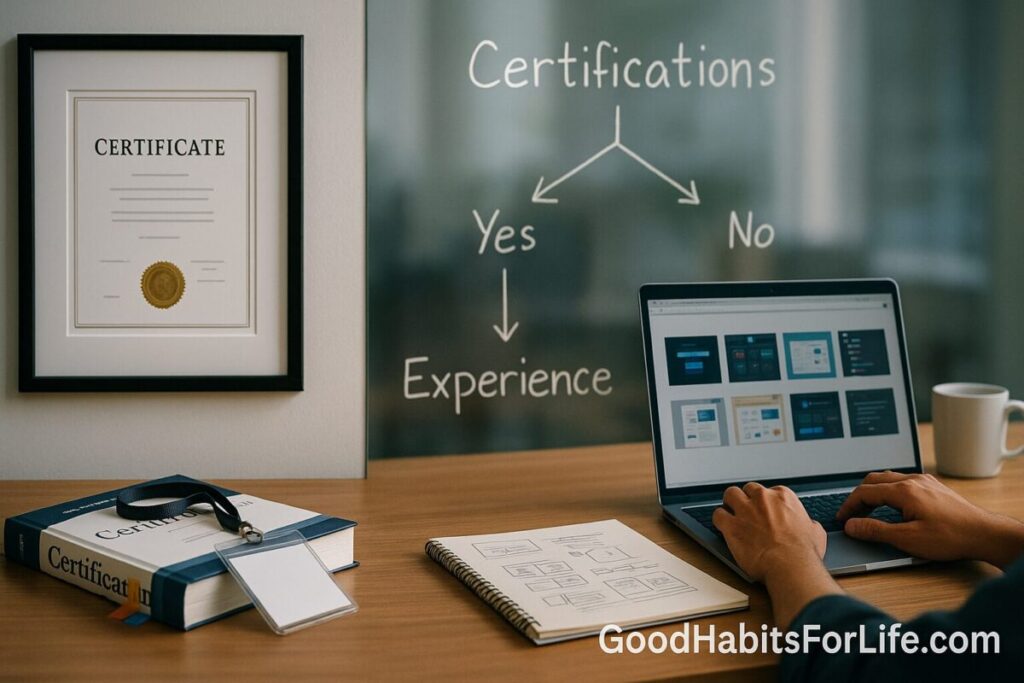
Certifications vs Experience: A 2025 Decision Tree
Certifications vs Experience: A 2025 Decision Tree
Table of Contents
🧭 What & Why
“Certifications vs experience” isn’t either/or—it’s about which signal the market trusts most for this role, right now, in your location. Certifications verify specific competencies; experience proves you can deliver outcomes under real constraints.
Why this matters in 2025: employer needs are shifting quickly. Global data show substantial skill change through 2030 and widespread plans to upskill and hire for new capabilities. That means credible signals (licenses, recognized certs, portfolios, shipped projects, apprenticeships) determine interview invites. World Economic Forum+2World Economic Forum+2
Evidence snapshot
-
Workers with a certification or license have higher median earnings than those without, per U.S. Bureau of Labor Statistics (BLS) 2024 tables. Bureau of Labor Statistics+1
-
In licensed or safety-critical roles (e.g., healthcare, pilots), the license is mandatory; for other roles, a portfolio or targeted cert often suffices. Bureau of Labor Statistics
-
Micro-credentials and stackable certs are gaining recognition (EU/OECD), but quality and recognition vary—verify employer acceptance before you enroll. EUR-Lex+2European Education Area+2
-
Research finds occupational licensing can raise wages for some groups but also restrict supply; certification is often a lighter-weight signal. Weigh costs and local demand. NBER+2NBER+2
✅ Quick Start (Do this today)
-
Name the target role + city/region.
-
Collect 25–50 recent job postings for that role. Paste requirements into a doc; tally recurring skills/tools (≥30% frequency = core). (Use LinkedIn/Indeed + labor intel like Lightcast for macro demand.) Lightcast+1
-
Tag each requirement as: license, recognized cert, portfolio artifact, or years in role.
-
Gap check (traffic-light):
-
Green: you can demonstrate now (ship a small project).
-
Amber: 2–6 weeks of focus (micro-credential + project).
-
Red: regulated license or multi-month foundation.
-
-
Choose one pilot signal to build in 14 days:
-
Tech/data/cyber/PM → short recognized cert + mini-project (GitHub or case). NIST+2Project Management Institute+2
-
Creative/ops/marketing → portfolio artifact that mirrors a posting’s deliverable.
-
Skilled trades → apprenticeship search + paid trial task. Apprenticeship.gov
-
-
Apply with evidence: tailor résumé to the posting’s exact verbs; attach the artifact/cert link.
-
Track signal: measure replies/interviews per 10 applications; iterate.
🧠 30-60-90 Habit Plan (with checkpoints)
Days 0–30 (Discover & Prove)
-
Map the role; do the gap check; complete 1 micro-credential or short, targeted cert; ship one scoped artifact (case study, demo app, dashboard).
-
Checkpoint: ≥1 interview per 10 tailored applications? If not, fix your artifact or switch the cert/provider.
Days 31–60 (Deepen & Signal)
-
Expand to two artifacts solving common tasks in postings (e.g., ETL + dashboard; sprint plan + risk log; compliance audit checklist).
-
Join the relevant community; post a teardown or walkthrough weekly.
-
Checkpoint: Recruiter replies improving? If flat, strengthen the market-recognized signal (e.g., PMP/ISACA/AWS associate) or pursue an apprenticeship angle. Project Management Institute+2ISACA+2
Days 61–90 (Convert & Compete)
-
Target 15–25 warm introductions; present your evidence pack (2–3 artifacts + cert/license + short STAR stories).
-
Mock interviews; close gaps; negotiate.
🛠️ Techniques & Frameworks
1) ROI Math (simple):
ROI score = (Prob. of job or raise × Annual salary lift) / (
Estimate conservatively. Prioritize the path with the highest ROI score and employer recognition (see Decision Tree).
2) Signal Tracking:
-
Application reply rate (≥20% = strong fit).
-
Interview conversion (screen → onsite).
-
Artifact opens/time-on-page (host on a simple site).
-
Referrals per week.
3) T-Shaped Skill Plan: breadth in role language + one deep specialty that job ads repeat.
4) Portfolio Minimum Viable Evidence (MVE): one artifact that maps to a core posting requirement and shows before/after.
5) Framework fit:
-
Cyber/IT: map to NICE work roles; align certs to role tasks. NIST+1
-
Project/Program Mgmt: PMP/PMI pathways + delivered outcomes. Project Management Institute
-
Skilled trades: registered apprenticeships for paid, structured training + portable credential. Apprenticeship.gov
🔀 The 2025 Decision Tree (text flow)
-
Is the role legally regulated in your region? (e.g., RN, pilot, electrician)
→ Yes: pursue the license path required by law (no shortcut). Build small artifacts to support interviews. Bureau of Labor Statistics
→ No: go to 2. -
Do ≥40% of target postings list a specific, recognized cert by name? (e.g., PMP, AWS-Associate, CISA)
→ Yes: prioritize that named cert plus a role-mirroring artifact. Project Management Institute+1
→ No: go to 3. -
Does the role value shipped work over credentials? (design, content, ops, growth)
→ Yes: ship 2–3 artifacts that match posting deliverables; consider micro-credentials only to fill gaps. Bureau of Labor Statistics
→ No/Unsure: go to 4. -
Time-to-income constraint <90 days?
→ Yes: pick a short, employer-recognized cert or apprenticeship with clear hiring pipelines; ship one artifact while studying. Apprenticeship.gov
→ No: go to 5. -
Career switch requiring new foundations (e.g., healthcare coding, cloud architecture)?
→ Yes: do a stackable plan: micro-credential → associate/entry cert → project → (optional) degree. OECD
→ No: deepen experience with scoped projects + mentorship; add cert only if it appears in ≥25% of postings. -
Market signal test: after 30–45 days, are interviews increasing?
→ Yes: double down (finish the sequence; expand artifacts).
→ No: change signal (different cert/provider) or reposition artifacts to match postings’ verbs.
👥 Audience Variations
-
Students (zero-to-one): pick one recognized entry cert in your lane (e.g., cloud associate, IT audit associate) + 2 artifacts tied to postings. Internships and apprenticeships accelerate credibility. ISACA+1
-
Career switchers (6–10 yrs exp): leverage domain experience; add one brand-name cert to cross the “screening” gate; ship artifacts that translate prior wins into the new stack. World Economic Forum
-
Parents returning to work: aim for portable signals (cert + artifacts) and flexible apprenticeships/returnships; emphasize recent, small wins. Apprenticeship.gov
-
Seniors (50+): showcase judgment and reliability; match modern tools via micro-credentials; mentor as a value add. OECD
-
Teens: explore pre-apprenticeships and capstone projects that mirror real tasks; keep artifacts public. Apprenticeship.gov
⚠️ Mistakes & Myths to Avoid
-
Myth: “A cert guarantees a job.” → It’s a signal, not a guarantee; you still need artifacts and aligned applications. World Economic Forum
-
Mistake: Collecting many low-value certs instead of one employer-recognized cert plus proof-of-work. Project Management Institute
-
Myth: “Experience alone beats any credential.” → In some fields, a license is non-negotiable. Bureau of Labor Statistics
-
Mistake: Ignoring costs/time; ROI can turn negative if the market doesn’t recognize the provider. OECD
-
Myth: “Licensing always boosts wages.” → Effects vary by occupation and may reduce labor supply; evaluate locally. NBER+1
💬 Real-Life Examples & Scripts
Example A — Cloud Support (switcher):
-
Week 2: Finish AWS Associate-level prep; ship a troubleshooting playbook + small lab repo.
-
Week 4: Apply to 15 roles citing the artifact; add a customer success case from prior job translated to cloud language. Bureau of Labor Statistics
Cold outreach DM (copy-paste):
Hi {Name}, I’m targeting {role} in {city}. I built a {artifact} that mirrors {company}’s stack (link). I’m also completing {recognized cert}. Could I get 10 minutes for feedback on the artifact and how you’d tailor it for your environment?
Manager pitch for upskilling budget:
I found a {recognized cert} mapped to our team’s backlog (tasks A/B/C). It costs {₹/$}, takes ~{hours}, and I’ll deliver {artifact} by Week 3. Expected lift: faster {metric} by {X%}. Shall we pilot this in Q4?
🧰 Tools, Apps & Resources (quick pros/cons)
-
BLS Occupational Outlook Handbook — authoritative role details; U.S.-centric but methodical. (Pro: clarity; Con: U.S. focus) Bureau of Labor Statistics
-
Lightcast Data/Explorer — demand & skills trends from postings. (Pro: market pulse; Con: paid features) Lightcast+1
-
NIST NICE Framework (Cyber) — align tasks and certs to roles. (Pro: role mapping; Con: tech-specific) NIST
-
PMI Salary Survey / PMP — country-level salary comparisons. (Pro: brand signal; Con: full report gated) Project Management Institute
-
Apprenticeship.gov — paid training + portable credentials. (Pro: earn while learning; Con: region-specific availability) Apprenticeship.gov
-
EU Micro-credentials / OECD reports — recognition & quality principles. (Pro: policy lens; Con: varies by employer) European Education Area+2EUR-Lex+2
📌 Key Takeaways
-
Start from market demand, not from the course catalog.
-
If licensed, licensing wins; otherwise pair one recognized cert with proof-of-work.
-
Use ROI math and signal tracking to decide quickly.
-
Reassess at 30-60-90 days; pivot the signal if interviews stall.
-
Your best edge is evidence that mirrors real job tasks.
❓ FAQs
1) Are certs or experience better for landing interviews?
Whichever the market treats as the stronger signal for your role—check postings and recruiter feedback. In many tech/cyber/PM roles, a named cert plus artifacts increases screening odds. Project Management Institute+1
2) How do I know a cert is “recognized”?
Look for explicit mentions in ≥25–40% of postings, provider reputation (industry body, standards alignment), and alumni outcomes. Check frameworks like NICE for role alignment. NIST
3) Are micro-credentials worth it?
They can be, if employers recognize them and they map to deliverables you can showcase. Use them as stackable steps, not endpoints. OECD
4) What if I can’t afford a cert right now?
Ship artifacts (open projects, case studies) and apply for apprenticeships or employer-funded training first. Apprenticeship.gov
5) Do licenses always boost pay?
Not always; effects vary by occupation and can reduce labor supply. Evaluate local demand and opportunity cost. NBER+1
6) Is the PMP actually useful?
In many regions/industries, yes—it’s a widely screened credential for PM roles. Pair it with delivered outcomes. Project Management Institute
7) How fast can I pivot careers?
If not regulated, 60–90 days is realistic for entry evidence (1 cert + 2 artifacts) to start getting interviews—outcomes depend on market conditions. World Economic Forum
8) Will AI make my new cert obsolete?
Skills keep shifting; focus on fundamentals + one applied specialty. Expect refresh cycles every 12–24 months. World Economic Forum
📚 References
-
U.S. Bureau of Labor Statistics — Median weekly earnings by certification/licensing status (2024). Bureau of Labor Statistics
-
U.S. Bureau of Labor Statistics — Median weekly earnings by cert/licensing status and occupation (2024). Bureau of Labor Statistics
-
U.S. Bureau of Labor Statistics — Occupational Outlook Handbook (role guidance). Bureau of Labor Statistics
-
World Economic Forum — Future of Jobs 2025 (report & digest on skills change/upskilling). World Economic Forum+1
-
OECD (2023) — Micro-credentials for Lifelong Learning and Employability. OECD
-
European Commission (2022) — Council Recommendation on a European approach to micro-credentials. EUR-Lex+1
-
NIST NICE Framework — Role & certification alignment resources. NIST
-
PMI — Project Management Salary Survey (PMP pay comparisons). Project Management Institute
-
NBER — Occupational licensing & wage effects (selected working papers/reports). NBER+3NBER+3NBER+3
-
U.S. Department of Labor — Registered Apprenticeship: definition & pathways. Apprenticeship.gov
-
Lightcast — Digital skills outlook & labor market intelligence. Lightcast+1
Disclaimer
This article provides general career information for education purposes only and is not financial advice; evaluate your own costs, risks, and outcomes.