
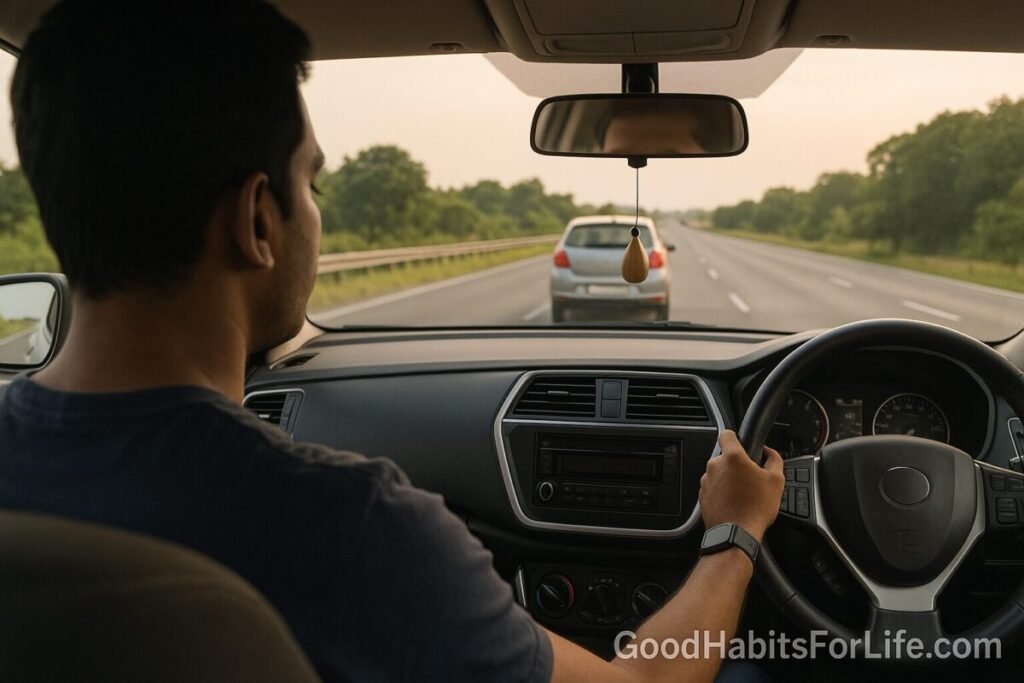
Calm Driver Mindset: Breathe, Buffer, Be Kind
Calm Driver Mindset: Breathe, Buffer, Be Kind
Table of Contents
🧭 What Is the Calm Driver Mindset (and Why It Works)
Definition. A calm driver mindset is the deliberate practice of regulating your state, protecting space around your vehicle, and choosing courtesy—especially when others don’t. In short: self-control, space management, and kindness.
Why it matters.
-
Road crashes remain a leading cause of injury and death worldwide; speeding, distraction, and aggression are major contributors. Calm driving directly counters these risks.¹²³
-
Physiologically, slow, controlled breathing activates the body’s relaxation response, reducing stress arousal that drives knee-jerk reactions.⁴⁵
-
Driving with a space cushion (time-based following distance) gives you options, cuts braking spikes, and reduces crash chains.⁶⁷
Benefits you’ll feel.
-
Fewer close calls and smoother commutes
-
Lower heart-rate spikes and mental fatigue
-
Better fuel economy (gentle acceleration and fewer hard brakes)
✅ Quick Start: Do This Today
-
Pre-drive reset (30–60 sec). Sit tall, shoulders down, unclench jaw. Inhale through nose for 4, hold 1, exhale through mouth for 6–8. Repeat x4.
-
Set a time buffer. Leave 10 minutes earlier than usual or accept being 5 minutes late without “making it up” on the road.
-
Space cushion. Maintain 3–4 seconds behind the car ahead; 4–6 seconds in rain/at night/with heavy loads.
-
Phones off. Enable “Do Not Disturb While Driving.” Navigation only; no calls or texts.
-
Courtesy defaults. Wave thanks, let one car merge, and avoid eye contact with aggressive drivers.
-
One measurable win. Count how many times you didn’t accelerate to block a merge—aim for ≥3 per trip.
🛠️ The “Breathe, Buffer, Be Kind” Method
1) BREATHE — Regulate your state
-
Cue: Notice jaw/shoulder tension, rapid breathing, or racing thoughts.
-
Action: 60–90 seconds of “4-1-6” breaths (4s inhale, 1s pause, 6s+ exhale).
-
Why: Longer exhalations stimulate the vagal (parasympathetic) response that lowers arousal and improves decision-making.⁴⁵
Micro-drills
-
Red-light reset: 3 slow breaths at every red light.
-
Trigger label: “Name it to tame it”—“I’m feeling rushed/annoyed.” Label, breathe, release.
2) BUFFER — Manage space and speed
-
Follow time: 3–4 sec (dry), 4–6 sec (wet/night), ≥6 sec (ice/low visibility).
-
Side space: Avoid lingering in blind spots; complete overtakes decisively within limits.
-
Smoothness: Drive by time, not by distance—look 12–15 seconds ahead; feather accelerator and brake.
-
If tailgated: Increase your following gap to create escape space; change lanes when safe.
3) BE KIND — Choose courtesy, end escalation
-
Defaults: Signal early, merge like a zipper, let one in, wave “thanks,” and never pace another vehicle.
-
De-escalation: No gestures, no stares, no brake checks. If provoked, look away, keep moving legally, or exit to a public, well-lit place if followed.²
🗓️ 7-Day Starter Plan (Build the Habit Fast)
Daily baseline: Pre-drive reset + “3-sec rule” + one act of courtesy.
| Day | Focus | What to do | Proof you did it |
|---|---|---|---|
| 1 | Awareness | Count stress spikes; use 4-1-6 breathing x3 | Fewer harsh brakes on your trip computer |
| 2 | Following time | Lock 3–4 sec in clear weather | No close-call moments |
| 3 | Merges | Practice zipper merges, leave a gap | One friendly wave received |
| 4 | Tailgaters | Lengthen your forward gap; change lane when safe | Zero horn/gesture exchanges |
| 5 | Distraction | Enable DND driving; phone out of reach | Screen time during drive = 0 |
| 6 | Smoothness | Gentle starts/stops, anticipate lights | Better fuel economy display |
| 7 | Review & reward | 5-min reflection; plan next week | Small self-reward; share win with a friend |
Checkpoint at 2 weeks: Crashes/near-misses down, calmer arrivals, fewer spikes on your car’s “hard brake” metric (if available).
🧠 Techniques & Frameworks That Stick
-
If-Then Plans (Implementation Intentions).
If I’m cut off, then I say “Not about me,” lift off the accelerator, and re-establish 3–4 seconds. -
OODA Loop (Observe-Orient-Decide-Act).
Scan 12–15 seconds ahead, orient to hazards, decide, then execute smoothly—repeat. -
The 2-Question Pause.
“Am I trying to win the lane or arrive?” and “What would a calm professional do?” -
Time Hedging.
Add 10% to ETA, or accept +5 minutes without compensating with speed. -
Trigger Map.
List top 3 stressors (e.g., scooters weaving, late merges, honking). Pre-write a script for each (see below).
👥 Audience Variations
Students & New Drivers
-
Practice in low-traffic times; use a co-pilot to talk through OODA and following time.
-
Sim practice: call out hazards you see 12–15 seconds ahead.
Parents with Kids
-
Pre-pack car, add 10 minutes buffer for loading/unloading.
-
Teach kids “quiet cue” (finger over lips) when merging or parking.
Professionals/Commuters
-
Treat drive as a decompression zone: podcasts or silence; no work calls unless fully hands-free and legally permitted (cognitive load still matters).²⁸
Seniors
-
Prefer daylight and dry weather; increase following time; check vision and meds that may cause drowsiness.
Teens
-
DND while driving is non-negotiable; limit passengers early on; log “calm drives” toward a family reward.
⚠️ Mistakes & Myths to Avoid
-
Myth: “Hands-free means distraction-free.”
Reality: Conversation can still tax attention and slow reaction time.²⁸ -
Mistake: “Making up time” by speeding.
Often saves less time than you think and increases severity of outcomes.³⁹ -
Mistake: Staring down or gesturing at aggressive drivers.
Escalation risk rises. Keep eyes on the road and de-escalate.² -
Myth: “Two seconds is always enough.”
In poor conditions, heavy vehicles, or at night, you need more—4–6+ seconds.⁶⁷
💬 Real-Life Scripts for Stressful Moments
-
Cut off: “Not about me. Ease off. Rebuild gap.”
-
Tailgater: “Create room ahead. Signal. Change lanes when safe.”
-
Blocked merge: “Zipper merge; I’ll let one in.”
-
Honking behind me: “Check hazards. If safe, maintain speed or move right; don’t race.”
-
Near-miss adrenaline: “Stop. Park if needed. 4 slow breaths. Shake it out, sip water.”
🧰 Tools, Apps & Resources
-
Do Not Disturb While Driving (iOS/Android). Pros: blocks notifications; Cons: may hide urgent messages—set trusted contacts.
-
Navigation (Google Maps/Waze). Pros: alternate routes/ETA; Cons: may tempt last-second lane changes—decide early.
-
Calm-Breathing Apps/Watch Timers. Pros: haptic pacing; Cons: set before driving only.
-
Dash cams. Pros: objective record; Cons: don’t let it change your behavior; mind data/privacy laws.
📌 Key Takeaways
-
Breathe to regulate your body first; decisions improve when arousal drops.
-
Buffer your vehicle with time and space; it’s the best crash-avoidance “tech.”
-
Be Kind to end escalation cycles; you’ll arrive safer and feel better doing it.
❓ FAQs
How many seconds should I follow the car ahead?
Use 3–4 seconds in clear weather; 4–6+ seconds in rain, darkness, or poor visibility. Heavy vehicles need more.
What’s the fastest way to calm down after a scare?
Three to five slow breaths with longer exhales (e.g., 4-1-6) plus a quick body scan (drop shoulders, unclench jaw).
How do I handle a tailgater?
Increase your forward gap to create options, keep steady speed, and change lanes when safe. Avoid brake-checking.
Does music help or hurt?
Moderate, familiar music can lower stress; avoid high-arousal tracks or fiddling with playlists while moving.
Is hands-free calling safe?
It’s legally permitted in many places, but cognitive distraction still impairs attention. Keep calls rare and short.²⁸
What if someone tries to confront me?
Do not engage. Keep windows up, doors locked, and drive to a public, well-lit place or police station.
How much time buffer do I really need?
Add 10% to your normal trip time (e.g., 45-min commute → leave 5 minutes earlier). It pays for lane-calm choices.
📚 References
-
World Health Organization. Road traffic injuries – Fact sheet. https://www.who.int/news-room/fact-sheets/detail/road-traffic-injuries
-
NHTSA. Aggressive driving & road rage. https://www.nhtsa.gov/road-safety/aggressive-driving
-
IIHS. Speed. https://www.iihs.org/topics/speed
-
Harvard Health Publishing. Breath control helps quell the stress response. https://www.health.harvard.edu/mind-and-mood/relaxation-techniques-breath-control-helps-quell-errant-stress-response
-
NCCIH (NIH). Relaxation Techniques for Health. https://www.nccih.nih.gov/health/relaxation-techniques-for-health
-
National Safety Council. Following distance & tailgating. https://www.nsc.org/road/safety-topics/tailgating
-
UK Highway Code. General rules, techniques and advice for all drivers and riders (103–158). https://www.gov.uk/guidance/the-highway-code/general-rules-techniques-and-advice-for-all-drivers-and-riders-103-to-158
-
NHTSA. Distracted driving. https://www.nhtsa.gov/risky-driving/distracted-driving
-
AAA Foundation for Traffic Safety. Aggressive Driving: Research & resources. https://aaafoundation.org
-
CDC. Drowsy Driving: Asleep at the Wheel. https://www.cdc.gov/sleep/features/drowsy-driving.html
📝 Disclaimer
This article is for general education, not medical or legal advice; always follow your local traffic laws and regulations.