
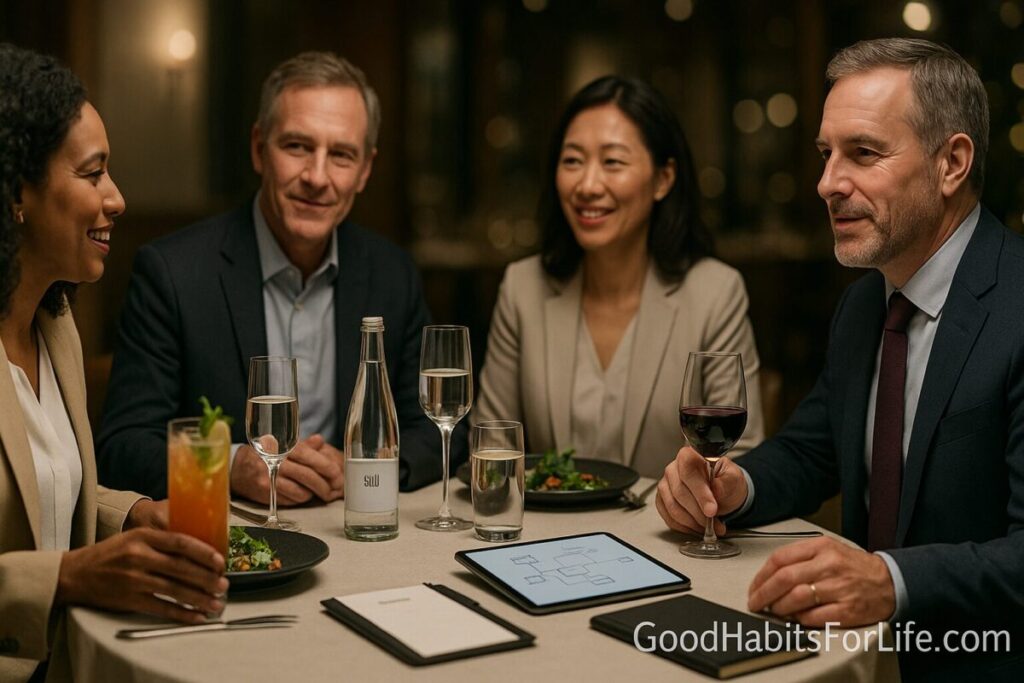
Business Dinners: Drink or Decline with Ease: AI workflows (2025)
Business Dinners: Drink or Decline—AI Playbook (2025)
Table of Contents
🧭 What This Guide Covers & Why It Matters
Business dinners blend hospitality, negotiation, and impression management. Whether you drink or decline, the goal is the same: stay sharp, build trust, and advance the relationship—without health or reputational downsides.
Key facts to ground your choice:
-
There is no amount of alcohol that is risk-free for health; risk starts at low levels. World Health OrganizationThe Lancet
-
If you do drink, many national guidelines define “moderate” as up to 1 drink/day for women, 2 for men (not an average for “saving up” on weekends). Drinking less is better than more. CDCDietary Guidelines
-
Even small amounts of alcohol impair driving; risk of a crash rises at low BAC and jumps steeply with higher levels—so pre-plan transport. World Health OrganizationNHTSA
-
Many workplaces endorse clear alcohol policies to protect health, safety, and professionalism. International Labour Organization
This guide gives you AI-powered workflows, etiquette scripts, and safety guardrails so your decision—drink or decline—is easy to make and easy to honor.
✅ Quick Start: Your 10-Minute Plan Today
-
Pick your lane: Drink (cap at 1–2 max) or Decline (no alcohol). Decide before you leave.
-
Open your calendar note: Add your limit or your phrasing (e.g., “I’m off alcohol for training—sparkling water for me”).
-
Pre-book transport: Set a rideshare or driver. Never plan to drive after drinking. World Health OrganizationNHTSA
-
Choose a default order:
-
Pocket a polite script: “I’m good with a zero-proof tonight—big day tomorrow.”
-
Eat first, pace, hydrate: Alternate each alcoholic drink with water; snack on protein + carbs. Practical tip also echoed in public health advice to reduce intake. nhs.uk
-
Focus on outcomes: steer conversation toward deal points, next steps, and wins for both sides.
🤖 AI Workflows: Decide, Script, and Follow Through
Use these copy-paste prompts in your AI assistant (adapt as needed).
1) Decision Workflow (Context → Risk Check → Choice)
Prompt:
“Here’s my dinner context: [who’s attending], [role levels], [venue], [culture], [tomorrow’s commitments]. Give me a risk-aware recommendation: drink (max X) or decline, with 3 reasons tied to reputation, negotiations, and safety. Then list 3 alternative non-alcoholic orders that fit the venue’s vibe.”
2) Script Builder (Polite Decline or Controlled Acceptance)
Prompt:
“Write 5 concise, friendly lines to (a) decline alcohol or (b) limit to one drink, tailored to a business dinner with [client/manager/team]. Tone: confident, warm, and brief. Add one redirect line to switch back to the agenda.”
3) Logistics Guardrails
Prompt:
“Create a one-tap checklist for safe transport, including pre-booked rideshare, tip messages for the driver, and a ‘leave by’ reminder timed to my calendar. Include a fallback plan if the event runs long.”
4) Boundary & Accountability Nudges
Prompt:
“I’ve chosen [decline / max 1 drink]. Create 3 micro-commitments, 2 phone reminders, and a post-dinner reflection template (3 bullets) to capture wins and lessons.”
5) Cross-Culture Etiquette Helper
Prompt:
“For a dinner with guests from [country], give me 5 etiquette notes about toasting norms, whether declining is acceptable, and how to participate respectfully without drinking.”
6) Post-Dinner Follow-Ups
Prompt:
“Draft a thank-you email that recaps key business points and next steps. Keep it crisp, professional, and appreciative. Include any promised documents and dates.”
📚 Alcohol Basics for Business Dinners (Know Your Numbers)
What is a standard drink?
Common equivalents: beer 330 ml (5%), wine 150 ml (12%), spirits 45 ml (40%)—each contains ~14 g ethanol. These help you track intake across different beverages. NIAAACDC
Moderation ≠ health benefit.
Some guidelines define “moderate” limits, but “less is better,” and WHO notes no safe level for health risk. Don’t drink for health; decide based on professionalism and personal risk. Dietary GuidelinesWorld Health Organization
Driving and alcohol don’t mix.
Risk of a crash rises even at low BAC; at higher BAC the risk multiplies sharply. Always separate alcohol from driving with pre-planned transport. World Health OrganizationNHTSA
🧠 Techniques & Frameworks to Keep You in Control
-
Implementation Intentions (“If-Then” Plans): If offered a second drink, then order sparkling water and ask the host about next quarter’s goals.
-
Pre-Commitment: Tell a colleague your plan before the event; ask them to support your decision.
-
Default Options: Choose a “house zero-proof” or low-ABV option as your first order.
-
Delay & Replace: Wait 10 minutes before any second drink; replace with water or NA beverage. nhs.uk
-
Workplace Alignment: Know your company’s policy and your client’s expectations; default to professionalism. International Labour Organization
👥 Audience Variations (Interns, Managers, Clients & Cultures)
-
Interns/Students: Default to decline; prioritize judgment and reliability.
-
New Managers: Model boundaries—set a 1-drink cap or go zero-proof and emphasize outcomes.
-
Sales/Client Leads: Mirror the occasion’s formality, not the pour. Keep a clear head for negotiation and recap.
-
Cross-Cultural Dinners: In some contexts a toast is customary; you can participate with a non-alcoholic drink and a warm gesture. (Use the Cross-Culture Etiquette Helper prompt above.)
-
Health/Medication/Religious Reasons: A simple “I’m not drinking tonight” is enough. Redirect swiftly to business.
⚠️ Mistakes & Myths to Avoid
-
“It’s rude not to drink.” Polite participation and great conversation matter more than alcohol.
-
“I’ll drive carefully.” Risk rises at low BAC; separate drinking from driving completely. World Health Organization
-
“I can bank drinks for the weekend.” Daily limits aren’t “rollover minutes.” Binge patterns raise harm. CDC
-
“NA drinks look awkward.” Most venues now offer quality zero-proof options; order them with confidence.
-
“One more won’t hurt.” Decide once; use If-Then plans to keep that decision.
💬 Real-Life Examples & Scripts
When offered a drink (decline):
-
“I’m off alcohol tonight—sparkling water for me. How was your Q3 launch?”
-
“I’m driving/early start tomorrow, so zero-proof for me. What’s the chef best known for?”
When accepting one drink (cap at one):
-
“I’ll do a small glass of red with the main—and then I’m switching to sparkling water.”
-
“One pilsner for the toast; after that I’m good with NA options.”
If someone insists:
-
“Appreciate it—tonight I’m sticking to zero-proof.” (smile, redirect) “Curious—how did you approach [initiative]?”
If the host drinks heavily:
-
“I’m pacing myself—big day tomorrow. Tell me more about [project milestone].”
Text to your accountability buddy (before dinner):
-
“Dinner 7–9. My plan: zero-proof / max 1. I’ll message you at 9:15 that I stuck to it.”
Post-dinner thank-you (email snippet):
-
“Thanks for the great conversation tonight. Quick recap: we aligned on [A], [B], and next steps by [date]. I’ll send the draft proposal by [date].”
🧰 Tools, Apps & Resources
-
Rideshare or Driver Booking: Pre-schedule pickup + fallback window. Pros: safety, peace of mind. Cons: minor extra cost. World Health Organization
-
BAC & Drink Trackers: Use only as rough guides; err on the side of caution. Pros: awareness. Cons: not precise; never a license to drive. NHTSA
-
Notes/Task Apps: Save your scripts, set reminders, and capture follow-ups immediately after the meal.
-
NA Menu Scouting: Check the venue site or call ahead for zero-proof options.
-
Cut-Down Aids: Hydration, breaks, and lower-ABV choices support your plan. nhs.uk
🗺️ 30-60-90 Habit Plan for Confident Business Dining
Days 1–30 (Foundations):
-
Decide your default lane (zero-proof or 1-drink cap).
-
Create your AI scripts and store them in Notes.
-
Practice 3 decline lines until they feel natural.
-
Pre-set a rideshare rule for any event with alcohol. World Health Organization
Days 31–60 (Consistency):
-
Attend 2–3 business meals; log outcomes (deal progress, clarity, next steps).
-
Trial different zero-proof orders to find your favorites.
-
Pair each meal with a post-dinner recap email within 12 hours.
Days 61–90 (Mastery & Coaching):
-
Mentor a teammate on professional dining boundaries.
-
Host one dinner yourself—set expectations upfront (NA welcome, transport arranged).
-
Review your logs; refine your scripts and limits.
📌 Key Takeaways
-
Decide once, early; professionalism beats peer pressure.
-
Use AI to create scripts, guardrails, and follow-ups.
-
Know standard drinks; “moderation” isn’t a health benefit, and less is safer. NIAAADietary GuidelinesWorld Health Organization
-
Never pair alcohol with driving—plan transport. NHTSA
-
Zero-proof is not zero-presence: you can lead the table with clarity and warmth.
❓ FAQs
1) Is it rude to decline a drink at a client dinner?
No. A friendly, brief decline with a quick redirect to business is perfectly professional in most contexts.
2) If the client insists I try a special wine, what do I do?
Offer appreciation, take a small sip if appropriate or explain you’re not drinking tonight and toast with a non-alcoholic option.
3) How many drinks are “safe” at dinner?
There’s no risk-free level; if you choose to drink, many guidelines cap at 1/day for women and 2/day for men—less is better. World Health OrganizationCDC
4) Can I drive after one drink?
Don’t assume it’s safe. Even low BAC impairs driving; separate alcohol from driving via pre-planned transport. World Health Organization
5) What counts as one drink?
Beer 330 ml (5%), wine 150 ml (12%), or spirits 45 ml (40%)—roughly one “standard drink.” NIAAACDC
6) How do I avoid a second drink without awkwardness?
Use an If-Then plan: If offered another, then I’ll order sparkling water and ask about [topic].
7) Do NA drinks look unprofessional?
No—most venues now feature excellent zero-proof menus; order confidently and move on.
8) My company has an alcohol policy—why mention it at dinner?
Policies exist to keep people safe and professional; following them protects your reputation and the business. International Labour Organization
📚 References
-
World Health Organization. No level of alcohol consumption is safe for our health (2023). World Health Organization
-
Anderson BO et al. Alcohol—no safe level for cancer and health (The Lancet Public Health, 2023). The Lancet
-
U.S. CDC. Moderate Alcohol Use (2025). CDC
-
U.S. Dietary Guidelines site. Alcoholic Beverages—Information (current edition). Dietary Guidelines
-
NIAAA. What Is a Standard Drink? NIAAA
-
U.S. CDC. About Standard Drink Sizes (2024). CDC
-
WHO. Road traffic injuries: drink-driving risk starts at low BAC (2023). World Health Organization
-
NHTSA. Drunk Driving—Risk and Stats (ongoing resource). NHTSA
-
WHO SAFER. Drink-driving laws & enforcement overview. World Health Organization
-
NHS. Tips on cutting down alcohol. nhs.uk
-
International Labour Organization. Management of alcohol- and drug-related issues in the workplace (Code of Practice, 2025). International Labour Organization
⚖️ Disclaimer
This guide is for general information only and not medical, legal, or company-policy advice; follow your local laws and workplace policies and consult a professional if needed.