
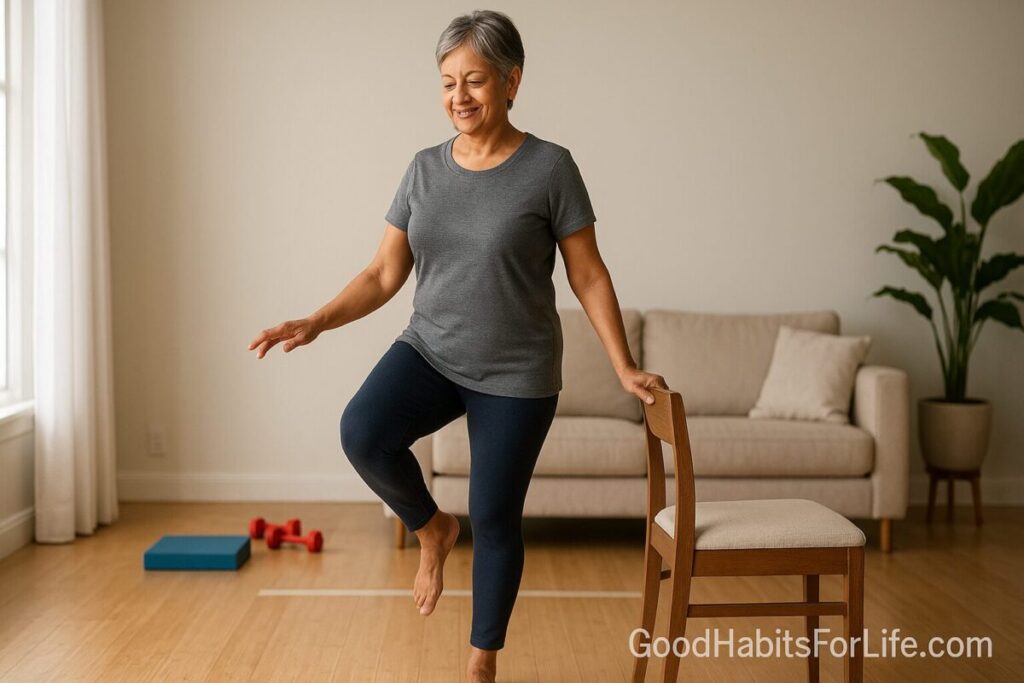
Balance Training: 8 Minutes a Day
Balance Training: 8 Minutes a Day
Table of Contents
🧭 What Balance Training Is & Why It Matters
Balance training improves how your body maintains posture while still and moving—by tuning strength, coordination, vision, inner-ear (vestibular), and joint-position (proprioception) systems. For older adults, falls are common and serious: globally ~684,000 people die from falls each year; adults 60+ have the greatest number of fatal falls. In the U.S., more than 1 in 4 adults 65+ fall each year. World Health OrganizationCDC
The good news: exercise that includes balance work reduces falls for community-dwelling older adults, and major guidelines recommend it. Cochrane reviews and the U.S. Preventive Services Task Force (USPSTF) support exercise (particularly balance/functional training) to prevent falls. CochraneUSPSTF
Beyond fall prevention, better balance improves walking speed, transfers, and everyday confidence—key to staying independent. The ACSM’s position stand also recommends “neuromotor” exercise (balance, agility, coordination) alongside strength and aerobic work. PubMed
✅ Quick Start: The 8-Minute Daily Routine
Do this once a day (barefoot or in firm, flat shoes). Stand near a counter or sturdy chair.
-
Minute 0:00–1:00 — Warm ankles & hips. Slow ankle circles (10 each way per foot), hip circles (10 each way).
-
1:00–2:00 — Narrow stance → semi-tandem. Feet together (30s), then heel-to-arch (30s).
-
2:00–3:00 — Full tandem stance. Heel-to-toe; switch lead foot at 30s.
-
3:00–4:00 — Weight shifts. Side-to-side (30s), forward-back (30s) without lifting feet.
-
4:00–5:00 — Single-leg stance (SLS). Lift one foot just off floor; switch at 30s. Light fingertip support allowed.
-
5:00–6:00 — Heel-toe walk (tightrope). 6–8 steps forward and back, slow and controlled.
-
6:00–7:00 — Sit-to-stand. From a chair: 10–12 smooth reps, arms crossed if safe.
-
7:00–8:00 — Hip hinge + reach. Soft knees, hinge at hips, reach forward 2–3s, return (8–10 reps).
Make it easier: widen stance, add hand support, reduce time.
Make it harder: eyes to a target 3 m away → eyes closed (only if safe), add head turns, hold a light object, or count backward by 3s (dual-task).
Baseline & track: Use 4-Stage Balance Test and Timed Up & Go (TUG) monthly. CDC+1
🛠️ 30-60-90 Day Habit Roadmap
Goal: practice 6–7 days/week, 8 minutes/day; add challenge layers every 2 weeks.
Days 1–30 (Foundation)
-
Practice the 8-minute routine daily.
-
Target holds: 20–30s tandem, 10–20s SLS per side.
-
Environment: bright lighting, clutter-free, sturdy support.
-
Re-test: 4-Stage + TUG at Day 30. CDC+1
Days 31–60 (Progress)
-
Add dynamic moves: step-over line, side stepping with pause, gentle turns.
-
Introduce dual-task (count backwards, spell words) 2–3 sets.
-
Option: Tai Chi mini-flow (commencement → parting wild horse’s mane) 2–3 min. Evidence shows Tai Chi lowers fall risk and improves balance tests. PMC
-
Re-test at Day 60.
Days 61–90 (Performance)
-
Add unstable surface (foam pad) only if prior levels feel easy and safe.
-
Progress sit-to-stands to single-leg sit-to-touch (light tap).
-
If you’re 65+ at increased fall risk, consider a structured program (e.g., Otago, PT-supervised). Otago-style strength + balance programs reduce falls by ~35–40% in high-risk adults. PMClivestronger.org.nz
🧠 Techniques & Progressions (Skill Tree)
1) Base of Support (BoS)
-
Wide → narrow → semi-tandem → tandem → single-leg.
-
Rule: when you can hold 30s with steady breathing and minimal sway, progress one step.
2) Sensory Challenge
-
Eyes focused → head turns → eyes closed (with spotter/support).
-
Add dual-tasking (cognitive load) to reflect real life.
3) Dynamic Control
-
Weight shifts → step & hold → heel-toe walk → figure-8 walk → turns.
-
Add external perturbations (gentle band pulls from partner).
4) Strength Synergy
-
Strong ankles/calves, hips/glutes, and trunk improve balance responses. Pair balance with calf raises, hip abduction, bridges, and sit-to-stands. (ACSM recommends combining neuromotor with resistance and mobility work.) PubMed
5) Testing & Feedback Loop
-
Monthly 4-Stage, TUG, and 30-s chair stand; log times/reps. Use changes to tune difficulty. CDC+1
👥 Audience Variations
Seniors (65+)
-
Prioritize safety: bright room, chair/counter nearby, no eyes-closed tasks until steady.
-
Consider Tai Chi or Otago (PT-guided) if you’ve fallen in the last year or feel unsteady. PMC+1
Desk-bound professionals
-
Do the 8-minute set during two ad breaks, or split into 2×4 minutes.
-
Add hip mobility (90/90 switches, standing calf stretch).
Runners & active adults
-
Pair balance with single-leg calf raises and lateral hops (soft, controlled).
-
Use eyes-up drills (look ahead, not down) for gait realism.
Students/teens
-
Turn it into a micro-challenge: 30-day streak board; balance while reviewing flashcards.
After illness/injury or on multiple meds
-
Start supported; ask your clinician about dizziness/orthostatic hypotension screening; some medicines increase fall risk. Use clinical tests (TUG, 4-Stage) to monitor. CDC
⚠️ Mistakes & Myths to Avoid
-
Myth: “Short sessions don’t help.”
Reality: Consistency beats marathon sessions; evidence supports regular balance-focused exercise to reduce falls. Cochrane -
Jumping to eyes-closed too soon. Keep support handy; progress only when steady.
-
Only doing strength or only walking. Blend balance + functional + strength for best results. Cochrane
-
Ignoring the environment. Clear clutter, fix loose rugs, improve lighting.
-
Holding your breath. Exhale during the hardest part; relaxed breathing steadies you.
💬 Real-Life Scripts & Habit Triggers
-
Morning kettle cue: “While water boils, I’ll do tandem stance (1 min) and weight shifts (1 min).”
-
TV ad cue: “At the next ad break, 10 sit-to-stands + 1 minute heel-toe walk.”
-
Evening brush-teeth cue: “I’ll single-leg stand (30s/side) facing the sink.”
-
Accountability text: “I did 8 today 🕗—your turn?”
-
Travel tweak: Do SLS while waiting for the lift; heel-toe walk along a hallway line.
🧰 Tools & Resources
-
Self-tests & how-tos: CDC STEADI—4-Stage Balance Test, TUG, chair-stand, patient resources. (Clear instructions and short videos.) CDC+1
-
Community programs: Evidence-based falls-prevention classes curated by NCOA; local agencies often host Tai Chi or Otago-style sessions. National Council on Aging
-
Structured options: Otago Exercise Program materials (patient + PT guides) from UNC/NZ manuals. UNC School of Medicinelivestronger.org.nz
-
Minimal gear: kitchen counter, sturdy chair, painter’s tape line, optional foam pad; sneakers with firm heel cup.
Pros/cons:
-
DIY routine: free, flexible; needs self-motivation.
-
Class/PT-guided: technique feedback & progression; cost/scheduling required.
📌 Key Takeaways
-
Daily 8 minutes of focused balance work builds steadiness fast.
-
Measure monthly (4-Stage, TUG) so your training matches your current level. CDC+1
-
Layer difficulty gradually: narrower stance → single-leg → dynamic → dual-task.
-
Combine with strength for ankles, hips, and trunk to reinforce balance responses. PubMed
-
If you’ve fallen recently or feel unsteady, consider Tai Chi or Otago or speak with a clinician. PMC+1
❓ FAQs
1) Is 8 minutes really enough?
Yes—when done daily and progressed over time. Balance adapts quickly to frequent, specific practice, and exercise with balance elements is recommended for fall prevention. Cochrane
2) How fast will I notice improvements?
Many people feel steadier within 2–4 weeks; measurable test changes often appear by 4–8 weeks with consistent practice.
3) What if I’m already strong from the gym—do I still need balance work?
Probably. Strength helps, but balance + functional drills produce the fall-prevention benefits seen in trials. Cochrane
4) Is this safe with osteoporosis or arthritis?
Generally yes—these are low-impact drills. Keep support nearby and avoid eyes-closed until steady; consult your clinician if you have pain, dizziness, or recent fractures.
5) Barefoot or shoes?
Either is fine on a firm, non-slip surface. If you use orthotics or have neuropathy, choose supportive shoes.
6) How do I test progress without equipment?
Use 4-Stage Balance (aim to reach tandem 10–30s and brief single-leg) and TUG (time to stand, walk 3 m/10 ft, turn, return, sit). Track monthly. CDC+1
7) What’s a good weekly plan besides the 8 minutes?
Add 2–3 days/week of strength (lower-body focus) and include neuromotor/balance sessions per ACSM guidance. PubMed
8) Are classes like Tai Chi worth it?
Yes—meta-analyses show Tai Chi reduces falls and improves balance scores; it’s a great complement to your daily micro-routine. PMC
9) I get dizzy when I stand up—what should I do?
Pause, hold support, and discuss orthostatic blood pressure screening with your clinician (part of STEADI tele-adapted guidance). CDC
10) When should I seek professional help?
If you’ve had a fall in the last year, feel persistently unsteady, or your TUG time is slow relative to peers, ask your clinician or a physical therapist about a multi-factorial plan or PT-led programs like Otago. USPSTF
📚 References
-
WHO. Falls — Fact sheet. https://www.who.int/news-room/fact-sheets/detail/falls World Health Organization
-
CDC. Facts About Falls. https://www.cdc.gov/falls/data-research/facts-stats/index.html CDC
-
Sherrington C, et al. Exercise for preventing falls in older people living in the community (Cochrane Review). https://www.cochrane.org/evidence/CD012424_exercise-preventing-falls-older-people-living-community
- MentorPeerMentee: Build a Healthy Mix: AI workflows (2025)
- Salt & Potassium: Retrain Your Taste Buds