
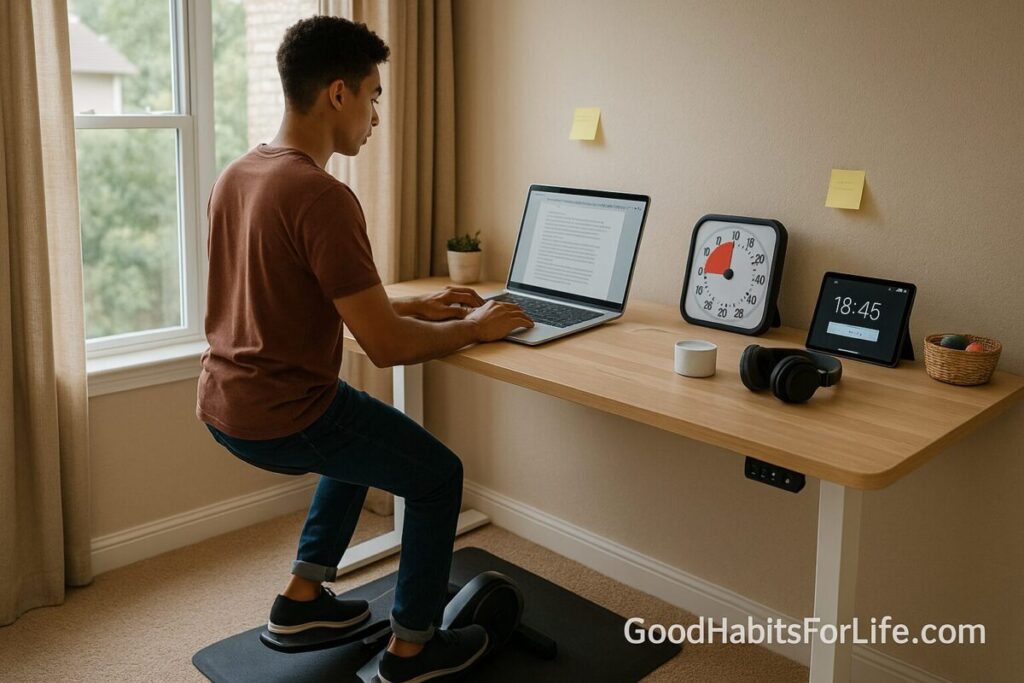
ADHD Study Setups: Movement, Sound & Visual Timers
ADHD Study Setups: Movement, Sound & Visual Timers
Table of Contents
🧭 What This Guide Covers & Why
Studying with ADHD often breaks down at three pressure points: sustaining attention, regulating stimulation (too much/too little), and sensing time (“time blindness”). Research shows that light, purposeful movement can improve executive control in ADHD rather than distract from it. Short bouts of aerobic exercise and allowing small, frequent movements have been linked with better inhibition and working memory in ADHD. PMC+2PMC+2
Sound also matters. Controlled studies and recent meta-analyses suggest low-to-moderate level auditory noise (often white or pink) can enhance cognitive performance in ADHD via mechanisms like stochastic resonance—though benefits vary by person and task. PMC+1
Finally, time perception is consistently different in ADHD. Reviews find robust timing deficits, which explains why external, visual time cues (big countdowns, progress bars) help convert the abstract into something the brain can “see.” PMC+1
✅ Quick Start (Do This Today)
-
Pick one task. Write it as a verb + noun (“Outline Chapter 3”).
-
Set a visual timer for 15–20 min (screen or physical). Put it in your line of sight.
-
Add light movement: sit on a wobble cushion or stand for the first 5 minutes; pace during the 2–5 minute break. PMC
-
Add sound: try white or pink noise at conversation-level or lower—generally ≤70–75 dB for safe listening over longer periods. Adjust down if it feels loud. World Health Organization+1
-
Do one sprint → 2–5 min reset → repeat ×3. After three cycles, take a longer 10–15 min break (walk, water, stretch).
-
Log what helped (noise type, chair, timer length). Keep what works; drop what doesn’t.
🛠️ Core Components: Movement, Sound & Visual Time
1) Movement: “Busy Body, Calmer Brain”
-
Seating options: wobble stool, balance cushion, or standing desk to permit micro-movements without leaving the desk. Allow leg bouncing or under-desk pedaling. Short, moderate-intensity movement “snacks” (e.g., brisk 3–5 min walk or 30 min cycling before a session) can improve executive function in ADHD. PMC+1
-
Rule of 2s: every ~20 minutes, take a 2–3 minute movement reset (walk the corridor, stair run, dynamic stretch). Acute exercise benefits attention and inhibition; frequent movement breaks keep arousal in the “sweet spot.” PMC
Minimalist layout (desk):
-
Stable surface + wobble cushion
-
Foot rail or pedal device
-
Cue card on monitor bezel: “Move when the timer turns red.”
2) Sound: “Tune the Noise”
-
Start with white/pink noise at low volume. Many with ADHD perform better with added noise; some prefer pink/brown over white. Test 40–55 dB first (roughly quiet conversation at close range), then adjust. PMC+1
-
Safety first: For prolonged sessions, keep levels well below occupational thresholds. WHO/NIOSH guidance indicates risk rises with sustained exposures ≥80–85 dB; aim much lower for study. World Health Organization+1
-
Headphones: closed-back to reduce distractions, or open-back if you need environmental awareness. If music, choose instrumental or steady-state; lyrics often compete with verbal tasks.
Sound checklist
-
Choose: white/pink/brown noise → set low volume
-
Task type match: verbal tasks → instrumental/no-lyrics; spatial tasks → broader options
-
Log: “Felt focused?” “Any headache?” “Distracted by lyrics?”
3) Visual Time: “Make Time Visible”
-
Use large, visual countdowns (physical disc timers or fullscreen apps). These externalize time—helpful where internal timing is unreliable. Classroom and assignment accommodations often include timers that show time passing. chadd.org+1
-
Timer lengths: 10–20 min for high-friction starts; 25–30 min once engaged; micro-timers (2–5 min) for transitions.
-
Traffic-light timers (green-yellow-red) can reduce transition battles for kids and cue natural breaks. Visual schedules also reduce problem behaviors in children with ADHD. PMC
Timer placement: within sightline; brightness high; end-tone soft (startle-free).
🧠 Techniques & Frameworks That Work
-
Pomodoro-style sprints (adapted): 15–20 min work, 2–5 min reset. Extend only if you want to. Pair with movement resets.
-
Time boxing: Put tasks into actual calendar blocks; start each block with a 2-minute “activation” (open doc, type one sentence).
-
Implementation intentions (If-Then): “If I drift to my phone, then I stand up and read the next heading aloud.”
-
Body doubling: study quietly on video with a friend or virtual focus room—mild social pressure anchors attention.
-
Nature micro-breaks: a 10–20 min walk in green space between sessions can aid attention in youth with ADHD. ScienceDirect
-
Sound matching: test white vs pink noise; some ADHDers benefit more from certain “colors” of noise than others. ScienceDirect
📅 7-Day Starter & 30-60-90 Habit Plan
7-Day Starter
-
Day 1–2: Baseline. One 15-min timer ×3 cycles; log distractions. Add white noise at low volume.
-
Day 3–4: Add movement: wobble cushion or 3-min brisk walk between cycles.
-
Day 5: Try pink noise. Compare to white.
-
Day 6: Bump one sprint to 25 min if focus was solid.
-
Day 7: Review logs → keep best noise + timer length; set up a default “study scene.”
30-60-90 Roadmap
-
30 days: Standardize your scene (same chair, noise preset, timer). Add one body-double session/week.
-
60 days: Expand to two daily study blocks; introduce traffic-light timer for transitions (kids/teens).
-
90 days: Add a pre-study exercise ritual (10–20 min) before demanding tasks; this reliably supports inhibition/attention in ADHD. PMC
👥 Variations by Audience
-
Students (school/college): Sit near the edge/back for easy movement; ask for timer-visible seating or personal disc timer accommodation; noise via one earbud at low volume if permitted. CHADD lists timers and alternative settings among common accommodations. chadd.org+1
-
Professionals (open offices): Open-back headphones + pink noise; negotiate a 15-min “focus block” sign; use standing desk for the first 10 minutes of each sprint.
-
Parents helping kids/teens: Use visual schedules with pictures; teach “green→yellow→red” transitions; movement break jar (2-minute cards). Evidence supports visual activity schedules in ADHD. PMC
-
Seniors/adult learners: Gentle pedaling device; larger high-contrast timers; softer end-tone; shorter sprints (10–15 min) to protect energy.
⚠️ Mistakes & Myths to Avoid
-
“Silence is always best.” Not necessarily in ADHD—added noise can help some learners; test safely at low volumes. PMC
-
Over-long marathons. Focus often collapses after 20–30 minutes; short cycles + movement resets work better. PMC
-
Too-loud “focus” audio. Keep well under 80–85 dB exposure ceilings; quieter is usually more effective and safer. World Health Organization+1
-
Zero movement rules. Suppressing fidgeting can backfire; allow controlled movement outlets. PMC
-
One-size-fits-all timers. Adjust sprint length to the task’s friction level; use shorter starts for hard tasks.
💬 Real-Life Examples & Scripts
-
Study scene script (self-cue):
“Start timer 20:00 → open outline → type any sentence. When timer hits yellow, stand. Break at 0:00 = 3-min walk.” -
If-Then list:
If I scroll social media → then I flip the phone face-down and restart a 10-min micro-sprint.
If I can’t start → then I do a 2-minute “starter” (read headings aloud). -
Email to teacher/professor (accommodation):
“I’m managing ADHD and focus best with a visible countdown timer and periodic movement breaks. CHADD recognizes timers and alternative seating as reasonable supports. May I use a small disc timer on my desk and stand during quiet work?” chadd.org
🧰 Tools, Apps & Resources
-
Timers: physical disc timers; traffic-light timers; fullscreen countdown apps; smartwatch complications.
-
Noise: white/pink noise apps; noise-generating websites; low-volume fans.
-
Movement: wobble cushions, under-desk ellipticals, standing desks; 3-minute brisk-walk alarms.
-
Planning helpers: simple task pads; sticky “If-Then” cards; calendar time-boxes.
-
For kids: visual schedule boards; color progress timers.
(Choose tools you’ll actually use. Simpler beats fancier.)
🔑 Key Takeaways
-
Externalize time with big, visual countdowns to counter time-perception differences in ADHD. PMC
-
Light, frequent movement supports—rather than harms—executive function and study stamina. PMC
-
Low-level white/pink noise can improve focus for many with ADHD; keep volume conservative for hearing safety. PMC+1
-
Iterate: log your best timer length, noise “color,” and movement pattern; keep what works.
❓ FAQs
1) What timer length works best for ADHD?
Start with 15–20 minutes for hard starts; extend to 25–30 if you’re “in flow.” Kids often benefit from shorter starts and traffic-light timers.
2) Is white or pink noise better?
Both can help; individuals differ. Try each at low volume and pick the one that feels least intrusive yet steady. PMC+1
3) Won’t fidgeting distract me?
Chaotic movement can, but controlled micro-movement (wobble, pedaling, brief walks) is linked with better executive function in ADHD. PMC
4) Are these strategies OK for classrooms?
Yes. CHADD lists visible timers and environmental adjustments among common accommodations; confirm with educators. chadd.org
5) How loud is “safe” for study audio?
Keep volume well below occupational thresholds; continuous listening is safer around everyday conversation levels. World Health Organization+1
6) Do short workouts before study really help?
Evidence shows acute aerobic exercise can improve attention and inhibition in adolescents and adults with ADHD. PMC+1
7) My timer makes me anxious—what now?
Lower the volume of the end-tone, choose a visual-only countdown, and try shorter sprints with gentler transitions (traffic-light style).
8) Is nature time useful or just nice?
Brief green-space walks have shown attention benefits in youth with ADHD—good between study blocks. ScienceDirect
📚 References
-
Hartanto TA, Krafft CE, Iosif AM, Schweitzer JB. More intense physical activity is associated with better cognitive control performance in ADHD. 2015. PMC
-
Chan Y-S et al. Effects of physical exercise on children with ADHD. Systematic review, 2021. PMC
-
Mehren A et al. Acute aerobic exercise improves executive function in adults with ADHD. 2019. PMC
-
Nigg JT et al. Do white noise interventions improve ADHD symptoms/cognition? Systematic review & meta-analysis, 2024. PMC
-
Söderlund GBW et al. Sensory white noise in clinical ADHD: who benefits? 2024. PMC
-
Rijmen J et al. Pink noise benefits ADHD-related performance without stochastic resonance. 2024. ScienceDirect
-
Mette C et al. Time perception in adult ADHD: a decade review. 2023. PMC
-
Ptáček R et al. Clinical implications of time perception in ADHD. 2019. PMC
-
CHADD—Classroom & assignment accommodations (timers, settings). 2021–2024. chadd.org+1
-
WHO—Safe listening guidance (Q&A), 2025. World Health Organization
-
CDC/NIOSH—Recommended exposure limit: 85 dBA over 8 hours. CDC
-
Systematic Review—Visual Activity Schedules reduce problem behaviors in children with ADHD. 2022. PMC
⚖️ Disclaimer
This guide is educational and not a substitute for personalized medical or mental-health advice; consult your clinician for recommendations tailored to you.