
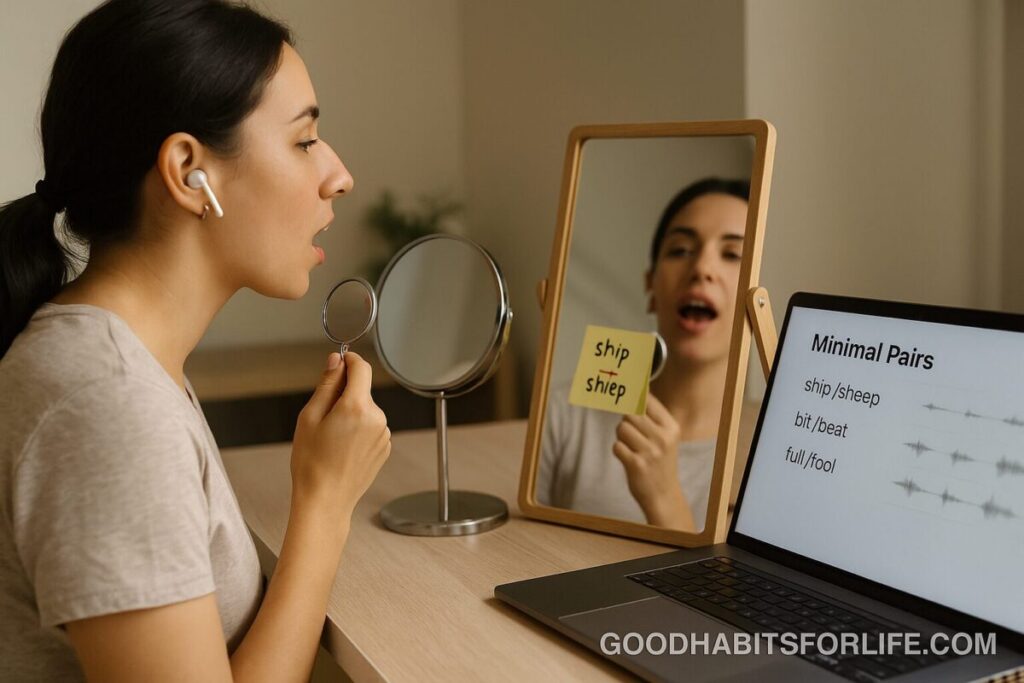
Accent Training: Minimal Pairs & Mirror Work
Accent Training with Minimal Pairs & Mirror Work
Table of Contents
🧭 What This Is & Why It Works
Minimal pairs are word pairs that differ by one sound (e.g., ship /ʃɪp/ vs sheep /ʃiːp/). Training these contrasts sharpens your ear and guides your tongue and lips toward the right targets. Meta-analyses and classic studies show that pronunciation instruction—especially with high variability (many voices/contexts)—improves both perception and production and helps learners generalize to new words and speakers. Oxford Academic+2PubMed+2
Mirror work adds instant, visual feedback: you see lip rounding, jaw height, tongue position (where visible), and voicing cues (e.g., throat vibration). Speech-language therapy literature documents mirror use as a practical self-monitoring aid that accelerates motor patterns for clearer sounds. SciSpace
You’ll pair both: minimal pairs for contrast + mirror for form. Add trusted models (e.g., Cambridge/Oxford audio, Sounds of Speech) and light acoustic feedback (Praat spectrograms) for a complete loop: hear → shape → say → see → compare → adjust. Cambridge Dictionary+2Sounds of Speech+2
✅ Quick Start: Today’s 15-Minute Routine
-
Pick one contrast (5 min). Choose the biggest pain point:
-
Vowels: /iː/ vs /ɪ/ (sheep–ship), /eɪ/ vs /ɛ/ (late–let). UCI OpenCourseWare
-
Consonants: /r/ vs /l/ (rice–lice), /θ/ vs /t/ (think–tink), /f/ vs /v/ (fan–van).
-
-
Model & map (3 min).
-
Watch the U. Iowa Sounds of Speech clip for each sound; notice lips, tongue, and airflow. Sounds of Speech
-
Play Cambridge Dictionary audio (UK/US). Cambridge Dictionary
-
-
Mirror drill (4 min).
-
Stand at a mirror. Exaggerate the target shape (e.g., spread lips for /iː/, relaxed for /ɪ/; curl tongue tip for /r/ vs touch alveolar ridge for /l/).
-
Say 10 minimal pairs slowly, then at natural speed.
-
-
Record & compare (3 min).
-
Record your pairs. In Praat, view the spectrogram and waveform; check steadier vowels and clearer transitions. FON
-
Tip: Keep a small notebook (or Notes app) with three wins and one fix after each session.
🛠️ 30-60-90 Accent Training Plan
Goal: Clear, consistent contrasts in everyday words and common phrases.
Daily dose: 10–15 minutes, 6 days/week.
30 Days — Foundation
-
Contrasts: Prioritize 3–4 (e.g., /iː/–/ɪ/, /ʊ/–/uː/, /r/–/l/, /θ/–/s/).
-
Input: 10–15 minimal pairs each; use multiple voices (dictionary UK/US; podcasts or videos). Cambridge Dictionary
-
Mirror: 5 minutes/day focusing on one articulatory cue per sound (lip rounding, jaw height, tongue tip). Sounds of Speech
-
Checkpoint (Day 30): Read a 60-second paragraph and a 20-word list; compare to Day 1.
60 Days — Transfer
-
Context: Embed pairs in phrases/sentences (e.g., cheap sheet, light rail).
-
HVPT: Add randomized words from different speakers (YouTube news clips, interviews). Expect better generalization with high-variability phonetic training. PubMed+1
-
Acoustics: 2×/week, glance at Praat to visualize steadier vowels or clearer consonant releases. FON
90 Days — Automaticity
-
Fluency: Shadow (repeat along with) 2–3 minutes/day of clear speech; mark target sounds.
-
Speed: Gradually increase rate while maintaining contrast.
-
Checkpoint (Day 90): Record the same paragraph from Day 30; share with a teacher or peer for external rating. Evidence suggests intensive, focused pronunciation training yields measurable gains. ASHA Pubs
🧠 Core Techniques & Frameworks
1) Minimal Pair Ladder
-
Level A (Ear first): Listen & select which word you hear (A/B).
-
Level B (Mouth next): Mirror → say word A five times, word B five times.
-
Level C (Mix & match): Randomize 20 items; self-mark.
-
Level D (Phrases): I need a seat vs I need to sit.
-
Level E (Conversation): 30-sec story using at least 5 target words.
Why? Instruction that includes both perception and production outperforms passive exposure. Oxford Academic
2) HVPT (High Variability Phonetic Training)
Use many talkers and contexts so your brain forms robust sound categories (fewer “only-that-recording” successes, more real-world wins). Classic /r/–/l/ studies and recent meta-analyses support HVPT. PubMed+1
3) Mirror Micro-Cues
-
/f/ vs /v/: Bottom lip touches top teeth; feel vibration for /v/, none for /f/.
-
/r/ vs /l/: Keep tongue tip off the ridge for /r/ (bunched/retroflex), on for /l/.
-
/iː/ vs /ɪ/: Wider smile and higher tongue for /iː/; slightly lower/jaw relaxed for /ɪ/.
Mirror use supports awareness and motor learning in speech drills. SciSpace
4) IPA Lite
Learn 10–15 symbols for your target contrasts and use dictionary audio to anchor them. Cambridge shows IPA plus UK/US audio for every entry. Cambridge Dictionary+1
5) Acoustic Spot-Checks
Open Praat → record a word pair → verify clear vowel length/quality or voicing bands. You don’t need lab skills—just quick comparisons. FON
👥 Audience Variations
Students: Make it gamified—5-minute “contrast sprints” between classes; use class texts to harvest pairs.
Professionals: Build a meeting phrase bank (e.g., We need a sheet by Friday). Prioritize industry terms.
Seniors: Keep sessions short; use larger mirrors and slower tempos; if hearing is reduced, rely more on visuals and dictionary IPA/audio. Cambridge Dictionary
Teens: Pair with tongue-twisters and short video clips; encourage duet shadowing with creators who articulate clearly.
⚠️ Mistakes & Myths to Avoid
-
Myth: “Minimal pairs alone fix everything.” They’re powerful but work best with varied input + phrases + feedback. Cambridge Core
-
Mistake: Practicing only one voice. Add UK/US dictionary audio and different speakers to avoid “training to one sample.” Cambridge Dictionary
-
Mistake: Skipping perception. If you can’t hear it, it’s hard to say it—train ear + mouth together. Oxford Academic
-
Myth: “Mirror work is vanity.” It’s a valid therapy aid for articulatory placement. SciSpace
-
Mistake: No measurement. Record weekly; read the same paragraph to track progress. Intensive, focused programs show clearer gains. ASHA Pubs
🗣️ Real-Life Examples & Copy-Paste Scripts
/r/–/l/ (rice–lice):
-
“I’ll order rice, not lice.” (smile, then pull tongue tip back for /r/; touch ridge for /l/.)
-
10-rep ladder: rice–lice → read–lead → right–light.
/iː/–/ɪ/ (sheep–ship):
-
“We saw sheep near the ship.” (wide lips & high tongue for /iː/; slightly lower for /ɪ/.) UCI OpenCourseWare
/θ/–/t/ (think–tink):
-
“I think it fits.” (show a little tongue between teeth for /θ/; keep tongue behind teeth for /t/.)
Self-Cue Script:
-
“Hear the model → Shape mouth in mirror → Say slowly → Record → Compare → Adjust one cue.”
🧰 Tools, Apps & Resources (Pros/Cons)
-
University of Iowa – Sounds of Speech (free)
Pros: Clear animations & audio; shows exact articulators. Cons: Focused on segments, not rhythm. Sounds of Speech -
Cambridge Dictionary (UK/US audio + IPA)
Pros: Two accents; consistent IPA. Cons: Single words—add sentence practice. Cambridge Dictionary -
Praat (Windows/macOS/Linux)
Pros: Gold-standard acoustic analysis; free. Cons: Learning curve—use it for quick checks. FON -
CMU Pronouncing Dictionary (CMUdict)
Pros: Huge machine-readable pronunciations; great for building custom pair lists. Cons: ARPABET (not IPA) but easy to map. GitHub -
AJSLP research on intensive training
Pros: Supports focused, time-bound programs. Cons: Typically clinician-led—adapt intensity at home. ASHA Pubs
📚 Key Takeaways
-
Train contrasts you actually confuse—start with 3–4.
-
Use many voices (HVPT) so gains transfer to real life. PubMed
-
Combine mirror cues with minimal pairs and recordings for fast feedback. SciSpace
-
Keep it short and daily; measure progress monthly.
-
Lean on trusted resources (U. Iowa, Cambridge/Oxford, Praat, CMUdict). GitHub+3Sounds of Speech+3Cambridge Dictionary+3
❓ FAQs
1) How many minutes per day are enough?
10–15 focused minutes/day typically beats longer, infrequent sessions. Intensive blocks can accelerate gains when you have time. ASHA Pubs
2) Do I need to learn the whole IPA?
No. Learn the 10–15 symbols tied to your problem sounds and use dictionary audio as your anchor. Cambridge Dictionary+1
3) Why do teachers recommend “many voices”?
High-variability input helps your brain build robust categories that generalize beyond one speaker or word list. PubMed+1
4) Are minimal pairs enough on their own?
They’re a powerful starting point—pair them with phrases, spontaneous speech, and feedback (mirror/recording). Oxford Academic
5) Can I do this without a teacher?
Yes—use the tools above and a simple weekly recording routine. Evidence supports structured, targeted self-practice; outside feedback still helps. ASHA Pubs
6) Which contrasts should I pick first?
Target those known to be challenging for your L1 (e.g., /iː/–/ɪ/; /r/–/l/). University handouts and U. Iowa videos can guide choices. UCI OpenCourseWare+1
7) Does mirror work really help?
Yes—mirror use is a long-standing speech-therapy aid for articulatory awareness and motor learning. SciSpace
8) How do I know I’m improving?
Re-record the same paragraph every 30 days and ask a peer/teacher to rate target words; expect clearer contrasts with consistent training. ASHA Pubs
References
-
Lee, J. (2015). Effectiveness of Second Language Pronunciation Instruction. Applied Linguistics. (Meta-analysis on pronunciation instruction efficacy.) Oxford Academic
-
Lively, S., Logan, J., & Pisoni, D. (1993). Training Japanese listeners to identify English /r/ and /l/. JASA. (Classic HVPT with generalization insights.) PubMed
-
Uchihara, T., et al. (2025). HVPT: A meta-analysis of L2 perceptual training studies. Studies in Second Language Acquisition (Cambridge). Cambridge Core
-
ASHA Practice Portal. Accent Modification; Speech Sound Disorders—Minimal Oppositions. (Professional guidance on minimal pairs & training approaches.) ASHA+1
-
University of Iowa. Sounds of Speech. (Articulatory videos/animations.) Sounds of Speech
-
Yoshida, M. Vowels of American English (UCI OCW). (Common minimal pairs & cross-language contrasts.) UCI OpenCourseWare
-
American Journal of Speech-Language Pathology (2022). Effectiveness of Intense Accent Modification Training. (Outcomes for intensive programs.) ASHA Pubs
-
Kissling, E. (2014). Perception & Pronunciation Improvement. (Perception predicts production change.) UR Scholarship Repository
-
Cambridge Dictionary. Pronunciation & IPA help; UK/US audio. (Reliable audio models and symbol guide.) Cambridge Dictionary+1
-
Praat—Doing Phonetics by Computer (official site/manual). (Free acoustic analysis for learners.) FON
-
CMU Pronouncing Dictionary (CMUdict). (Machine-readable pronunciations; useful for custom pair lists.) GitHub