
CoParenting Calendars: Fair, Flexible, Firm
Co-Parenting Calendars: Fair, Flexible, Firm
Table of Contents
🧭 What & Why
What is a co-parenting calendar?
A living schedule that maps where the child is, who’s on duty for school runs and activities, and how holidays/special days work. It’s part of a broader parenting plan designed to lower conflict and make life predictable for kids.
Why it matters:
-
Children do better with routine, stability, and low-conflict communication after separation. Predictable schedules and unified, calm messaging help them cope and thrive. APA+1
-
Family-court and professional bodies encourage clear parenting plans that account for age and developmental needs, with routines and shared caregiving. afccnet.org+1
-
Many jurisdictions publish parenting time guidelines and example calendars—use them as models even if you’re creating a private plan. rules.incourts.gov
The GoodHabits approach: Fair (meets the child’s needs and each parent’s realities), Flexible (adapts to real life), and Firm (written rules everyone can trust).
✅ Quick Start (Do This Today)
-
Pick a base pattern (e.g., 2-2-3 for young children; 2-2-5-5 or week-on/week-off for school-age or teens).
-
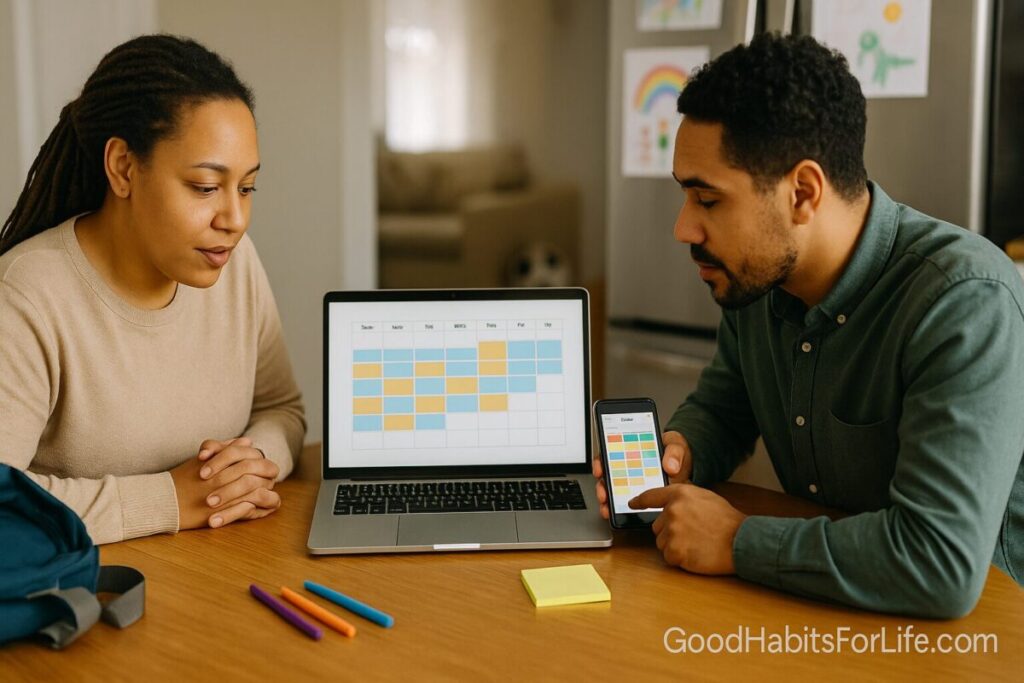
Create your shared calendar (Google Calendar or a co-parenting app). Color-code Parent A, Parent B, and “Both”.
-
Write three “firm rules”: swaps, response times (e.g., 24 hours), and pick-up/drop-off locations.
-
Add school + activity feeds (iCal links) and set standard reminders (the night before, day-of).
-
Holiday overlay: alternate even/odd years for major holidays; pre-define notice windows for travel. Use a recurring “Review the plan” event every 6 months. rules.incourts.gov+1
-
Communication norm: BIFF style (Brief, Informative, Friendly, Firm). Keep to the calendar thread, not scattered apps.
-
Back-up clause: what happens if someone is late, sick, or unreachable (e.g., 30-minute grace; then default hand-off plan).
🛠️ Habit Plan: 30-60-90 Day Roadmap
Days 1–30 (Stabilize):
-
Finalize the base pattern + add school/holiday layers.
-
Agree on the three firm rules + grace periods.
-
Do a 15-minute weekly sync (agenda template below).
-
Track exceptions and missed hand-offs in one place (not in texts).
Days 31–60 (Optimize):
-
Adjust hand-off times to reduce traffic/stress.
-
Add care tasks (homework checks, meds, lunchbox) into events.
-
Write a “special events” protocol (birthdays, tournaments, exams).
-
Start quarterly “kid voice” check-ins if age-appropriate (5–10 minutes).
Days 61–90 (Lock-in & Future-proof):
-
Add annual calendar overlays (school breaks, family traditions).
-
Decide on mediation triggers (e.g., >3 unresolved calendar disputes in 60 days).
-
Schedule the first semi-annual plan review with agenda and data (attendance, punctuality, swap balance).
-
If needed, seek guidance/coordination per local standards. APA+1
Weekly 15-minute sync (micro-agenda):
-
Next 2 weeks: pickups, activities, meds, bedtime changes.
-
Exceptions requested: who/what/when.
-
Confirmed swaps & calendar updates.
-
Open issues → assign an owner, due date.
🧠 Schedule Patterns (with Fairness Math)
| Pattern | How it works | Typical use | Hand-offs/week | Fairness math* |
|---|---|---|---|---|
| 2-2-3 | Parent A Mon-Tue, B Wed-Thu, A Fri-Sun; then flip | Younger kids; frequent contact | 3–4 | ~50/50 |
| 2-2-5-5 | A Mon-Tue, B Wed-Thu, Fri-Sun alternate | School-age; stable weekdays | 2–3 | ~50/50 |
| 3-4 (and 4-3) | One parent 3 days, the other 4; alternate weekends | Logistics/commute constraints | 2 | ~43/57 or 57/43 |
| Week-on/Week-off | 7-day blocks, swap on Fri or Sun | Teens & long commutes | 1 | 50/50 |
| Every-other-weekend + one weekday | NCP has alt weekends + a midweek day/evening | When 50/50 not feasible | 1–2 | ~60/40 to 70/30 |
*Approximate share of overnights; adjust with holiday/summer overlays. Many public guidelines offer age-wise examples—use them as references, not rigid rules. rules.incourts.gov
Holiday overlay example: Even years → Parent A gets Diwali/Christmas morning/Spring Break; odd years → Parent B; both get birthday time (split day or alternate years). Summer can rebalance time (e.g., two-week blocks). Courts often publish holiday examples—mirror their clarity even if you stay private. rules.incourts.gov
🛠️ Techniques & Frameworks for Smooth Co-Parenting
Fair
-
Child-first lens: Ask, “What lowers stress and keeps school/life steady for the child?” Research and professional guidance emphasize stable routines and age-aware care by both parents. afccnet.org
-
Transparent math: Track overnights and swaps so neither parent “feels shorted.”
Flexible
-
Swap windows: Standardize (e.g., request ≥72 hours in advance; reply within 24).
-
Exam/sport seasons: Allow temporary shifts with an agreed “give-back” period.
Firm
-
Written norms: response times, lateness grace, right of first refusal (optional), and who transports.
-
One source of truth: the shared calendar is binding unless both confirm a change.
-
Escalation ladder: discuss → email summary → mediator/parenting coordinator if unresolved (where available). APA
Routines that help kids: “Predictable routines” and considering developmental needs are repeatedly highlighted in professional resources—bake routines into the calendar (homework, meds, bedtime). afccnet.org
Legal/Process notes (varies by country):
-
UK: Agreements can be captured in a Parenting Plan and made legally binding via a consent order if needed. GOV.UK
-
Example US state models: Parenting-time guidelines (e.g., Indiana) illustrate age-wise schedules and holiday rules—useful as templates. rules.incourts.gov+1
-
Australia: Parenting Plans are voluntary agreements that can be revised by mutual consent; government fact sheets outline what to include. Attorney-General’s Department
🧒 Age-Wise Variations
Infants & toddlers: Shorter intervals, more frequent contact; overnights only if consistent with sleep/feeding patterns and both parents’ caregiving history. afccnet.org
Primary school (5–11): School-anchored stability matters; 2-2-5-5 or 3-4 patterns reduce midweek chaos. Keep homework and activity routines mirrored across homes.
Tweens/teens (12+): Longer blocks reduce hand-off friction; week-on/week-off or 2-2-5-5 with flexible midweek access for extracurriculars. Offer a voice in reviews (not a veto), and protect focus periods (exams).
⚠️ Mistakes & Myths to Avoid
-
Myth: “50/50 is the only fair plan.”
Reality: Fairness is child-centric. Logistics, school needs, and developmental stage may call for 60/40 or seasonally rebalanced time. Public guidelines emphasize best-interest solutions, not one ratio. rules.incourts.gov -
Mistake: “We’ll remember the swaps.”
Use the calendar. If it’s not logged, it didn’t happen. -
Mistake: Weaponizing hand-offs or messages.
Keep communication neutral and brief; conflict harms kids. APA -
Mistake: No holiday plan.
Holidays are flashpoints—pre-write rotations and notice windows. rules.incourts.gov -
Mistake: Ignoring local process.
Mediation/consent-order pathways differ—know yours. GOV.UK+1
🗣️ Real-Life Scripts (Copy-Paste)
Swap Request (Neutral & BIFF):
“Hi Sam—Requesting to swap Thu 16 Jan (A’s custody) with Tue 21 Jan due to school rehearsal. No change to total overnights; I’ll add to the calendar and note a give-back by 31 Jan if approved. Please confirm by 7 pm tomorrow.”
Sick Day Contingency:
“Alex has a fever (38.5 °C). I’ll keep him home and log a make-up evening by Fri next week. I’ve updated the calendar and sent the school a note.”
Holiday Coordination:
“Per odd-year holiday plan, you have Spring Break. I’ll share the itinerary (flights, hotel, emergency contacts) 14 days prior as agreed.”
Exam-Season Pause:
“GCSE week is 3–7 June. Suggest reducing hand-offs to evenings only; I’ll do pickups that week and return the time during Summer Block 1.”
Late Arrival Protocol:
“Running 20 minutes behind—traffic delay. I’ve updated the calendar timestamp per our 30-minute grace rule.”
📚 Tools, Apps & Resources
Shared Calendars: Google Calendar (free), Apple Calendar, Outlook—easy iCal sharing.
Co-parenting apps: OurFamilyWizard, 2Houses, TalkingParents, Coparently—centralize messages and logs; some offer tone filters or exportable records (useful if coordination escalates).
Reference models:
-
Indiana Parenting Time Guidelines (clear holiday/summer examples; online scheduler). rules.incourts.gov
-
AFCC family resources & guidelines for parenting plans and coordination (professional standards). afccnet.org+1
-
AAP & APA guidance on supporting children through separation (communication, routines, resilience). HealthyChildren.org+1
-
UK Government & Cafcass parenting plan resources; consent order pathway. GOV.UK+1
-
Australia: Parenting Plan factsheets and checklists. Attorney-General’s Department
Pros/Cons (quick):
-
General calendars = free, familiar; less structured logs.
-
Co-parenting apps = better documentation & features; subscription fees.
🔑 Key Takeaways
-
A great calendar is clear, child-first, and written down.
-
Use a base pattern + holiday/summer overlays and log every change. rules.incourts.gov
-
Fair ≠ always 50/50; aim for best-interest stability and age fit. rules.incourts.gov
-
Flexible for real life (exams, illness), with firm rules to prevent conflict.
-
Review the plan twice a year; bring in coordination/mediation if stuck. APA
❓ FAQs
1) What’s the “best” schedule?
The one that lowers stress and fits your child’s age, school, and caregiving history. Use public guidelines as models; adapt locally. rules.incourts.gov
2) How often should we review the calendar?
At least every 6–12 months, and after big life changes (new school, job shift, health needs).
3) Should young children have frequent hand-offs?
Often yes—shorter intervals preserve contact with both parents when developmentally appropriate and routines are predictable. afccnet.org
4) Do we need a court order?
Not always. Some countries let you keep a private Parenting Plan; others allow consent orders to formalize agreements. Check local rules. GOV.UK+1
5) How do we handle holidays?
Pre-write an even/odd rotation, define notice windows, and post the plan on the calendar. Many state/court guidelines publish examples to copy. rules.incourts.gov
6) What if communication keeps blowing up?
Move to written norms, log everything in one app, and consider parenting coordination or mediation per professional guidelines. APA
7) Can we change the plan for exams or tournaments?
Yes—time-limited adjustments with give-back rules keep fairness intact without upending the base plan.
8) What about long-distance co-parenting?
Use longer blocks (week-on/week-off or monthly chunks) plus scheduled video calls and travel notice clauses.
9) How do we calculate “fairness”?
Track overnights and major care duties (medical, school, activities). Publish a monthly summary in your calendar notes.
10) Should kids have a say?
Offer developmentally appropriate input during reviews while adults keep responsibility for final decisions.
References
-
American Psychological Association. Divorce and child custody; Healthy divorce: How to make your split as smooth as possible. https://www.apa.org/topics/divorce-child-custody; https://www.apa.org/topics/divorce-child-custody/healthy APA+1
-
American Academy of Pediatrics / HealthyChildren.org. How to Support Children after Parents Separate or Divorce; How to Talk to Your Children about Divorce. https://www.healthychildren.org/…/Support-Children-after-Parents-Separate-or-Divorce.aspx; https://www.healthychildren.org/…/How-to-Talk-to-Your-Children-about-Divorce.aspx HealthyChildren.org+1
-
Association of Family and Conciliation Courts (AFCC). Practice Guidelines & Family Resources; 2022 Parenting Plan Guidelines (PDF). https://www.afccnet.org/Resource-Center/Practice-Guidelines; https://www.afccnet.org/Portals/0/Committees/2022%20Parenting%20Plan%20Guidelines.pdf afccnet.org+1
-
APA. Guidelines for the Practice of Parenting Coordination (PDF). https://www.apa.org/practice/guidelines/parenting-coordination.pdf APA
-
Indiana Courts. Indiana Parenting Time Guidelines (web + PDF) and Section II: Specific Parenting Time Provisions. https://rules.incourts.gov/Content/parenting/default.htm; https://rules.incourts.gov/pdf/PDF%20-%20Parenting/parenting.pdf; https://rules.incourts.gov/Content/parenting/section2/current.htm rules.incourts.gov+2rules.incourts.gov+2
-
UK Government. Making child arrangements if you divorce or separate; If you agree on child arrangements. https://www.gov.uk/looking-after-children-divorce; https://www.gov.uk/looking-after-children-divorce/if-you-agree GOV.UK+1
-
Cafcass (England & Wales). How a Parenting Plan can help; Parenting Plan (template). https://www.cafcass.gov.uk/…/how-parenting-plan-can-help; https://www.cafcass.gov.uk/…/Parenting%20plan%20word%20version.docx Cafcass+1
-
Australian Government (Attorney-General’s Department). Parenting plans — fact sheet. https://www.ag.gov.au/families-and-marriage/publications/parenting-plans-fact-sheet Attorney-General’s Department
Disclaimer: This guide is educational and not legal advice. Follow your local laws and any court orders, and consult a qualified professional when needed.