
Track Your CPD: A Simple 12Month Template: AI workflows (2025)
Track Your CPD: Simple 12-Month Template (AI 2025)
Table of Contents
🧭 What CPD Is & Why It Matters
Continuing Professional Development (CPD) is the intentional maintenance and development of knowledge and skills after initial qualification. It keeps you competent, current, and credible in your role, and it’s expected across regulated professions.gmc-uk.org+1
Beyond compliance, adult learning is tied to better employment, wages, and even civic participation—clear reasons to invest in your skills every year.OECD
Important: Specific CPD requirements vary by profession and country. For example, UK nurses must complete 35 hours in 3 years (with participatory learning), many UK physicians follow a 50 credits/year recommendation, and ICAEW accountants follow minimum hours with verifiable ethics training under 2023 rules. Always check your regulator.ICAEW+3nmc.org.uk+3Royal Colleges of Physicians UK+3
✅ Quick Start (Do This Today)
-
Pick the main outcome for this year. What will be different at work because of your CPD (e.g., “ship two data dashboards colleagues actually use”)—not just “complete 40 hours.”
-
Map your regulator’s rules. Note total hours/credits, “verifiable” definitions, ethics requirements, and documentation standards. (Examples: NMC, RCP, ICAEW.)nmc.org.uk+2Royal Colleges of Physicians UK+2
-
Create your tracker. Use Notion/Sheets with fields: date, activity, provider, duration, category, outcomes, tags, evidence link, reflection (100–150 words).
-
Automate evidence. Email rule → “CPD” label → Zapier/Make → drive folder + tracker row.
-
Reflect right away. Capture a short reflection using a model (e.g., Gibbs: what happened, so what, now what).Reflection Toolkit
-
Review weekly (15 min). Approve auto-entries, attach files, add outcomes, and plan the next action.
🛠️ The 12-Month CPD Template (with AI workflows)
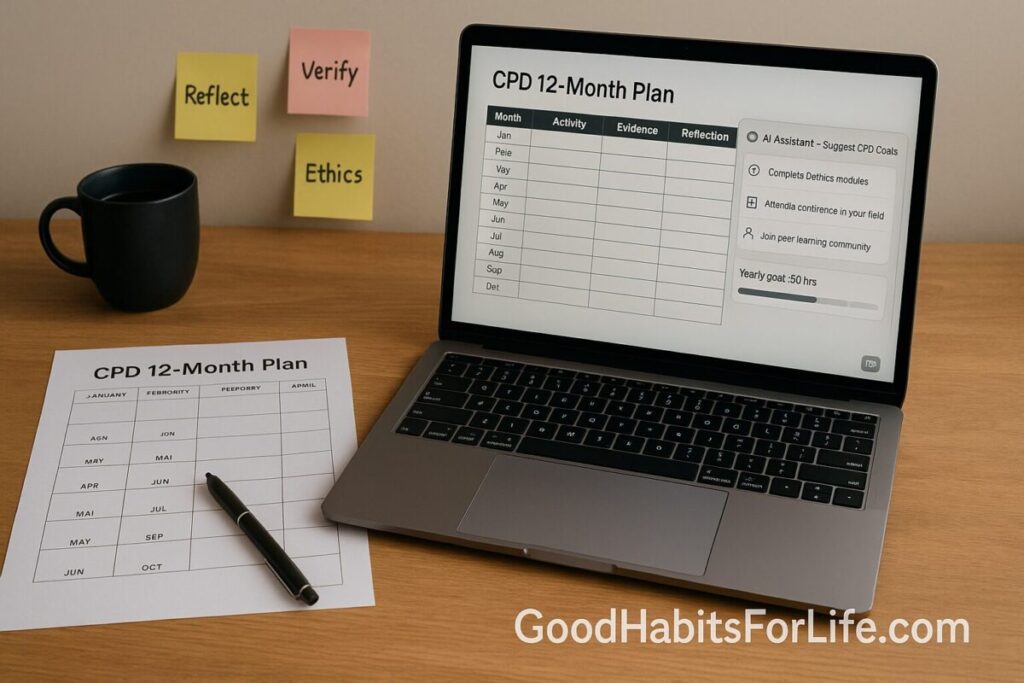
How it works: Set one quarterly capability goal. Each month, complete 1–2 substantial activities + weekly micro-learning. Use AI to speed admin: summarizing notes, suggesting tags, and drafting reflections. Keep verifiable evidence.
| Month | Focus (aligned to quarterly goal) | Typical Activities | AI Workflow (examples) |
|---|---|---|---|
| Jan | Baseline & plan | Skills self-assessment; goal & risk analysis; build tracker | Ask an AI to suggest skill indicators; generate quarterly plan; create tag taxonomy from your role description |
| Feb | Core skill #1 | Course/webinar + practice task | Paste course notes → AI summary + action list; auto-tag with suggested keywords |
| Mar | Share & apply | Brown-bag talk; SOP update | Draft slides + SOP from your notes; ask AI for a 2-minute talk track |
| Apr | Core skill #2 | Workshop; mentoring | Convert session recording to transcript → AI extracts decisions & follow-ups |
| May | Field test | Pilot a new method on a real project | Ask AI for risk checklist; generate experiment template; log before/after metrics |
| Jun | Review & ethics | Ethics refresher; portfolio tidy | AI identifies gaps; drafts ethics reflection to meet verifiable requirement (where applicable)ICAEW |
| Jul | Complementary skill | Short course; shadow a peer | AI suggests scenarios; produces quick-reference cheat sheet |
| Aug | Build assets | Create internal guide; code/data template | Turn notes → “How-To” page; AI checks clarity and adds FAQ |
| Sep | Impact | Case study; KPI review with manager | AI assembles case study from evidence; graphs KPI changes |
| Oct | Leadership/mentoring | Coaching sessions; community talk | AI drafts agenda & feedback forms; synthesizes insights |
| Nov | Renewal | Conference; standards update | Upload PDFs → AI highlights relevant clauses; proposes actions |
| Dec | Audit-ready wrap | Evidence review; appraisal pack | AI compiles index of activities, outcomes, and proofs; prepares appraisal summary aligned to your regulator’s language (teachers/engineers/healthcare).GOV.UK+1 |
Weekly cadence (20–40 min):
-
Learn: 1 micro-item (article, module, lab).
-
Apply: 1 small action at work.
-
Share: 2–3 lines in the team channel or a mini-demo.
-
Reflect: 100–150 words using Gibbs.Reflection Toolkit
🧠 Techniques & Frameworks (Reflection & Impact)
-
Reflection model (Gibbs). Six steps—description, feelings, evaluation, analysis, conclusion, action plan—keep reflections concise yet meaningful. Use the same template every time.Reflection Toolkit
-
Quality CPD features. Effective CPD is evidence-informed, sustained over time, and focused on outcomes (not seat time)—principles recognized in the UK Department for Education standard for teachers’ professional development and related guidance.GOV.UK+1
-
Outcome evaluation (Kirkpatrick-style). Track reaction (useful?), learning (what changed in knowledge/skill), behavior (what changed at work), and results (KPI impact).
-
Engineer’s lens. CPD can include workshops, site visits, lectures, mentoring, and self-directed study; diversity of formats is expected.EngC
-
Healthcare/Accountancy specifics. Know your scheme (credits vs hours), what counts as verifiable evidence, and any ethics requirements (e.g., ICAEW requires at least 1 hour of ethics each year).ICAEW
👥 Audience Variations
-
Students/Graduates: Treat internships, labs, hackathons, and society roles as CPD-equivalents. Log outcomes (what you built/delivered) and supervisor feedback.
-
Professionals (Individual Contributors): Focus on 1–2 career-critical capabilities per quarter. Prioritize activities that ship: internal guides, dashboards, process improvements.
-
Managers/Team Leads: Add coaching, delegation, and change leadership. Track how your CPD improves team throughput, quality, or retention.
-
Regulated Practitioners: Match the scheme’s hours/credits, “participatory” requirements, and audit evidence. (Examples: NMC 35 hours/3 years; RCP physicians 50 credits/year; ICAEW verifiable hours & ethics.)nmc.org.uk+2Royal Colleges of Physicians UK+2
-
Freelancers/Consultants: Align CPD to service lines. Keep client-sanitized artifacts as proof (templates, checklists, before/after metrics).
⚠️ Mistakes & Myths to Avoid
-
Myth: “CPD = hours.” → Reality: Track impact (behavior and results), not just time.
-
Mistake: Hoarding certificates without reflections. → Add a 100–150-word reflection using a consistent model.Reflection Toolkit
-
Mistake: Ignoring ethics. → Some regulators mandate verifiable ethics learning annually (e.g., ICAEW).ICAEW
-
Mistake: Losing evidence. → Automate file capture and keep a clean, dated index.
-
Myth: “Only courses count.” → Site visits, mentoring, peer teaching, and self-study often count (check scheme rules).EngC
💬 Real-Life Examples & Scripts
1) One-page CPD plan (Q1 example)
-
Outcome: “Reduce our reporting cycle from 8 → 5 days.”
-
Capabilities: SQL optimization; stakeholder comms.
-
Activities: 1 course, 2 brown-bags, 1 mentored refactor.
-
Evidence: Certificate, PR links, meeting notes, before/after runtimes.
-
Reflection (Gibbs, 120 words): What happened? So what? Now what?
2) Email to manager (budget/time)
Subject: Q2 CPD plan linked to reporting speed
Hi [Manager], I’m planning a Q2 CPD sprint focused on SQL performance and stakeholder updates, aiming to cut our reporting cycle to 5 days. Activities include [course], 2 mentoring sessions, and one internal talk. Total time: ~10 hours with visible deliverables (refactor PR, SOP). Could we allocate budget/time accordingly? I’ll share a 1-page outcome summary and evidence each month. Thanks!
3) Reflection prompt (paste this every time)
What did I try? What changed for users/colleagues? What will I do next week? What risks/ethics should I consider?
4) AI prompt (certificate to reflection)
“Summarize this certificate + notes into a 120-word reflection using Gibbs, extract 3 tags, and draft one measurable ‘apply at work’ step for next week.”
🧰 Tools, Apps & Resources
Trackers
-
Notion / Airtable / Google Sheets: Flexible fields, quick filters, easy exports.
-
Obsidian + Templater: Local markdown vault; superb for repeatable reflection templates.
Evidence capture
-
Google Drive / OneDrive: Versioned folder for certificates, agendas, slides.
-
Zapier / Make: Auto-create a tracker row + folder when emails contain “Certificate,” “Webinar,” or a known provider domain.
-
Toggl / Clockify: Optional time evidence (pair with outcomes).
Reading & references
-
Zotero / Readwise: Clip articles and PDFs, auto-tag, and surface highlights for your reflections.
Pros & Cons (quick)
-
Notion/Airtable: +Fast dashboards; −Vendor lock-in.
-
Sheets: +Portable, auditable; −Less pretty.
-
Obsidian: +Private, extensible; −Setup time.
-
Zapier/Make: +Saves hours; −Adds another system to maintain.
📌 Key Takeaways
-
Define outcomes first; align activities to what changes at work.
-
Use a simple 12-month cadence: plan → learn → apply → share → reflect → review.
-
Automate admin with AI/automation; you do the judgment and ethics.
-
Keep verifiable evidence and short reflections; be audit-ready all year.
-
Match your regulator’s exact rules (hours/credits/ethics/participatory learning).nmc.org.uk+2Royal Colleges of Physicians UK+2
❓ FAQs
1) How many CPD hours do I need?
It depends on your profession and regulator. Examples: UK nurses must complete 35 hours over 3 years (20 participatory). Many UK physicians follow a 50 credits/year recommendation. ICAEW accountants have minimum hours by category plus verifiable ethics each year. Always check your scheme.ICAEW+3nmc.org.uk+3Royal Colleges of Physicians UK+3
2) What counts as verifiable CPD?
Provider certificates, agendas, signed logs, assessment scores, or public artifacts (e.g., published SOPs) typically count—your regulator defines specifics (see scheme pages and guidance).ICAEW
3) Do mentoring, shadowing, or site visits count?
Often yes. Engineering guidance recognizes varied formats including visits, mentoring, lectures, and short courses. Check your institution’s definitions.EngC
4) How do I make reflections fast (and useful)?
Use a standard model (e.g., Gibbs) and keep it to ~120 words: what happened, so what, now what; add one next action.Reflection Toolkit
5) How can AI help without risking compliance?
Use AI to: summarize notes, suggest tags, draft reflections, and create evidence indexes. You still approve entries and ensure they meet your regulator’s rules (e.g., ethics or participatory learning).ICAEW+1
6) I’m a teacher—what does “effective CPD” look like?
Sustained, content-focused, and evidence-informed CPD aligned to pupil outcomes, as described in the DfE standard and its guidance.GOV.UK+1
7) How do I show impact, not just hours?
Capture “before/after” KPIs, user feedback, and artifacts (SOPs, dashboards, code diffs). Use a monthly case-study note to summarize results and lessons.
📚 References
-
General Medical Council. Continuing professional development: guidance for all doctors. PDF. gmc-uk.org
-
Federation of Royal Colleges of Physicians (UK). CPD Diary guidelines for Physicians (Aug 2023). PDF. Royal Colleges of Physicians UK
-
Nursing & Midwifery Council (UK). CPD requirements for revalidation. nmc.org.uk
-
ICAEW. CPD regulations 2023 and Your guide to CPD (ethics requirement). ICAEW+1
-
ICAEW. CPD categories (minimum hours & verifiable requirement). ICAEW
-
Engineering Council (UK). Continuing Professional Development (CPD) overview and CPD Policy Statement (2022). EngC+1
-
UK Department for Education. Standard for teachers’ professional development (2016) and guidance PDF. GOV.UK+1
-
OECD. Education at a Glance 2025 – Adult participation in education and training. OECD
-
University of Edinburgh. Gibbs’ Reflective Cycle (Reflection Toolkit). Reflection Toolkit