
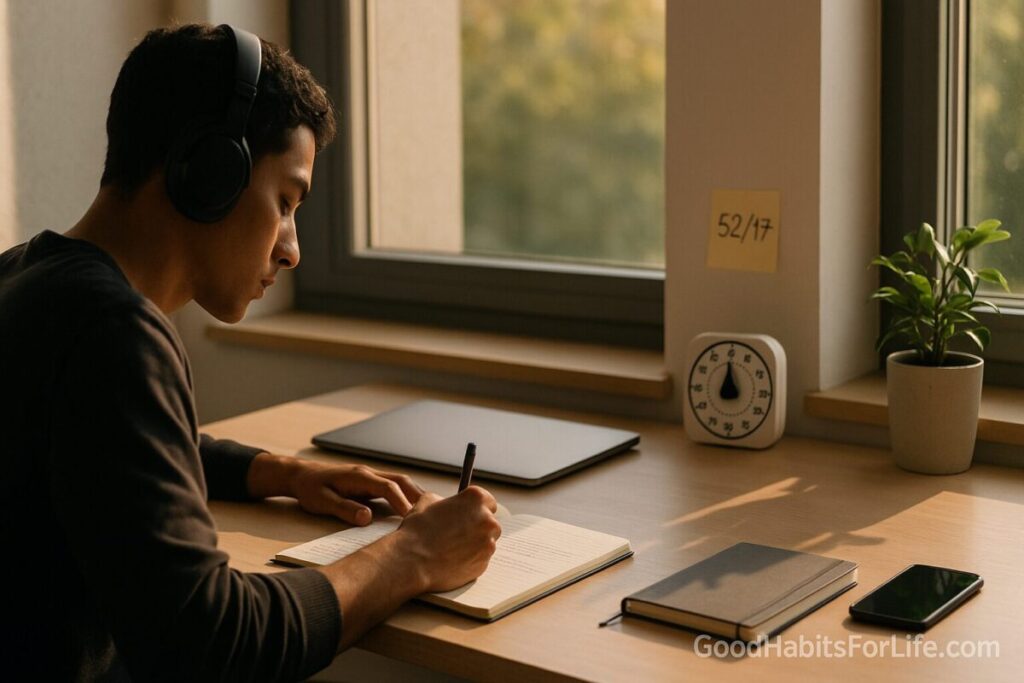
Deep Work for Students: The 5217 Pattern
Deep Work for Students: Try the 52/17 Pattern
Table of Contents
🧭 What Is the 52/17 Deep-Work Pattern & Why It Works
Definition. The 52/17 pattern means one focused work interval of about 52 minutes, then a 17-minute break. It’s a practical, student-friendly variant of deep work: single-task, distraction-free effort on cognitively demanding study tasks (e.g., problem sets, reading with notes, spaced retrieval). The idea became popular after an analysis of top performers’ computer-use data by DeskTime; while it wasn’t a controlled lab trial, it highlighted a consistent rhythm among high performers. DeskTime+1
Why it helps.
-
Brief breaks prevent vigilance decline. Controlled experiments show that short, intentional breaks counter “vigilance decrement” and restore goal focus. PubMed+1
-
Micro-breaks lift well-being and can aid performance. A 2022 meta-analysis found micro-breaks improve vigor and reduce fatigue; performance benefits grow as breaks lengthen (within reason). PLOS+1
-
Attention wanes over time in lectures and study. Mind-wandering rises with time-on-task, so scoping effort into crisp blocks helps. PMC
-
Nature snippets restore attention. Even a 40-second “green” view can measurably sustain attention—ideal for breaks. Learning through Landscapes
-
Distractions sabotage capacity. The mere presence of a smartphone measurably reduces available cognitive capacity; put it out of sight. Chicago Journals
-
Spacing beats cramming. Decades of research: distributing study events improves long-term retention versus massed practice. Use the 17 to plan spaced reviews. PubMed
Bottom line: 52/17 isn’t “magic,” but it operationalizes well-researched principles—planned relief from effort, protection from distraction, and distributed practice—into a simple routine students can actually run.
✅ Quick Start: Do This Today
-
Pick one “Big Task.” Example: “Chapter 4 problems 1–12 with worked steps.”
-
Clear the deck (2 min). Close tabs, silence laptop notifications, put phone in another room or a bag. Chicago Journals
-
Set timers. 52 minutes work, 17 minutes break.
-
Work rules (the 52).
-
Single task only (notes, problems, or retrieval).
-
Mark any tempting thought on a “later” pad; stay on task.
-
-
Break rules (the 17).
-
Stand, walk, breathe, water, snack, stretch, quick green-view. No doomscrolling. Learning through Landscapes
-
-
Repeat 2–4 cycles. Stop before you’re spent; leave a win for next time.
-
Log 60 seconds. What moved? What stalled? Adjust next block.
🗓️ 7-Day Starter Plan
Goal: Run 2 cycles/day for 7 days to learn your rhythm.
| Day | Focus Targets (per 52) | Break Menu (per 17) | Notes |
|---|---|---|---|
| 1 | Syllabus skim + plan tasks | Walk + water | Note distractions that bite |
| 2 | Read 15 pages + margin Qs | Stretch + green view | Try laptop DND |
| 3 | 12 practice Qs | Snack + short chat | Phone out of room |
| 4 | Retrieval: self-quiz | Walk + sunlight | Identify prime hours |
| 5 | Rewrite weak answers | Mobility + refill bottle | Trim break screen time |
| 6 | Mixed set: hard problems first | Micro-nap (10 min) | Stop at “good tired” |
| 7 | Cumulative review | Walk + plan week | Draft 30-60-90 goals |
📈 30-60-90 Roadmap (Scale Without Burnout)
-
Days 1–30 (Foundation).
-
2–3 cycles on study days; 1 on light days.
-
Build a Break Menu you actually enjoy (movement, water, snack, green view).
-
Start spaced-review cards after each 52 (tag by date). PubMed
-
-
Days 31–60 (Optimization).
-
3–4 cycles on heavy days; slot by course difficulty.
-
Add weekly long review (90 minutes) for cumulative subjects.
-
Track: percent of 52s finished without a phone glance (aim 90%+). Chicago Journals
-
-
Days 61–90 (Exam Fit).
-
4 cycles for capstone days; insert one longer break (25–30 minutes) between cycles 2 and 3. PLOS
-
Shift 30–40% of time to active recall and mixed practice sets.
-
🛠️ Techniques & Frameworks That Supercharge Each 52
Inside the 52
-
One-Big-Thing (OBT): Write the one concrete outcome for this block.
-
Active Recall: Close the book; answer from memory; then check.
-
Problem First: Do a hard problem cold, then consult notes.
-
Mini-milestones: 13-minute sub-chunks ×4 (checkpoints keep pace).
-
Distraction shield: Full-screen, DND, phone outside room, headphones if needed. Chicago Journals
During the 17
-
Move + green view: 5–7 min easy walk + 40-second green view (window/plant photo). Learning through Landscapes
-
Refuel: Water + small protein/fiber snack.
-
Plan the next 52: Adjust OBT; schedule spaced reviews (today + 2d + 7d). PubMed
Weekly
-
Retrospective (15 min): Wins, blockers, next tweaks.
-
Cumulative stack: Convert errors into flashcards or a “fix it” list.
🧠 Audience Variations
-
School students (grades 8–12): Start 40/10 or 45/15, build up to 52/17 by week 2–3.
-
University/college: Use 52/17 between classes; for dense reading, alternate 26-minute reading + 26-minute notes.
-
Exam season: Keep 52/17, but make every third break 25–30 min (snack + short walk) to prevent late-day crashes. PLOS
-
Neurodivergent learners (e.g., ADHD): Many find shorter 25/5 or 35/10 blocks easier. Keep rules identical; increase duration only if comfortable. (For clinical guidance, consult a licensed professional.)
⚠️ Mistakes & Myths to Avoid
-
Myth: “More hours = more learning.” Without breaks, vigilance and memory suffer. PubMed+1
-
Scrolling in breaks. Phone time erodes restoration and invites rabbit holes; keep phones out of sight. Chicago Journals
-
Cramming only. Short-term gains, long-term losses; schedule spaced practice. PubMed
-
Multitasking. Laptop multitasking tanks comprehension for you and neighbors. Athabasca University
-
Rigid minutes. 52/17 is a template—adjust by course and energy.
💬 Real-Life Examples & Scripts
Roommate script (noise):
“I’m running a 52-minute study block till 4:20. Can we keep it quiet? Happy to chat on my 17.”
Group-study ground rules:
“Let’s do two 52s: no phones, one problem set, then a 17-minute walk + water.”
Phone boundary (self):
“I’ll leave my phone in the kitchen. If it’s truly urgent, call twice—DND will let it through.” Chicago Journals
Break checklist (stick on your desk):
-
Stand + stretch
-
Water refill
-
40-second green look (window/plant)
-
Snack or short chat
-
Plan next 52 start
🧰 Tools, Apps & Resources
-
Focus To-Do / Pomofocus / Minimal timers (web/phone). Pros: simple, stats. Cons: notifications tempt checks.
-
Forest / Flora. Pros: gamified staying off phone. Cons: phone must remain untouched.
-
RescueTime / Rize. Pros: tracks focus time automatically. Cons: not perfect with all apps.
-
Anki / RemNote. Pros: spaced repetition built-in. Cons: setup curve (worth it).
-
Website blockers (Cold Turkey, Freedom). Pros: hard-lock distractions. Cons: plan whitelist ahead.
✨ Key Takeaways
-
Plan breaks on purpose (17 minutes) to protect focus on purpose (52 minutes).
-
Put your phone out of sight; even its presence taxes cognition. Chicago Journals
-
Use the 17 to move, hydrate, and schedule spaced reviews—memory’s best friend. PubMed
-
Tune durations to your course load; consistency beats heroics.
-
Log cycles; scale with the 30-60-90 roadmap.
❓ FAQs
1) Is 52 minutes the “perfect” length?
No—there’s no universal perfect length. 52/17 is a practical starting point grounded in how top performers worked and in research showing benefits of breaks; adjust ±10 minutes to fit your task and energy. DeskTime+1
2) What should I do in the 17-minute break?
Move, hydrate, look at greenery, light snack, short chat. Avoid deep phone dives. Even a 40-second green view helps attention. Learning through Landscapes
3) Can I swap 52/17 for 50/10 or 45/15?
Yes. Keep the spirit: single-task focus + true restoration. Many students like 45/15 for heavy reading, 35/10 for ramp-up weeks.
4) How many cycles per day?
Start with 2–3; cap at 4–5 on intense days. Insert one longer break between cycles 2 and 3. PLOS
5) Does music help or hurt?
Instrumental or ambient can help some students; lyrics often interfere with verbal tasks. If in doubt, try quiet or pure instrumentals.
6) What if I must use the laptop for notes?
Full-screen the document, block sites, and keep messaging apps closed; multitasking reduces comprehension. Athabasca University
7) How does this help with memory?
Use each 17 to schedule spaced reviews and convert mistakes into cards. Spacing beats cramming for long-term retention. PubMed
8) I feel guilty taking breaks—won’t it waste time?
Evidence shows brief breaks reduce fatigue, support sustained attention, and can improve performance when well used. PLOS+1
📚 References
-
Albulescu, P., et al. (2022). “Give me a break!” A systematic review and meta-analysis on the efficacy of micro-breaks. PLOS ONE. https://journals.plos.org/plosone/article?id=10.1371/journal.pone.0272460
-
Ariga, A., & Lleras, A. (2011). Brief and rare mental “breaks” keep you focused. Cognition. https://pubmed.ncbi.nlm.nih.gov/21211793/
-
Farley, J., et al. (2013). Everyday attention and lecture retention: the effects of time, lecture content, and student engagement strategies. (Open access). https://pmc.ncbi.nlm.nih.gov/articles/PMC3776418/
-
Lee, K. E., et al. (2015). 40-second green roof views sustain attention. Journal of Environmental Psychology. (PDF) https://ltl.org.uk/wp-content/uploads/2019/02/40-second-green-roof-views-sustain-attention.pdf
-
Ward, A. F., et al. (2017). Brain Drain: The Mere Presence of One’s Own Smartphone Reduces Available Cognitive Capacity. Journal of the Association for Consumer Research. https://www.journals.uchicago.edu/doi/full/10.1086/691462
-
Sana, F., Weston, T., & Cepeda, N. (2013). Laptop multitasking hinders classroom learning for both users and nearby peers. Computers & Education. https://pure.athabascau.ca/en/publications/laptop-multitasking-hinders-classroom-learning-for-both-users-and
-
Cepeda, N. J., et al. (2006). Distributed practice in verbal recall tasks: A review and quantitative synthesis. Psychological Bulletin. https://pubmed.ncbi.nlm.nih.gov/16719566/
-
DeskTime (2024 update). Does the 52-17 rule really hold up? https://desktime.com/blog/52-17-updated
-
TIME (2014). The exact perfect amount of time to take a break, according to data. https://time.com/3518053/perfect-break/